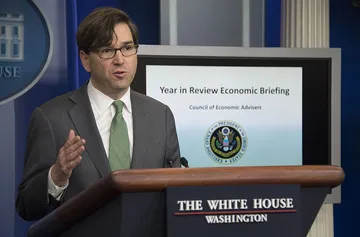
经济学家们多年来在各种语境下进行的关于人工智能的辩论,如今已波及到该行业自身。曾在贝拉克·奥巴马总统任内担任白宫经济顾问委员会主席、现为哈佛大学教授的杰森·弗曼近日表示,如果他现在掌管经济顾问委员会,会“略带遗憾和悲伤地”使用现有的人工智能系统,而不是雇佣20名真正的人类经济学家。他补充道,主席的职位是安全的。
The AI debate, which economists have been having for years in various contexts, has come for the profession itself. Jason Furman, chair of the Council of Economic Advisers under President Barack Obama and now a professor at Harvard, recently said that if he were running the CEA today, he would “somewhat regretfully and sadly” use current AI systems instead of hiring 20 actual human economists. The chair’s job, he added, is safe.
在遭到大量反对(包括来自我等前任工作人员的反对)后,弗曼软化了立场,呼吁建立一个“以人工智能为主、仅保留骨干人员的经济顾问委员会”。他仍会基本用人工智能取代初级员工——应届大学毕业生和研究生,因为他无法为“其大部分工作可由人工智能完成”的职位辩护。弗曼承认,按他自己的逻辑,他在比尔·克林顿总统任内担任经济顾问委员会初级经济学家的职位也会被裁掉。
After a lot of pushback, including from former staff like me, Furman softened his stance, calling for an “AI-intensive CEA with only a skeleton staff.”He would still largely replace the junior staff — recent college graduates and graduate students — with AI, since he couldn’t justify jobs where “the bulk of what they did could be done by an AI.”By his own logic, Furman admits, his job as a junior economist at the CEA under President Bill Clinton would have been cut, too.
这场辩论的参数或许很窄,但大体轮廓与经济其他领域正在进行的辩论相似。也可能正因为这场争议切中要害,我发现换个角度提问很有用:不是问人工智能能取代哪些工作,而是问人工智能如何服务于组织的使命。
The parameters of this debate may be narrow, but in broad outline it is similar to those going on elsewhere in the economy. And maybe it’s because this particular controversy cuts so close to home, but I have found it useful to ask a different question: Not which work AI can replace, but how AI can serve the mission of the organization.
弗曼的论点基于人工智能当前已能做到的事情,他用一个名为“Econvitals”的自建网站加以说明。该网站提供相当不错的经济数据仪表盘、博客文章、备忘录、简报和研究论文。但他把任务置于使命之前。经济顾问委员会的使命依然需要人,尤其是年轻人。
Furman bases his argument on what AI can already do, which he illustrates with a website he built called Econvitals. It features reasonably good economic data dashboards, blog posts, memos, briefings and research papers. But he is putting the tasks before the mission. CEA’s mission still requires people, especially younger people.
经济顾问委员会(CEA)成立于1946年,其使命是就“国内和国际经济政策的制定”向总统提供“客观的经济建议”。其中最重要的一条是:阻止糟糕的想法。CEA有着作为白宫“扫兴者”的悠久历史。诺贝尔奖得主肯尼斯·阿罗经常讲述,他一生中最有价值的事情,是他在20世纪60年代作为CEA工作人员时写的一份备忘录,反对用原子弹拓宽巴拿马运河的计划。
Created in 1946, the CEA’s mission is to offer the president “objective economic advice on the formulation of both domestic and international economic policy.”The most important version of that: Stop bad ideas. CEA has a storied history as the wet blanket of the White House. Kenneth Arrow, a Nobel laureate, often recounted that the most valuable thing he did in his life was a memo he wrote as a CEA staffer in the 1960s opposing a plan to widen the Panama Canal with an atomic bomb.
AI模型往往不会指出糟糕的想法;人会。当然,不是所有人。白宫内部的异议往往来自有一定距离的人。主席和成员是政治任命者,部分原因是他们认同总统的优先事项;而工作人员中的经济学家——许多人是从大学请假或从美联储或内阁机构借调而来——则不然。他们说“不”的代价更小,而据我的经验,他们也更经常说“不”。
AI models tend not to call out bad ideas; people do. Not everyone, of course. Dissent inside the White House tends to come from a distance. The chair and members are political appointees, chosen in part because they share the president’s priorities; the staff economists, many of them on leave from universities or detailed from the Federal Reserve or cabinet agencies, are not. They have less to lose by saying no, and in my experience they say it more often.
与专业的距离也是如此。在我与美联储、CEA及其他机构的初级工作人员共事的那些年里,那些尚未完全吸收经济学每一条信条的人,往往最善于发现事情哪里对不上。这很少像阿罗的备忘录那样戏剧性。更常见的是一个困惑的表情,告诉你某个项目需要重新思考,或者某个论点需要完善。
The same goes for distance from the profession. In my years working with junior staff at the Fed, CEA and elsewhere, the people who had not yet absorbed every tenet of economics were often the best at noticing when something did not add up. It is rarely as dramatic as Arrow’s memo. More often it is a confused look that tells you a project needs rethinking, or an argument needs refining.
向总统提供建议不仅仅是叙述图表上的线条。我在CEA那一年最紧张的项目始于一篇杂志文章,作者在文中写道,他是近半数无法在不借钱或变卖东西的情况下应付400美元紧急开支的美国人之一。总统想知道,这项来自美联储调查的统计数据,在复苏七年之后,怎么可能是真的。
Offering advice to the president is more than narrating lines on a chart. The most intense project of my year at CEA started with a magazine article in which the author reported that he was among the nearly half of Americans who could not cover a $400 emergency expense without borrowing or selling something. The president wanted to know how that statistic, which came from a Fed survey, could be true seven years into a recovery.
经济学家们没有一个好的答案。我们调取了能找到的所有数据集,撰写了数份备忘录,并与高级幕僚和总统进行了数轮讨论。人工智能本可以让数据处理更快。但它写不出更好的答案,因为当时谁也没有答案。我们的过程是一个创造性的过程,汲取了团队中每个人的想法。我始终没有完全放下这件事。几年后,我主持了包含那道“400美元问题”的美联储调查。
Economists did not have a good answer. We pulled every data set we could find, wrote several memos, and went a few rounds with senior staff and the president. AI would have made the data work faster. It would not have written a better answer, because nobody had one yet. Ours was a creative process, drawing on ideas from everyone on the team. I never quite let it go. A few years later, I was running the Fed survey with the $400 question in it.
创造性的过程播下种子,日后结出果实。弗曼担心如果初级员工被人工智能取代,人才梯队会出现问题,他的担忧有理,但损失不仅关乎他们的职业生涯,更关乎经济政策。萨姆规则——我的衰退指标——源于另一个白宫经济顾问委员会(CEA)项目,以及我在大衰退期间在美联储的早期工作经历。拼凑这些碎片花了数年,让其他人看到自动稳定器的价值又花了数年。一个你暂时无法回答的问题,是我所知道的最好的动力。
A creative process plants seeds that bear fruit later. Furman worries about the pipeline if juniors are replaced with AI, and he should, but the loss is not only to their careers. It is to economic policy. The Sahm rule, my recession indicator, grew out of another CEA project and my early years at the Fed during the Great Recession. It took years to put the pieces together, and years more for others to see the value in automatic stabilizers. A question you cannot quite answer yet is the best motivation I know.
白宫经济顾问委员会提供的建议应当达到尽可能高的质量,而这正是我对人工智能持乐观态度的地方。即使在弗曼任内,白宫经济顾问委员会也是一个精简团队,总是时间不够,赶制总统的每日简报书。求快意味着犯错,我犯过一个至今仍让我耿耿于怀的错误,因为白宫经济顾问委员会的失误会被解读为政治说辞,而非诚实的疏漏。
The advice CEA gives should be the highest quality possible, and here is where I am optimistic about AI. The CEA, even in Furman’s time, was a small team, always short on time to make the president’s nightly briefing book. Moving fast means making mistakes, and I made one that still haunts me, because a mistake from the CEA gets read as political spin, not an honest error.
人工智能可以腾出时间,充当另一轮审核。它还能为那些原本无暇顾及的质量改进腾出空间,例如回过头去询问我们引用的研究者,他们的观点是否已有演变,或者我们初次审视时是否遗漏了什么。人工智能还能帮助研究触达新受众,比如将年度《总统经济报告》剪裁成人们真正会用的形式。我至今还记得它曾被列为我大学经济学课程的指定读物。
AI can free up time and serve as another round of checks. It can also make room for the kinds of quality improvements nobody had time for, like going back to the researchers whose work we cited to ask whether their views had evolved or whether our first pass missed something. AI can also help research reach new audiences, like tailoring the annual Economic Report of the President to formats people will actually use. I still remember it being assigned in my college economics course.
经济顾问委员会(CEA)将因人工智能而改变,而且理应如此。弗曼说得没错,如果初级员工整天都在“照看”机器人,那将是对纳税人钱财和他们自身才华的浪费。但这将是一个关于如何设计工作的选择,而非关于人工智能能做什么的既定事实。同样的工具也能让初级员工从枯燥的数据提取和格式排版中解脱出来,腾出时间来提升质量,并去探索目前没人能回答的问题。总统值得拥有一个更好的经济顾问委员会,而不是一个规模更小的委员会。
The CEA will change with AI, and it should. Furman is right that juniors who spend their days babysitting bots would be a poor use of taxpayer money and their own talents. But that would be a choice about how to design the job, not a fact about what AI can do. The same tools can also free juniors from monotonous data pulls and formatting, creating time for quality improvements and the question nobody can answer yet. The president deserves a better CEA, not a smaller one.