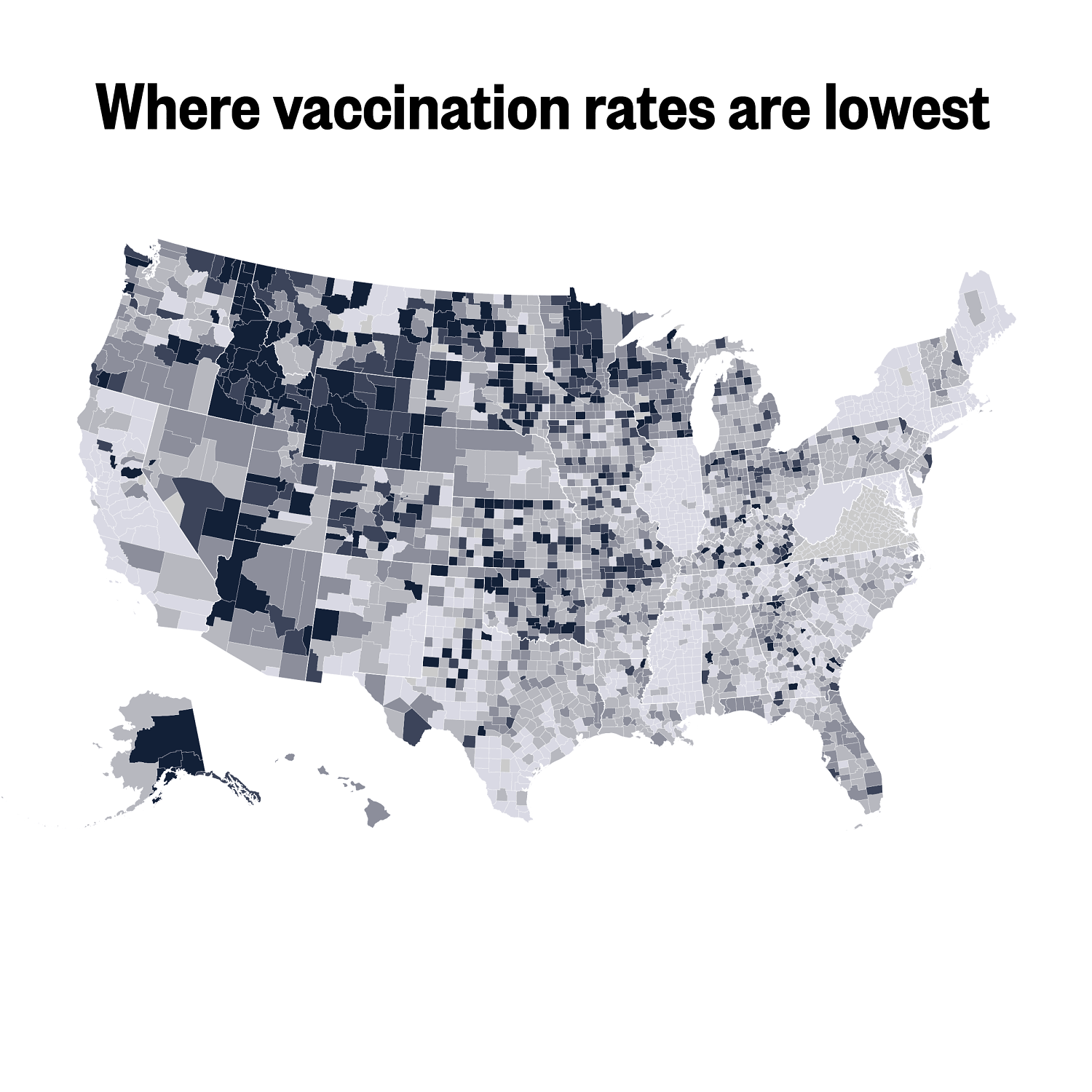
编者注:这项2026年NBC新闻的数据调查是对《疫苗分歧》的更新,后者最初于2025年9月发表。两个项目的方法类似。新数据于2026年6月至10月收集。对于《疫苗分歧》,NBC新闻从州政府和公共记录档案中收集了大量数据。在斯坦福大学传染病研究人员的帮助下,NBC新闻提交了数十份文件请求,包括根据《信息自由法》获得的材料,并将不同类型的数据整理成标准格式,以绘制和比较数千个县的接种率。
Editor’s note: This 2026 NBC News data investigation is an update of The Vaccine Divide, which was originally published in September 2025. The methodology for both projects is similar. The new data was collected from June to October 2026. For “The Vaccine Divide,” NBC News gathered massive amounts of data from state governments and archives of public records. With the help of infectious disease researchers at Stanford University, NBC News filed scores of requests for documents, including materials obtained under the Freedom of Information Act, and wrestled different types of data into a standardized format to map and compare rates across thousands of counties.
方法 NBC新闻如何收集数据 NBC新闻利用州政府(主要是卫生机构)提供的数据,建立了儿童疫苗接种和豁免信息数据库。该数据结合了部分州可公开的信息以及直接提供给NBC新闻的数据。数据涵盖每个学年的幼儿园疫苗接种情况。收集后,数据被整理,并计算了豁免率以便进行分析。分析侧重于数据的四个方面:医疗豁免:当学生患有可能使疫苗接种有潜在危害的疾病时授予的豁免。
Methodology How NBC News collected the data NBC News built a database of childhood vaccination and exemption information using data provided by state governments, primarily health agencies. The data combines public information available for some states and data provided directly to NBC News. The data covers kindergartner vaccinations for each academic year. After collection, the data was collated, and exemption rates were calculated in order to be analyzed. The analysis focuses on four facets of the data: Medical exemptions: Exemptions granted when students have a medical condition that would make vaccination potentially harmful.
非医疗豁免:学生因个人信仰或宗教信念而选择不接种必需疫苗的豁免。MMR(麻疹-腮腺炎-风疹)疫苗接种:对于按剂量细分数据的州,MMR疫苗接种按第二剂计算。有些州分别追踪麻疹、腮腺炎和风疹免疫情况;在这些州,用麻疹来代表MMR接种率。接种及时:如果学生已接受其所在学校入学所需的完整疫苗系列,则被视为“接种及时”。
Nonmedical exemptions: Exemptions for students who opt out of required vaccinations due to personal beliefs or religious convictions.MMR (measles-mumps-rubella) vaccinations: For states in which data is subdivided by number of doses, MMR vaccination is counted by the second dose. Some states track measles, mumps and rubella immunization separately; in these states, measles was used to represent MMR rates. Up-to-date vaccinations: Students are considered “up to date” with their vaccinations if they have received the full vaccination series required for enrollment in their school.
数据处理方式 各州的数据格式、管辖权和采集方式各不相同,因此这项工作需要大量投入,以确保数据中可能存在的不一致性得到处理。俄亥俄州和纽约州等部分州,需要对州提供的数据进行进一步计算以汇总。其他州则需要手动输入数百行表格数据。所有数据均经过准确性核查。
How the data was processed With a hodgepodge of formats, jurisdictions and collection practices across states, the task required extensive work to ensure that possible inconsistencies in the data were managed. Certain states, such as Ohio and New York, required further calculations to aggregate the state-supplied data. Other states required hand input of hundreds of rows of tabular data. All data was checked for accuracy.
数据分析 本次关于儿童麻疹、腮腺炎和风疹(MMR)疫苗接种率的分析,聚焦于提供2025-2026学年MMR数据的州。随本分析一同进行的还有多项变体分析,结果证实了结论的稳健性。所有变体分析得出的结果大体相似,大多在1个百分点以内。我们还考察了各县MMR疫苗接种率下降的规模,近4成10个县自2019年以来下降超过5个百分点,约有8分之1的县自2024年以来下降了该幅度。自2019年以来,下降幅度在0.1个百分点或以下的县不足2%。
Analyzing the data This analysis of childhood MMR vaccination rates focused on states that provided MMR figures for the 2025-2026 school year. Accompanying this analysis were several variant analyses, which confirmed that the results were robust. The variant analyses all yielded similar results, mostly within 1 percentage point. We also examined the scale of MMR vaccination rate decline across counties, with almost 4 in 10 counties declining by over 5 percentage points since 2019 and approximately 1 in 8 declining by that amount since 2024. Fewer than 2% of counties declined by 0.1 percentage points or less since 2019.
数据差异 各州在数据采集和报告方式上存在差异。部分州采用卫生区而非县。部分州提供了超过十年的数据;其他州仅提供了两年的数据。部分州因隐私问题删减了某些数据。并非所有州都有最新数据。佛罗里达州未提供2021-2022学年后的幼儿园豁免数据。蒙大拿州在2019年后停止收集疫苗和豁免数据,最初是由于新冠疫情,随后是由于2021年通过的一项州法案(HB 334),该法案废除了州收集免疫数据的强制要求。
Variations in the data Many states collect and report their data differently. Some use health districts instead of counties. Some states provided over a decade of data; others provided only two years’ worth. Some states redacted certain data due to privacy concerns. Not all states have recent data. Florida did not provide data on kindergarten exemptions after the 2021-2022 school year. Montana stopped collecting vaccine and exemption data after 2019, first due to Covid and thereafter due to the passage of a state bill (HB 334) in 2021 that struck down the mandate for the state to collect data on immunizations.
部分州(如亚利桑那州和明尼苏达州)不收集代表符合所有必需疫苗接种要求的幼儿园儿童比例的总体“及时接种”数据。其他州(如佛罗里达州、新罕布什尔州和南卡罗来纳州)仅提供了“及时接种”数据。
Certain states (such as Arizona and Minnesota) do not collect an overall “up-to-date” figure representing the percentage of kindergarteners who are compliant with all required vaccines. Others (such as Florida, New Hampshire and South Carolina) provided only “up-to-date” numbers.
在其他州——密西西比州、新罕布什尔州和南卡罗来纳州——提供的数据仅针对K-12年级,而非专门针对幼儿园儿童。西弗吉尼亚州的豁免数据也属于此类。一些州——伊利诺伊州和纽约州——不按年级收集数据,因此数据涵盖小学整体(伊利诺伊州为K-8年级,纽约州基于人数统计,小学定义为K-6年级以上注册学生比例低于3%的学校),而非专门针对幼儿园儿童。
In other states — Mississippi, New Hampshire and South Carolina — data was provided only for years K-12, rather than specifically kindergarteners. West Virginia also falls into this category for its exemption data. Some states — Illinois and New York — do not collect data at grade level, so data is for elementary schools as a whole (up to K-8 for Illinois, and New York was based on headcounts, where elementary schools were defined as having less than 3% enrollment above grades K-6), rather than kindergarteners specifically.
夏威夷州也属于此类(至学前班至5年级),因为其学校层面的数据比幼儿园特定数据更一致。其他州未提供县一级的数据。阿拉斯加州和内布拉斯加州提供了其他辖区的数据。特拉华州和罗得岛州无法提供县一级的数据,改用州一级数据。印第安纳州无法提供县一级的豁免数据。西弗吉尼亚州无法提供县一级的免疫数据,但能够提供按县划分的豁免数据,自2025年1月起开始提供。
Hawaii also fell into this category (up to pre-K-5), as its school-level data was more consistent than its kindergarten-specific data. Other states did not provide data on a county level. Alaska and Nebraska provided data for other jurisdictions. Delaware and Rhode Island were unable to provide data at the county level, state-level figures were used instead. Indiana was unable to provide county-level exemption data. West Virginia was unable to provide county-level immunization data, but was able to provide exemption data per county, starting in January 2025.
一些州(例如密歇根州)按日历年而非学年收集数据。怀俄明州未能持续报告幼儿园儿童的数据,因此使用了最一致的报告值:19至35个月大儿童的一剂麻疹、腮腺炎、风疹(MMR)疫苗接种率。相应地,使用了5岁以下儿童的豁免数据以对应这一年龄组。阿拉斯加州因样本量较小,出于隐私原因无法提供地区豁免数据。
Some states (such as Michigan) collect data by calendar year, rather than school year. Wyoming did not consistently report data among kindergarteners, so the most consistent reported value was used instead: one-dose MMR among 19- to 35-month-olds. Accordingly, exemptions among children younger than 5 were used to correspond with this age group. Alaska was unable to provide regional exemption data for privacy reasons because of small sample sizes.