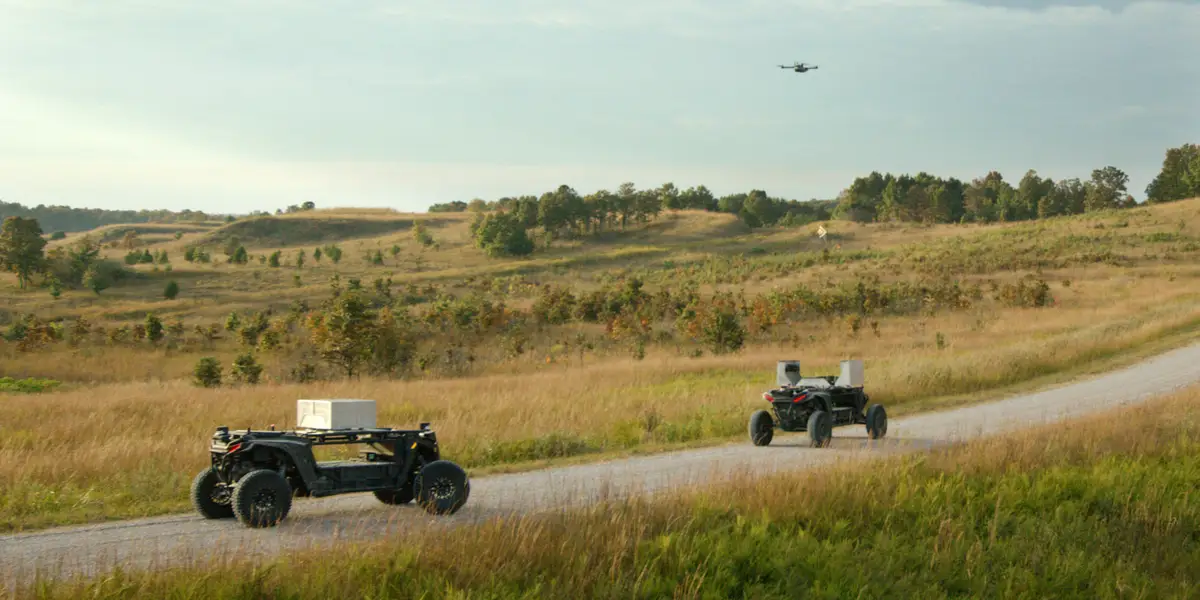
五角大楼的研究部门测试了如何成组派遣地面无人机去搜寻并猎杀目标,同时让一名人类操作员保持在决策回路中。国防高级研究计划局(DARPA)的项目考察了无人地面车辆(UGV)如何在受争夺环境中快速行驶、绘制地形图并自主收集情报。官员表示,经验教训将为美军各项无人技术的持续发展提供参考。
The Pentagon's research arm tested how ground drones could be sent out in groups to look for and hunt down targets while keeping a human operator in the loop to make decisions. The Defense Advanced Research Projects Agency, or DARPA, program examined how uncrewed ground vehicles, or UGVs, could quickly drive, map out terrain, and gather information on their own in contested environments. Lessons will inform ongoing developments in uncrewed technologies across the US military, officials said.
上个月,作为其“具备韧性的复杂环境机器人自主性”(RACER)计划的一部分,DARPA在肯塔基州诺克斯堡的一次演习中试验了四辆自主UGV。演习期间,这些地面机器人对周边区域实施监视,为远离行动现场的操作员独立搜寻敌方力量。DARPA技术顾问杰森·格雷戈里对《商业内幕》表示:“我们正把传感器和效应器前推至战术前沿,同时让操作员保持在安全、远离伤害的地方”,但人类“始终保持控制权、监管权和态势感知”。
Last month, DARPA experimented with four autonomous UGVs at an exercise at Fort Knox, Kentucky, as part of its Robotic Autonomy in Complex Environments with Resiliency, or RACER, program. During the exercise, the ground robots conducted surveillance of the surrounding area, independently searching for enemy forces for an operator located away from the action. Jason Gregory, technical advisor at DARPA, told Business Insider that "we're moving sensors and effectors forward to the tactical edge while keeping the operator in safety out of harm's way," but humans still "maintained control and custody and situational awareness at all times."
一经发射,UGV便执行各自任务。格雷戈里说,视情景而定,它们既可协同作战,也可独立行动。与此同时,人类操作员监督UGV、分配任务、核查发现,再决定如何最佳打击敌方目标。在诺克斯堡演示中,操作员利用卫星影像给机器人下达任务。一辆UGV在发现疑似目标——一个装有无人机的封闭箱子——后原地停下,随后人类操作员决定向该目标发射一枚模拟火箭。
Once launched, the UGVs went off on their missions. Gregory said they could work together or independently depending on the scenario. Meanwhile, the human operator supervised the UGVs, assigned them tasks, checked their findings, and then decided how best to engage enemy targets. At the Fort Knox demonstration, the operator used satellite imagery to task the robots. One UGV stopped in place once it spotted a potential target — a closed box holding a drone inside — and then the human operator decided to launch a simulated rocket at the target.
近期RACER机器人测试计划的一个重要环节,是确保UGV能在没有GPS的情况下完成任务。取而代之的是,机器人在移动过程中自行构建地图。
An important part of the recent RACER robotic testing program was ensuring that the UGVs could perform their tasks without GPS. Instead, the robots built the map as they moved.
美军表示,需要做好准备,在 GPS 不易获取的争夺或拒止环境中作战,并正在探索替代的精确导航和授时解决方案,以及更传统的战术。美军还在考虑其他可能的干扰,例如地形干扰或信号丢失。“我们开发这款新软件,是为了让地面车辆仅利用车载传感器做出决策,以尽可能快的速度移动,”格雷戈里说。该软件在四轮全地形无人地面车辆和履带式无人地面车辆上进行了测试,以确保能部署在不同硬件上。
The US military has said it needs to be prepared to fight through contested or denied environments where GPS isn't readily available, and is looking into alternative precision navigation and timing solutions, as well as more traditional tactics. The military is also considering other possible disruptions, such as terrain interference or loss of signal. "We developed this new software so that ground vehicles could use only their onboard sensors to make decisions to move as fast as possible," Gregory said. The software was tested on four-wheel, all-terrain UGVs as well as tracked UGVs to ensure it could be deployed on different hardware.
在各团队致力于利用商业技术构建系统的同时,RACER 计划还开展了为期五年的研究,以更好地了解自主性、人工智能算法和地面机动的科学与技术挑战。DARPA 的工作还依托对俄乌战争的观察,了解地面机器人的独特作用,以及操作员如何在不同情境下使用它们。自主无人地面车辆面临的挑战因地形、环境和气候而异。
While teams worked to build systems using commercial technologies, the RACER program also involved five years of research to better understand the scientific and technical challenges of autonomy, artificial intelligence algorithms, and ground mobility. DARPA's work also relied on observations from Russia's war in Ukraine on the distinct role of ground robots and how operators employ them in different situations. Autonomous UGVs face distinct challenges depending on the terrain, environment, and climate.
例如,在沙漠中,机器人可能需要穿越沙地、岩石和其他障碍物,而极端高温可能会给电池和通信系统带来压力。沼泽地、森林、泥泞田野和积雪也会增加作业难度,要求机器人能够适应截然不同的条件。RACER 的演示为美军整体提供了经验教训。其中一些专门针对自主地面机器人,其他则——包括在无 GPS 环境下作业、人机协同,以及在机器人行动中保持人工监督——可适用于全军的无人系统。美军也在与业界分享这些经验教训。
In the desert, for example, robots might need to navigate sand, rocks, and other obstacles, while extreme heat might strain the batteries and communications systems. Swamplands, forests, muddy fields, and snow can also make operations more difficult, requiring robots to be able to adapt to very different conditions. RACER's demonstration offers lessons for the broader US military. While some are specific to autonomous ground robots, others — including operating without GPS, teaming humans with machines, and maintaining human oversight in robotic operations — could apply to uncrewed systems across the military. It's also sharing the lessons with industry.