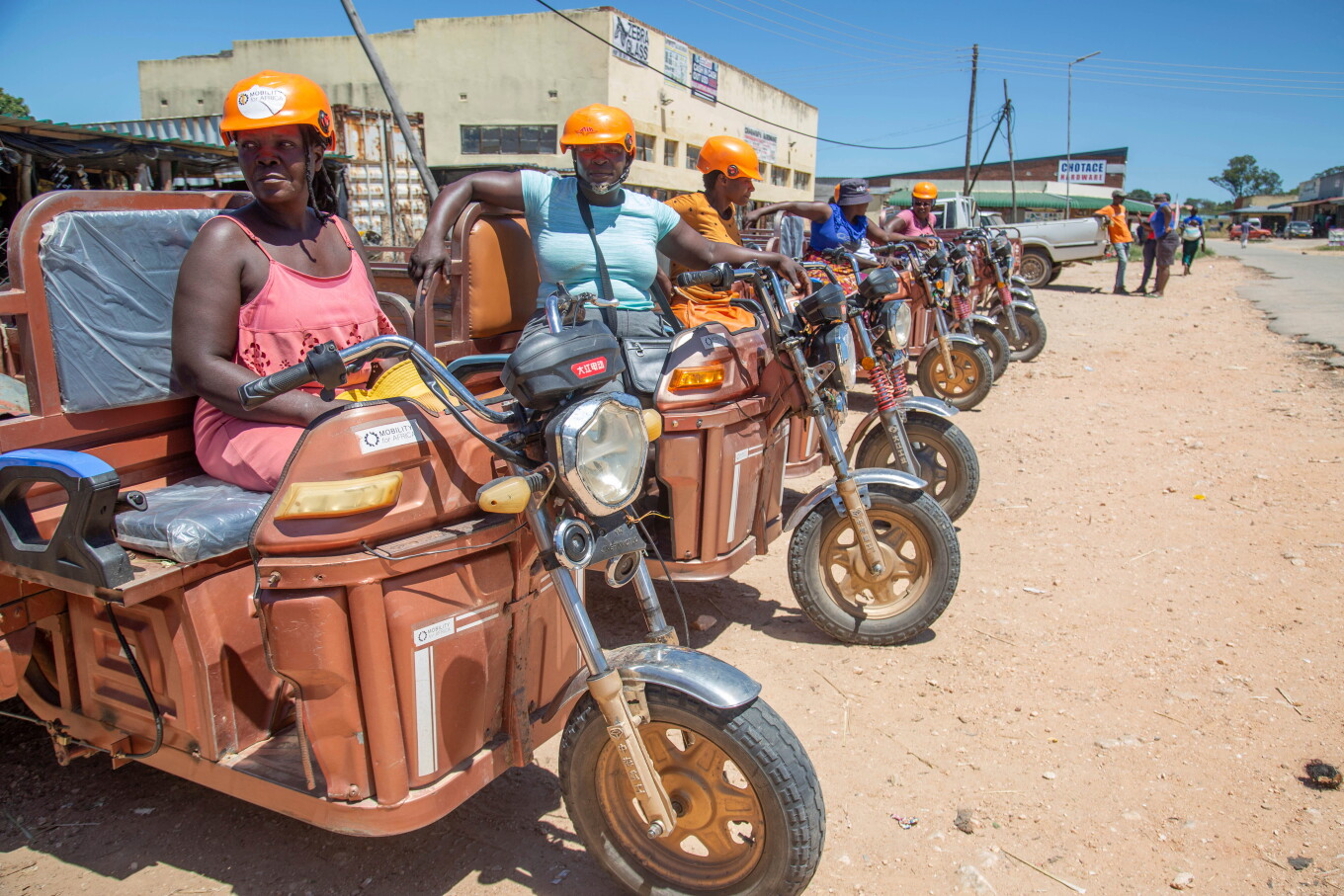
法拉伊·穆察卡 哈拉雷,津巴布韦 —— 津巴布韦的电动汽车革命始于乡间泥泞小道。三轮车将卷心菜运往集市,接送女农户去田间地头,把病人送往诊所,服务于交通长期匮乏的社区。
Farai Mutsaka HARARE, Zimbabwe — The electric vehicle revolution in Zimbabwe began on rural dirt paths. Three-wheeled vehicles carried cabbages to markets, women farmers to their fields and patients to clinics in communities where transport has long been scarce.
对于拥有一辆电动三轮车的农户阿格菲·穆坦博来说,自2021年以来,这彻底改变了她的生意和家庭。
For farmer Agefi Mutambo, the owner of an electric three-wheeler since 2021, it has transformed her business and family.
以前,她要步行7到10公里(4.3到6.2英里),头顶平衡着一个装有20公斤(44磅)西红柿的桶去出售,收入仅6美元。
Before, she walked seven to 10 kilometers (4.3 to 6.2 miles) balancing a 20-kilogram (44-pound) bucket of tomatoes on her head that she sold for $6.
56岁的她说:“钱甚至不够买食物。我一天只能跑一趟,到市场时已晚,农产品也不再新鲜。”
“The money wasn’t even enough for food. I would do a single trip a day, arrive at the market late and the produce would no longer be as fresh,” the 56-year-old said.
现在,她每周能跑两到三趟,每趟运送300公斤(661磅)农产品,向学校和诊所供货,每趟毛收入约80美元。她还接送邻居去医院,有时半夜为临产妇女送医。
Now she makes two to three deliveries a week transporting 300 kilograms (661 pounds) of produce on each trip, grossing roughly $80 a trip supplying schools and clinics. She also ferries neighbors to hospital, sometimes at midnight for a woman in labor.
“电池电量低时,我只需花4美元换个电池,就能继续上路,”她说。
“When my battery is low, I simply swap it for $4, and I am back on the road,” she said.
穆坦博是津巴布韦数十位生活因电动三轮车而改变的农村女企业家之一。这些车辆由当地社会企业“非洲出行”于2019年引入。
Mutambo is among dozens of rural women entrepreneurs in Zimbabwe whose lives have been transformed by electric tricycles introduced by local social enterprise Mobility for Africa in 2019.
该公司推出了太阳能充电三轮车,由锂离子电池驱动,主要面向农村女性,采用租赁购买制,每周成本约30美元。这种车名为“汉巴”,在当地恩德贝勒语中意为“去”,可载重400公斤(880磅)以上,单次充电续航约100公里(62英里)。太阳能充电站和可更换电池让驾驶员能直接换上满电电池,而非等待充电。
The company introduced the solar-charged tricycles, powered by lithium-ion batteries, mainly for rural women, under a lease-to-own scheme costing about $30 a week. Called “Hamba,” meaning “go” in the local Ndebele language, the vehicles can carry loads of over 400 kilograms (880 pounds) and travel about 100 kilometers (62 miles) on a single charge. Solar-powered charging stations and swappable batteries allow drivers to exchange depleted batteries rather than wait for them to recharge.
在非洲部分地区,摩托车和三轮车正成为通往电动出行的途径,特别是在长期被传统出行企业忽视的农村社区。虽然电动汽车在较富裕的市场站稳脚跟,但这些较小的车辆可以在充电基础设施不那么广泛和昂贵的情况下运行,为这片拥有15亿人口的大陆提供了一条可能更廉价的跨越式电气化路径。
Across parts of Africa, motorcycles and three-wheelers are emerging as a route to electric mobility, particularly in rural communities long overlooked by conventional mobility businesses. While electric cars gain ground in wealthier markets, these smaller vehicles can operate with less extensive and expensive charging infrastructure, offering a potentially cheaper leapfrog to electrification for the continent of 1.5 billion people.
尽管拥有制造电动汽车电池所用关键矿产的巨大储量,非洲在全球电动汽车市场中仍是一个次要参与者。
Despite holding vast reserves of critical minerals used in electric vehicle batteries, Africa remains a minor player in the global EV market.
根据国际能源署《2026年全球电动汽车展望》,2025年非洲售出约2.5万辆电动汽车,主要集中在埃及、摩洛哥和南非,而全球销量超过2000万辆。
Africa sold about 25,000 electric cars in 2025, concentrated in Egypt, Morocco and South Africa, compared with more than 20 million worldwide, according to the International Energy Agency’s Global EV Outlook 2026.
2026年,联合国非洲经济委员会将不可靠的电力基础设施、有限的技术能力和薄弱的监管确定为阻碍采用的因素。
In 2026, the United Nations Economic Commission for Africa identified unreliable electricity infrastructure, limited technical capacity and weak regulation as barriers to adoption.
但适合日常交通、送货和商业的小型电动汽车市场正在增长,电动出行专家赫兹本·莫西说。他说,非洲的转型主要集中在创收的摩托车和三轮车上,埃塞俄比亚因其以汽车为中心的政策而成为例外。
But the market for small electric vehicles that are relevant to everyday transport, deliveries and commerce is growing, said Hezbon Mose, an e-mobility expert. Africa’s transition is largely centered on income-earning motorcycles and three-wheelers, with Ethiopia an exception because of its car-focused policies, he said.
虽然两轮车仍占主导地位,但三轮车市场正在兴起。莫西说,在肯尼亚,电动三轮车年注册量从2023年的39辆增至2025年的517辆,今年6月已达1965辆。莫西是非营利组织“非洲电动出行”的联合创始人。
While two-wheelers remain dominant, a three-wheeler market is emerging. In Kenya, annual electric three-wheeler registrations rose from 39 in 2023 to 517 in 2025, reaching 1,965 by June this year, said Mose, co-founder of non-profit, E-Mobility Africa.
这一转变也具有潜在的公共卫生效益。电动摩托车和三轮车不产生尾气排放,提供了减少路边污染的机会。根据清洁空气基金会的数据,在肯尼亚首都内罗毕,摩托车是公共交通文化的一部分,仅道路运输就占细颗粒物空气污染的40%。
The shift also has potential public health benefits. Electric motorcycles and three-wheelers produce no exhaust fumes, offering an opportunity to reduce roadside pollution. In Kenya’s capital, Nairobi, where motorcycles are part of public transport culture, road transport alone is responsible for 40% of fine particle air pollution, according to the Clean Air Fund.
2025年发表在《世界电动汽车期刊》上的一项研究还发现,将内罗毕的摩托车车队电气化将消除这些车辆的尾气颗粒物排放,同时将每日汽车二氧化碳排放量减少约85%。
A 2025 study published in the World Electric Vehicle Journal also found that electrifying Nairobi’s motorcycle fleet would eliminate tailpipe particulate emissions from those vehicles, while cutting daily automotive carbon dioxide emissions by about 85%.
专家莫塞表示,对企业家而言,吸引力在于创收车辆的经济性,而非奢侈品属性。“电动三轮车对职业司机来说已经能实现自给自足,”他说。
For entrepreneurs, the appeal lies in the economics of income-generating vehicles rather than luxury, said Mose, the expert. “Electric three-wheelers already pay for themselves for working drivers,” he said.
莫塞表示,肯尼亚沿海城市蒙巴萨的一辆出租电动三轮车,与燃油车相比,每天可节省约4美元至10美元的运营成本,较高的购买价格可在5个月至21个月内收回。
A taxi electric three-wheeler in the Kenyan coastal city of Mombasa can save roughly $4 to $10 a day in running costs compared with a petrol-powered vehicle, with the higher purchase price recouped in five to 21 months, said Mose.
“它们适合非洲,因为它们是创收资产,而非消费品。同一底盘可用作出租车、末端配送、垃圾收集和农产品运输,将市场大大拓展至公共交通之外,”他说。
“They suit Africa because they are income assets, not consumer goods. The same chassis serves as taxi, last-mile delivery, waste collection, and produce haulage, widening the market well beyond public transport,” he said.
莫塞援引行业数据称,约有3000万非洲人靠两轮和三轮车谋生,但电动车型不足20万辆。“车主按日现金流购买,这正是电动车的优势所在,”莫塞说。
Citing industry figures, Mose said roughly 30 million Africans earn a living on two- and three-wheelers, yet fewer than 200,000 are electric. “An owner buys on daily cash flow, which is exactly where electric wins,” said Mose.
投资者正支持开发电动摩托车、三轮车、充电基础设施和换电系统的企业,尤其是在东非地区。
Investors are backing businesses developing electric motorcycles, three-wheelers, charging infrastructure and battery-swapping systems, especially in East Africa.
“非洲出行”创始人尚塔·布卢门认为,持久增长需要能在捐助者资助项目结束后继续生存的融资模式。
Shantha Bloemen, the Mobility for Africa founder, reckons lasting growth requires financing models that can survive beyond donor-funded projects.
“我们见过援助会发生什么,当国家将优先事项放在别处时,援助是多么短暂,”她说。“他们削减对非洲的投入,项目就烂尾了。我们需要人道主义援助,但我们更需要发展融资。”对布卢门而言,初衷是解决阻碍农村经济活动的基本障碍:缺乏可靠、负担得起的交通和资金。
“We have seen what happens with aid, how temporary it is when countries look at other priorities,” she said. “They cut Africa, their projects go to the ground. We need humanitarian assistance, but we need development finance more.”For Bloemen, the idea was to address basic obstacles to rural economic activity: the lack of reliable, affordable transport and funding.
“交通匮乏时,农作物在田间腐烂,孩子失学,家庭无法获得医疗服务,”布卢门说。“交通成为维持生计与从事商业活动的分水岭。”布卢门认为,改善交通获取有助于释放常规放贷机构往往忽视的农村经济潜力。
“When transport is scarce, produce rots in fields, children miss school and families cannot access healthcare,” Bloemen said. “Transport becomes the difference between subsistence and commerce.”Bloemen argues that improving access to transport can help unlock the potential of rural economies often overlooked by conventional lenders.
“农村非正规经济是大多数人的生存之地,”布卢门说。“看看我的市场——农村小规模农户……没有任何银行愿意借贷给他们,因为他们被视为不具备信用资质。”布卢门说,农村妇女往往受影响最深。
“The rural informal economy is where most people live,” Bloemen said. “And if you look at my market, rural small-scale farmers... none of the banks will lend to them because they are deemed not creditworthy.”Rural women, Bloemen said, are often most affected.
“我们存在性别偏见。我们不把女性小规模农户当回事,这实在不明智,因为女性极具创业精神,是每个经济的支柱,”她说。
“We have a gender bias. We don’t take women small-scale farmers seriously, which is really not a clever thing to do because women are so entrepreneurial and the backbone of every economy,” she said.
农户穆坦博视自己为例。收入增加让她支付了一个孩子的教师文凭费用、另一个孩子的高中学费,以及五个孙辈的小学学费。“我们曾被轻视,”她说。“现在我们成了全村的骄傲。”更多关于非洲与发展的内容:
Mutambo, the farmer, sees herself as an example. Her improved earnings have paid for one child’s teaching diploma, high school fees for another and primary schooling for five grandchildren. “We were looked down upon,” she said. “Now we are the pride of the village.”For more on Africa and development: