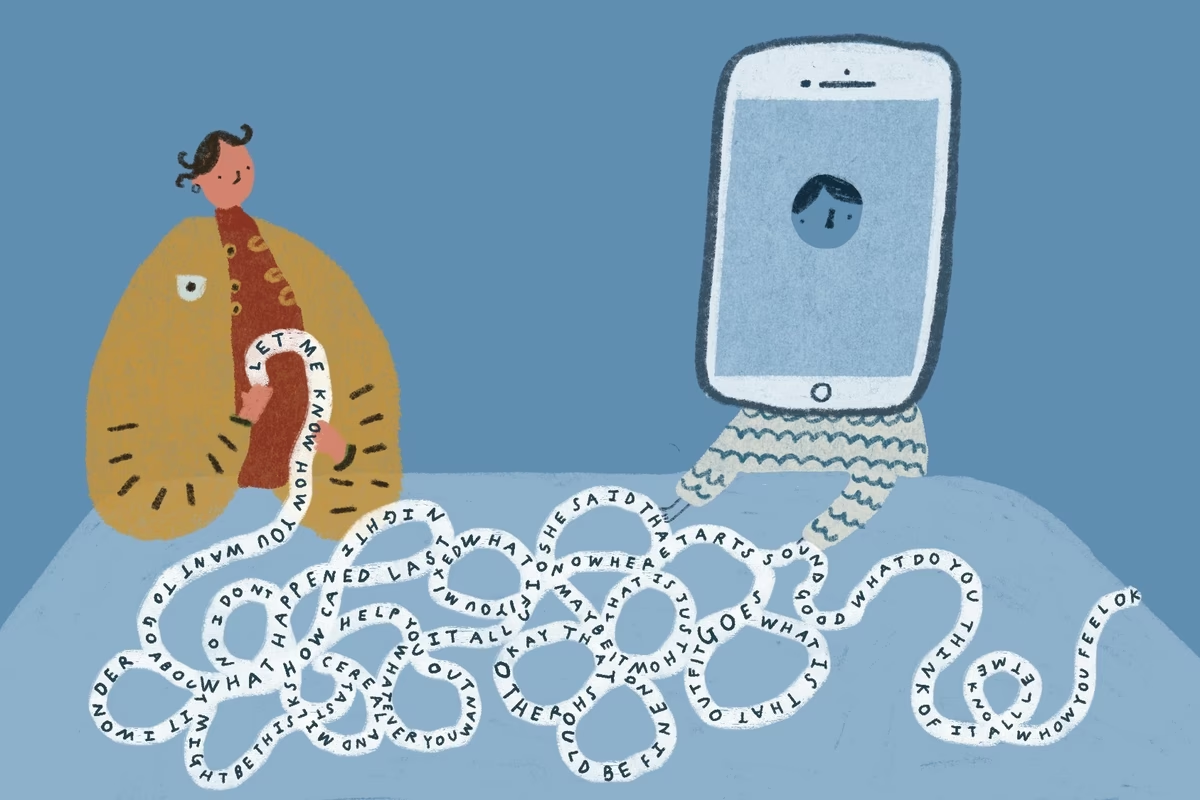
几周前,一个聊天机器人读取了我跨越十多年的一批短信记录,并宣称我一直是个糟糕的朋友。
A few weeks ago, a chatbot read a tranche of my text messages spanning more than a dozen years and declared that I’d been a bad friend.
首先,一些背景:我正在写一本关于我的爱情生活(或缺乏爱情生活)的回忆录,所以我一直在翻阅旧的通信记录,并询问朋友们对那些我单身的岁月(2012-2022年)以及不再单身的岁月(2022年至今)的记忆。其中一位朋友是迈克尔——他和我一样未婚;他和我一样,有着通过约会软件促成的大量约会经历;他和我一样,长期在寻找爱情,却常常感到失望。
First, some context: I’m writing a memoir about my love life, or lack thereof, so I’ve been going through old correspondence and quizzing friends about their memories of the years when I was single (2012–22) and not so single (2022–now). One of those friends is Michael—who, like me, is unmarried; who, like me, has an extensive history of encounters facilitated by dating apps; and who, like me, was long looking for love but often found himself disappointed.
我和迈克尔的短信记录可以追溯到2014年,那是我们初次见面的时候。有时,我们每天都保持联系。有时,我们会有几周、几个月,甚至一年不联系(原因从未完全清楚)。六年前,我从迈克尔居住的纽约搬到了洛杉矶,所以从那时起,我们的友谊主要通过电话维持。这意味着一段本已丰富的友谊变得更加丰富,不仅因为我们共同经历的积累,还因为我们的通信被自动记录和存档了下来。
My text history with Michael goes back to 2014, when we first met. Sometimes, we’re in touch daily. At other times, we go weeks, months, even a year without communicating (for reasons that have never been entirely clear to us). Six years ago, I moved from New York, where Michael lives, to Los Angeles, so since then, our friendship has been conducted largely via phone. This means that an already rich history of friendship has become richer, not just because of the accumulation of our shared experiences, but also because of the way our communications have been automatically documented and archived.
仔细想想,一串短信记录其实是一座令人难以置信的第一手资料宝库——实际上就是一个数据集——里面藏着人们生活中无数层面的线索,无论平凡还是深刻。对回忆录作者来说,这类材料简直是金矿。(我怀疑未来的历史学家也会同意。)比起信件或电子邮件,短信更随性自在,捕捉到了作者情感和观察的即时性,正因如此,显得格外“真实”。
A text thread, when you think about it, is an incredible repository of primary source material—in effect, a data set—containing clues to how people conduct countless aspects of their lives, whether mundane or profound. For a memoirist, such material can be a gold mine. (I suspect that future historians will agree.) More freewheeling than, say, letters or emails, texts capture the immediacy of a writer’s feelings and observations and, because of that, can seem particularly “authentic.”My initial quest for love-life insights within my archive with Michael yielded somewhat frustrating results.
我最初在与迈克尔的聊天记录里寻找恋爱生活的洞见,结果颇令人沮丧。当我搜索“和”“”等词汇时,迅速被海量信息淹没,便给他打电话抱怨:“材料太多了,我根本应付不过来。”几分钟后,手机响了。迈克尔发来一个 Excel 表格,里面装着我们的全部短信记录,建议我上传到 ChatGPT。我非常喜欢这个主意。我已经摸索聊天机器人一年半左右了。
When I searched for words such as and and , I quickly became overwhelmed and called him to complain: “There’s too much material for me to handle.”A few minutes later, my phone dinged. Michael had sent me an Excel spreadsheet containing our entire text history and suggested that I upload it into ChatGPT. I adored the idea. I’d been playing with chatbots for about a year and a half.
写回忆录时,我曾用它们从音频和 Zoom 访谈记录中提炼关键线索。我承认,我还曾让聊天机器人给一段潜在的恋情做过占星分析。所以,我毫不犹豫地采纳了迈克尔的建议,把我们的数据喂给 ChatGPT,静待结果。
For my memoir, I’d used them to pull out important strands from the transcripts of audio and Zoom interviews. I confess that I also once used a chatbot to give me an astrological analysis of a potential romantic relationship. So, with little hesitation, I took Michael’s advice, fed ChatGPT our data, and awaited the results.
结果并不算太惊人,至少在机器人对我的恋爱生活的分析上是这样。(除其他外,它告诉我我对男人的眼光很烂。)但我注意到,它还提供了一些关于我和迈克尔友谊的完全意想不到的内容(例如:“双方都不必为对方构建一个体面的自我版本”)。,我想。ChatGPT 把反馈从对我恋爱生活的分析,扩展到了对那些关于我恋爱生活的讨论所构成的关系的分析。我琢磨:如果我让它更深入地剖析我和迈克尔,它还会说出什么?
They weren’t all that surprising, at least when it came to the bot’s analysis of my romantic life. (Among other things, it told me that I had bad taste in men.) But I noticed that it shared some wholly unexpected stuff about my friendship with Michael (for instance: “Neither has to construct a respectable version of the self for the other”). , I thought. ChatGPT had expanded its feedback beyond an analysis of my love life to an analysis of the relationship the discussions of my love life. I wondered: If I asked it to go deeper on Michael and me, what more might it say?
我们从未拥有过这样一种手段,能如此迅速地将未经任何加工的文字倾倒进单一设备并加以综合。几年前,一位技术专家将自己收发的每一条 WhatsApp 消息导入自己创建的一款应用,让算法分析他与包括妻子、父亲在内的众人的互动情况。他对一位记者说:“很多人没有意识到,从本质上讲,他们的 WhatsApp 聊天记录——涵盖所有对话——就是他们不知不觉间一直在写的日记。”
Never before have we had the means to synthesize, so quickly, words poured unadulterated into a single device. A few years ago, one technologist imported into an app he created every WhatsApp message he’d ever sent or received, and had the algorithm analyze his interactions with people including his wife and father. As he told a reporter, “A lot of people don’t realize that, essentially, their WhatsApp history—across all their chats—is the diary they didn’t know they’d been writing.”
但像这样对整段关系进行大规模分析,也有可能把我们带入棘手的伦理领域。许多人认为短信是转瞬即逝且私密的(尽管有证据表明我们很容易以各种方式被监控)。因此,我们与家人和朋友——那些与我们关系最亲密的人——的短信对话往往相当诚实、直抒胸臆。“我们在 90 年代、2000 年代开始发电子邮件和短信时,根本没想到这些会成为我们之间创建的记录,而在那之前,这些交流是转瞬即逝的,” 研究 AI 辅助对话的斯坦福大学传播学教授杰夫·汉考克 告诉我。
But conducting wide-scale analyses of entire relationships like this also has the potential to launch us into sticky ethical territory. Many people think of text messages as ephemeral and private (despite evidence of the various ways we can be easily surveilled). Our text threads with family and friends—the people we’re closest with—can therefore be quite honest, quite raw. “We had no idea when we started emailing and texting in the ’90s, 2000s, that these were records we’d be creating between us, which until that time were evanescent,” Jeff Hancock, a communication professor at Stanford University who studies AI-assisted conversation, told me.
“谁能想到这会成为一件大事,”他说,“私人之间的对话如今竟会有了记录?”一个人可以如此随意地拿走自己书面通讯的内容——无论是否征得其他当事人同意——并让 AI 工具吞噬和分析这些数据,这一想法令人不安,甚至可以说直指反乌托邦。汉考克表示,人们利用聊天机器人审核我们过去视为封闭对话的内容,无疑会变得更加普遍。
“Who knew that this would be a massive new thing,” he said, the fact that “private conversations between individuals would now have a record?”The idea that a person can so casually take the contents of their written communications—with or without other people’s consent—and ask an AI tool to ingest and analyze that data seems disquieting, if not downright dystopian. Hancock said that people’s use of chatbots to audit what we previously thought of as closed conversations will no doubt become more prevalent.
他承认,这可能让人感觉像是一种侵入,但他也能看到净收益为正的益处。他想象了这样一个场景:“你会想,。” 分析你短信记录的机器人或许能为你下次给她打电话时该说的话提供完美建议。
This might feel like an intrusion, he acknowledged, but he could see net-positive benefits. Imagine a scenario, he suggested, in which “you’re like, .”A bot analyzing your text history might come up with the perfect thing to say the next time you call her.
即便如此,汉考克指出,这“可能出错的方式有很多”。考虑一下聊天机器人,它们不仅可能分析关系的演变,还可能预测结果——这听起来有点让我担心。然后还有准确性的问题:聊天机器人旨在服务,这意味着它们倾向于传达他们认为人们想听的话。汉考克说,有时,AI可能会“为一个人真正解锁一些东西”。“但它们是阿谀奉承的。”
Even so, Hancock noted that there are probably “lots of ways this will go wrong.”Consider chatbots that might not only analyze relationships as they evolve but also predict outcomes—which sounds a little to me. And then there’s the question of accuracy: Chatbots are designed to serve, which means that they tend to communicate what they think people want to hear. Sometimes, an AI might “really unlock stuff” for a person, Hancock said. “But they’re sycophantic.”
要有用,AI还需要“也要站在对方的角度考虑问题”。当我把自己和迈克尔的短信对话输入ChatGPT时,我发现——正如我最初所希望的——关于我的爱情生活的一些事情。我了解到,我对男人表达的意图过于轻信(“你可以看出一个男人是不可靠的、回避的、自私的或反复无常的,”机器人说,“但仍然继续把他表达欲望的言辞当作证据,认为可能会发展出更有意义的东西”),并且我是在错误的地方寻找爱情(“你有时会认识到一个男人的局限,但却表现得好像它们是可以商量的”)。
To be useful, the AI needs “to also take the perspective of the other person.”When I fed my text thread with Michael into ChatGPT, I found out—as I’d first hoped—a few things about my love life. I learned that I’m overly credulous when it comes to men’s stated intentions (“You can recognize that a man is unavailable, evasive, selfish, or inconsistent,” the bot said, “and nevertheless continue to treat his expressions of desire as evidence that something more meaningful might develop”) and that I’m looking for love in all the wrong places (“You sometimes recognize a man’s limitations but behave as though they are negotiable”).
然而,当机器人转向关于我和迈克尔的挑逗性评论时,它真的吸引了我。例如,它说我有选择性听力,在他提出善意建议后会表现得轻视:“你问他会怎么做,但不是认真考虑他的回答,你几乎立刻就构建了反对它的论点。”于是,在迈克尔的许可下,我提出了一个新查询,并追问得更深:“请分析迈克尔·韦特海姆和安娜·霍姆斯之间的这组短信数据集,他们是两位朋友,并描绘他们多年来的友谊画像。”
Yet when the bot pivoted to spicy comments about Michael and me, it really drew me in. It said, for instance, that I have selective hearing and can be dismissive after he has offered well-meaning advice: “You ask him what he would do, but instead of seriously entertaining his answer, you almost instantly construct the case against it.”So, with Michael’s permission, I came up with a new query and pressed harder: “Please analyze this data set of text messages between Michael Wertheim and Anna Holmes, two friends, and craft a portrait of their friendship over the years.”
我要求ChatGPT不仅看我和他互相说了什么,还要看我们是怎么说的。三分钟零五十三秒后,它告诉我,它已经分析了整个档案——32,245条短信,时间从2014年9月13日到2026年6月25日。它有话要说。
I asked ChatGPT to look not just at he and I had said to each other but at we’d said it. After three minutes and 53 seconds, it told me that it had analyzed the entire archive—32,245 messages, from September 13, 2014, to June 25, 2026. It had a to say.
“他们彼此间的语言异常坦诚,”它告诉我。“他们讨论工作上的屈辱、金钱、父母、家庭失调、抑郁和焦虑、疾病、衰老、性、约会软件、一夜情、拒绝、药物、身体问题、孤独和死亡。”还有:“他们能在几秒钟内从严肃转到荒诞,从死亡转到电视,从抑郁转到糟糕的约会,从职业焦虑转到猫砂。”还有:“他们的友谊最终会拥有家庭的一些基础设施。”
“Their language with each other is extraordinarily unguarded,” it told me. “They discuss work humiliation, money, parents, family dysfunction, depression and anxiety, illness, aging, sex, dating apps, hookups, rejection, medications, bodily problems, loneliness and death.”And: “They can move in seconds from something serious to something ridiculous, from mortality to television, from depression to a bad date, from career anxiety to cat litter.”And: “Their friendship eventually acquires some of the infrastructure of family.”
不过,当我告诉一位朋友这个实验,并给她读了几行时,她提出了一个敏锐的观察:听起来像是ChatGPT在描绘我在这段友谊中扮演的角色时,画得过于乐观。她问,如果我要求它给出更坦诚的评估会怎样?
When I told a friend about this experiment and read her a few lines, though, she made a smart observation: It sounded like ChatGPT was presenting a pretty rosy picture of my part in the friendship. What if, she asked, I pushed it for a more candid assessment?
于是我要求它更加直率地讲真话。作为回应,它承认自己在分析中“有些克制”,然后开始给我一些实话,用粗体字告诉我:“有时我觉得你明显是那个更难相处的朋友。”它还分享了一份相当严厉的10点清单,列举了我的过错,每条后面还附有一两段阐述。其中的观察包括:“你可能会沉浸在自己的生活中,并假设友谊自然会继续下去。”
So I asked it to be more brutally honest. In response, it conceded that it had been “somewhat restrained” in its analysis—and proceeded to give me some real talk, telling me, in bold type, “There are moments where I think you are plainly the harder person to be friends with.”It also shared a rather damning 10-point list of my transgressions, including a paragraph or two of elaboration with each item. Among its observations: “You can disappear into your own life and assume the friendship will simply survive it.”
“你可能会把自己对他的经历的理解置于他自身经历之上。”“当你认为迈克尔处理某事不当的时候,你可能会毫不留情。”“你可能会过于沉浸在自己的痛苦中,以至于迈克尔必须明确表达自己的需求。”真让人刺痛。
“You can center your interpretation of his experience over his own.”“You can be relentless when you think Michael is handling something badly.”“You can be absorbed enough in your own distress that Michael has to announce his needs explicitly.”Ouch.
这让我刺痛,因为我一直担心这可能是真的;机器人的评估感觉像是对这种恐惧的确认。它似乎在说:。
It stung because I’ve always worried that this is true; the bot’s assessment felt like a confirmation of that fear. It seemed to be saying: .
如果我想对自己宽容一些,我可以提醒自己,尽管ChatGPT拥有我们之间沟通的语料库,这仍然只是这段关系的一个快照,而非完整图景。人工智能肯定对某些细微之处视而不见,并不总能理解语境或意图。是的,我可以沉浸在自己的生活中,假设这段友谊会存续下去——但许多亲密友谊都是这种情况。是的,我可能“毫不留情”,但迈克尔从一开始就知道,我在给建议时一针见血,因为我假设他想要的是诚实而非纵容。
If I wanted to give myself some grace, I could remind myself that even though ChatGPT had a corpus of communication between us, this was still merely a snapshot of the relationship, not a complete picture. Surely the AI was blind to bits of nuance and didn’t always understand context or intent. Yes, I can disappear into my own life and assume that the friendship will survive—but that’s the case with many close friendships. And yes, I can be “relentless,” but Michael has known from the beginning that I’m trenchant when giving advice because I assume that he wants honesty rather than enablement. (Though I probably need to ask him if that’s true.)
(虽然我大概需要问问他这是否属实。)ChatGPT也仅仅代表一种人工智能生成的观点。在我撰写这篇文章时,苹果更新了其Siri人工智能,使其能够浏览iPhone用户的短信和电子邮件以提出后续步骤(例如根据与朋友的对话添加日历事件)。我意识到,一个用于实时友谊分析的工具或许现在就内置在我的手机里。为了测试它,我请Siri分析我与迈克尔的短信记录——即使我要求它少拍马屁,它对我的评价也比ChatGPT友善得多:它说我是一个可靠且给予支持的知己;如果我们的关系不对等,是因为它“似乎更多地围绕他的需求和日程,而非你的”。
ChatGPT also represents only one AI-generated opinion. As I was writing this article, Apple updated its Siri AI to go through iPhone users’ text messages and emails to propose next steps (such as adding a calendar event based on a conversation with a friend). I realized that a tool for real-time friendship analysis might now be built right into my phone. To test it, I asked Siri to examine my text history with Michael—and it was much kinder to me than ChatGPT, even when I asked it to be less sycophantic: I’m a reliable and supportive confidant, it said; if our relationship is asymmetrical, this is because it “appears to revolve more around his needs and schedule than yours.”
这该如何理解?或许只能说明,人工智能的分析是主观且可能不可靠的,有点像现实生活中朋友的意见。
What to make of this? Perhaps only that an AI’s analysis is subjective and possibly unreliable, kind of like the opinions of one’s real-life friends.
抛开短信不谈,迈克尔和我通过其他方式进行有意义的沟通——通过语音通话、面对面交流。这些互动未被记录在短信线程中,因此可能不易分析。但它们提供了智能手机上的来回发信息所不具备的东西,我认为这同样能揭示真相:语气、音色、面部表情、眼神交流。换句话说,它们提供了 。
Text messages aside, Michael and I communicate meaningfully in other ways—via voice calls, in person. Those interactions aren’t memorialized in a text thread, so they’re perhaps not as easy to analyze. But they offer something that a back-and-forth over a smartphone doesn’t, and that I’d argue can be just as revealing: tone, timbre, facial expressions, eye contact. Put another way, they offer .
经过这一番 AI 分析,我感到既着迷又不安。ChatGPT 提供的见解比我预想的更有说服力,但我犹豫要不要再把更多自己的文本喂给机器人。我意识到征得同意的必要性。我也决定,未经许可绝不上传他人的聊天记录,因为这构成双重侵犯:首先是下载文本,其次是对文本进行分析。我还担心,聊天机器人阅读上的盲区可能会让我错误或不公地评判那些对我很重要、或刚刚萌芽且脆弱的关系。
After all of this AI analysis, I felt a mixture of fascination and unease. The insights that ChatGPT offered were more compelling than I’d suspected they would be, yet I’m hesitant to feed more of my texts to a bot. I’m conscious of the need for consent. And I’ve decided never to upload another person’s chats without permission, because the violation would be twofold: the downloading of the texts in the first place, and the analysis of them in the second. I also worry that gaps in a chatbot’s reading might lead me to wrongly or unfairly assess relationships that are important to me, or new and tender.
拿我和男朋友的短信记录来说。我们在 iMessage 上的交流相当稀少。我毫不怀疑,如果让机器人分析我们的短信,它会把我描述为过于健谈,把他描述为沉默寡言、有时甚至不回复。但在现实生活中,我知道他要是不回复,通常是因为 。但在我对他不那么宽容的一天,我可以想象自己会回想起 AI 的分析而心生怨恨——或者在脑海里构建出关系走向毁灭的剧本。那又有什么用呢?正如另一位朋友所说: 。
Take the text thread between my boyfriend and me. Our communications over iMessage are fairly thin. I have no doubt that if a bot were to analyze our texts, it would characterize me as overly chatty and him as reticent and at times unresponsive. In real life, I know that if he’s unresponsive, this is typically because . But on a day when I might be feeling less generous toward him, I could imagine recalling the AI’s analysis and becoming resentful—or constructing relationship-doomsday scenarios in my head. And what good would that do? As another friend of mine put it: .
聊天机器人或许能告诉我们很多东西。但或许就像占星术一样,我们应该把它们对我们最重要关系的评判,不视为定论,而视为让我们更深思熟虑的契机;把它们的建议不视为命令,而视为一种推动。我是说,我们大概都能对亲人更好一些。归根结底,我不需要聊天机器人来告诉我我早已知道的事情。
Chatbots may tell us a lot. But perhaps, as with astrology, we should consider their assessments of our most important relationships not as determinative but as opportunities to be more thoughtful—and we should see their advice less as an edict than as a nudge. I mean, all of us could probably be better to our loved ones. In the end, I don’t need a chatbot to tell me what I already know.