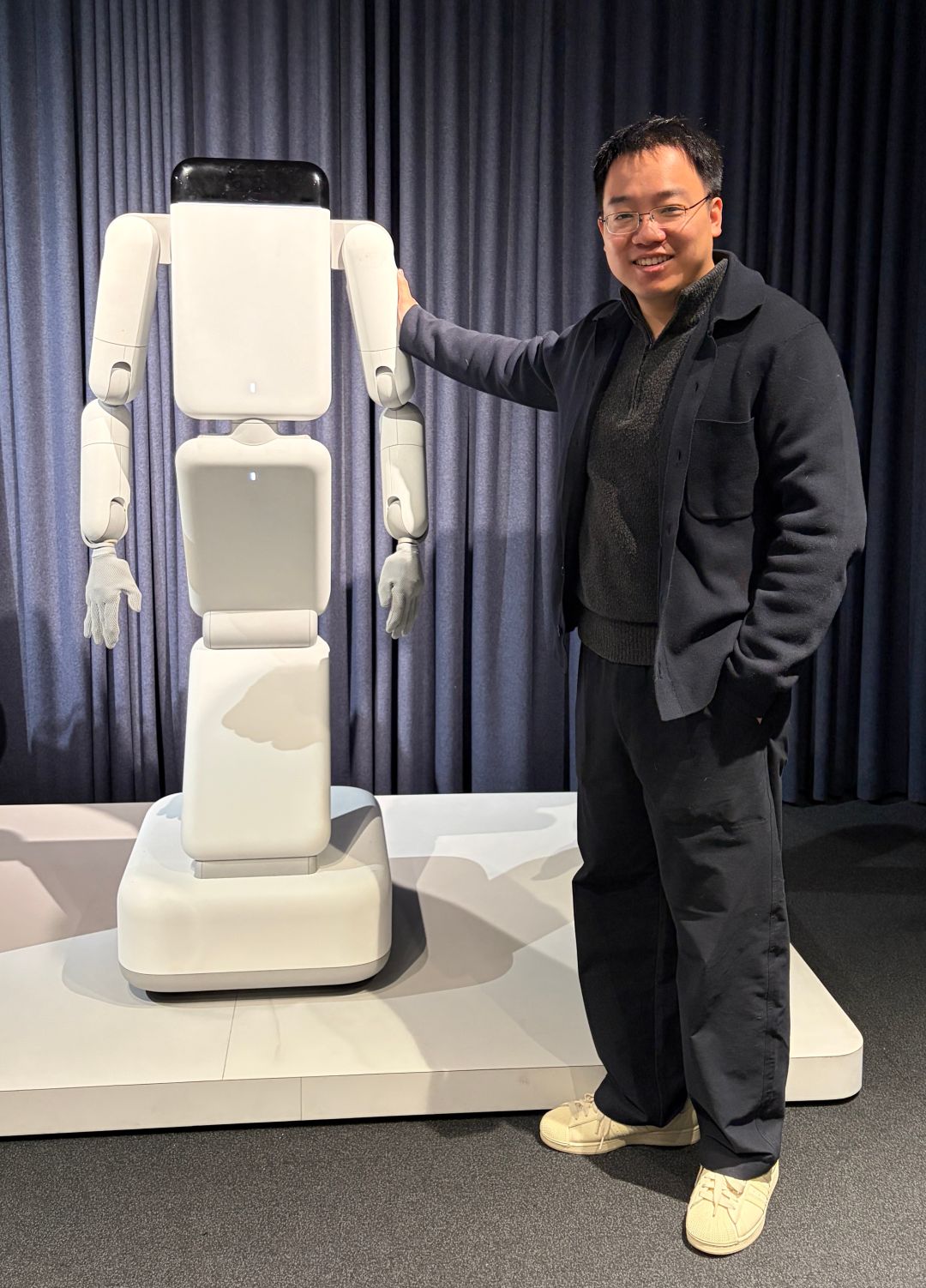
Genesis AI 首席执行官兼联合创始人周贤表示,该公司已“攻克灵巧操作”难题。
Genesis AI has “cracked dexterous manipulation,” CEO and co-founder Zhou Xian says.
为佐证这一说法,周贤在 Genesis AI 位于硅谷的设施接待了《TechCrunch》记者,现场演示了其物理 AI 模型操控一对现成的机械臂。在其中一个演示中,机械臂拾起两个小纸箱,扫描后将其放入一个较大的纸箱,折叠封箱、贴胶带封口,随后从一卷打印胶带上撕下一张标签并贴在箱子上。
To make his case, Xian hosted TechCrunch at Genesis AI’s Silicon Valley facility, where its physical AI model operated a pair of off-the-shelf robotic arms. In one demo, the arms picked up two small cardboard boxes, scanned them, placed them in a larger cardboard box, folded it closed, taped it shut, and then plucked a label off a strip of printer tape and applied it to the box.
这是一个令人印象深刻的演示,正是当今机器人难以完成的那种复杂工作流。虽然 Genesis 不允许记者亲自干预机器人以测试其应变能力,但公司同意重演一遍。第二轮演示中,机器人碰掉了一个纸箱,在从打印胶带上撕下那张微小的粘性标签时也费了好大劲。这是一个失误,但也是可用来改进模型的那类边缘情况——“打嗝数据”,一位 Genesis 高管如此称呼。
It’s an impressive demo, exactly the kind of complex workflow that today’s robots struggle to complete. And while Genesis wouldn’t let your reporter mess with the robot’s to test its wiles, the company did agree to re-run the presentation. During the second go-round, the robot fumbled a box and had a heck of a time peeling the tiny adhesive label off the printer tape. A mistake, but also the kind of edge case that can be used to improve a model—”hiccup data,” a Genesis executive suggests.
这正是实验室演示与可靠自动化之间的差距——Genesis 以及整个人形物理 AI 生态系统若想避免再次陷入“机器人寒冬”,就必须跨越这一鸿沟。为此,周贤的公司宣布完成 5 亿美元 A 轮融资,由 Khosla Ventures、Premji Invest 和 Eclipse 领投。
This is the exact gap—between a lab demo and reliable automation—that Genesis, and the rest of the humanoid physical AI ecosystem, need to bridge if they want to avoid another robot winter. To do so, Xian’s company is announcing a $500 million Series A round led by Khosla Ventures, Premji Invest, and Eclipse.
周贤与 Genesis 总裁 Théophile Gervet 系卡内基梅隆大学实验室的研究生同窗,二人于 2024 年共同创立了该公司。Genesis 于 2025 年 7 月宣布完成 1.05 亿美元种子轮融资。公司战略为垂直整合:自行生成大部分训练数据、自行开发生成式 AI 模型,并将二者与人形机器人的设计制造协同推进。“我们想交付最好的机器人、端到端的产品,”周贤说。
Xian and Genesis president Théophile Gervet, who met as graduate students in a Carnegie Mellon University lab, cofounded the company in 2024. Genesis announced its $105 million seed round in July 2025. The company’s strategy is vertical integration: generating the bulk of its own training data, developing its own generative AI model, and doing both in concert with the design and construction of a humanoid robot. “We wanted to ship the best robot, end-to-end product,” Xian said.
这家初创公司专注于灵巧性——即机器人用双手操作物体的能力——以及收集实现这一能力所需的正确数据,这使其区别于 Figure 或 Agility 等竞争对手。Genesis 利用配备传感器的手套收集力数据(显然是实现有效操作的关键)。这些手套以及配套的头戴式摄像头由全球 100 多名真实工人佩戴,他们的活动构成了一个训练数据集,输入到公司的模型中。
The startup’s focus on dexterity — the robot’s ability to do stuff with its hands — and gathering the right data to achieve it sets it apart from competitors like Figure or Agility. Genesis gathers force data (apparently the unlock for effective manipulation) using a sensor-enabled glove. The gloves, and accompanying headset cameras, are worn by more than 100 real workers around the world, whose activities contribute to a training dataset that feeds into the company’s model.
公司的机器人佩戴相同的传感器手套,其“手”被设计为模仿人类手部的比例。Xian 表示,这种保真度使机器人具备了分拣和线材操作的能力。
The company’s robots wear the same sensor-equipped gloves, and their “hands” are designed to mimic the proportions of human hands. That fidelity, Xian says, enables the robots’ capabilities in sorting and wire manipulation.
公司的另一项重大投入在于仿真。其顾问之一 Minchen Li 是一项有影响力的物理算法的合著者,该算法被初创公司用于创建数百万个机器人体验的高保真模型。
The other big investment the company has made is in simulation. One of its advisers, Minchen Li, is a co-author of an influential physics algorithm used by the startup to create millions of high-fidelity models of the robot’s experience.
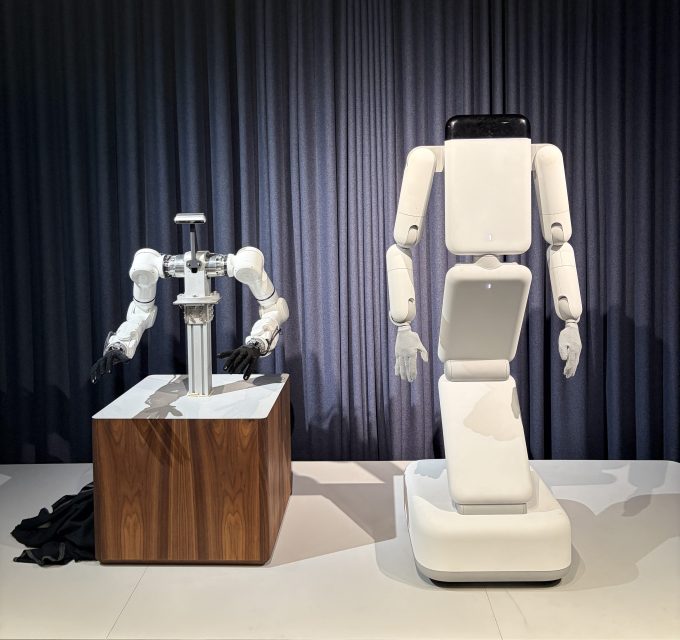
尽管如此,关于机器人本身:Xian 表示,公司的模型在操作 Eno——公司的旗舰人形机器人——时能力更强。但 Eno 尚未准备好向 TechCrunch 展示其能力。
Still, about that robot: Xian said that the company’s model was more capable when operating Eno, the company’s flagship humanoid robot. But Eno wasn’t ready to demonstrate its abilities for TechCrunch.
这台外观精美的机器,带有已故史蒂夫·乔布斯对科技产品及其营销影响的浓厚痕迹,Eno 体现了公司想要传递给客户的“感觉”。这意味着减少了 类金属骨架的风格,更像是一台装上轮子的 iMac。
A handsome machine bearing more than a hint of the late Steve Jobs’ influence on tech gadgets and their marketing, Eno reflects “the feeling” the company wants to deliver to its customers. That means less of a -styled metal skeleton and more of an iMac on wheels.
Genesis 表示已制造了 30 到 40 台 Eno,但尚未准备好透露明年将生产多少台。公司仅表示,已选定一家大规模制造承包商,将于明年在美国开始工作,且量产版本的设计已定型。公司正与少数未透露姓名的客户试点该机器。
Genesis said it has built 30 to 40 Enos, but wasn’t ready to share how many it would make in the year ahead. The company would only say that a mass-manufacturing contractor had been chosen to start work next year in the U.S. and that the design of the mass-produced version had been finalized. The company is piloting the machine with a handful of undisclosed customers.
冼表示,要实现公司愿景,关键瓶颈在于硬件能力,无论是机械设计,还是生产工业级机器所需的供应链。目前,公司的灵巧手只能在常规工作中运行几周,就需要更换。
To realize the company’s vision, Xian says the key bottleneck is hardware capability, both in mechanical design and in the supply chains needed to produce industrial-grade machines. Right now, the company’s dexterous hands can only operate for a few weeks of regular work before they need to be replaced.
要实现真正的通用机器人智能,Genesis 需要更多数据。冼不屑于区分视觉-语言-动作模型和世界-动作模型等架构的细微差别。在他看来,软件归根结底都是 Transformer 和注意力机制,“真正重要的是整个基础设施——训练基础设施、数据基础设施,以及数据质量。”他估计,“模型架构对最终结果的贡献可能只有 10% 左右。”
For truly generalized robotic intelligence, Genesis needs more data. Xian pooh-poohs the finer distinctions between architectures like Vision-Language-Action models and World-Action models. In his view, the software is ultimately transformers and attention, so “what really matters is is the whole infra — the training infrastructure, the data infrastructure, and the quality of the data.”He estimates that “the model architecture contributes to maybe 10% of of the final [result].”
“我不认为我们期待或需要另一次根本性的科学飞跃,”他告诉 TechCrunch。“不,我们已经掌握了所有配方。关键在于执行。”
“I don’t think we expect or we need another fundamental scientific leap,” he told TechCrunch. “No, we have all the recipes. It’s just about execution.”