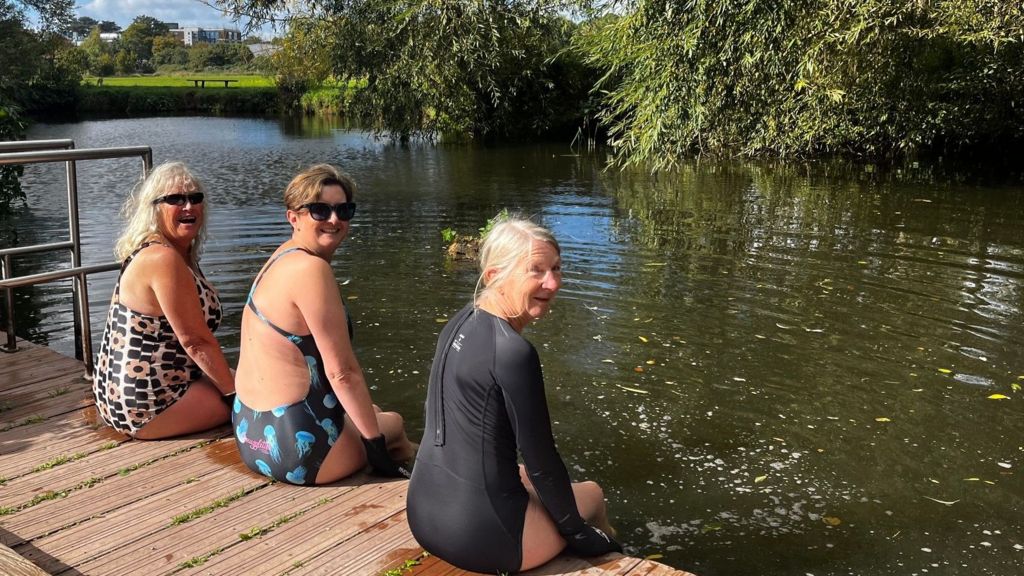
泰顿河畔弗伦奇威尔公园的官方告示牌建议人们不要游泳。但这并没有阻止乔、珍妮、苏和另一位乔一起定期游泳。
The official sign on the banks of the River Tone at French Weir Park in Taunton advises people not to swim. But that hasn't stopped Jo, Jenny, Sue and a second Jo from enjoying a regular dip together.
“人们会想,哦,你在超市旁边游泳,那肯定不好,但那里很美,”珍妮·希利尔说,她和其他几位女性裹着外套,喝着热饮,在十月一次令人精神振奋的游泳后聚在一起。人们在泰顿河这个位于陶顿市中心的地点游泳已有一百多年了。
"People think, oh you're swimming down by the supermarket, that can't be very nice, but it's gorgeous," Jenny Hillier says, as the women huddle round with their coats and hot drinks after a bracing October plunge. People have been swimming at the spot on the River Tone in the centre of Taunton for more than a hundred years.
但直到2024年,弗伦奇威尔公园才被指定为官方沐浴场所,这意味着从5月到9月,环境署(EA)会对水质进行检测。
But it is only since 2024 that French Weir Park has been designated an official bathing site, which means from May to September the water gets tested by the Environment Agency (EA).
这些检测经常证实,女性们的感官已经告诉她们一段时间的情况——水质很差。
Those tests regularly confirm what the women's senses have been telling them for a while - the water quality is poor.
“有时候我们来了却没下水,要么是因为水的颜色,要么是因为气味,”乔·麦克唐纳说。“我们不冒险。我们不把脸浸进水里。我们不带伤口游泳,或者其他什么。” “今年夏天我病得很重,”珍妮说,解释说她出现了腹泻、呕吐和肌肉痉挛。
"There are times when we've come down and we haven't got in, either because of the look or the smell," says Jo Macdonald. "We don't take risks. We don't put our faces in. We don't swim with cuts or anything." "This summer I got quite poorly," Jenny says, explaining that she'd had diarrhoea, vomiting and muscle cramps.
“我游完泳后,六小时内就不舒服了。我病了大约七到十天,很不舒服。我觉得那天是河里的问题。” 那么她为什么还要回去游泳?
"I'd swum and then within six hours I was unwell. I was poorly for probably about seven to 10 days and it was not nice. I think it was the river that day." So why is she back swimming in it?
“到处都有细菌,无处不在。你在特易购也可能感染新冠,”她说。
"There are germs everywhere, all over the place. You can catch Covid in Tesco," she says.
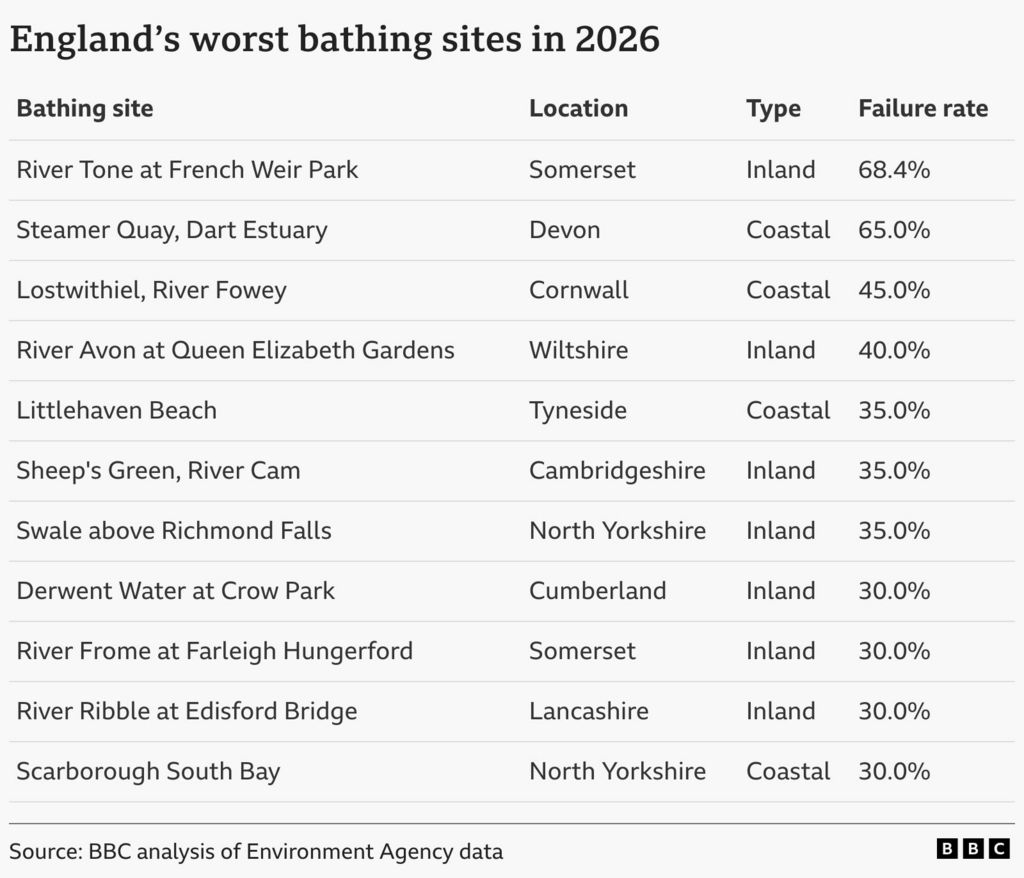
今年夏天,弗伦奇威尔公园在19个采样日中有13天检测不合格。BBC分析了2026年英国所有四个监管机构的数据,发现弗伦奇威尔公园的不合格率为68%,是所有沐浴场所中最高的。监管机构检测两种粪便细菌——大肠杆菌和肠球菌——它们来源于人类或动物的肠道,如果被摄入会让人生病。
This summer French Weir Park failed its tests on 13 of the 19 days it was sampled. The BBC analysed data from all four regulators across the UK for 2026 and found French Weir Park's failure rate of 68% was the highest of all the bathing sites The regulators look for two types of faecal bacteria – E. coli and intestinal enterococci – that originate either in human or animal guts and can make people ill if ingested.
那么,它到底是从法国威尔公园的哪里来的呢?当地自来水公司Wessex Water表示,可能来源于野生动物、农业、私人化粪池以及其污水处理设施。我们决定进一步调查,以弄清真相所在。
So where's it coming from at French Weir Park? The local water company Wessex Water says it could have come from wildlife, agriculture, private septic tanks as well as its sewerage works. We decided to take a closer look to see if we could work out where the truth lies.
我们的污水处理系统建立在这样一种假设上:粪便中的细菌一旦排入自然环境,就会被迅速稀释并死亡。
Our wastewater treatment system is built on the assumption that faecal bacteria - from our poo - once discharged into nature will be rapidly diluted and perish.
已知这些细菌对野生动物影响甚微,但若被人摄入会导致人类生病——因此,野泳的流行以及对浴场的检测提升了公众的意识。
The bacteria are known to have little impact on wildlife but they can make humans sick if ingested – so the rise in popularity of wild-swimming and testing of bathing sites have increased awareness.
在BBC的调查中,我们分析了今年夏季英国700个官方海岸、湖泊和河流浴场的水样检测结果。
As part of a BBC investigation we analysed the water sampling results from this summer across all the UK's 700 official bathing sites on the coast, in lakes and rivers.
结果显示,超过10%的英国海岸浴场以及37%的内陆浴场在整个夏季未能达到监管部门的最低标准。
We found that more than 10% of the UK's coastal sites and 37% of its inland sites failed to meet regulators' minimum standards across the summer.
这种差异可能是因为海水的扩散能力更强,能够比湖泊或河流更快稀释并杀死粪便细菌。
That difference is likely to be because the sea acts as a more effective dispersant and can dilute and kill faecal bacteria quicker than a lake or river.
在2026年英格兰11个最差的浴场中,有七个位于内陆河流或湖泊。去年,官方建议英格兰14个内陆河流浴场中有12个不宜游泳。
Of the 11 worst bathing sites in England in 2026, seven were on inland rivers or lakes. Last year the official advice was not to swim at 12 of the 14 inland river bathing sites in England.
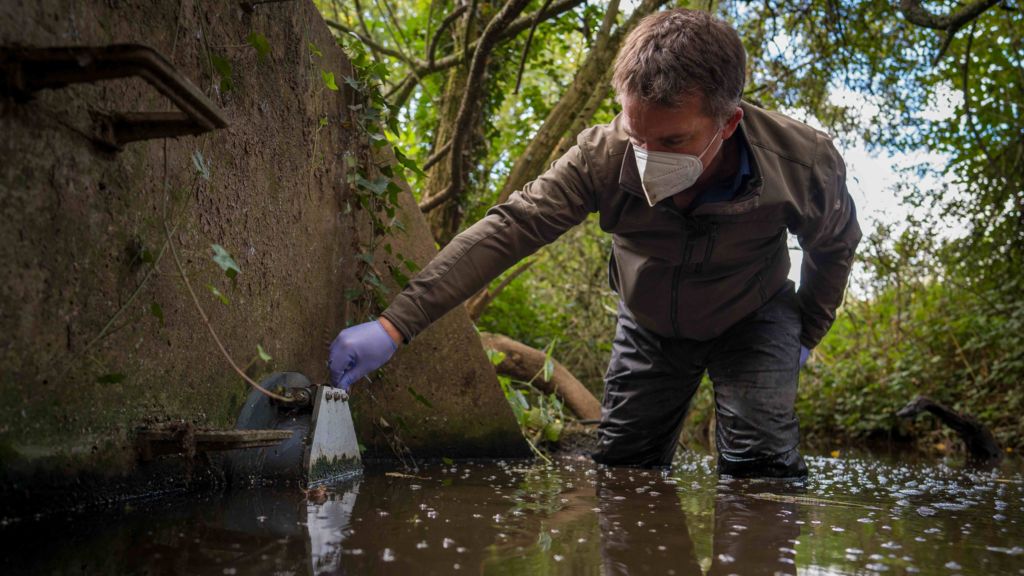
水质差历来与未经处理的污水泄漏有关。降雨后此类泄漏的可能性更大。那么,在异常干燥的夏季,为什么如此多的河流细菌水平仍然居高不下?在塔恩顿,官方检测数据表明,细菌持续流入河流。
Poor water quality has historically been linked to raw sewage spills. These are much more likely after it has rained. So why, in a summer that was extremely dry, did bacteria levels remain high in so many rivers? In Taunton the official testing data suggests there has been a constant flow of bacteria entering the river.
因此,BBC在塔恩顿站点上游的三个污水处理厂附近自行取样。我们发现,最近的Bradford-on-Tone污水处理厂排出的处理后液体中,每100毫升含约24万菌落形成单位(CFU)的埃希菌大肠杆菌——这一水平约是安全游泳标准的250倍。
So the BBC carried out its own sampling near three wastewater treatment works upstream of the Taunton site. We found the treated liquid coming out of the nearest sewage works at Bradford-on-Tone had about 240,000 colony forming units (CFU) of E. coli per 100ml - that's a level about 250 times higher than that considered safe for swimming.
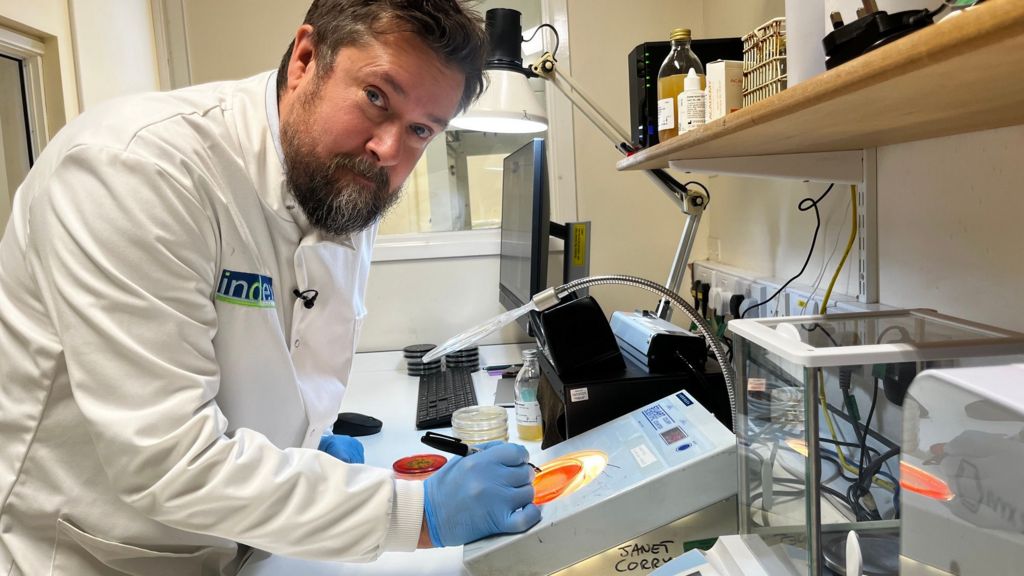
“根据我的经验,处理厂附近的计数值对于处理后的废水来说偏高,”来自Index Microbiology的罗布·莫利博士在其布里斯托尔附近的实验室里对我们说,他低头看着透明塑料盘上细小的大肠杆菌菌落。
"The counts from just outside the treatment works in my experience were high for treated effluent", Dr Rob Morley from Index Microbiology told us at his laboratory near Bristol as he peered down at small dots of E. coli bacteria on a transparent plastic plate.
莫利特别感兴趣的是,我们在处理后的废水进入托恩河的地点上游和下游采集的水样检测结果。
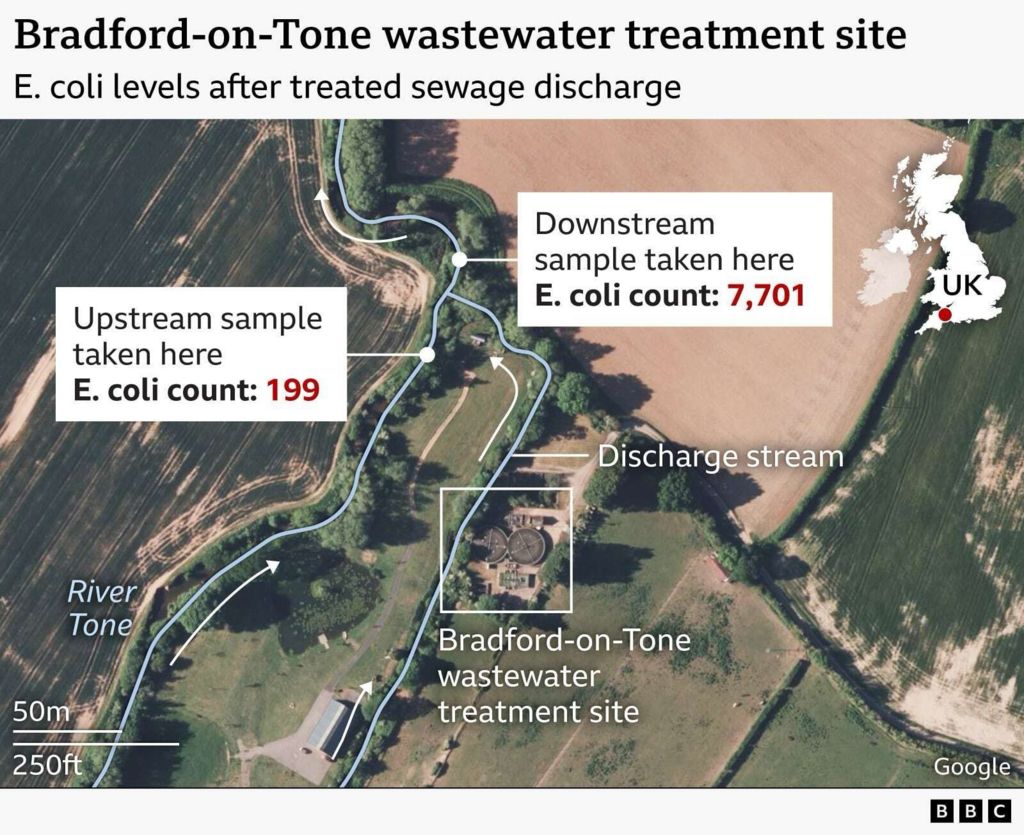
What was of particular interest to Morley were the results of the test on water samples we'd taken above and below the point where the treated wastewater enters the River Tone.
结果显示,上游大肠杆菌为199 CFU,适合游泳;下游紧邻处为7701 CFU,超过监管限值的八倍多。“你可以看到,它正在向河流播种污染,”莫利说。
It showed 199 CFU of E. coli above, which is fine for swimming and 7,701 CFU just below, more than eight times the regulators limit. "You can see where it's seeding the river with pollution," Morley says.
“如果我们顺着河流往下游看,预计随着稀释作用,细菌水平会降低。但这非常清楚地表明,处理后的废水对河流可能产生的影响。”我们将调查结果告知了化学工程师学会研究员安德鲁·汤普森博士。他参与了一份2024年的报告,该报告警告称,细菌和病毒的高浓度很常见,尤其是在夏季河流水位较低时,若被摄入可能导致严重疾病。
"If we were to look further down the river, we would expect the levels to get lower with the dilution effect. But that does quite clearly show the impact that treated effluent can have on the river." We shared our findings with Dr Andrew Thompson, a fellow at the Institute of Chemical Engineers. He was involved in a 2024 report that warned high concentrations of bacteria and viruses were common, particularly in the summer when river levels are lower and could cause serious diseases if ingested.
汤普森告诉BBC,我们在托恩河发现的大肠杆菌水平并不违法,甚至并不特别罕见,因为目前没有法律或法规限制水务公司在其所谓的处理后废水中排放多少细菌。
Thompson told the BBC the levels of E. coli we found in the River Tone were not illegal, or even particularly unusual, because there are currently no laws or regulations about how much bacteria water companies are allowed to discharge in what the industry calls treated effluent.
我们还想知道,分析沐浴地点的大肠杆菌样本是否能为我们提供污染来源的线索。
We also wanted to know whether analysing the E. coli samples from the bathing site could give us clues to where it came from.
在布里斯托尔大学研究人员的协助下,莫利安排进行了e-DNA分析,以鉴定这些大肠杆菌更可能来自人类还是动物的肠道。
With assistance from researchers at the University of Bristol, Morley arranged for e-DNA analysis to be carried out to identify whether the E. coli bacteria were more likely to be from a human or animal gut.
答案,如同水质问题常见的那样,是复杂的。样本中存在多种不同类型的大肠杆菌。
The answer, as is often the case with water quality, is complex. There were lots of different types of E.coli in the samples.
莫利说:“有些来自人类,有些来自动物,有些只是环境中的一般性细菌。”“这绝对表明,部分大肠杆菌确实来自人类来源,因此可能来自该污水处理厂。”与所有检测一样,要得出确凿结论,还需要做更多工作。
"Some were from humans, some were from animals and some were just generic from the environment," Morley says. "It definitely suggests that some of the E. coli is definitely coming from human origins, therefore potentially from that treatment works." As with all of our testing, more needs to be done to reach firm conclusions.
环境署和威塞克斯水务公司都在调查,是什么导致托顿的水质如此糟糕。但环境署的消息人士告诉BBC,持续排放的处理后废水是可能的罪魁祸首之一。
Both the EA and Wessex Water are investigating what's causing the water quality in Taunton to be so poor. But sources at the EA told the BBC that constant flows of treated effluent is high up the list of likely culprits.
作为对我们检测的回应,威塞克斯水务公司告诉BBC,其布拉德福德-昂-托恩污水处理厂运行正常,并满足环境署设定的所有许可条件。
In response to our testing Wessex Water told the BBC its treatment works at Bradford on Tone was working normally and was meeting all its permit conditions set by the EA.
那么,细菌负荷的稳定处理后废水排放,是否可能是英国各地众多沐浴场所问题的根源?
So could steady flows of treated effluent loaded with bacteria be behind many of the problems at bathing sites across the UK?
环境署西南地区经理吉姆·弗洛里说:“英国和英格兰的所有污水处理厂都有许可,用于保护河流中的生态和野生动物。”
"All the sewage treatment works in the UK and in England have permits to protect the ecology and the wildlife within the river," says Jim Flory, a regional manager for the EA in the south-west.
“它们没有为沐浴水质量法规设定许可,而这些法规旨在保护可能想要游泳、划独木舟或使用水域的人。”这导致了一种体系:一个受欢迎的沐浴场所被正式指定——检测制度发现其粪便细菌含量高——然后开始一个漫长的过程,试图找出污染源以及修复是否负担得起。
"They've not set permits for bathing water regulations, which are all about protecting people who may want to be swimming, canoeing or using the water." That has led to a system where a popular bathing site gets officially designated – the testing regime discovers it has high levels of faecal bacteria – and then a lengthy process begins to try to work out where the sources are and whether it's affordable to fix them.
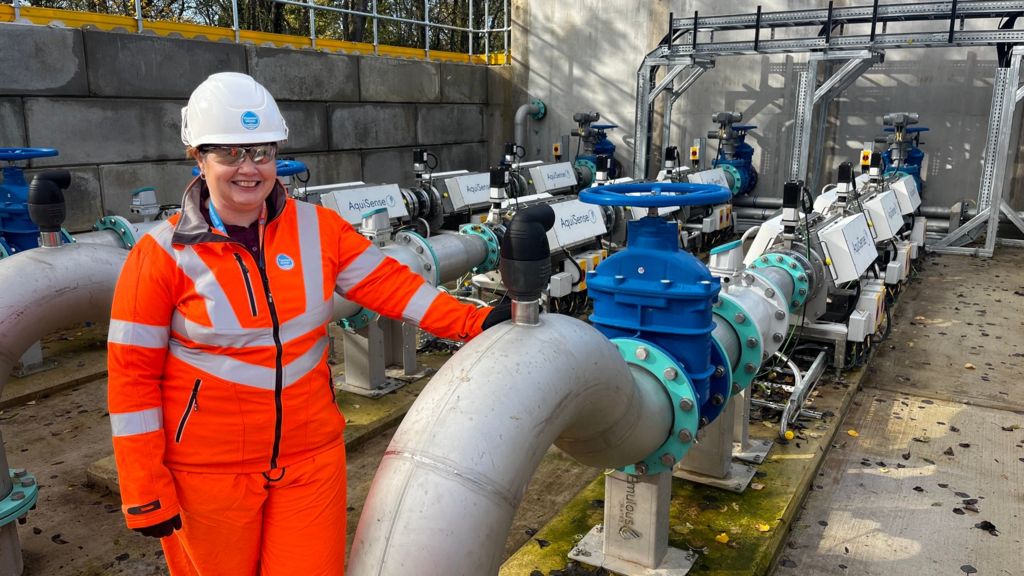
牛津的沃尔弗科特磨坊溪流是2022年第二个获得沐浴水质地位的内陆河流,自那时起,水质一直被评为“差”。
Wolvercote Mill Stream in Oxford was the second inland river to get bathing water status in 2022 and since then the water has always been rated "poor".
为改善情况,位于上游卡斯汀顿污水处理厂的紫外线灯组刚刚安装完毕,耗资400万英镑,用于在细菌到达泰晤士河之前将其杀死。但绝不可能在所有地方都安装。
In an attempt to improve things, banks of ultraviolet (UV) lights have just been installed at a cost of £4m upstream at Cassington wastewater treatment works to kill bacteria before they reach the River Thames. But there's no question of it being installed everywhere.
“现实情况是这很昂贵。我们必须确保把钱花在刀刃上,”泰晤士水务公司的特莎·费耶斯说。
"The reality is it's expensive. We have to be sure we're spending money wisely," Tessa Fayers from Thames Water says.
在英格兰近 7000 座污水处理厂中,已有 160 座安装了紫外线消毒设施——几乎总是作为有针对性的干预措施,以保护下游的贝类养殖区或浴场水域。
UV disinfection has been installed at 160 of the nearly 7,000 wastewater treatment works across England – almost always as targeted interventions to protect either shellfish or bathing sites downstream.
韦塞克斯水务公司表示,没有计划在布拉德福德昂通引入紫外线消毒,并将于 2027 年 4 月公布其关于水质为何如此糟糕的结论。
Wessex Water said it had no plans to introduce UV disinfection at Bradford-on-Tone and that it would publish its conclusions on why the water quality is so poor in April 2027.