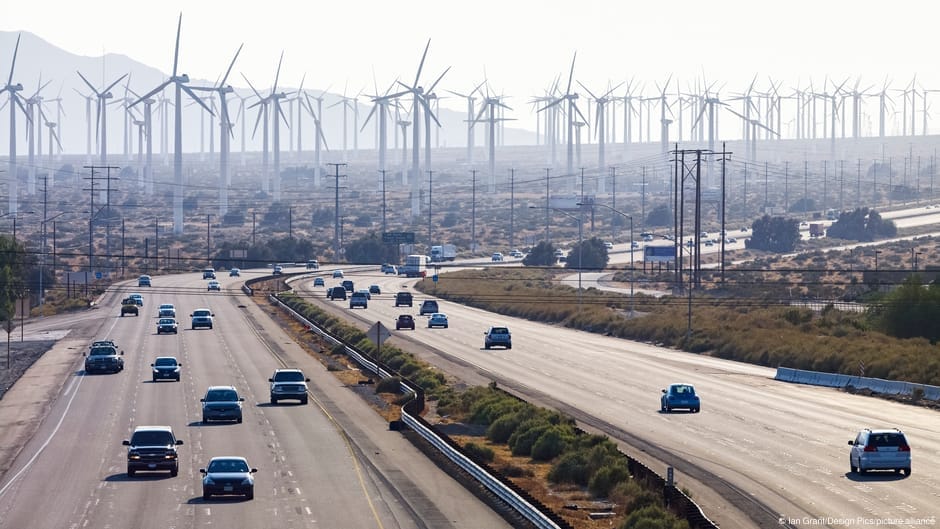
绿色增长承诺了一个未来:经济体能够蓬勃发展,而不破坏环境。但这一愿景现实吗?
Green growth promises a future in which economies thrive without destroying the environment. But is this vision realistic?
人类文明目前严重不可持续。地球已经越过了维持生命至关重要的九条行星边界中的七条,包括气候变化、海洋酸化和生物圈完整性。
Human civilization is currently profoundly unsustainable. Earth has already crossed seven of the nine planetary boundaries critical for sustaining life, including climate change , ocean acidification and biosphere integrity.
如果经济和社会一切照旧,地球的重要进程将继续严重失衡,威胁人类的未来。
If economies and societies keep to business as usual, the Earth's vital processes will continue to be thrown wildly out of balance, threatening the future of humanity.
如今人们已在很大程度上接受,如果人类想要有任何机会减缓全球变暖和自然丧失,这些社会和经济模式就必须改变。绿色增长的理念正是在此背景下提出的。
It's now largely accepted that if humans are to have any chance of slowing global warming and nature loss , those social and economic models must change. That's where the idea of green growth comes in.
它的承诺是在减少排放和资源使用的同时保持经济增长。这包括,例如,用风能、太阳能和其他绿色能源而非煤炭和天然气来运转工厂、企业和家庭,用热泵取代燃气炉,以及回收和再利用资源与原材料。
Its promise is to keep growing the economy while reducing emissions and resource use. That involves, for instance, running factories, businesses and homes on wind, solar and other green energy instead of coal and gas, replacing gas-fired furnaces with heat pumps and recycling and reusing resources and raw materials.
“基本上,这个理念是:一切照旧,但采用更可持续的技术,”维也纳自然资源与生命科学大学社会生态学教授赫尔穆特·哈伯尔说。他与同事在2020年发表了一份重要报告,评估了800多项关于绿色增长的研究。
"Basically, the idea is: business as usual, but with more sustainable technologies," said Helmut Haberl, a social ecology professor at BOKU University in Vienna. Along with his colleagues, he published a major report in 2020 evaluating more than 800 studies on green growth.
用可再生能源运转经济,是否足以完全防止经济增长对环境造成破坏?
Will running economies on renewable energy be enough to completely prevent environmental damage from economic growth?
经济能在排放下降的同时增长吗?原则上,世界经济产出可以长期持续增长,同时因燃烧煤炭、石油和天然气等化石燃料而产生的排放大幅减少。联合国政府间气候变化专门委员会(IPCC)的研究人员模拟的情景已经表明了这一点。
Image: Wang Shengwei/Xinhua/picture alliance ## Can economies grow while emissions fall? In principle, the world's economic output could continue to grow in the long term and generate significantly fewer emissions from the burning of fossil fuels like coal, oil and gas . That's been shown in scenarios modeled by researchers with the UN's Intergovernmental Panel on Climate Change, or IPCC.
得益于可再生能源和绿色技术,这些情景已在多个国家和地区成为现实。
Thanks to renewable energy and green technologies, those scenarios have already become reality in several countries and regions.
英国、美国、日本和澳大利亚等发达国家的经济经历了多年的增长,与此同时二氧化碳排放量却在下降。即便将离岸生产计算在内,这一趋势依然成立。
The economies of developed countries like the United Kingdom, the United States, Japan and Australia have experienced years of growth alongside sinking CO2 emissions. That's even when offshore production is included. In the European Union , the bloc-wide economy has grown by more than 70% since 1990.
在欧盟,自1990年以来,整体经济增长超过70%。与此同时,欧盟的碳排放量下降了约40%。
Meanwhile, the EU's carbon emissions have dropped by around 40%.
但据哈贝尔及其同事研究,这种增长与排放的完全“脱钩”相对罕见。
But such a complete decoupling of growth and emissions is, according to Haberl and his fellow researchers, relatively rare.
在印度以及非洲和东南亚的多个国家,经济效率正在提高。但尽管经济表现超过了排放增长,这些国家以及全球的排放量仍在上升。这与防止气候变化最严重的影响不相容。
In India, and in several countries in Africa and Southeast Asia, economies are becoming more efficient. But while economic performance is outpacing emissions growth, emissions are still rising in those countries and globally. This is not compatible with preventing the worst impacts of climate change.
哈贝尔表示:“但这并不意味着未来行不通。”他指的是增长与排放的“脱钩”。
"That doesn't mean, however, that it couldn't work in the future," said Haberl, referring to decoupling of growth and emissions.
尽管经济增长已被证明与减排相容,但要从钢铁或化工等污染行业中彻底消除所有温室气体却很复杂。
And even though economic growth has been shown to be compatible with emissions reduction , eliminating all greenhouse gases from a polluting industry like steel or chemicals is complicated.
这些行业不仅通过燃烧化石燃料获取能源而排放;碳还是制造其产品所用化学工艺的关键组成部分,钢铁行业尤为突出。
These sectors don't just release emissions by burning fossil fuels for energy; carbon is also a key part of the chemical processes used to create their products, notably in the steel industry .
用更环保的替代品或绿氢等替代能源取代它,需要巨额投资。
Replacing it with greener substitutes, or an alternative energy source like green hydrogen , requires significant investment.
排放并非经济增长的唯一问题还有一个障碍:全球资源的高消耗。一个高效的经济体依赖许多原材料和其他产品:矿石、化学品、木材、水泥、玻璃和农产品。
Emissions aren't the only problem with economic growth There's another hurdle: the world's high consumption of resources. A productive economy depends on many raw materials and other products: ores, chemicals, wood, cement , glass and agricultural products. ## EU Arctic strategy highlights security and raw materials
欧盟北极战略聚焦安全与原材料并且例如,许多国家现在正利用绿色技术来减少制造产品所需的资源量,并提高经济效率。
To view this video please enable JavaScript, and Many countries are now using green technologies to reduce the amount of resources needed to manufacture a product, for example, and are making their economies more efficient.
但这并不意味着总体上使用的资源减少了,因为成本下降会促使企业生产更多东西、人们消费更多。这会部分抵消绿色技术带来的节约,被称为反弹效应。
But that doesn't mean overall fewer resources are being used because falling costs can encourage businesses to produce more things and people to consume more. This can partially offset green savings and is called the rebound effect.
英国经济多年来一直在增长,排放量持续下降,效率不断提高,但英国2023年使用的资源仍比2001年多7%。
The British economy has been growing for years, emissions have been dropping and efficiency has increased, but the UK still used 7% more resources in 2023 than it did in 2001.
过去50年间,全球资源消耗量增长了两倍。如果世界继续沿着当前路径发展,到2060年这一数字可能再增加60%。目前尚不清楚绿色增长能否足够快地实现遏制气候变化和生物多样性丧失所需的减排和资源削减。
Global resource consumption has tripled over the last 50 years. If the world continues on the current pathway, that could increase by another 60% by 2060. It remains unclear whether green growth can deliver the emissions and resource reductions needed to stop climate change and biodiversity loss rapidly enough.
欧洲环境署可持续发展和公平转型专家凯瑟琳·甘茨莱本表示:“我们确实需要超越现有生产实践中的效率提升,更广泛地审视我们消费的东西。”
"We really need to move beyond efficiency gains in our existing production practices to look more broadly at what we consume," said Catherine Ganzleben, a sustainability and fair transitions expert at the European Environment Agency.
每年全球售出约7500万辆新车,其中包括大众汽车,图为德国埃森一家工厂生产的汽车。 们还需要重新思考自己的消费方式,以及日常生活中使用的一切是否真的都需要拥有——比如汽车。
Some 75 million new cars — including Volkswagens, seen here at a plant in Essen, Germany — are sold worldwide each yearImage: Martin Meissner/AP Photo/picture alliance She told DW that people also need to reconsider how they consume and whether they really need to own everything they use in their daily life — cars, for example.
“但我们可以转向共享汽车的模式,这样我们就能集中资源,通过共享我们所需的物品,大幅降低人均资源消耗。”
"But we can shift towards models where we share cars, so we pool our resources and have significantly lower resources per person through sharing the goods that we need."
去增长是未来吗?一些研究人员得出结论,从长远来看,无限制的经济增长已不再可能,即使这种增长是可持续的。
Is degrowth the future? Some researchers have concluded that unrestricted economic growth is no longer possible in the long term, even if it's sustainable.
相反,他们呼吁实行“去增长”。这一理念主张放缓经济增长、完全不增长甚至负增长,以便让世界生态系统和气候有机会恢复并趋于稳定。
Instead, they've called for degrowth . This posits slower economic growth, no growth at all or even negative growth, so that the world's ecosystems and the climate have a chance to recover and stabilize.
这主要适用于较富裕国家的经济体,这些国家需要采取有针对性的措施来减少能源和资源使用。较贫穷的国家则将继续增长,直到其经济和生活质量显著改善。
That applies mainly to economies in richer countries, which would need to take targeted steps to reduce their energy and resource use. Poorer countries would continue to grow until their economies and quality of life improve significantly.
在去增长理论下,一个社会的繁荣不仅仅以国内生产总值的增长来衡量,还要看生活质量、教育和社区等价值。其理念是,一旦国家发展到一定程度,额外的增长并不会转化为更大的福祉。
Under the degrowth theory, a society's prosperity is not measured solely by the growth of its gross domestic product, but by values such as quality of life, education and community. The idea is that once countries develop to a certain point, additional growth doesn't translate into greater well-being.
归根结底,这一概念基于这样一种观点:只有通过有计划、符合社会公平地减少物质生产和资源消耗,人类福祉和生态可持续性从长远来看才有可能实现。去增长的支持者认为,这比气候极端事件不断加剧所导致的无计划、可能具有灾难性的经济萎缩更可取。
Ultimately, the concept is based on the idea that human well-being and ecological sustainability is only possible in the long term with a planned, socially just reduction of material production and resource consumption. Degrowth advocates argue this would be preferable to an unplanned and potentially catastrophic economic contraction caused by escalating climate extremes. ## Degrowth: Slowing growth for the environment?
去增长:为环境而放缓增长?并利兹大学和洛桑大学的研究人员2020年的一项研究表明,去增长的理念支持世界气候目标——而且不必以牺牲高质量生活为代价来换取能源和资源消耗的大幅降低。
To view this video please enable JavaScript, and A 2020 study by researchers from the universities of Leeds and Lausanne showed that the concept of degrowth supported the world's climate goals — and that a high quality of life didn't have to be sacrificed in exchange for a significantly lower consumption of energy and resources.
然而,目前仍没有确凿证据表明,一个完整的现代经济能够长期完全按照去增长原则持续运转。
However, there is still no conclusive evidence that an entire modern economy could continue to function entirely on the degrowth principles in the long term.
环境友好型经济是否可能?尽管如此,哈伯尔并不认为环境友好型经济模式必然意味着牺牲,他反而主张建立一种基于需求的经济。
Is an environmentally friendly economy possible? Nevertheless, Haberl doesn't assume that an environmentally friendly economic model automatically goes hand in hand with sacrifice, arguing instead for a needs-based economy.
“一个社会生产更多的商品和服务,并不一定就更富裕,”他说。这一切都取决于未来如何衡量繁荣和生活质量,以及各国决定如何开展经济活动。
"A society isn't necessarily better off when it's producing more goods and services," he said. It all depends on how prosperity and quality of life are measured in the future, and how states decide to do business.
如今,衡量一个经济是否成功,看的是一个国家国内生产总值的增长——简单说,就是其所有商品和服务的价值。这种计算方式并不考虑收入分配、无偿劳动、生活质量或环境损害。
Today, a successful economy is measured by the growth of a country's gross domestic product — put simply, the worth of all of its goods and services. This calculation doesn't account for income distribution, unpaid work, quality of life or environmental damage.
“从长远来看,为每个人提供尽可能高的实际收入,很可能与生态目标不相容,”哈伯尔说。“另一方面,繁荣程度的提高——与更高的生活质量相关——则是相容的。”
"The highest possible real incomes for every individual would probably not be compatible with ecological goals in the long term," said Haberl. "On the other hand, an increase in prosperity — related to a higher quality of life — would be." ## Pitfalls of GDP — When growth isn't everything
国内生产总值的陷阱——当增长并非一切并欧洲环境署(EEA)的一项分析指出,稳定增长的理念是世界经济周期的一部分,并深深植根于我们的制度、规范和社会话语之中。就业市场和税收体系也与国内生产总值增长密切相关。因此,经济萎缩将要求我们的思维方式发生根本性转变。
To view this video please enable JavaScript, and An analysis by the European Environment Agency (EEA) pointed out that the idea of steady growth is part of the world's economic cycle, and deeply anchored in our institutions, norms and societal discourse. The job market and tax system are also closely tied to gross domestic product growth. A shrinking economy would therefore require a fundamental shift in our way of thinking.
各国面临两难:根据欧洲环境署的说法,稳定增长的经济与生态目标不相容。另一方面,增长急剧下滑可能引发巨大的社会动荡。
Countries face a dilemma: a steadily growing economy is not compatible with ecological goals, according to the EEA. On the other side, a sharp decline in growth could trigger enormous social upheaval.
这种相关性远比“少即是多”这一观点复杂得多,正如欧洲环境署2021年11月的一项研究所强调的那样。“GDP增长对环境有害这一事实,并不一定意味着GDP下降就会有利于环境,”报告指出。
And the correlation is much more complex than the idea of "less is more," as highlighted by an EEA study in November 2021 . "The fact that GDP growth has been harmful for the environment does not necessarily mean that declining GDP would be good for the environment," noted the report.
在尊重环境承载力的前提下实现绿色增长,将需要“经济活动与环境及气候压力前所未有的脱钩。这在目前是否可行尚不确定。”
Achieving green growth while respecting environmental limits would require an "unprecedented decoupling of economic activity from environmental and climate pressures. Whether this is feasible is currently uncertain."