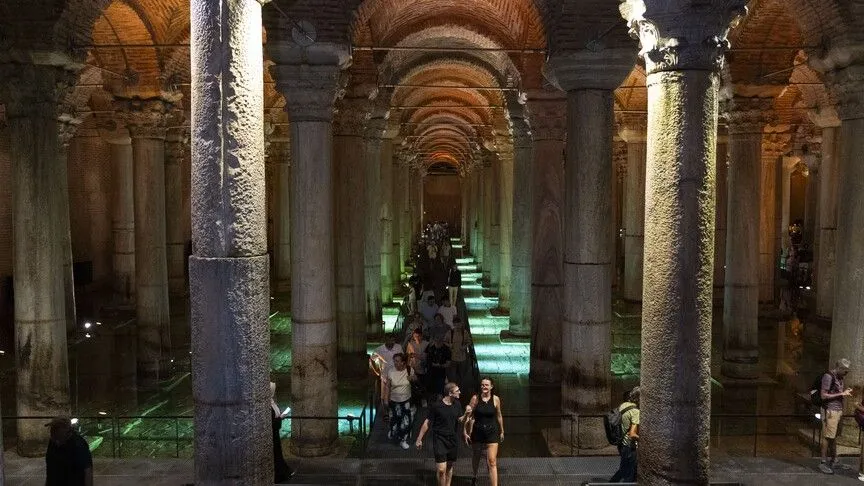
伊斯坦布尔历史半岛的地标之一——耶雷巴坦地下蓄水池,凭借其数百年的建筑细节以及跨越拜占庭、奥斯曼和共和国时期的历史,将这座城市的文化遗产从过去传承至未来。
The Basilica Cistern, one of the landmarks of Istanbul’s Historic Peninsula, carries the city’s cultural heritage from the past into the future through its centuries-old architectural details and history spanning the Byzantine, Ottoman and Republican periods.
作为伊斯坦布尔最重要的文化遗产之一,该蓄水池建于公元532年至542年间,由东罗马皇帝查士丁尼一世下令修建。因水中耸立着数不清的大理石柱,当地人称其为“沉没的宫殿”。
One of Istanbul’s most important cultural heritage sites, the cistern was built between 532 and 542 by Eastern Roman Emperor Justinian I. It came to be known among locals as the “Sunken Palace” because of its seemingly countless marble columns rising from the water.
蓄水池在艾哈迈德三世统治时期进行了首次修复,由建筑师凯塞里利·梅赫梅特·阿加主持;在奥斯曼时代阿卜杜勒-哈米德二世统治时期进行了第二次修复。随后几年又进行了进一步的修复工作。
The cistern underwent its first restoration during the reign of Ahmed III, carried out by architect Kayserili Mehmet Aga, and a second restoration during the reign of Abdulhamid II in the Ottoman era. Further restoration work was carried out in subsequent years.
经过最近一次修复,该遗址于2022年7月22日重新对游客开放,吸引了大量国内外游客。
Reopened to visitors on July 22, 2022, following its latest restoration, the site attracts large numbers of local and foreign tourists.
马尔马拉大学人文与社会科学学院教员、副教授尤努斯·乌古尔表示,根据考古发现,伊斯坦布尔的城市历史可追溯至2600年前,定居历史更可追溯至8000年前。
Assoc. Prof. Yunus Ugur, a faculty member at Marmara University’s Faculty of Humanities and Social Sciences, said Istanbul’s urban history dates back 2,600 years, while its settlement history extends back 8,000 years, according to archaeological findings.
乌古尔说,耶雷巴坦地下蓄水池是最清晰反映这座城市层叠历史的记忆场所之一。
Ugur said the Basilica Cistern was one of the city’s sites of memory that most clearly reflected its layered history.
他说:“如今伊斯坦布尔兼具拜占庭、奥斯曼和共和国三个历史层面。耶雷巴坦地下蓄水池难得地同时反映了这三个时期。”他表示,美杜莎石头是最令游客着迷的特色之一。
“Today, Istanbul has Byzantine, Ottoman and Republican layers. The Basilica Cistern is rare in that it reflects all three periods at once,” he said. He said the Medusa heads were among the features that most captivated visitors.
他说:“两颗美杜莎石头被用作柱基,用于支撑长度不足的柱子。一颗倒置,另一颗侧放。”
“Two Medusa heads were used as bases to provide support where the columns were too short. One was placed upside down and the other sideways,” he said.