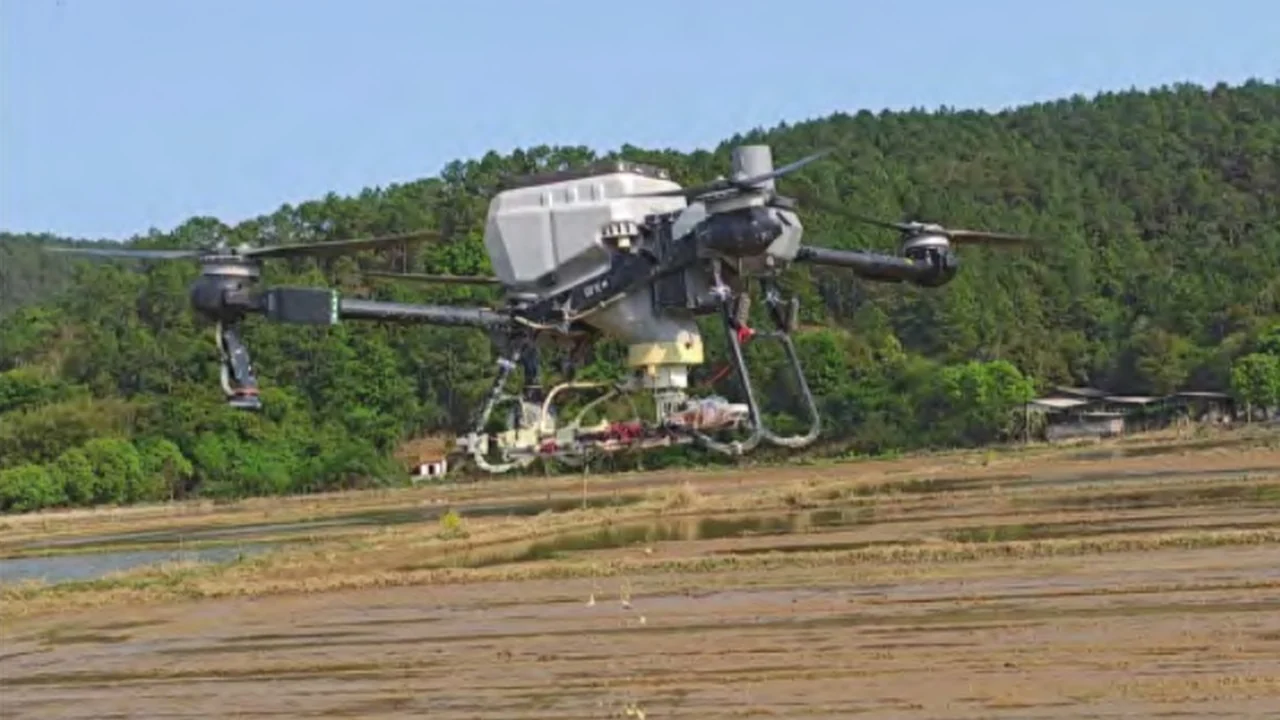
研究人员研发出一种利用喷射装置播种的泵系统,其效率高于在田地里随机撒种。该无人机有助于提高作物产量。图片:提供多年来,世界各地的工程师一直在尝试在无人机上安装枪支,以增强战场火力。
Researchers develop pump system that uses jets to plant seeds more efficiently than randomly scattering them in the field. The drone could help improve crop yields. Photo: Handout For years, engineers around the world have experimented with mounting guns on drones to boost battlefield firepower.
但中国研究人员的一项新研究表明,无人驾驶车辆可以用来发射一种非常不同的“弹药”——水稻。
But a new study by Chinese researchers shows that unmanned vehicles could be used to shoot a very different kind of ammunition – rice.
研究人员上个月发表的一篇论文中详细介绍了一种优化的泵系统,该系统可利用精准的高压喷射来播种水稻,而不是随机撒种。
In a paper published last month, the researchers detailed an optimised pump system that could use precise, high-pressure jets to plant rice rather than randomly scattering the seeds.
“本研究提出了一种专为基于无人机的脉冲喷射水稻播种系统设计的计量播种泵,”研究人员在中文期刊《中国农业工程学报》中写道。
“This study proposes a seed-metering pump designed for a drone-based, pulsed-jet rice seeding system,” the researchers wrote in the Chinese-language journal Transactions of the Chinese Society of Agricultural Engineering .
在测试了多种泵送方法后,来自华南农业大学以及广东省专注于农业装备、航空和人工智能的实验室的团队,选择了一种克服了流量不佳、种子受损、堵塞和喷射压力不足等难题的系统。
After testing several pump methods, the team – from South China Agricultural University and Guangdong-based laboratories specialising in agricultural equipment, aviation and artificial intelligence – settled on a system that overcame hurdles such as poor flow rates, seed damage, clogging and weak ejection pressure.
在田间测试中,使用优化泵系统的无人机将种子播种成整齐、间距均匀的簇,与市售泵相比,其偏离目标线的程度更小,簇与簇之间的间距也更加一致。
In field tests, a drone using the optimised pump system planted seeds in neat, evenly spaced clusters – straying less from the target line and maintaining more consistent spacing between clusters than a commercially available pump.
所种植水稻的产量平均达到每公顷约6730公斤(每英亩约6000磅),而传统方法的产量约为每公顷6040公斤。
The resulting yield of the planted rice reached an average of around 6,730kg per hectare (6,000lb per acre), compared with around 6,040kg per hectare using the conventional method. Drones have become a major modern weapon of war used to carry out precision strikes.
无人机已成为现代战争中的主要武器,用于执行精确打击。中国和其他国家也测试过在无人机上安装枪支进行近距离战斗的方式。然而,无人机也被用于民用目的,包括农业。
China and other countries have also tested ways of using guns mounted on drones for close-quarters combat . However, drones are also being used for civilian purposes, including agriculture.
在中国,它们已经被用于喷洒农药和水,以及运输收获的农作物等任务。
In China, they are already being used for tasks such as spraying pesticides and water, as well as carting harvested crops.
根据美国农业部最新数据,中国是世界上最大的稻米生产国之一,占全球产量的近27%,仅次于印度,印度占比略高于28%。
China is one of the world’s biggest producers of rice, accounting for nearly 27 per cent of global production, second only to India, which accounts for just over 28 per cent, according to the latest figures by the United States Department of Agriculture.
2020年,机器人公司极飞科技研发的基于无人机的直播系统开始商用。
In 2020, a drone-based direct seeding system made by robotics firm XAG was made commercially available.
该公司当时表示,水稻种植不能依赖自动拖拉机等大型机械,因为这些机械不适合亚洲许多水稻农场的地形和规模。
The company said at the time that rice farming could not rely on large machinery such as automated tractors because they were not compatible with the terrain and size of many rice farms in Asia.
传统的无人机水稻播种将种子随机撒在田地里,但新系统背后的团队表示,这种方法存在多个缺点,包括“种子容易受到旋翼气流干扰、无法控制种子落位以及分布不均匀”。
Conventional drone-based rice planting scatters the seeds randomly across fields, but the team behind the new system said this method suffered from several drawbacks including “the susceptibility of seeds to interference from rotor-generated airflow, a lack of control over seed placement and poor uniformity in distribution”.
“这些问题导致作物密度不一致、通风和光照不足、病虫害风险增加以及作物产量不稳定,”该研究称。
“These issues lead to inconsistent crop density, inadequate ventilation and light penetration, an increased risk of pests and diseases and unstable crop yields,” the study said.
脉冲喷射水稻播种使用一种专用泵,将液体和发芽稻种的混合物喷出,将种子以均匀的行或簇状射入田地。
Pulsed-jet rice seeding uses a specialised pump that ejects a mixture of liquid and germinated rice to shoot seeds into fields in uniform rows or clusters.
团队写道,虽然有序种植可以提高效率、提升产量并降低成本,但专为液体设计的常规泵无法满足水稻播种的技术要求。
While orderly planting can boost efficiency, raise yields and cut costs, the team wrote that conventional pumps designed for liquids fell short of the technical demands for rice seeding. “Consequently, there is a need to develop a specialised seed-metering pump tailored for pulsed-jet rice seeding,” they said.
“因此,有必要开发一种专为脉冲喷射水稻播种定制的种子计量泵,”他们表示。
To achieve organised row and cluster seeding, the team said the initial ejection velocity of the rice seeds needed to be increased to minimise the impact of rotor airflow on the seeds’ trajectory.
为了实现有序的行播和簇播,团队表示,需要提高水稻种子的初始喷射速度,以尽量减少旋翼气流对种子轨迹的影响。
To address this, the researchers tested three different pump configurations to determine the optimal design. “In terms of its superior seeding performance, the semi-open impeller pump was selected as the seeding pump configuration,” they wrote.
为解决这一问题,研究人员测试了三种不同的泵配置,以确定最优设计。
They then conducted field tests using a prototype pump, including tests at a site in Guangzhou’s Zengcheng district where they compared its performance with that of a commercially available pump.
他们写道:“就播种性能更优而言,半开式叶轮泵被选为播种泵的配置方案。”
The rice was soaked and germinated before being incorporated into a mixture containing cellulose powder, bentonite clay and water.
随后,他们用一台原型泵进行了田间试验,其中包括在广州增城区一处场地开展的试验,将原型泵的性能与市面上一款商用泵进行了对比。
[embedded media] During the experiment, the drones flew at a speed of 2 metres per second (6.6 feet per second) and operated 2 metres above the ground, with row spacing set to 1.5 metres.
稻谷先经过浸泡和催芽,再混入含有纤维素粉末、膨润土和水的混合物中。
[[嵌入媒体]](
The team’s pump system planted rice in evenly spaced clusters, with a standard deviation of 2cm (0.8 inches) off the target row line, compared with 2.9cm for the commercially available pump.
该团队的泵系统将稻种以间距均匀的簇状播下,偏离目标行线的标准差为2厘米(0.8英寸),而商用泵为2.9厘米。在相邻种子簇中心到中心距离的平均偏差上,实验系统也更小。
The average variation for the centre-to-centre distance between adjacent seed clusters was also lower for the experimental system. A few months later, in November, the team measured the harvest using a random sampling method, finding that the average yield from their system outperformed conventional drone seeding. The team said these results indicated the seeding pump increased the exit velocity of the rice, limiting the impact of rotor airflow on the descent trajectory of the seeds.
几个月后的11月,团队采用随机抽样方法测产,发现其系统的平均产量优于常规无人机直播。
“This facilitates orderly, row-based and pocket-specific seeding, confirming the feasibility of a drone-mounted, pulsed-jet rice seeding device based on a semi-open impeller pump,” they wrote.
团队表示,这些结果表明,播种泵提高了稻种的出射速度,从而减小了旋翼气流对种子下落轨迹的影响。
However, the researchers emphasised that the system still warranted further exploration, including its high power consumption during operation and the difficulty of precisely controlling how deeply the seeds penetrated into the ground. Passionate about science?
他们写道:“这有利于实现有序、成行、按穴播种,证实了基于半开式叶轮泵的无人机载脉冲射流水稻播种装置的可行性。”
Dive deeper with the Dark Matters newsletter, a weekly in-depth analysis on China’s rise in science, technology and military that goes beneath the surface. Sign up for free now. Sections: News / China / Science | Topics: Science, China, China Agricultural University, Drones
不过,研究人员强调,该系统仍需进一步探索,包括运行期间功耗较高,以及难以精确控制种子入土深度的问题。
对科学充满热情?
Short link: https://sc.mp/sgr5d Read the original article on SCMP