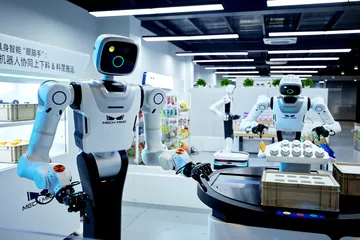
我正在与一台机器人进行智力较量,感觉胜算不大。身高5英尺7英寸(约1.7米)、体重143磅(约65公斤)的人形机器人Matrix-3看起来有点像《星球大战》中达斯·维达的冲锋队士兵。一小群人聚集在中国大连世界经济论坛夏季年会的会场上,围观这场对决。Matrix-3能识别面部表情,所以它大概能看出我正盯着它黑色塑料面部那道细细的白光带,心里发紧。我强作镇定,准备进行一场高风险的“石头、剪刀、布”游戏。
I’m in a battle of wits with a robot, and I’m not feeling lucky. Standing 5-foot-7 and weighing in at 143 pounds, the humanoid Matrix-3 looks a bit like one of Darth Vader’s stormtroopers. A small crowd has gathered to watch the showdown on the floor of the World Economic Forum’s summer conference in Dalian, China. The Matrix-3 can read facial expressions, so it can probably tell I’m nervous as I stare into the thin band of white light that stretches across its black plastic face. I steel myself for a high-stakes game of rock, paper, scissors.
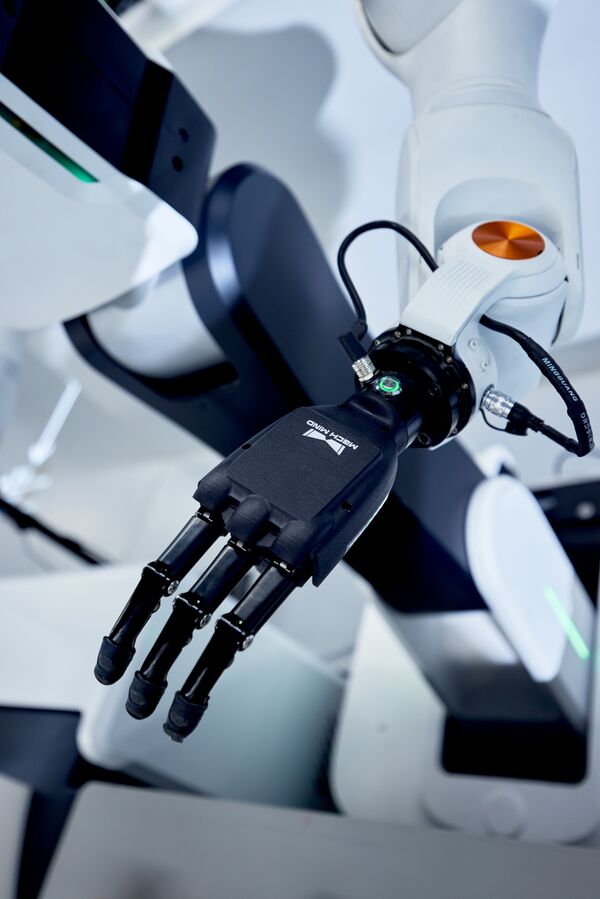
这听起来或许微不足道,但Matrix-3能胜任这项任务实属不易。在数十年的机器人研发历程中,人手的灵巧度和柔韧性一直是工程师们用机械结构最难复刻的特征之一。总部位于上海的Matrix Robotics(矩阵机器人)公司在今年早些时候推出这款机型时,特别强调每只手内置的27个电机协同工作。“最复杂的是手部”,参与开发Matrix-3的Matrix Robotics工程师Eric Xu(徐工,音译)表示。
This might sound trivial, but it’s a big deal that the Matrix-3 is up to the task. Over decades of robotics development, the dexterity and flexibility of the human hand has been one of the toughest things for engineers to match with machinery. When Matrix Robotics, based in Shanghai, rolled out this model earlier in the year, it emphasized the 27 motors in each hand working in harmony with each other. “The most complicated thing is the hands,” says Matrix Robotics engineer Eric Xu, who helped develop the Matrix-3.
据制造方介绍,Matrix-3能装箱、搬运约70磅(约32公斤)重物、做家务清洁、在客服前台工作,甚至能调制饮品。就在这次会议上,Xu身后的一台Matrix-3正为需要提神的与会者冲煮浓缩咖啡。
According to its makers, a Matrix-3 can pack boxes, lift and carry about 70 pounds, clean up around the house, work a customer service desk, even mix drinks. Just behind Xu at the conference, one is brewing espresso for attendees in need of a pick-me-up.
Matrix-3的零售价约为8.5万美元,目前已证明物有所值:第一局打平,我们都出了剪刀。我预感它第二局还会出剪刀,于是我只有一个选择。一、二、三……石头。
The Matrix-3 retails for about $85,000 and so far it’s proving its worth: Round 1 is a draw; we both opt for scissors. I have a feeling it’ll go for scissors again in Round 2, which leaves me just one option. One, two, three … rock.
机器人确实出了剪刀,所以我赢了。几名围观者鼓起掌来,机器人竖起大拇指,用普通话对徐某说了句什么。徐某笑了。“他说你运气好。”
The robot does indeed stick with scissors, so I win. As a few onlookers clap, the robot offers a thumbs-up and says something to Xu in Mandarin. Xu smiles. “He says you got lucky.”
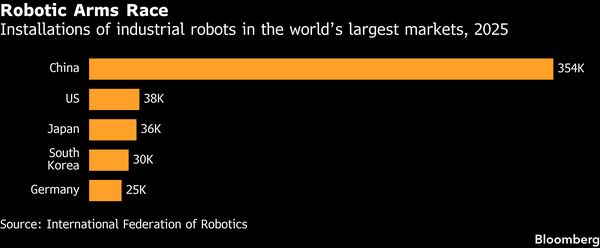
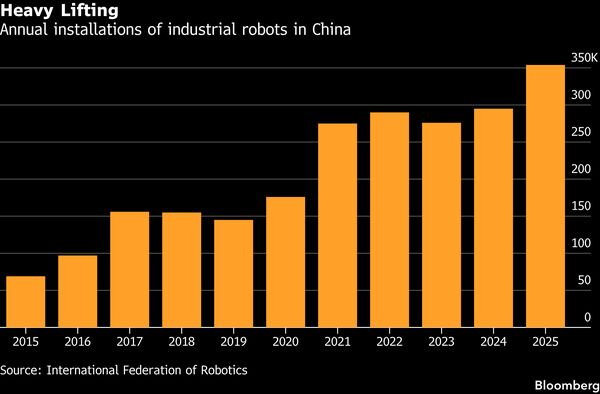
美国公司和投资者一直在向人工智能软件开发倾注数万亿美元,而中国则专注于主导与AI相关的硬件领域,从小工具到无人机,再到这些出奇地具有竞争力的机器人助手。最值得注意的是,中国公司正利用这种优势来放大其庞大制造基地的实力。根据国际机器人联合会的一份报告,中国现在是最大的机器人制造国和购买国,每年投入使用的新机器人数量超过世界其他国家总和。
While American companies and investors have been pouring trillions of dollars into the development of artificial intelligence software, China has focused on dominating AI-related hardware, from gadgets to drones to these oddly competitive robo-assistants. Most notably, Chinese companies are using that dominance to amplify the power of their massive manufacturing base. China is now the largest maker and buyer of robots, and the country is putting more new robots to work each year than the rest of the world combined, according to a report from the International Federation of Robotics.
中国公司如宇树科技、智元机器人和优必选主导着新兴的人形机器人市场,占据全球出货量的97%以上。如果说硬件之路不像OpenAI等公司的公开产品发布那样抢眼,但它对AI的商业前景同样至关重要。
Chinese companies like Unitree, AgiBot and UBTech dominate the emerging market for humanoid robots, accounting for more than 97% of global shipments. If hardware has been a less headline-grabbing path than public offerings from the OpenAIs of the world, it’s no less vital to the business case for AI.
“这是一种大脑与肌肉的对比路径,”布鲁克林学会研究员陈凯尔说,他最近曾就中国的AI战略在国会作证。“我不知道他们是否一直希望‘赢得AI竞赛’,但他们确实不想输。”十年前,当习近平政府首次推出国家AI发展规划时,中国的智能手机和平板电脑工厂已处于有利位置,可以开始为机器人未来做规划。但在那个时候创立了北京美智机器人公司的邵天蓝回忆起推销这一想法的挑战。
“There’s sort of a brains-versus-brawn approach,” says Kyle Chan, a fellow at the Brookings Institution who recently testified before Congress on China’s AI strategy. “I don’t know if they were always hoping to ‘win the AI race,’ but they really do not want to lose.”When Xi Jinping’s government first rolled out a national AI development plan a decade ago, China’s smartphone and tablet factories were well-positioned to begin planning for a robo-future. But Shao Tianlan, who founded robotics company Mech-Mind in Beijing around that time, recalls the challenge of selling the idea.
“我得向每个投资者解释为什么机器人需要大脑,”他笑着说。“现在不用了。”他表示,美国汽车制造商和制药公司都在其国际客户之列,但他不愿透露具体名字。
“I had to explain to every investor why robots need a brain,” he says with a smile. “Not anymore.”He counts US automakers and pharmaceutical companies among his international clients, though he wouldn’t name any.
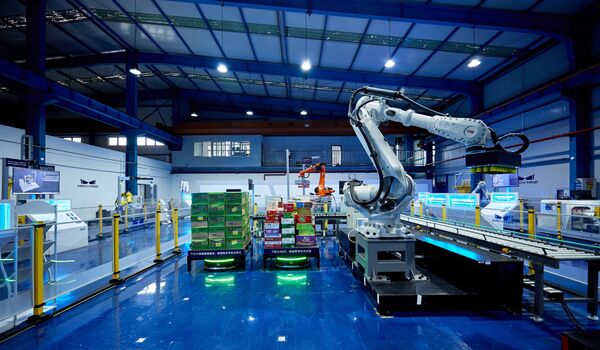
虽然机械化和机器人技术已在制造业应用数十年,但Mech-Mind(梅卡曼德)的机器将这一领域推进了好几步。在上海一间吵闹、大小堪比飞机库的展厅里快速走一圈,邵某便滔滔不绝地说出了我们眼前搬运箱子、分拣设备、拧螺栓、焊接金属板的机械臂,与之前几十年的机械化机械臂有何不同。传统工厂机器人只能精准执行单一任务,不允许有任何偏差,而Mech-Mind承诺其产品能在问题出现时识别并处理更广泛的问题。
While mechanization and robotics have been part of manufacturing for decades, Mech-Mind’s machines take things several steps further. During a quick lap around the company’s noisy, airplane-hangar-size showroom in Shanghai, Shao rattles off things that distinguish the robot arms we see moving crates, sorting equipment, screwing in bolts and soldering metal plates from the decades of mechanized arms that have come before. Whereas traditional factory robots are limited to performing one task precisely without deviations, Mech-Mind promises that its products can identify and deal with a broader range of issues as they arise.
例如,配备3D相机“眼睛”和AI驱动“大脑”的机械臂,能在箱子里筛选出特定螺栓,或拾起被碰倒的物品。邵某说,它在工作中也在学习。当它卡住或无法完成任务时,会记录发生的情况,供日后分析。
For example, a robotic arm equipped with a 3D camera “eye” and an AI-powered “brain” can sift through a box for a particular bolt or pick up an item that’s been knocked over. It’s also learning as it works, Shao says. When it gets stuck or can’t complete a task, it records what’s happening for later analysis.
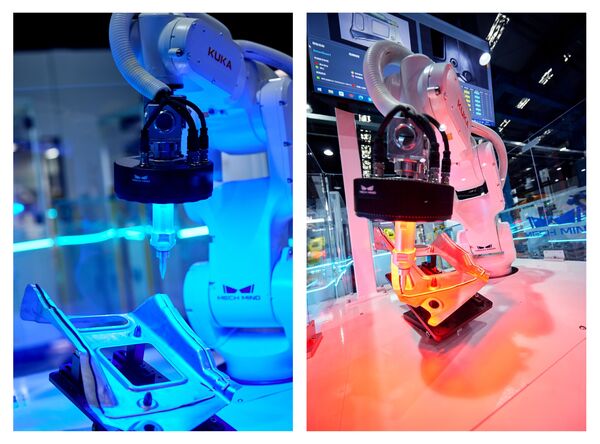
邵某在两台白色机械臂旁停下脚步,每台大约10英尺(约3米)高,粗细堪比汽车轮胎。两臂配合作业,吊起形状不规则的黑色金属板,小心翼翼地码放进大箱子里。这是全球汽车工厂和重型机械制造商常见的作业。据邵某介绍,这项工作危险且容易出错,因此这些机器人对潜在客户极具吸引力。他称Mech-Mind每年销售约1万台机器人:有的大如大象,能举起整辆汽车;有的小到能装进旅行袋,适合精细作业。但据邵某透露,公司的未来将更加安静,且更像我们人类。
Shao pauses next to two white robot arms, each roughly 10 feet high and as big around as a car tire. The arms work together, lifting irregularly shaped black metal plates and carefully arranging them inside of a large crate. This is a job done in auto factories and heavy machinery makers around the world. It’s also a dangerous task that’s easy to mess up, which makes these robots particularly impressive to potential clients, according to Shao. He says Mech-Mind sells around 10,000 robots a year: some as large as an elephant, able to lift entire cars into the air; others small enough to fit in a duffel bag, suited for detail work. But according to Shao, the future of the company is much quieter and looks more like us.
在展厅旁边一栋安静、洁白的建筑里,Mech-Mind 正在测试其人形机器人,邵总半开玩笑地称它们为“Mech 先生”。和 Matrix-3 一样,它们是哑光白配黑色面部。没有腿,但面部细节多了一些。嘴部位置是一个发光的绿色圆环,让每个机器人看起来都像是一脸惊讶。每个右眼是一个圆形的金色灯光,每个左眼则是一个摄像头镜头。
In a quiet, gleaming-white building adjoining the showroom, Mech-Mind is testing its humanoid robots, the Mr. Mechs, as he jokingly calls them. Like the Matrix-3, they’re matte white with black faces. They don’t have legs, but their faces have a bit more detail. There’s a glowing green donut where the mouth should be, which makes each robot look constantly surprised. Each right eye is a round, gold-colored light and each left eye is a camera lens.
机器人的躯干固定在跪姿上,安放在能在房间里滑行的大型方形平台上。如果需要够取高处的东西,机器人可以将身体向上伸展。邵总说,这些机器人是未来,注定要走进零售商和其他企业。“十年内,我非常有信心,智能机器人将无处不在,”他说。
The robots’ torsos are fixed in kneeling positions on large, square platforms that glide around the room. The robots can extend their bodies high into the air if they need to reach for something. These robots are the future, Shao says, destined for retailers and other businesses. “In 10 years, I’m quite confident smart robots are going to be everywhere,” he says.
一个演示机器人停在一整墙饮料和零食前。邵总在 iPad 上下单要一瓶可乐,机器人滑向货架,蹲下身,伸出一只纤细如骨架般的手抓起可乐,然后转身滑回到我们面前,轻轻把汽水放在柜台上。我夸赞它的灵巧,但邵总说,已经在路上的下一代机型,手部会强得多。快速迭代是中国 AI 硬件优势的一部分。这很大程度上得益于其非凡的供应链,包括超现代化的电网、中国花费数十年锁定的充足原材料储备,以及雄厚的工厂、熟练工人、设计师和工程师基础。
One demo bot is stationed in front of a wall of drinks and snacks. Shao punches in an order for a Coke on an iPad and the robot glides over to the shelves, crouches down, reaches out a slim, skeletal hand to grab the Coke, then swivels and glides back to us, placing the soda gently on the counter. I compliment its dexterity, but Shao says the next model’s hands, which are already on the way, will be much better. Iterating quickly is part of China’s AI hardware advantage. That has a lot to do with its extraordinary supply chain, including an ultramodern power grid and a ready stock of raw materials the country has spent decades locking down, along with a strong base of facilities, skilled workers, designers and engineers.
但尽管中国拥有诸多优势,该国仍面临一些严峻限制,最显著的是资金和芯片。“中国处于一个算力受到深度制约的环境中,”卡内基国际和平基金会中国项目联合主任斯科特·辛格说。“它没有足够的先进AI芯片来训练真正先进的模型。”目前,美国基本控制着全球芯片市场,并让中国处于一种受限状态。中国AI初创企业也缺乏获取那种似乎源源不断的投资资金的渠道,正是这些资金帮助美国AI公司成为地球上估值最高的企业之一。
But for all of China’s advantages, the country faces some formidable limitations, most notably money and chips. “China operates in a deeply compute-constrained environment,” says Scott Singer, co-director of the China Initiative at the Carnegie Endowment for International Peace. “It doesn’t have enough advanced AI chips to train really advanced models.”Right now, the US essentially controls the global chip market, and it has put China on a restrictive diet. Chinese AI startups also lack access to the seemingly endless investment dollars that helped American AI companies become some of the most highly valued businesses on earth.
“在美国,目前对AI有一种近乎救世主般的、有远见的看法,”布鲁金斯学会的陈某说。“存在一种对技术的超验式信仰。”至少曾经如此。近期对AI的担忧已使中美两国的投资放缓。
“In the US, there’s this almost messianic, visionary take on AI right now,” says the Brookings Institution’s Chan. “There is this sort of transcendental belief in technology.”At least, there was. Recent worries about AI have slowed investment in both the US and in China.
中国对待AI的方式更侧重产业应用。AI和机器人已相当深度地融入其经济的许多领域,包括农业、国防和医疗保健,医生利用AI审查病历、辅助诊断并监测不良药物相互作用。在一些地方,机器人也是日常生活的一部分。在我下榻的上海一家酒店大堂,一台机器人咖啡师制作了一杯卡布奇诺;另一台机器人从移动小卖部向我售出一瓶水;还有一台机器人沿着高档购物中心的走廊跟在我身边,吸尘、躲避购物者,并播放一段小曲子。
China’s approach to AI has been more industry-minded. AI and robots are already quite integrated into many sectors of its economy, including agriculture, defense, and healthcare, where doctors use AI to review patient records, suggest diagnoses and watch for adverse drug interactions. In some places, robots are also a part of everyday life. In the lobby of my hotel in Shanghai, a robot barista whipped up a cappuccino; another robot sold me a bottle of water out of a mobile bodega; still another trundled next to me down the hallway of a high-end shopping mall, vacuuming up dirt, dodging shoppers and playing a little tune.
有由机器人服务的餐厅和爵士俱乐部,也有可租赁用于体力劳动的机器人。“中国一直高度专注于将AI融入其所谓的实体经济,”辛格说。换句话说,致力于当下提振经济产出,而非追逐那统御一切的唯一超级智能。
There are restaurants and jazz clubs staffed by robots, and rent-a-robots available for manual tasks. “China has been heavily focused on integrating AI into what it calls the real economy,” says Singer. In other words, working to boost economic output now, rather than chasing the one superintelligence to rule them all.
至于初创企业的终局:“上市并不需要背负巨大的估值压力,”邵说,“每家公司的规模都要小得多。”梅卡曼德于9月上市,目前估值约13亿美元。宇树于8月上市,截至11月16日估值约430亿美元——以中国标准衡量规模很大,但远不及美国AI公司动辄万亿美元以上的估值。邵表示,尽管相对利害如此,中国投资者仍施压要求展示一条非常快速的盈利路径。
As for the startup endgame: “There’s no pressure to have a huge number attached to you if you go public,” says Shao. “The scale of each company is much, much smaller.”Mech-Mind went public in September and is now valued at about $1.3 billion. Unitree went public in August and is valued at about $43 billion as of Nov. 16 — large by China’s standards, but nowhere near the trillion-plus valuations coming from US-based AI companies. The relative stakes notwithstanding, there’s pressure from Chinese investors to show a very quick path to profit, Shao says.
“他们想知道你今年或明年能部署多少台机器人。”那么,这场伟大的AI竞赛中谁在赢?布鲁金斯学会的陈说,这个问题问错了。“这更像是共生关系,”他说,“两国彼此需要。”美国依赖中国的数据中心零部件、稀土和原材料,更不用说把AI技术装入设备和硬件所需的硬件——这些设备和硬件将使AI在我们的工作和生活中占据越来越大的比重。
“They want to know how many robots you can deploy this year or next year.”So who’s winning the great AI race? Wrong question, says Brookings’ Chan. “It’s more symbiotic,” he says. “The two countries need each other.”The US is dependent on data center components, rare earths and raw materials from China, not to mention the hardware needed to put the AI technology into the devices and hardware that will make it a bigger and bigger part of our work and lives.
与此同时,中国则日益依赖美国的技术进步和芯片,以及来自美国投资者、消费者和企业的资金。
China, meanwhile, is increasingly counting on US technological advancement and chips, as well as money from US investors, consumers and businesses.
离开上海前,邵给我看了一条能响应自然语言指令的机械臂原型。一顶草帽俏皮地挂在它正上方的一个挂钩上,机械臂悬停在一个装满碗、积木和塑料农产品的箱子之上。邵在连接的键盘上输入请求:“你能请在每个碗里放一个鸡蛋吗?”机器人开始工作时,我问为什么要说“请”。
Before I leave Shanghai, Shao shows me a prototype robotic arm that can respond to natural language commands. While a straw hat playfully hangs from a peg just above it, the arm hovers over a bin full of bowls, blocks and plastic produce. Shao types his request into a connected keyboard: “Can you please put an egg into every bowl?”As the robot goes to work, I ask why the “please.”
“哦,我每次都跟机器人说‘请’,”邵带着浅浅的微笑说,“以防有一天它们统治世界。”
“Oh, I say ‘please’ to the robot every time,” Shao says, with a slight smile. “In case someday they rule the world.”