保罗·德库齐(PAOLO DECUZZI)数十年来致力于让微型装置发挥重大作用。这位生物医学工程师任职于热那亚的意大利技术研究所,发明了一系列纳米技术,旨在更有效地输送药物。为将这些发明转化为可用的医疗手段,他长期与美国科学家合作,参与由美国国家卫生研究院(NIH)——全球最大的生物医学研究资助机构——资助的项目。
PAOLO DECUZZI has spent decades trying to get tiny devices to do big things. The biomedical engineer, based at the Italian Institute of Technology in Genoa, has devised an assortment of nanotechnologies that aim to deliver drugs more effectively. To turn these inventions into working medical treatments, he has long collaborated with American scientists on projects funded by the National Institutes of Health (NIH), the largest funder of biomedical research in the world.
但去年,NIH突然暂停了一项研究,该研究旨在探究德库齐博士发明的一种微型板将药物直接输送至关节炎关节的效果。他估计,另一项面向癌症患者的研究因此倒退了长达两年。
But last year the NIH abruptly suspended an investigation to study a microscopic plate Dr Decuzzi had invented to deliver drugs directly into arthritic joints. He estimates that another one, intended for cancer patients, was set back by as much as two years.
许多研究人员经历过类似情况。在截至2024年9月的财年中,NIH向3600名合作的外国科学家提供了约4亿美元资助。这仅占该机构发放的近350亿美元拨款的一小部分,却成为特朗普政府广泛削减NIH项目时的一个容易下手的目标。结果是,美国资助国际研究的体系已被掏空。
Many researchers have experienced something similar. In the fiscal year ending September 2024 the NIH gave an estimated $400m to 3,600 collaborating foreign scientists. It was a fraction of the nearly $35bn in grants the agency doled out, but an easy target for the Trump administration as it cut NIH projects broadly. The result is that America’s system for funding international research has been gutted.
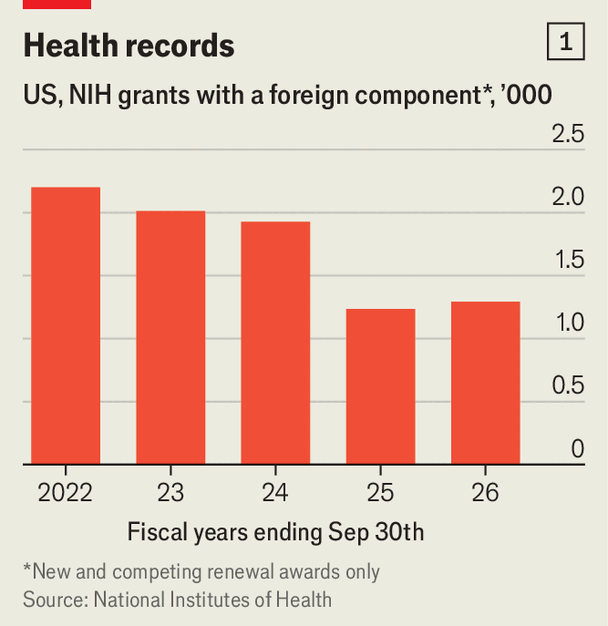
《经济学人》在匿名条件下获得的大量NIH内部数据显示了这一变化的规模。在2022至2024财年,该机构每年平均向包含外国成分的项目授予2040项拨款。2025和2026财年的平均值降低了38%(见图表1)。政府在追求透明度和问责制的过程中,扰乱了宝贵的科学研究,并使支出更加难以捉摸。
Extensive internal NIH data shared with The Economist on the condition of anonymity shows the scale of the change. In the fiscal years 2022-2024 the agency awarded an average of 2,040 grants a year to projects with foreign components. The average for 2025 and 2026 was 38% lower (see chart 1). In its pursuit of transparency and accountability, the administration has disrupted valuable science and made spending more inscrutable.
尽管美国在科学领域占据主导地位,但有些资源在国内不易获取。例如,德库齐博士的微粒无法现成购买。对罕见病开展临床试验,往往需要招募病例更常见国家的患者。
For all of America’s science dominance, some resources cannot easily be found at home. Dr Decuzzi’s microparticles, for example, cannot be bought off the shelf. Conducting clinical trials on rare diseases often requires enrolling patients from countries where cases are more common.
此类合作长期以来一直受严格条件约束,至少在纸面上如此。然而,现有指导方针在2025年5月被打破,当时美国国家卫生研究院(NIH)禁止美国大学利用一项既定计划将拨款资金转拨给海外合作伙伴。已获得资助的项目可继续进行,但等待下一年度分期拨款的项目被暂停,直至次年春季。一年多来,NIH实际上切断了资助新的国际研究合作的渠道。
Such collaborations have long been governed by strict conditions, at least on paper. The existing guidelines were blown apart in May 2025, however, when the NIH barred American universities from using an established scheme to pass grant money to their overseas partners. Projects that already had funding could continue, but those waiting for their next yearly instalment were suspended until the following spring. For over a year, the NIH essentially shut off its means of funding new international research partnerships.
这项改革的设计者是杰伊·巴特查里亚,他于2025年4月起领导NIH。他也是新冠病毒实验室泄漏假说的积极支持者,该假说主张病毒源自中国武汉病毒研究所。(美国国家情报委员会得出结论,尽管信心较低,认为自然起源的可能性更大。)该实验室此前曾获得NIH资助,这让巴特查里亚博士感到担忧。“目标”,他在2025年接受福音派杂志《今日基督教》采访时表示,“是让那些外国合作建立在更稳固的基础上,以免武汉事件再次发生”。
The architect of this overhaul is Jay Bhattacharya, who has led the NIH since April 2025. He is also a vocal proponent of the covid lab-leak hypothesis, which contends that the virus escaped from the Wuhan Institute of Virology in China. (America’s National Intelligence Council has concluded, albeit with low confidence, that a natural origin was more likely.) The lab had previously received NIH funding, which troubles Dr Bhattacharya. “The goal”, he said in a 2025 interview with Christianity Today, an Evangelical magazine, is “to put those foreign collaborations on more solid footing so that a Wuhan situation never happens again”.
对监管的担忧并非毫无根据。疫情发生后,武汉研究所拒绝与其美国研究合作伙伴配合,导致调查人员无法获取NIH资助研究的记录,而这些记录本有助于确定病毒起源。2023年,国会监督机构政府问责局(GAO)发现,NIH“未采取近期措施管理”与资助海外研究相关的风险,并提出了建议,该机构随后据此采取了行动。
Concerns about oversight are not unfounded. After the pandemic the institute in Wuhan refused to co-operate with its American research partner, leaving investigators unable to retrieve records of NIH-funded research that could help establish the virus’s origins. In 2023 the Government Accountability Office (GAO), a congressional watchdog, found that the NIH “had not taken near-term steps to manage risks” associated with funding research abroad, and made recommendations that the agency then acted on.
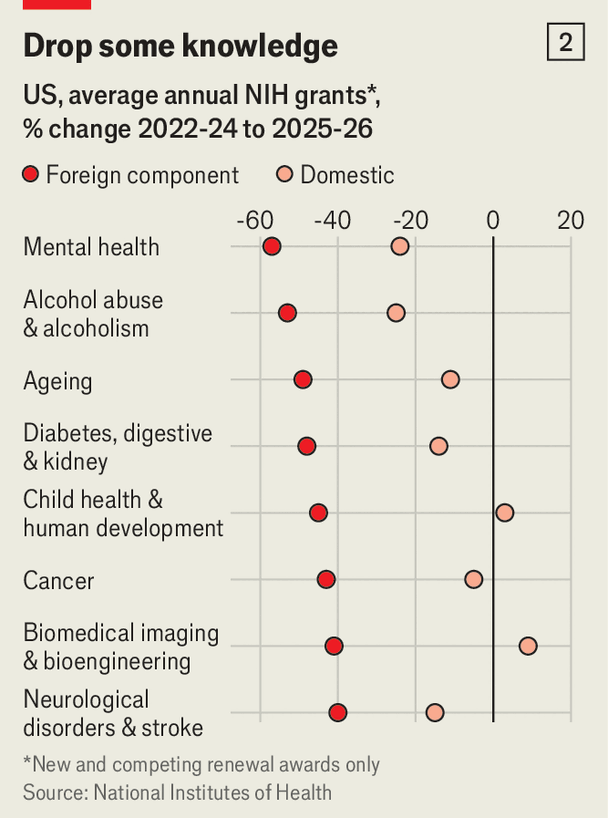
特朗普政府走得更远。尽管外国拨款在NIH奖项中所占比例很小,但它们遭受的打击却不成比例。在国家老龄化研究院,带有外国成分的拨款下降了49%,而国内拨款仅下降11%。在儿童健康研究院和生物医学成像研究院,外国拨款下降均超过40%,而国内奖项却略有上升(见图表2)。新的大型项目资助几乎完全停止。金额在500万美元或以上且包含外国成分的拨款,从2022年至2024年的年均20项骤降至2026年的仅3项。
The Trump administration has gone much further. Although foreign grants make up a small share of NIH awards, they have suffered disproportionately. At the National Institute on Ageing grants with a foreign component fell by 49%, compared with 11% for domestic grants. At both the children’s health and biomedical imaging institutes foreign grants declined by over 40% even as domestic awards rose slightly (see chart 2). Funding of new large projects has all but stopped. Grants of $5m or more that include a foreign component fell from an average of 20 from 2022 to 2024 to just three in 2026.
削减几乎波及每一个研究院,但研究传染病和心理健康的机构项目数量降幅最大。《经济学人》的分析显示,标题提及非洲、临床试验、儿童、母亲、艾滋病毒或“衰老与痴呆”的拨款数量,大约只有前三年平均水平的一半。
The reductions cut across nearly every institute but those studying infectious diseases and mental health saw the largest drop in the number of projects. The Economist’s analysis reveals that the number of grants whose title mentions Africa, clinical trials, children, mothers, HIV or “ageing and dementia” was roughly half that of the average during the previous three years.
对于德库齐博士而言,这种混乱意味着多年的博士后学生流失、发现速度放缓以及文书工作增加。“一旦我们摧毁了这些东西,重建实际上非常困难,”他感叹道。对其他人来说,后果更为严峻。在加州大学洛杉矶分校研究艾滋病毒的流行病学家德沃拉·约瑟夫·戴维长期与开普敦大学有合作关系。2025年5月,美国国立卫生研究院撤回了她的国际资助,迫使她终止了一项临床试验。
For Dr Decuzzi the chaos means years of lost postdoctoral students, slower discoveries and more paperwork. “Once we have destroyed things, rebuilding is actually very difficult,” he laments. For others the consequences have been grimmer still. Dvora Joseph Davey, an epidemiologist studying HIV at the University of California in Los Angeles, has long been affiliated with the University of Cape Town. In May 2025 the NIH pulled her international funding, forcing her to end a clinical trial.
她一直在研究如何最好地预防艾滋病毒在孕妇和哺乳期妇女中传播,在该国,育龄妇女中约有20%感染了该病毒。研究参与者随后失去了获得暴露前预防药物的机会,这是一种能将艾滋病毒感染风险降低99%的药物。她研究中的两名停药女性被感染,其中一人将病毒传染给了婴儿。巴特查里亚博士称这一案例“令人遗憾”,但表示资助暂停后确保患者护理是研究人员的责任。
She had been investigating how best to prevent HIV transmission among pregnant and breastfeeding women in a country where roughly 20% of women of reproductive age have the virus. Study participants subsequently lost access to PrEP, a kind of drug that reduces the risk of HIV infection by 99%. Two women in her study who stopped taking the drug became infected and one of them transmitted the virus to her baby. Dr Bhattacharya calls this case “unfortunate”, but says that ensuring patient care following a grant suspension is the researchers’ responsibility.
与《经济学人》共享的内部数据未按国家列出支出情况,但资助项目标题显示,南非受到的冲击尤为严重。2022年至2024年间,标题中包含“南非”的新外国资助项目年均为18项。2026年这一数字降至1项。非营利组织“Grant Witness”单独进行的一项分析表明,受资助研究的重点也在发生变化。对比资助项目发现,2025年和2026年共有184份资助项目摘要删除了关于非洲的表述。
The internal data shared with The Economist do not identify spending by country, but grant titles suggest that South Africa has been hit particularly hard. Between 2022 and 2024 a yearly average of 18 new foreign grants contained South Africa in their title. In 2026 that figure dropped to one. A separate analysis by Grant Witness, a non-profit, suggests that the focus of funded research is also changing. A comparison of grants shows that references to Africa had been removed from 184 grant abstracts in 2025 and 2026.
南非研究人员还因特朗普先生指责南非政府对布尔人实施“白人种族灭绝”而陷入与其政府的争端。2025年2月,特朗普先生暂停了对南非的美国援助,美国国立卫生研究院(NIH)将这一限制解释为也适用于其研究资助。直到2026年8月,巴特查里亚博士才宣布NIH资助项目获豁免,但这对许多项目(如约瑟夫·戴维博士的项目)来说为时已晚。
Researchers in South Africa have also been tangled up in Mr Trump’s dispute with their government over allegations of a “white genocide” against Afrikaners. In February 2025 Mr Trump halted American aid to South Africa, a restriction the NIH interpreted as applying to its research grants, too. It was not until August 2026 that Dr Bhattacharya announced that NIH grants were exempt, though that came too late for many projects, like Dr Joseph Davey’s.
目前,对国际研究网络的破坏比监管改进的成效更为切实可见。在以往的体系下,外国资助的大部分日常监管工作由美国大学及其庞大的合规官员、律师和承包商队伍承担。一位不愿具名的前大学校长(负责研究事务)承认,各机构的尽职程度差异巨大。他们认为,更好的做法是要求所有大学更严格地执行监管,并在其失职时追究责任。
The damage to international research networks is so far more tangible than the improvements to oversight. Under the previous system much of the quotidian monitoring of foreign grants fell to American universities and their armies of compliance officers, lawyers and contractors. A former university vice president for research, speaking on the condition of anonymity, acknowledged that institutions’ diligence varied enormously. A better approach, they argue, would have been to demand more rigour from all universities and hold them accountable when they fell short.
相反,NIH剥夺了大学执行合规的主要手段:对资金的控制权。巴特查里亚博士表示,外国机构正在“建立其满足美国监管要求的能力”。他认为,这一变革将使NIH专业人员能够接管大学原本承担的监管负担。
Instead the NIH has stripped universities of their primary means of enforcing compliance: control of the purse. Dr Bhattacharya says that foreign institutions are “building up their capacity to comply with American oversight requirements”. The change, he argues, will allow NIH professionals to take the oversight burden away from universities.
具体如何操作仍不清楚。纽约福特汉姆大学法学教授多尼·布卢姆菲尔德表示:“美国国立卫生研究院没有详细的调查文化或执法能力。”与此同时,美国国立卫生研究院各地的工作人员认为,新制度增加了文书工作,同时激励申请人寻找漏洞。一位项目官员表示:“这一切只是让人们尽量减少、重新描述或完全隐藏外国参与。我们的监管将会大幅减少。”■
How exactly this would be done remains unclear. “The NIH does not have a detailed investigatory culture or enforcement capacities,” says Doni Bloomfield, a law professor at Fordham University in New York. Meanwhile, staff across the NIH argue that the new system has increased paperwork while incentivising applicants to find loopholes. “This is all just making people minimise, recharacterise or completely hide foreign involvement,” says one programme officer. “We are going to get dramatically less oversight.” ■