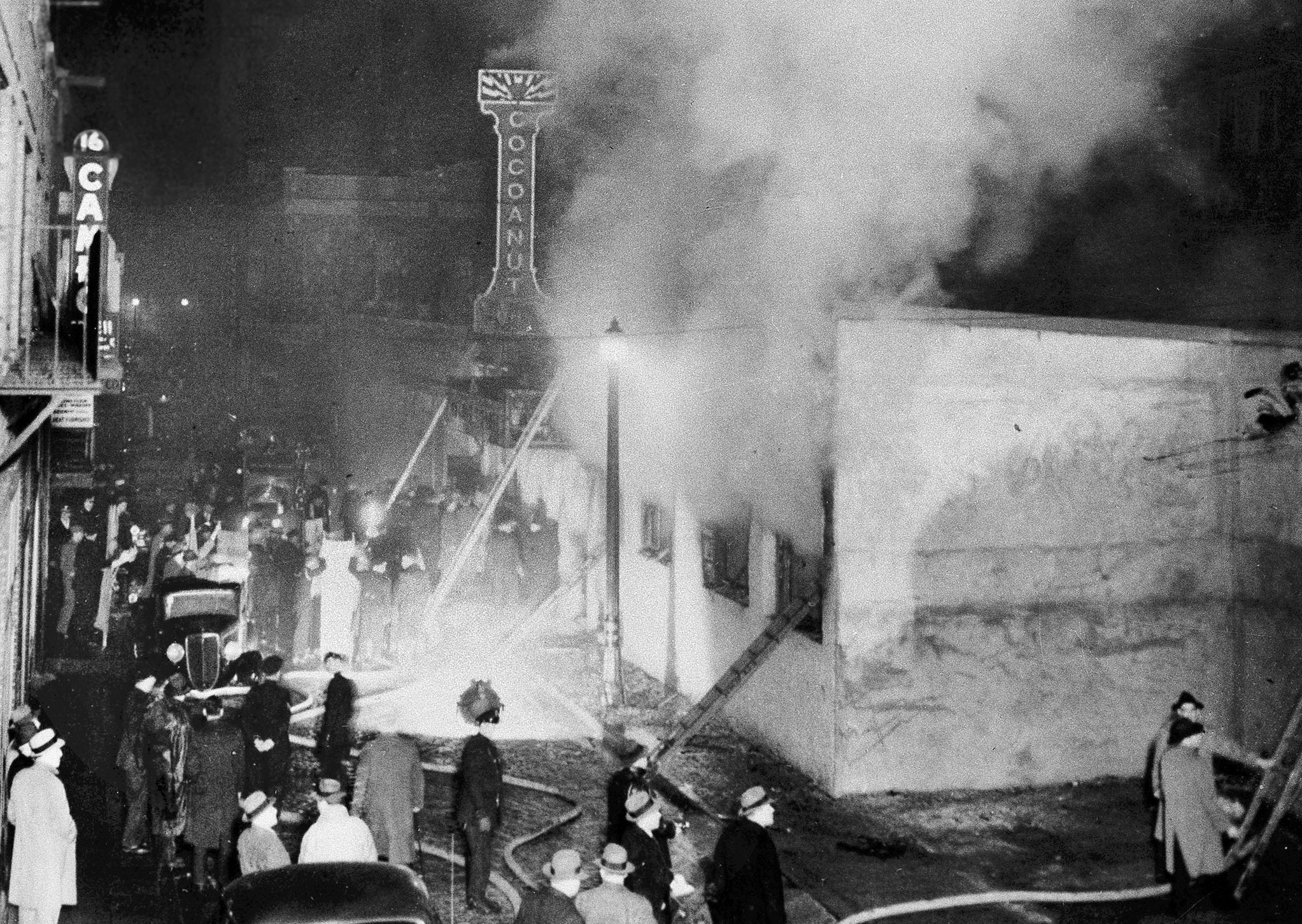
1942年11月28日,浓烟从波士顿后湾区的椰林夜总会涌出。(美联社)84年前的周六,如果你有幸在椰林夜总会的纸质热带装饰起火后被拉出,你能否在至今仍是美国最致命夜总会大火中幸存,很大程度上取决于你被送往哪家医院。
The nation's deadliest nightclub fire was a proving ground for effective burn treatments. Smoke pours from the Cocoanut Grove nightclub on Nov. 28, 1942, in the Back Bay section of Boston. (AP) If you had been fortunate enough to have been pulled from the Cocoanut Grove after its papery tropical decor caught flame 84 years ago Saturday, your chances of surviving what’s still the nation’s deadliest nightclub fire would have depended in large part on the hospital to which you were sent.
在波士顿市立医院,烧伤患者接受的是当时治疗烧伤的标准疗法——并承受了标准的死亡率。但在马萨诸塞州总医院,代理外科主任奥利弗·科普尝试了不同的方法。
At Boston City Hospital, burn victims received the then-standard treatment for burn wounds — and suffered the standard mortality rate. But at Massachusetts General Hospital, Oliver Cope, the acting chief of surgery, tried something different.
1942年11月28日晚,估计有1000人挤进这座波士顿场所,人数超过其合法容纳量的两倍多,大火随即爆发。(如果波士顿学院那天赢了橄榄球赛,人群会更多,灾难可能更严重。我们稍后再谈这一点。)大火从地下室的“旋律休息室”迅速蔓延到主楼层,建筑面积相当于一个街区。惊慌的顾客挤堵在前门的旋转门处。其他9个出口中有6个被锁上,显然是为了防止客人逃单。有些门藏在窗帘后面,或者向内开,在蜂拥的人群面前毫无用处。消防员不得不砸墙才能接近受害者。
An estimated 1,000 people, more than double the Boston venue’s legal capacity, had packed the building on the evening of Nov. 28, 1942, when the fire broke out. (The crowd would have been larger, and the disaster likely still greater, had Boston College won its football game that day. We’ll get back to that.) The flames spread quickly from the basement Melody Lounge to the main level of the building, the size of a city block. Panicked patrons jammed the front entrance revolving door. Six of the nine other exit doors were locked, apparently to prevent guests from skipping out on their tabs. Some doors were behind curtains, or opened inward, useless before a stampeding crowd. To get to the victims, firefighters had to break through walls.
一份救护车召集令不仅引来市内,还引来郊区和军事基地的响应。市政府官员警告医院将有大量伤亡。
A call for ambulances drew responses from not only the city but also suburbs and military installations. City officials warned the hospitals of mass casualties.
他们已做好准备。自去年12月日本偷袭珍珠港将美国卷入第二次世界大战以来,波士顿市立医院和马萨诸塞州总医院均制定了应对更多袭击的应急预案,据马萨诸塞州总医院称 。两家医院均获得拨款用于研究烧伤,并储备了物资。波士顿市在前一个周末刚演练过灾难应对。
They were ready. Since the Japanese bombing of Pearl Harbor the previous December drew the United States into World War II, both Boston City and Mass General prepared emergency plans for more attacks, according to Mass General . Each received grant money to study burn injuries, and laid in supplies. The city of Boston had rehearsed a disaster response only the weekend before.
被送往波士顿市立医院的“椰林”夜总会火灾受害者中,有114人在周日早晨仍然存活。
Of the Cocoanut Grove victims taken to Boston City that Saturday night, 114 were alive Sunday morning.
首先,他们被注射吗啡,这是一种强效阿片类药物,但对于极其痛苦、有时甚至致命的标准疗法来说,这几乎杯水车薪。
First, they were administered morphine, a powerful opiate that was hardly sufficient for the excruciating, sometimes lethal standard treatment.
每位扭曲挣扎的患者都需要多人按住,才能让医生继续操作。医生切除并刮除烧伤水泡和坏死组织,随后涂抹鞣酸。
Multiple people were required to hold each writhing patient still enough for the doctors to proceed. They cut and scraped away burn blisters and dead tissue. Then they applied tannic acid.
目的是将存活的皮肤变成耐感染的“皮革”。即使治疗成功,康复也需数月,毁容性疤痕将永久留存。接受此疗法的“椰林”受害者中,仍有三分之一死亡。
The goal was to turn the surviving skin into an infection-resistant leather. Even when successful, recovery took months. The disfiguring scars were permanent. A third of the Cocoanut Grove victims so treated still died.
被送往马萨诸塞州总医院的受害者中,有39人熬过了第一个夜晚。哈佛医学院外科教授科普看到了机会。自珍珠港事件以来,他一直在思考烧伤治疗,并假设一种疗法可能比鞣酸法创伤更小——且可能更有效。
Of the victims taken to Mass General, 39 survived the first night. Cope, a professor of surgery at Harvard Medical School, saw an opportunity. He’d been thinking about burn wounds since Pearl Harbor, and had hypothesized a treatment that would likely be less traumatic than tanning — and possibly more effective.
在他的指导下,患者被给予青霉素,这是该抗生素的早期应用之一,用于预防细菌感染。随后,他们的伤口被涂有凡士林的纱布包裹,无需刮除或鞣制,任其自然愈合。
Under his direction, patients were given penicillin, an early use of the antibiotic, to protect against bacterial infection. Then their wounds were wrapped in petroleum jelly-infused gauze, not scraped or tanned, and left to heal.
疗效显著:所有39名患者均存活出院,这种所谓的“软疗法”成为新的标准。二战期间,该疗法用于盟军士兵,并在随后几十年中进一步改进。
It worked: All 39 patients survived to discharge, and the so-called soft treatment became the new standard. It was used for Allied soldiers during the war and further refined in the ensuing decades.
“活着被送到波士顿市立医院和马萨诸塞州总医院的171名受害者,成为了烧伤治疗史上最全面临床试验的受试对象,”作者芭芭拉·拉维奇在《烧伤病房:大火之后的生命拯救》一书中写道。“新疗法被尝试,旧方法被摒弃,烧伤研究未来25年的议程由此确立。”
“The 171 victims who made it alive to Boston City and Mass General hospitals became subjects in the most comprehensive clinical trial in the annals of burn treatment,” author Barbara Ravage wrote in Burn Unit: Saving Lives After the Flames . “New ideas were tried, old methods discarded, and the agenda for burn research was set for the next quarter century.”
即使有了治疗上的突破,仍有492人因大火丧生,超过了椰林俱乐部460人的法定容纳人数。
Even with the treatment breakthrough, 492 people, more than the Cocoanut Grove’s legal capacity of 460, died as a result of the fire.
情况本可能更糟。波士顿学院老鹰队当时战绩8胜0负,高居全国第一,原定当晚在该场所庆祝不败赛季。但他们在当天下午被宿敌圣十字学院以55比12大比分横扫,遭遇大学橄榄球史上最惊人的冷门之一,全国冠军梦碎,随即取消了庆祝活动。
It could have been worse. The B.C. Eagles, 8-0 and ranked first in the nation entering the day, had planned to celebrate an undefeated season at the venue that night. But they were stunned that afternoon by archrival Holy Cross in one of college football’s greatest upsets, a 55-12 rout at Fenway Park that dashed their national championship hopes. They canceled the party.
椰林俱乐部老板巴内特·“巴尼”·韦兰斯基于1943年因19项非预谋杀人罪被判有罪。该案确立了商业主未能履行对顾客应尽的注意义务可被追责。他被判处12至15年监禁,但因患癌在服刑四年后获释,不久后去世。
Barnet “Barney” Welansky, the Cocoanut Grove’s owner, was convicted in 1943 of 19 counts of involuntary manslaughter. The case established that a business owner could be held accountable for failing to meet an appropriate duty of care to his customers. He was sentenced to 12 to 15 years in prison but released after four with cancer and died a short tine later.
这场大火及其后果还推动了消防法规和执法的改革,并促进了对悲伤创伤和创伤后应激障碍的理解。
The fire and its aftermath led also to reforms in fire codes and enforcement, and advances in the understanding of grief and post-traumatic stress disorder.
哈佛医学院的杰弗里·C·施奈德和科琳·M·瑞安医生在2013年撰文指出,虽然这场大火“灾难性”,但它“尽管如此,仍成为推动研究与创新的引擎,此后挽救的生命远超逝去的生命——这是对遇难者及一生被改变者最恰当的纪念”。
While it was “catastrophic,” physicians Jeffrey C. Schneider and Coleen M. Ryan wrote for Harvard Medical School in 2013, it “nonetheless served as an engine for research and innovation that has since saved many more lives than were lost — a fitting memorial” to those who died or whose lives were forever changed.
《华盛顿邮报》不定期推出的《照片年鉴》系列,通过查阅照片档案,回顾过去,以了解当下所在。
Photo Almanac is an occasional series from The Washington Post, using photo archives to understand where we are today by examining where we’ve been.