东京否认支持克隆战斗犬,但确实资助神经毒剂解毒剂和猪胚胎基因编辑。
Tokyo denies backing cloned combat hounds, but it does fund nerve-agent antidotes and pig-embryo gene edits.
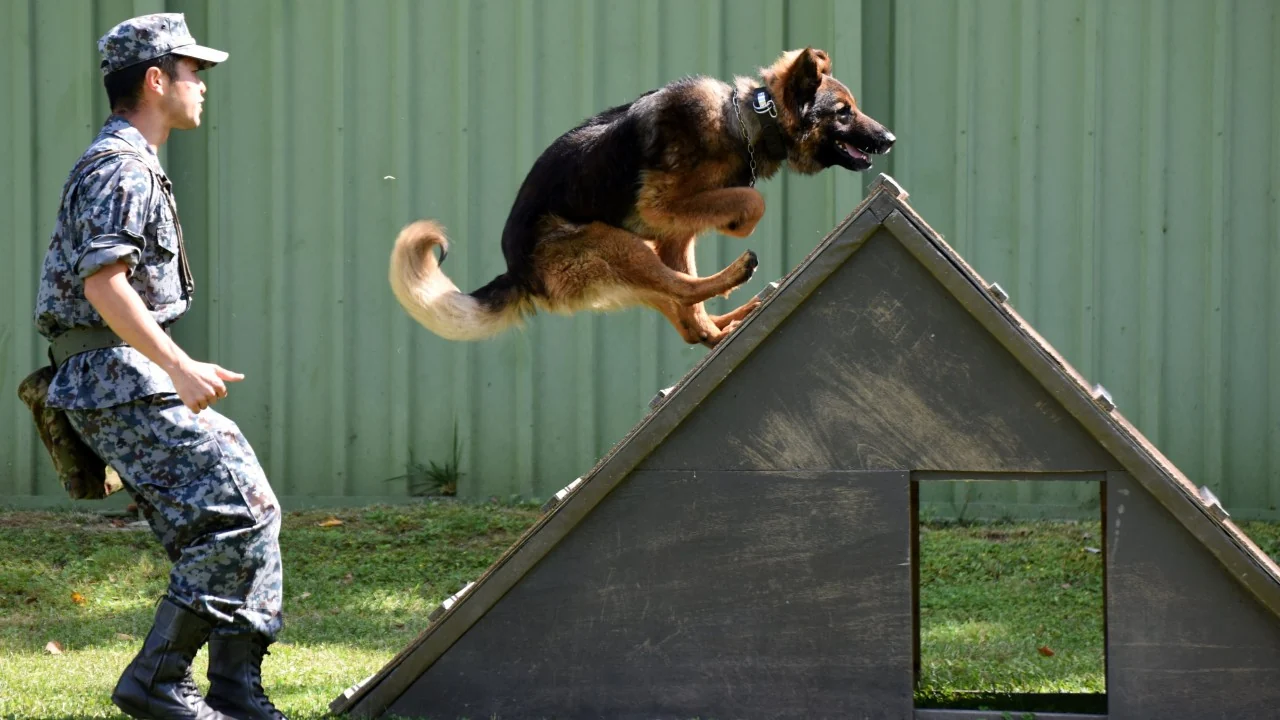
2017年,日本航空自卫队一名队员在北海道一处航空基地训练军犬。图:法新社一场关于基因改造军犬的争议在日本引发,紧迫地提出了这样一个问题:东京的生物技术防护措施能否跟上步伐,是否适应人工智能时代。
A member of Japan’s Air Self-Defence Force trains a security dog at an air base in Hokkaido prefecture in 2017. Photo: AFP A row over genetically modified military dogs in Japan has raised urgent questions about whether Tokyo’s biotech safeguards can keep pace and are fit for the AI age.
防卫大臣小泉进次郎本月否认其省正与一家美国公司合作开发基因编辑军犬,他在11月5日于国会表示,对此“完全没有”考虑。
他是在回应一名在野党议员的提问,该议员询问了一张近期重现网络、引发强烈反弹的社交媒体照片。
Defence Minister Shinjiro Koizumi denied this month that his ministry was working with a US company to develop gene-edited military dogs, telling parliament on November 5 that he was not considering it “at all”.
这张照片拍摄于去年,画面显示小泉进次郎与帕尔默·拉基握手。拉基是美国防务科技公司Anduril Industries的联合创始人,也是位于得克萨斯州、为军方和执法部门克隆及基因编辑犬只的初创公司Warhound的核心人物之一。
He was responding to an opposition politician who asked about a recently resurfaced social media photo that had sparked a backlash. The picture, taken last year, shows Koizumi shaking hands with Palmer Luckey, co-founder of US defence tech company Anduril Industries and one of the brains behind Warhound, a Texas-based start-up cloning and gene-editing dogs for the military and law enforcement.
日本防卫大臣小泉进次郎于2025年12月与美国防务公司Anduril Industries的帕尔默·拉基握手。图:X/shinjirokoiz当被追问防卫省对这类基因工程军犬的立场时,小泉进次郎显得明显恼火,称该问题“完全是对事实的误解”,并要求提问者“准确陈述事实”。
Japanese Defence Minister Shinjiro Koizumi shakes hands with Palmer Luckey of US defence company Anduril Industries in December, 2025. Photo: X/shinjirokoiz When grilled on the ministry’s position on such genetically engineered military dogs, a visibly irritated Koizumi called the question “a complete misunderstanding of the facts” and demanded that his interlocutor “state the facts accurately”.
这一否认平息了围绕这张照片持续数周的舆论哗然,该照片拍摄于2025年12月。日本歌手兼动物权益倡导者坂本美雨助推了舆论发酵,她转发了该照片及基因编辑犬的新闻,表达强烈反对。
The denial capped weeks of social media outcry over the photo, which was taken in December 2025. Japanese singer and animal rights advocate Miu Sakamoto helped fan the flames, sharing the photo alongside news of the gene-edited dogs to voice her strong opposition.
“我无法抑制我的愤怒,”她在10月26日的帖子中写道。“仅仅为了让它们去杀人,就通过改变基因来玩弄生命。怎么能丧失人性到这种程度?”
“I cannot contain my anger,” she said in her post on October 26. “Toying with life by altering dogs’ genes just to use them to kill human beings. How can anyone lose their humanity to this extent?”
几天内,日本社交媒体上充斥着对 Warhound 活动伦理性的愤慨,以及对防卫省是否介入的猜测。
Within days, Japanese social media was awash with anger over the ethics of Warhound’s activities and speculation about the defence ministry’s involvement. ### Pigs and poisons
猪与毒物日本防卫省或许未涉足基因工程军犬研发,但确实通过其装备技术厅(ATLA)资助一系列先进研究,其中包括生物技术领域,并将部分项目公布在其网站上。
Japan’s defence ministry may not be involved in genetically engineering war dogs, but it does fund a wide range of advanced research, including on biotechnology, through its Acquisition, Technology and Logistics Agency (ATLA), which publishes some of its projects on its website .
过往项目涵盖电磁轨道炮、高能激光系统、长航程水下无人机、微型制导导弹系统以及可穿戴脑活动监测仪。
Past projects have included rail guns, high-energy laser systems, long-endurance underwater drones, miniature guided missile systems and wearable brain-activity monitors.
目前由 ATLA 资助的生物医学项目包括:自治医科大学开展的为人体移植而进行的猪胚胎基因编辑研究,以及信州大学一个团队正在研发的治疗技术,旨在直接在血液中解毒有机磷化合物——这类化合物既存在于农药中,也存在于某些神经毒剂中。
Biomedical projects currently being funded by ATLA include work on gene-editing pig embryos for human transplants at Jichi Medical University and a therapeutic technology being developed by a team at Shinshu University to detoxify organophosphorus compounds, found in both pesticides and some nerve agents, directly in the bloodstream.
本周亚洲向日本防卫医科大学校研究所及四所参与 ATLA 项目的大学的科学家发出采访请求,均未获回复。
This Week in Asia contacted Japan’s National Defence Medical College Research Institute and scientists at four universities involved in ATLA projects but received no replies.
一只微型猪在东京一家动物咖啡馆内被拍摄。日本防卫省正在资助为人体移植而进行的猪胚胎基因编辑研究。图:美联社东洋英和女学院大学生物技术安全与生物武器不扩散教授木和田纪和子表示,日本的防护措施主要旨在防范实验室或研究设施中的危险病原体。
A micro pig pictured at an animal cafe in Tokyo. Japan’s defence ministry is funding research on gene-editing pig embryos for human transplants. Photo: AP Kiwako Tanaka, a professor of biotechnology security and biological weapons non-proliferation at Toyo Eiwa University, said Japan’s safeguards had primarily been designed to protect against dangerous pathogens in laboratories or research facilities.
但她表示,随着人工智能和合成生物学(即在实验室环境中设计和构建新的生物部件、装置和系统,如改良微生物)近期取得的飞跃,管控可能被用于军事用途的生物技术研究的规则面临过时的风险。
But the rules for policing biotechnology research that could be put to military use were at risk of becoming outdated, she said, amid recent leaps in artificial intelligence and synthetic biology, or the designing and building of new biological parts, devices and systems, such as modified microbes, in a laboratory setting
“研究病原体特性以治疗或预防传染病对公共卫生至关重要,”田中说。“然而,从这类研究中获得的知识和技术也有可能被滥用,用于增加病原体危害性的目的。”
“Researching the properties of pathogens to treat or prevent infectious diseases is of paramount importance to public health,” Tanaka said. “However, there is also the possibility that the knowledge and technologies gained from such research could be misused for purposes that increase the danger posed by pathogens.”
一名化学研究人员在东京一所大学的实验室内。专家称,日本管控可能被用于军事用途的生物技术研究的规则面临过时的风险。 化。
A chemistry researcher at a university laboratory in Tokyo. Japan’s rules for policing biotech research that could be put to military use are at risk of becoming outdated, experts say. Photo: AFP
“这并非说现行体系完全无效,但我认为,仅靠现有监管框架不足以应对快速演变的生物能力,”田中说。
Against that backdrop, she said Japan’s conventional biosecurity measures needed an update to also cover digital information, research processes and changes in what biology could do.
大东文化大学专门研究军事问题的国际关系教授加伦·马洛伊表示,日本在国防研究方面落后于其他国家,目前正在追赶。
“This is not to say that the current system is completely ineffective, but I do not believe that existing regulatory frameworks alone are sufficient to cope with rapidly evolving biological capabilities,” Tanaka said.
“日本正在为此投入大量精力,”他说,并补充称,日本“相当公开”地进行研究,“这与美国、中国、俄罗斯和朝鲜大量秘密开展的工作形成对比”。
Garren Mulloy, a professor of international relations at Daito Bunka University who specialises in military issues, said Japan had lagged behind other nations in defence research and was now playing catch up.
“正在开展的这类研究属于防御性质,意味着他们正在竞相研发应对潜在生物危害的对策,”马洛伊说。他引用了俄罗斯对持不同政见者、叛逃者以及乌克兰军队使用放射性和化学制剂的有据可查的案例,还有其涉嫌的进攻性生物武器计划。
“Japan is putting a lot of effort into this,” he said, adding it was “being quite open” about its research “in contrast to the extensive work that is being done in secret in the US, China, Russia and North Korea”. “The sort of research that is being carried out is defensive, meaning that they are racing to develop responses to potential biohazards,” Mulloy said, citing Russia’s documented use of radiological and chemical agents against dissidents , defectors and Ukrainian troops , as well as its suspected offensive biological weapons programme.
2006年,俄罗斯持不同政见者亚历山大·利特维年科在伦敦被放射性钋-210毒杀身亡。十二年后,一名英国妇女在针对前俄罗斯军事情报军官谢尔盖·斯克里帕尔的一次失败暗杀行动中接触神经性毒剂“诺维乔克”而死亡,斯克里帕尔及其女儿在暗杀未遂中幸存。
Alexander Litvinenko, a Russian dissident, was fatally poisoned in London in 2006 with radioactive polonium-210. Twelve years later, a British woman died after exposure to the nerve agent Novichok following a bungled hit on Sergei Skripal, a former Russian military intelligence officer, who survived the attempt along with his daughter.
亚历山大·利特维年科在被俄罗斯特工用放射性钋-210毒害后躺在病床上。他数日后去世。图:美联社马洛伊说,新冠疫情促使日本加强生物医学研究。他说,直到2023年下半年,日本没有一家国内药企生产出有效的新冠疫苗,一度只能依赖最初稀缺的进口疫苗。
Alexander Litvinenko pictured in his hospital bed after being poisoned with radioactive polonium-210 by a Russian agent. He died days later. Photo: AP Mulloy said the Covid-19 pandemic had prompted Japan to step up biomedical research. No domestic drug maker had produced an effective Covid vaccine until the latter half of 2023, he said, leaving the country reliant for a time on initially scarce imports.
他说,对美国——曾被视为危机时刻的可靠盟友——未来是否会伸出援手的疑虑,更增加了紧迫感。
Doubts about whether the United States, once seen as a dependable ally in times of crisis, would come to Japan’s aid in future had added to the urgency, he said.
药物还是武器?田中表示,修订日本国家生物安全战略的目标,是在保留技术红利的同时,限制滥用和事故带来的危险,“不必要地阻碍其发展”。
Medicine or weapon? The aim of revising Japan’s national biosecurity strategy would be to limit the dangers posed by misuse and accidents while keeping the benefits of the technology “without unnecessarily hindering its development”, Tanaka said.
她指出,生物技术推动了医学和药物研发的进步,但“两用”知识也伴随风险。
Biotechnology had brought advances in medicine and drug discovery, she said, but “dual-use” knowledge also carried risk.
两用是指为和平目的(如研究病原体以治疗疾病)而开展的工作,也可能被滥用,使其更具危险性。
Dual-use refers to work done for peaceful purposes, such as studying a pathogen to treat disease, that can also be misused to make it more dangerous.
她说:“光靠政府制定法规是不够的,光靠研究人员和企业依赖自身的自愿举措也不够。”
“It’s not enough for the government to simply put regulations in place, nor is it enough for researchers and companies to rely solely on their own voluntary initiatives,” she said.
“研究人员监测科技趋势、企业开发和提供技术、政府负责制定政策,这三方持续共享信息并评估风险至关重要。”
“It’s essential that researchers monitoring trends in science and technology, companies developing and providing technologies and the government, responsible for policymaking, continuously share information and assess risks.”
版块:本周亚洲 / 健康与环境 / 政治 / 新闻 / 亚洲 / 东亚 | 话题:日本、科学、俄罗斯、美国、小泉进次郎、Anduril Industries短链接: 阅读SCMP原文
Sections: This Week in Asia / Health & Environment / Politics / News / Asia / East Asia | Topics: Japan, Science, Russia, United States, Shinjiro Koizumi, Anduril Industries Short link: https://sc.mp/wjlz7 Read the original article on SCMP