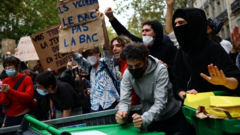
亨利·阿斯蒂埃 23分钟前自9月下旬以来,法国各地的学生纷纷举行抗议活动,反对教育经费不足,并封锁了众多高中的出入口。
Henri Astier 23 minutes ago Since late September students across France have been holding protests against underfunding in education, and have been blocking access to many high schools.
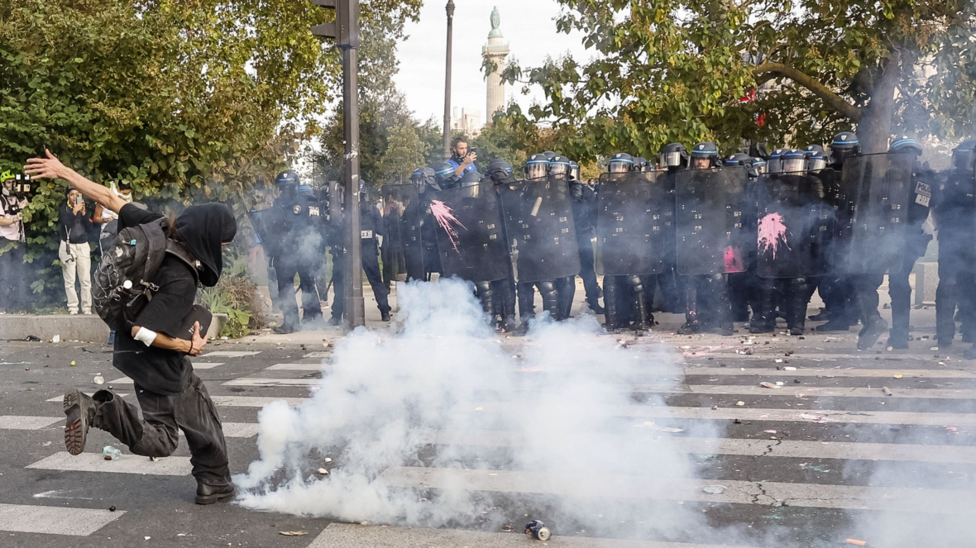
这场运动在某些地区演变成了暴力冲突:数百名学生、教师及警察受伤,数千人被捕,其中包括数量不明的外部煽动分子。
The movement has turned violent in places – hundreds of students, teachers and police officers have been injured. Thousands of people – including an unknown number of outside troublemakers – have been arrested.
抗议者抱怨国内高中师资短缺、设施破旧。这些高中主要招收15至18岁的学生。
The protesters are complaining about staff shortages and dilapidated facilities in the country's lycées, schools which are attended by 15-18-year-olds.
周二,在全法各地爆发大规模示威活动时,巴黎学生玛达莱娜对BBC表示:“有时我们的老师会连续数周缺席且无人替补。”她还称,近期热浪来袭时,学校校舍内“热得如同蒸笼”。
"Sometimes our teachers are absent for several weeks without being replaced," Madalena, a Paris student, told the BBC on Tuesday as demonstrations brought out hundreds of thousands across France . Her school buildings, she added, were "boiling hot" during the recent heat waves.
抗议者的不满还涉及其他方面:有人反感学校禁止携带手机的规定,也有人不满上课时间延至晚上6点。“晚上7点才到家,根本没时间睡觉或做作业,”一名高中生对法国电视二台说道。
There is a variety of other complaints. Some resent the banning of mobile phones or school days that last until 18:00. "You get home at 7 pm, and have no time to sleep or do your homework," one lycéen told France 2.
负责分配大学入学名额的法国在线平台“Parcoursup”同样是引发不满的焦点。
France's online platform that allocates places in higher education, Parcoursup, is another sore point.
这种不满情绪由来已久:如今约80%的毕业生都能通过高中毕业会考,从而获得大学入学资格——尽管未必能进入心仪的专业。这导致热门专业名额竞争激烈,而许多学生认为“Parcoursup”的录取机制不透明,由此产生焦虑情绪。
The frustration has deep roots. About 80% of each cohort now passes the baccalauréat, which entitles students to a university place - though not necessarily their preferred choice. This leads to a scramble for desirable courses, and an anxiety focused on Parcoursup, which many regard as opaque.
这些不满确实存在。但它们能否单独解释此次抗议运动的具体形式?法国与其他国家相比情况又如何呢?
Those grievances are real. But do they by themselves explain the form the protest movement has taken? How does France compare with other countries?
根据经合组织(由发达国家组成的国际组织)近期发布的报告,法国政府在每位高中生身上的教育投入高于欧盟同类学校的平均水平。
According to a recent report by the OECD, a club of developed nations, the French government spends more per lycée student than the EU average for upper-secondary schools.
师资短缺现象确实严重,但与其他国家相比并无更糟情况。按经合组织的标准衡量,法国的空缺教师岗位数量反而更少;不过法国教师的薪资水平相对偏低。
Teacher shortages are indeed acute, but no worse than elsewhere. By OECD measures they are actually milder – fewer posts go unfilled – although French teachers receive relatively low pay.
对于法国学生来说,那些持续到下午晚些时候的学校上课时间确实是个问题。造成这一现象的主要原因是漫长的午餐休息时间以及复杂的课程安排,而非法国的假期时间本身(与其他欧盟国家相比,法国的假期时间其实并不长)。
Schooldays that stretch into the late afternoon are indeed a problem for French pupils. This is the result mostly of long lunch breaks and complex schedules rather than making up for holidays, which are not especially long compared with other EU countries.
这种“延长上课时间”的做法长期以来一直是法国学校教育体系中的一个负面现象;不过,这很难解释当前学生抗议活动的规模为何会如此之大。同样,教育体系本身的低效或运作不畅所造成的压力,也无法完全解释这一现象的根源。
The extended day has always been a sad fact of French school life and can hardly account for the present eruption. Neither can pressure created by a dysfunctional higher-education system.
在大多数欧洲国家,80%至90%的年轻人能够完成中等教育;而在这些国家,争夺优质大学入学名额的压力同样会导致学生产生压力。
In most European countries, 80-90% of young people complete secondary education, and competition for good university places creates stress elsewhere too.
虽然资金不足、校舍破旧以及对未来的担忧是学生不满情绪的根源,但这些因素本身并不能解释为什么这次抗议活动在参与学校数量、学生人数以及暴力程度方面都达到了“前所未有的水平”(正如内政部长洛朗·努涅斯所说)。
And while underfunding, dilapidated buildings and fears about the future are behind the students' discontent, those complaints do not by themselves explain why the movement has become "unprecedented" in terms of the number of schools, pupils and the degree of violence involved, in the words of Interior Minister Laurent Nuñez.
在周二的抗议活动中,约有500人被逮捕。这些抗议活动的规模尤其引人注目,因为参与者们都在承担着巨大的风险:通过威胁或暴力手段封锁学校或大学的行为是违法的,这会引发警方的介入;同时,一些破坏公物的捣乱者也会参与其中,导致学生卷入警方的高强度人群控制行动中。
About 500 people were arrested during Tuesday's unrest The scale of protests is all the more remarkable as those involved are taking considerable risks. Blockading a school or university by threats or force is illegal, and draws in police, as well as casseurs (vandals), and pupils have become caught up in police crowd-control operations that are often heavy handed.
总理塞巴斯蒂安·莱科努在最新声明中强调,安全部队仅被授权执行法律,而非与高中生发生冲突。
Prime Minister Sébastien Lecornu, in his latest message, has insisted security forces are not under orders to "confront high-school students", only to enforce the law.
要理解学生的抗议策略,就必须超越那些被封锁的学校大门,去审视法国的政治传统。在法国,权力往往既存在于民选机构中,也存在于街头——学生们对此再清楚不过了。
To understand the pupils' tactics, one must look beyond the barricaded school gates to a political tradition. In France, the power has often resided on the street as much as in elected bodies. Students know this as well as anyone else.
1990年10月,巴黎北部塞纳-圣但尼区(Seine-Saint-Denis)一所学校发生的强奸案成为引发大规模抗议活动的导火索。学生们抗议学校资金不足和师资短缺的问题。最终,政府为当地的高中学校拨款了约12亿欧元(按现行货币价值计算)。
In October 1990, a rape at a school in Seine-Saint-Denis – an area north of Paris that has been a focus for the present unrest – was the trigger for mass rallies against underfunding and staff shortages. It resulted in the government releasing the equivalent of €1.2bn (£1bn) in today's money for lycées.
1998年10月,又有50万名学生走上街头,提出类似诉求;这促使政府拨款近10亿欧元用于学校翻新,并额外招聘了1.4万名教师。
In October 1998, 500,000 pupils marched across France over similar demands, resulting in almost €1bn to renovate schools and 14,000 extra staff.
在多次抗议活动中,学生们成功阻止了政府的改革计划——例如1986年的大学改革方案以及1994年降低青年最低工资的举措。那么,为什么法国会暂停对抗议者使用眩晕手榴弹呢?
On several occasions student protests defeated government reforms – such as a university overhaul in 1986 and a lower youth minimum wage in 1994. Why has France suspended the use of stun grenades on protesters?
2006年可能是学生力量最显著的一次体现:当时政府试图通过一项法律来放宽26岁以下年轻人的雇佣和解雇规定,以缓解青年失业问题。然而,在大学和高中发生的多次暴力抗议活动后,这项法律最终被废除了。这些抗议活动显示:学生群体确实具有强大的影响力。
Probably the most striking display of student power came in 2006, with the withdrawal of a law designed to loosen hire-and-fire rules for those under 26 to try to tackle youth unemployment. The measure, passed by parliament and signed by then-President Jacques Chirac, was scrapped after weeks of blockades in universities and lycées often marred by violence.
2018年至2019年的“黄背心运动”(gilets jaunes)更是将这种影响力推向了高潮——全国各地的商店遭到洗劫,政府建筑也遭到袭击。这场运动迫使政府放弃了提高燃油税的计划,并同意投入10亿欧元用于社会福利支出。
French adults have shown how blockading roads can prevail over elected officials. The gilets jaunes (yellow vests) uprising of 2018-2019 – which saw shops ransacked and government buildings attacked across the country – led the government to drop a rise in fuel taxes and approve €10bn in spending.
不过,街头抗议并不总能取得决定性胜利。1968年的学生运动虽然被视作法国所有抗议活动的典范,但实际上是通过选举才平息的。如今的学生抗议者继承了一种政治传统:他们与政府官员竞争,试图证明自己才是人民的合法代表。
The street does not always win. In 1968 – a heroic precedent cited by every French protest movement – a student uprising was actually brought to an end by election. But the lycéens are heirs to a political culture in which demonstrators compete with elected officials to be seen as the legitimate voice of the people.
从表面上看,当前的权力平衡似乎有利于学生一方。根据BMFTV的一项民意调查,72%的法国人认为学生的诉求合法,55%的人支持他们的抗议活动。在许多教师、工会和左翼政治家的支持下,抗议者们处于有利地位。他们计划于周四下午再次举行集会。
On the face of it, the current balance of power favour the pupils. A poll for BMFTV suggests that that 72% of French people regard their demands as legitimate and 55% support the movement. Backed by many teachers, labour unions and left-wing politicians, the protesters are on the front foot. Another rally is planned for Thursday afternoon.
勒科努将难以获得政府所需的资金支持;相比之下,政府的实力却从未如此薄弱。埃马纽埃尔·马克龙执政九年之后,已成为一位极不受欢迎的政治人物——他已被禁止参加六个月后举行的总统选举。
Lecornu will find it difficult to open the purse strings The government, by contrast, has never been weaker. After nine years in power, Emmanuel Macron is a deeply unpopular lame duck, barred from standing in the presidential election due in six months' time.
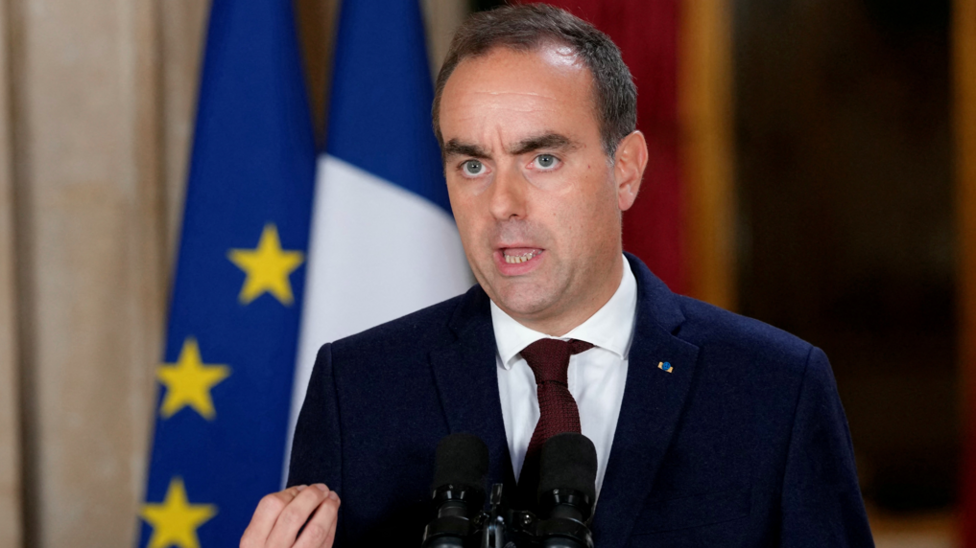
他决定在2024年6月提前举行大选,这导致议会陷入了僵局。勒科努自称为“有史以来最无能的总理”,似乎根本无法在议会中通过任何预算案。
His decision to call a snap election in June 2024 has resulted in a hopelessly gridlocked assembly. Lecornu has described himself as the "weakest prime minister" in living memory and seems unlikely to get a budget through parliament.
然而,这种“软弱”反而可能成为他与学生抗议者对抗时的优势。面对不断上升的借贷成本、占GDP 5.4%的财政赤字以及自20世纪40年代以来最高的公共债务水平,勒科努在财政和政治上都陷入了困境。
But that very weakness could prove an asset in his showdown with students. Faced with rising borrowing costs, a deficit of 5.4% of GDP and a public debt at its highest level since the 1940s, Lecornu is financially as well as politically hamstrung.
与那些曾受到街头抗议者强烈压力的前任们不同,勒科努已经没有任何可以用来应对危机的资源或手段了……
Unlike his predecessors under intense pressure from the street, he has nothing to give. France