赛义斯·德米斯·哈萨比斯表示,他创立谷歌DeepMind的初衷是打造“科学的终极工具”。在这些年里,DeepMind的研究成果曾九次登上《自然》杂志 。起初,这些成果主要体现在人工智能本身的突破上,但近年来其更多成功则来自于将人工智能应用于其他科学领域。例如,其蛋白质折叠模型AlphaFold使赛义斯·德米斯在2024年获得了诺贝尔奖的一份奖金。
SIR DEMIS HASSABIS says he started Google DeepMind to create “the ultimate tool for science”. In the years since, DeepMind’s research has graced the cover of Nature nine times. At the beginning that was for breakthroughs in AI itself, but its more recent successes have come from applying AI to other areas of scientific endeavour. Its protein-folding model AlphaFold, for example, earned Sir Demis a share of a Nobel prize in 2024.
DeepMind的竞争对手也在追赶。今年秋季,OpenAI通过首先解决一个具有里程碑意义的千年难题,随后在一天内发表超过300个未解问题的解答(见关于人工智能在数学领域的报道),重塑了数学的格局。Anthropic的首席执行官达里奥·阿莫迪在9月宣布,该公司利用其Claude模型发现了一种可能取代CRISPR基因编辑技术的后继者,并承诺AI驱动的生物学正处于“指数趋势”之中。
DeepMind’s peers are catching up. This autumn, OpenAI reshaped the terrain of mathematics, first by solving a landmark Millennium Prize problem and then by publishing solutions to more than 300 open questions in a single day (see story on AI in maths). Dario Amodei, Anthropic’s boss, declared in September that the company had discovered a potential successor to CRISPR, a gene-editing technique, using its Claude model, promising that AI-powered biology is on an “exponential trend”.
更小的实验室也在加入这一行列:2024年,总部位于东京的研究团队Sakana AI推出了一款“AI科学家”,其创作者声称该系统能够完成撰写一篇科学论文所需的全部任务。今年3月,Sakana在《自然》杂志上发表的一篇经过同行评审的文章中报告称,该AI科学家撰写的一篇论文通过了顶级人工智能会议初审——这一关卡曾让近三分之一的人类撰写论文无法通过。
Smaller labs are joining in: in 2024 Sakana AI, a Tokyo-based research group, unveiled an “AI scientist” which its creators claimed could complete all the tasks required to write a scientific paper. In a peer-reviewed article published in Nature this March, Sakana reported that the AI scientist wrote a paper which passed the first round of peer review for a top-tier AI conference—a hurdle which defeated almost a third of the human-written papers.
此类工作起初得到了更广泛科学界的欢迎。但随着AI驱动发现的步伐日益加快,许多研究者开始感到不安。令研究者不安的部分原因在于,AI公司不仅仅是在提供发现工具,而是选择亲自使用这些工具。这种情况很不寻常:AI公司通常愿意将其服务售卖给从会计事务所到媒体机构的各种客户,而自身并不进入这些行业运营。那么,为什么在科学领域的情况会如此不同?
Such work was initially welcomed by the broader scientific establishment. But the growing pace of AI-powered discovery has put many on edge. Part of what unnerves researchers is the extent to which AI companies are not merely providing a tool for discovery but choosing to wield it themselves. This is unusual: AI companies are content to sell their services to everyone from accountancies to media outlets without operating in those industries themselves. Why, then, is the situation so different with science?
实验室的说法意味着,他们认为推动科学前沿本身就是一件好事——或者更愤世嫉俗地说,只是一件值得被看作好事的事情。许多大型人工智能公司的科学工作被宣传为纯粹为了研究而研究。正如德米斯·哈萨比斯告诉《经济学人》杂志的那样,他之所以设定如此崇高的目标,是因为他想“理解宇宙中正在发生的事情”。对所有优秀科学家而言,实际应用几乎只是次要的。
What the labs say implies that they see pushing the frontiers of science as simply a good thing to be doing—or, more cynically, a good thing to be seen doing. Much of the scientific work at the biggest AI companies is promoted as research for its own sake. Sir Demis’s lofty goals came about, he told The Economist, because he wanted “to understand what’s going on here in the universe”. Practical applications, as for all good scientists, were almost secondary.
DeepMind的同行也传递着同样的信息。“我们确实真心关心这项事业,”OpenAI首席研究官马克·陈说道,他驳斥了公司科学工作只是企业慈善的指责。正如陈先生所说,该公司许多研究人员在进入企业部门之前本来就是科学家或数学家,他们仍然渴望新发现的美感。
DeepMind’s peers echo the message. “We just genuinely care about this endeavour,” says Mark Chen, OpenAI’s chief research officer, dismissing accusations that the company’s scientific efforts are corporate philanthropy. Many of the company’s researchers were scientists or mathematicians before moving to the corporate sector, says Mr Chen, and they still yearn for the beauty of a new discovery.
不过,盈利前景也并非无益。由德米斯·哈萨比斯创立的DeepMind衍生公司同构实验室(Isomorphic Labs)就是典型例子。该公司旨在利用DeepMind的技术开发用于癌症、心血管和免疫疾病的新型疗法。它已经研发出自己的技术——AlphaFold 3的更新版本,该技术能够对生化反应发挥作用,正如其前身对蛋白质折叠所做的那样(参见关于人工智能在生物学中的报道)。如果这一赌注成功,那么当其正在开发的17种候选分子被全球制药公司转化为真正的药物时,同构实验室将开始展现财务回报。
The prospect of profit doesn’t hurt, though. Isomorphic Labs, a spin-out of DeepMind founded by Sir Demis, is the exemplar. The company seeks to use DeepMind’s technology to develop novel therapies for cancers, as well as cardiovascular and immune conditions. It has developed its own technology, an updated version of AlphaFold 3, with the ability to do for biochemical reactions what its predecessor did for protein folding (see story on AI in biology). If the gambit pays off, then Isomorphic will begin to show a financial return as its candidate molecules, of which it has 17 under development, begin to be turned into real medicines by pharmaceutical companies around the world.
尽管赞誉和利润是强大的动机,但它们只是故事的一部分。人工智能实验室如此热衷于投资科学的真正原因很可能是,这是改进其模型的最佳途径。
Praise and profits, strong motives though they are, are only part of the story. The real reason AI labs are so keen to invest in science is probably because it is the best way to improve their models.
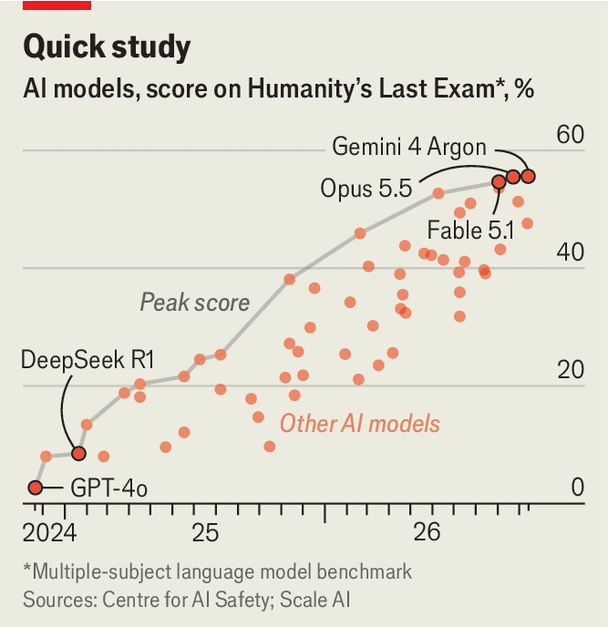
在大型语言模型(LLMs)早期,科学能力曾是用于测试模型如何超越前代模型的基准之一。但那项测试的难度并不超过高中科学测验。相比之下,如今最优秀的模型能够处理研究生水平的问题,在“人类最后一场考试”上得分略高于50%——这是一项覆盖所有领域、设计得尽可能难的知识型测验(见图表)。
In the early days of large language models (LLMs), scientific aptitude was one of the benchmarks used to test how models surpassed their predecessors. But that test was no trickier than a high-school science quiz. Today’s best models, by contrast, are capable of handling postgraduate level questions, scoring a little over 50% on “humanity’s last exam”, a quiz spanning all domains designed to be as hard as a knowledge-based test can be (see chart).
这种快速进步意味着AI实验室正在耗尽用于测试模型的数据。下一步的逻辑选择是让AI模型自行进行新颖研究。“科学和数学”,谷歌DeepMind科学团队负责人Pushmeet Kohli表示,“充当了游乐场,是我们赋予AI的宏大挑战,以推动创新。”数学中的未解问题尤其有价值,因为它们的答案可以被形式化地证明和验证。AI发展的前沿依赖于一种被称为“可验证奖励的强化学习”的技术。
This rapid progress means AI labs are running out of data on which to test their models. The logical next step is for AI models to do novel research themselves. “Science and mathematics”, says Pushmeet Kohli, the head of Google DeepMind’s science team, “act as the playground, the grand challenges that we give to AI to drive innovation.”Unsolved questions in mathematics are particularly valuable, since their answers can be formally proven and verified. The frontier of AI development relies on a technique known as “reinforcement learning with verifiable rewards”.
实验室通过在数学等具有客观正确答案的领域中给AI模型布置任务,并在其成功时给予奖励来训练模型。有猜测认为,OpenAI最近倾倒的数学论文可能是此类训练过程的副产品,而非为自身目的而产出的研究。“为这个未解问题提供形式证明”可能是人类所能提供的最具挑战性的可验证任务。
Labs train AI models by giving them tasks in domains like mathematics, which have objectively correct answers, and reward them for success. There has been speculation that OpenAI’s latest dump of maths papers may be the by-product of one such training run, rather than research produced for its own sake. “Provide a formal proof of this unsolved problem” could be the hardest verifiable challenge humanity has to offer.
然而,将模型推向数学领域的世界领先水平,并不一定意味着它们在其他任务上会更胜任。反复处理科学问题可能使AI系统的智能仍然更具“锯齿状”特征——即在某些领域表现出超人类潜力,而在其他领域则犯可笑的错误(尽管频率可能低于以前)。根据一位实验室内部人士的说法,具备科学超智能的AI模型是否会 subsequently 发展出通用能力,是一个“存在性”问题,其后果将影响人类的未来。
Pushing models to be world-leading in mathematics, however, does not necessarily mean they will be more competent at other tasks. Churning through scientific problems may make the intelligence of AI systems still more “jagged”, meaning they show superhuman potential in some domains while making laughable errors in others (if less frequently than they once did). Whether AI models with scientific ultra-smarts go on to develop general competency is an “existential” question, according to one lab insider, with ramifications for the future of humanity.
有理由认为,以这种方式训练的模型的智能可能没有预期的那么不均衡。OpenAI 的陈先生引用了人工智能科学的“苦涩教训”:即体积更大、架构更简单的系统最终往往比那些为了辅助专门化而添加繁复结构的系统表现更好。根据首次使用该短语的人工智能研究员 Rich Sutton 的说法,从国际象棋到语音识别的人工智能系统,在研究人员停止试图规定其模型应如何处理任务之后,表现得到了提升。
There are reasons to think the intelligence of models trained this way may be less jagged than expected. Mr Chen, of OpenAI, invokes the “bitter lesson” of AI science: that bigger, architecturally simpler systems turn out to be better than ones with baroque additions designed to aid specialisation. According to Rich Sutton, the AI researcher who first used the phrase, AI systems in domains from chess to speech recognition got better once researchers stopped trying to dictate how their models should approach the task.
最近的研究印证了这一点。上海交通大学 Yong Liu 领导的初步研究发现,在不进行微管理的情况下训练系统折叠蛋白质,似乎也使它们在其他方面表现得更好。阿里巴巴开源的 Qwen AI 的一个版本,在蛋白质折叠相关的问题和答案上进行训练后,在空间、图形、科学和一般推理等方面表现出了增强的能力。
Recent work bears that out. Preliminary research led by Yong Liu from Shanghai Jiao Tong University found that training systems—without micromanagement—to fold proteins appears to make them better at everything else, too. A version of Alibaba’s open-source Qwen AI trained on questions and answers related to protein folding displayed improved capabilities in such areas as spatial, graph, scientific and general reasoning.
正如陈先生所说,OpenAI 如今是“苦涩教训信奉者”:该公司押注大注,认为构建适用于单一任务的模型的最佳方式,就是构建一个能够处理所有任务的模型。并非所有人都持这种观点。例如,DeepMind 在开发专门化模型方面取得了成功。
The upshot is that OpenAI is, Mr Chen says, “bitter lesson-pilled”: the company has bet big that the best way to build a model for any one task is to build a model that can handle all tasks. Not everyone agrees. DeepMind, for example, has had success developing specialised models.
但“苦涩教训”也正在临近 DeepMind。该公司在五月份发布的“共同科学家”是一个通用系统,它利用多个 Gemini 聊天机器人的实例来生成新假设、内部审视这些假设并对其进行改进。许多人认为这标志着该公司此前方法的转折。(该工具的发布时间紧接在 Sir Demis 转任 Alphabet、DeepMind 及谷歌母公司首席科学家的新职务之前。)Kohli 博士将这些变化描述为其科学工作的扩展。
But the bitter lesson is coming for it, too. The company’s “co-scientist”, released in May, is a general system, using multiple instances of its Gemini chatbot to generate new hypotheses, ponder them internally, and improve them. This struck many as being a pivot from the company’s prior approach. (The tool was released shortly before Sir Demis moved into a new role as chief scientist of Alphabet, DeepMind and Google’s parent company.) Dr Kohli characterises the changes as an expansion of its scientific work.
如果这一沉痛教训继续成立,它可能会重塑科学事业。构建一个小型、专注的机器学习系统对许多研究人员来说是可行的。例如,牛津大学物理学家Héloïse Stevance表示,一个由AI驱动的超新星探测器仅用了“15,000个样本和我的笔记本电脑的算力”就完成了训练。但构建前沿大语言模型需要TB级的数据和相当于服务器农场的算力——这使得只有世界上少数几家最富有的公司才能负担得起。
If the bitter lesson continues to hold, it could reshape scientific endeavour. Building a small, focused machine-learning system is within the scope of many researchers. An AI-powered supernova detector, for instance, took “just 15,000 examples and the computing power of my laptop” to train, according to Héloïse Stevance, a physicist at Oxford University. But building a frontier LLM takes terabytes of data, and a server farm’s worth of compute—enough to render it out of reach of all but a few of the richest companies in the world.
而更好的模型可能会带来值得投入资本的回报。一名优秀的AI科学家也可能证明自己在开发更好的AI系统方面同样出色。让模型训练更高效、AI芯片更省电,是从Sakana到DeepMind的实验室都已将其列为目标的方向。Anthropic联合创始人Jack Clark预测,到2028年,这一任务将完全落入AI系统的能力范围之内。AI科学家制造更多AI科学家的未来正在召唤。■
And better models might offer a prize that is worth throwing capital towards. A good AI scientist may also prove to be good at developing better AI systems. Making model training more efficient and AI chips less power-hungry are goals upon which labs from Sakana to DeepMind have set their sights. Jack Clark, a co-founder of Anthropic, predicts that this task will be fully within the capabilities of AI systems by 2028. A future of AI scientists making more AI scientists beckons. ■