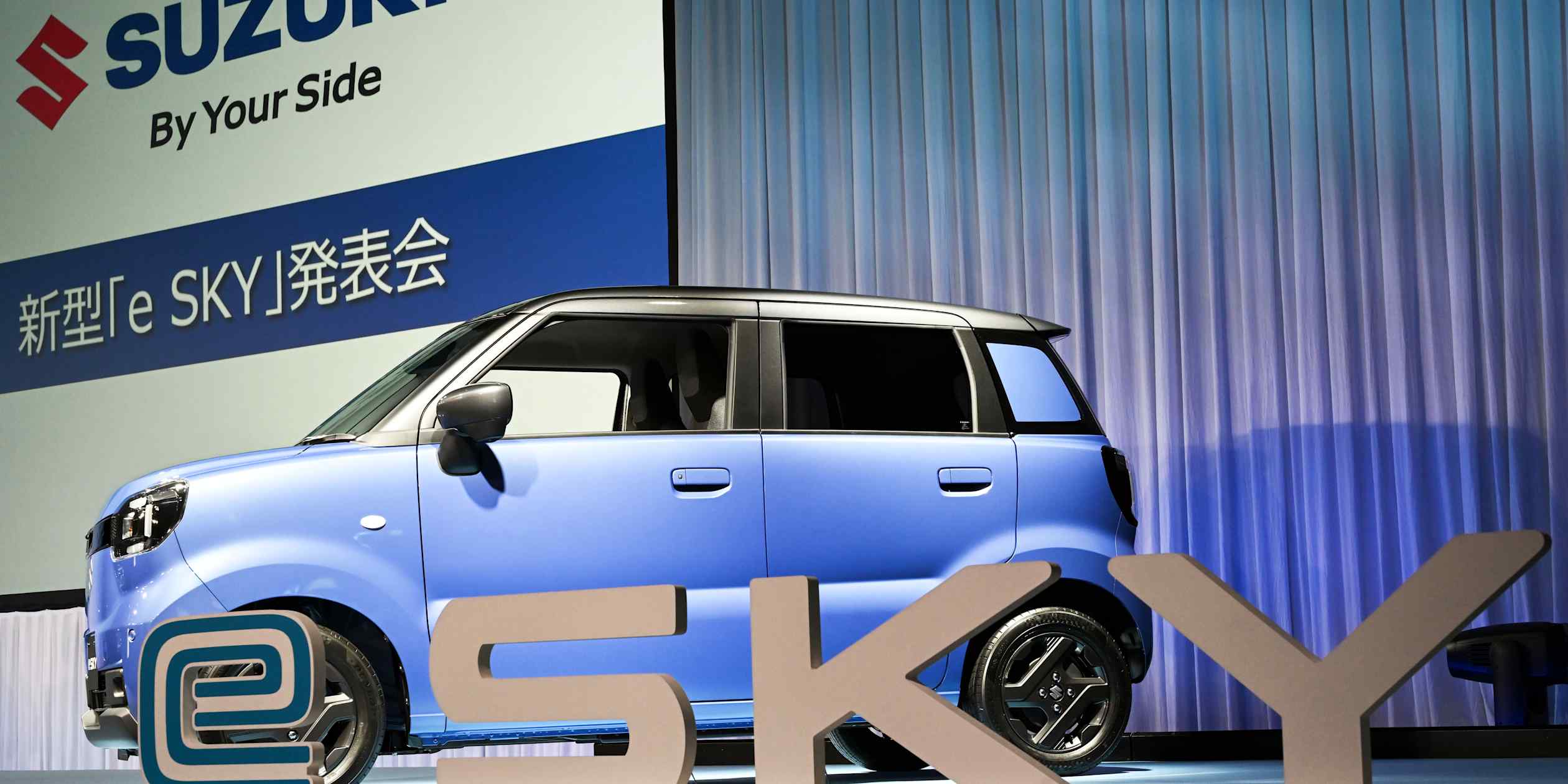
东京——铃木汽车正押注一款日本史上最便宜的电动汽车,以捍卫其本土市场,抵御中国电动汽车竞争对手的冲击。然而,这款新的微型车也暴露出日本汽车制造商面临的一个更广泛问题——它们对中国电池的依赖。
TOKYO -- Suzuki Motor is making a major bet to defend its home market from Chinese electric-vehicle rivals with the launch of the cheapest Japanese EV yet. But its new minicar also exposes a broader vulnerability facing Japan's automakers -- their dependence on Chinese batteries.
周二,铃木发布了其首款微型电动汽车e-Sky,售价为212万日元(约合13400美元),略低于竞争对手比亚迪7月在日本开始销售的Racco电动微型车。
Suzuki unveiled its first kei passenger EV, the e-Sky, on Tuesday, priced at 2.12 million yen ($13,400), slightly cheaper than a rival model -- BYD's Racco electric minicar that the Chinese automaker began selling in Japan in July.
微型车是日本独有的汽车类别,因其较低的持有成本而广受欢迎,约占日本新车销量的40%。这类小型轻量化的汽车以燃油效率高、在狭窄道路上易于驾驶而著称。
Kei minicars, a vehicle category unique to Japan and which are popular due in part to their low ownership costs, account for about 40% of new-car sales in the country. The small and lightweight auto is known for its fuel efficiency and ease of driving on narrow roads.
e-Sky的续航里程为310公里,略低于比亚迪Racco的320公里,但其能源效率最高,每千瓦时可行驶约12公里。这是铃木首次自主研发e-axle驱动系统,并专为微型电动汽车打造了一个全新的平台。
Its driving range is 310 kilometers, short of the 320 km offered by BYD's Racco, but the e-Sky is the most energy-efficient mini EV at around 12 km per kilowatt-hour. Suzuki developed its own version of the e-axle drive system in-house for the first time, as well as a new vehicle platform just for kei EVs.
但问题依然存在。作为电动汽车成本中占比显著的核心部件,其电池由比亚迪的关联公司生产。
But there is a catch. Its battery, a core component that accounts for a significant share of an EV's cost, is made by a BYD affiliate.
在东京举行的新车发布会上,几乎未提及这家中国电池供应商。当被问及中国制造商通过推出微型车进入日本市场一事时,铃木汽车社长铃木利弘表示:“当中国和外国制造商进入市场时,我们很容易选择退缩,但我们必须找到生存和竞争的方法。”这一决策凸显了专家所称的日本在与中国竞争对手较量中最薄弱的环节之一——电池。
There was little mention of the Chinese battery supplier during a news conference in Tokyo for the unveiling. When asked about the Chinese manufacturer's Japanese market entry with its kei offering, Suzuki President Toshihiro Suzuki said, "It would be easy to retreat when Chinese and other foreign manufacturers enter the market, but we need to find a way to survive and compete." The decision highlights what experts describe as one of the weakest links in Japan's efforts to compete with Chinese rivals -- batteries.
总部位于东京的伊藤忠研究所的福尾三四郎表示,在电池技术方面,中国制造商比日本竞争对手“领先了三到四圈”。
Sanshiro Fukao of the Itochu Research Institute, a Tokyo-based think-tank, said Chinese manufacturers were "three or four laps ahead" of their Japanese rivals in battery technology.
福尾表示,由于电池在电动汽车成本中占比较大,若依赖比亚迪供应这一零部件,日本制造商将难以在价格上击败其中国竞争对手。
Because batteries account for a large share of an EV's cost, relying on BYD for the component makes it difficult for Japanese manufacturers to undercut their Chinese rival on price, Fukao said.
他补充说:“理论上,如果日本电动汽车使用这家中国公司的电池,就完全没有机会在成本竞争力上超越比亚迪。”
"In theory, Japanese EVs have no chance of being more cost-competitive than BYD" if they use the Chinese company's batteries, he added.
10月6日,铃木汽车总裁铃木敏弘在东京发布了新款e SKY微型车。
Suzuki Motor Presdient Toshihiro Suzuki unveils the new e SKY kei vehicle in Tokyo, on Oct. 6.
麦肯锡咨询公司指出,电池组通常占电动汽车总成本的30%至40%,而一些中国电池制造商在成本上比全球竞争对手拥有25%至40%的优势。
Battery packs typically account for 30% to 40 % of the total cost of an EV, according to consultancy McKinsey, while some Chinese battery manufacturers enjoy a cost advantage of 25% to 40% over global competitors.
福尾表示,尽管日本拥有一些电动汽车电池制造商,但它们无法在成本和竞争力方面与中国的对手相匹敌。相比之下,比亚迪一直大力推广用于电动汽车的磷酸铁锂电池(LFP),这是一种价格较低的锂离子电池,其正极材料采用磷酸铁锂。
While Japan has a handful of EV battery makers, they are not in a position to match Chinese rivals on cost and competitiveness, Fukao said. BYD, on the other hand, has championed LFP batteries for EVs, a cheap version of the lithium-ion battery which uses lithium iron phosphate for its cathode material.
微型车的电动化进程一直进展缓慢。这类车辆的主要吸引力在于其低廉的价格,制造商在过去几十年中不断优化生产效率,甚至将成本削减到仅1日元(不到一美分)。
Kei minicars have been slow to electrify. Much of their appeal rests on their low price, with manufacturers having spent decades perfecting production efficiency and celebrating cost reductions down to a single yen, or less than one cent.
铃木汽车的已故创始人铃木修曾 famously 要求工程师为每个零部件削减“一克重量和1日元成本”。
Osamu Suzuki, Suzuki's late patriarch, famously urged engineers to shave "one gram and one yen" from every component.
作为日本最大的两家微型车制造商,铃木和丰田汽车旗下的大发工业至今尚未进入乘用微型车电动市场,而是专注于商用货车。
Suzuki and Toyota Motor-owned Daihatsu Motor, Japan's two biggest kei car makers, have until now stayed out of the passenger kei EV market, focusing instead on commercial vans.
一家微型车制造商的员工质疑,电动乘用微型车是否真能赢得消费者青睐,他认为小型电动汽车有限的续航里程对乘用车而言是更大的制约因素。
One employee at a kei-car manufacturer questioned whether electric passenger minicars would ever take off with consumers, arguing that the limited range of small EVs was a bigger constraint for passenger cars.
该员工表示,商用车辆是更理想的切入点,因为其日常行驶里程更具可预测性。微型货车被农民和小企业主广泛用于日常出行,因此更容易根据实际工作需求匹配电池容量。
Commercial vehicles offer an easier starting point because their daily driving distances are more predictable, the person said. Kei vans are widely used by farmers and small business owners for routine journeys, making it easier to match battery capacity to everyday workloads.
比亚迪于7月携Racco小型电动汽车进入日本市场,此举正给本土制造商带来压力,迫使其提升竞争力。
BYD's entry into Japan with its Racco mini EV in July is now putting pressure on domestic manufacturers to become more competitive.
日本瑞穗银行的研究员金堂表示,比亚迪的战略很可能不仅限于日本。“亚洲可能成为小型电动汽车的关键战场,这类车型尤其适合在该地区的城市中使用。”他说。
Jin Tang, a researcher at Japan's Mizuho Bank, said BYD's strategy was likely to extend well beyond Japan. "Asia could become a key battleground for small EVs, which are particularly well suited to driving in the region's cities," he said.
比亚迪周日表示,其新款小型电动汽车也将在澳门和斯里兰卡销售。金堂认为,这家中国公司可能正利用澳门等相对容易进入的市场来测试该车型的需求,然后再进行更广泛的扩张。
BYD said on Sunday that it would also sell its new mini EV in Macao and Sri Lanka Tang said the Chinese company could be using relatively accessible markets such as Macao to test demand for the vehicle before expanding more broadly.
他还补充说,亚洲城市对比亚迪而言是极具潜力的市场,因为比亚迪功能丰富的电动汽车与具有竞争力的定价相结合,很可能吸引城市消费者。
Asian cities were particularly promising markets for BYD because its combination of feature-rich EVs and competitive pricing was likely to appeal to urban consumers, he added.
一家轻型汽车制造商的员工承认,Racco似乎获得了早期评测者的好评,并且“定价极具吸引力”。不过,该员工表示,以轻型车尺寸拓展整个亚洲市场并非这家日本公司的优先事项。他指出,该地区流行的紧凑型车辆通常搭载的发动机比日本660毫升的轻型车更大。
The employee of a kei car maker acknowledged that the Racco appeared to have been well received by early reviewers and was "aggressively priced." However, the person said expanding across Asia with kei-sized cars was not a priority for the Japanese company, noting that popular compact vehicles in the region typically have larger engines than Japan's 660 cc kei cars.
铃木汽车正着眼于国内市场之外,并考虑向欧洲出口。去年,欧盟决定引入一个受日本轻型车制度启发的新车辆类别,以推动电动汽车的普及。雷诺和大众汽车已宣布推出符合欧盟这一新车辆类别的车型。
Suzuki is looking beyond the domestic market and considering exports of its to Europe. Last year, the European Union decided to introduce a new vehicle category inspired by Japan's kei system to promote EV adoption. Renault and Volkswagen have announced models that qualify for the EU's new vehicle class.
铃木社长告诉记者,他将“逐步”考虑将这款轻型车出口海外的机会,但态度谨慎地补充道:“首先,我们希望这款电动汽车在日本经过测试和完善。”福尾将轻型微型车这一细分市场视为日本汽车制造商的象征性市场,它体现了日本在二战后为生产比西方竞争对手更便宜、质量更高的汽车而积累起来的制造优势。
President Suzuki told reporters that he will consider opportunities "step by step" for selling the kei car overseas, but took a cautious note, adding that "First, we want the EV to be tested and refined in Japan." Fukao described the kei minicar segment as a symbolic market for Japanese automakers, embodying the manufacturing strengths they developed after World War II to produce cheaper, higher-quality cars than their western rivals.
但他表示,随着中国制造商生产出价格越来越实惠、质量也越来越高的汽车,这种竞争格局正在发生变化,使得日本汽车制造商更难与他们“正面交锋”。
But that competitive dynamic is changing as Chinese manufacturers produce increasingly affordable and higher-quality cars, making it harder for Japanese automakers to beat them "head-on," he said.
深尾补充说,来自中国的挑战为日本汽车制造商提供了一个重新审视其紧凑型汽车独特之处以及消费者为何应选择它们而非竞争对手的机会。“我们必须改变我们的竞争方式,”他说。
Fukao added that the Chinese challenge offered Japanese automakers an opportunity to reassess what distinguishes their compact cars and why consumers should choose them over their rivals. "We have to change how we fight," he said.