能“读取”你脑海画面的计算机:科学家研发出可精准还原人们所见图像的人工智能。今后想保守自己的想法恐怕越来越难了。
The computer that can read your mind: Scientists reveal AI that can recreate exactly what you're looking at The days of keeping your thoughts to yourself may be numbered.
科学家们最新研发出一种具有开创性意义的“读心”人工智能,只需分析大脑扫描数据,就能还原出人们正在观看的图像。
Scientists have unveiled a groundbreaking ‘mind-reading’ AI that can recreate images people are looking at simply by analysing their brain scans.
在这项研究中,参与者被要求观看各类图片,内容涵盖棒球比赛场景、一只把头探出车窗的狗,以及一群人在雪原上徒步的画面。
As part of a study, participants were asked to look at photos ranging from images of a baseball game to a dog leaning out of a car and a group trekking across a snowy plain.
该人工智能程序通过分析参与者的脑部活动模式,成功还原出了这些它此前从未见过的图片,且还原准确度极高。
The AI programme analysed their brain activity patterns through a scan and reproduced the pictures – which it had never seen before – with remarkable accuracy.
来自魏茨曼科学研究所的米哈尔·伊拉尼教授说道:“目前已有一些能够将大脑活动转化为图像的模型,它们生成的还原图效果相当出色,也能较好地保留原图的语义信息。不过这些模型往往在图像构图、色彩等基础特征上会出现偏差。”
‘There exist nowadays models that translate brain activity into images, and they can even produce impressive reconstructions that preserve the semantic meaning of the image reasonably well,’ Professor Michal Irani, from the Weizmann Institute of Science, said. ‘However, they tend to make mistakes in basic features such as composition and colour.
“而我们研发的新模型在还原图像内容及其细节方面都优于现有模型。此外,其他所有同类模型都需要对数十小时的大脑扫描数据进行学习才能‘读懂’新个体的脑电信号,而我们的模型仅需一小时即可完成学习。”
‘The new model we developed outperforms them in reconstructing both the content of the image and its details. ‘What’s more, while every other model requires dozens of hours of brain scans to learn to “read” a new person, our model needs only one hour.’Scientists have unveiled a groundbreaking ‘mind-reading’ AI that can recreate images people are looking at simply by analysing their brain scans.
为开发出这款名为Brain-IT的系统,科学家们收集了8名志愿者观看各类图片时的数千份大脑扫描数据,以此训练程序。
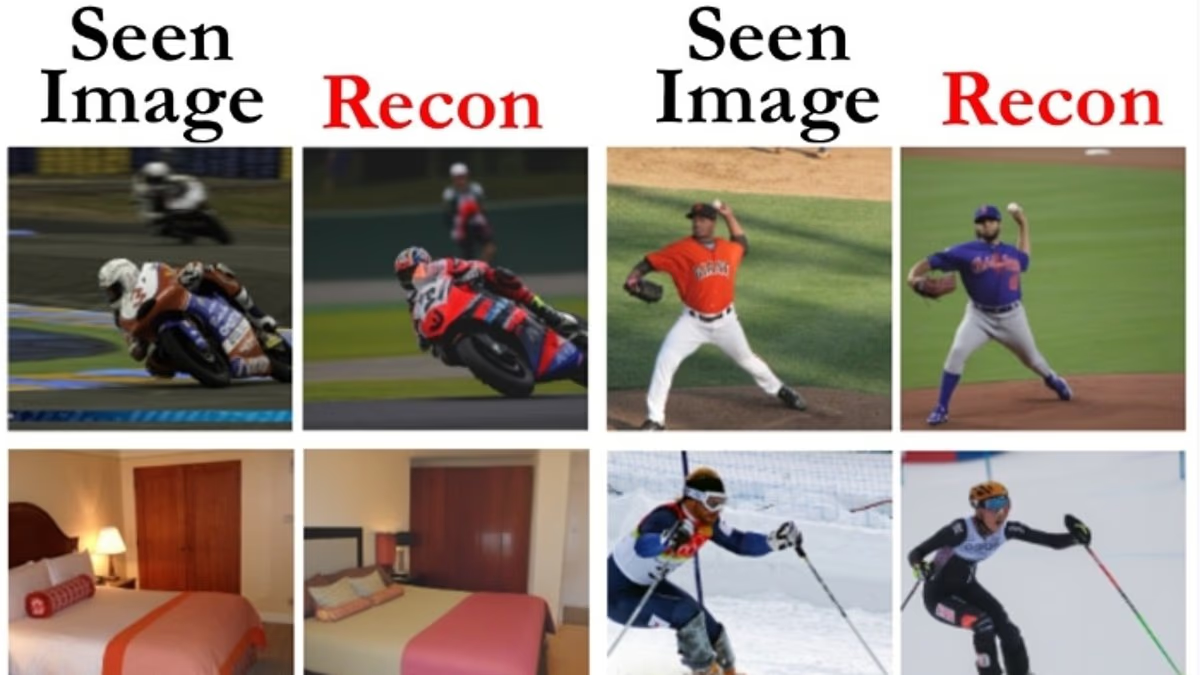
Pictured: The photos people viewed (left) and the AI reconstruction (right) To build the system, called Brain-IT, the scientists fed it thousands of brain scans collected while eight volunteers looked at different images.
这一过程让程序掌握了特定的大脑活动模式与色彩、形状及物体之间的对应关系。该系统的精准度极高,甚至能根据图像预测出对应的大脑扫描图像会是什么样子。
This allowed the programme to learn how specific patterns of neural activity correspond to colours, shapes and objects. It was so accurate that it even learned to predict what a brain scan would look like from an image.
通过整合多项研究的数据,研究人员还找出了在不同个体身上都承担着相似功能的大脑区域。
By combining data from multiple studies, the researchers identified brain regions that appear to perform similar functions across different people.
例如,某个脑区会对食物图片产生反应,而另一个脑区则会对体育相关图片作出响应。
For example, one area consistently responded to images of food while another was activated by pictures of sport.
“在训练过程中,该编码器自然识别出了128个功能区域,这些区域存在于所有人的大脑中,并在图像处理过程中发挥特定作用,”伊拉尼教授说道。
‘During training, the encoder naturally identified 128 functional regions that are shared by all people and perform specific roles in image processing,’ Professor Irani said.
“其中一些区域是神经科学家所熟知的,但也有一些完全是新发现的。”
‘Some of them are familiar to neuroscientists, but others are entirely new.
“比如,我们发现负责处理场景图像的脑区——后侧顶叶皮层——内部存在明确的分工:一部分区域会对室内场景产生反应,另一部分则对室外场景作出响应。”当输入新的脑部扫描数据后,该人工智能系统能够生成与原始图像极为相似的重建图像。
‘For example, we discovered a division of roles within the brain region that processes images of places – the PPA – with one part responding to indoor scenes and another to outdoor scenes.’When given a new brain scan, the AI was able to generate a remarkably accurate reconstruction of the original image.
研究人员让8名志愿者观看各类图片,同时采集他们的脑部扫描数据。随后测试该系统时,它成功还原出了志愿者们当时所看到的图片。这些图片内容多样,从棒球比赛画面(左图)到狗把头探出车窗、以及一群人在雪原上徒步的场景都有。最终,Brain-IT成功还原出了对应的图像(右图)。
The system was fed thousands of brain scans collected while eight volunteers looked at different images. When it was then tested, it could recreate a set of new images (RECON) the participants were looking at Participants were asked to look at photos ranging from images of a baseball game (left) to a dog leaning out of a car and a group trekking across a snowy plain. Brain-IT could then reproduce the picture (right) Other AI ‘mind reading’ tools require about 40 hours of brain scan data on anyone new before they can be used to predict what a person is seeing.
其他用于“读心”的人工智能工具在用于预测新对象的视觉感知内容前,需要采集约40小时的脑部扫描数据。不过研究团队指出,这款新解码器仅需60分钟的数据即可完成训练。
But this new decoder only needs 60 minutes of data, the team explained.
为验证这一点,研究人员对比了仅用1小时数据训练的Brain-IT与用40小时数据训练的同一系统所生成的图像,结果显示两者效果极为相似。此外,将该系统的图像重建效果与其他程序进行对比后也发现,它的重建精度明显更高。
To prove this, they compared the images generated by Brain-IT when trained with one hour of data compared to the same system trained with 40 hours, and the results are remarkably similar. They also compared their system’s image recreation results with those of other programmes, revealing it generated much more accurate reconstructions.
目前,伊拉尼教授的实验室正致力于将这类“读心”技术拓展至听觉信息的解码领域。
Professor Irani’s lab is now working to extend these ‘mind-reading’ methods to the decoding of auditory information as well.
“目前最具挑战性的任务还是视频解码——比如人在做梦时的视觉信息解码,”她解释道。
‘What remains especially challenging is decoding video – for example, during dreaming,’ she explained.
“每秒钟都会出现数十幅图像,而一次功能性磁共振成像扫描则需要约两秒钟。如果我们能克服所有这些技术障碍,未来甚至有可能解读人们的梦境。”该团队还在研发类似的系统,用于解码通过脑电图技术记录下的大脑活动信号。
‘Dozens of images change every second, while an fMRI scan takes about two seconds. If we overcome all these obstacles, it’s possible that in the future we may even be able to read dreams.’The team are also working towards similar systems that decode brain activity recorded using electroencephalography (EEG).
这种技术是通过放置在头皮上的传感器来测量大脑电信号的,这些传感器有时被集成在帽子中,甚至专门设计的耳机里。
This technique measures the brain's electrical signals through sensors placed on the scalp, sometimes via a cap or even specially designed headphones.
随着人工智能模型日益完善,科学家们预计,解读通过这种方式获取的大脑数据将变得比通过磁共振成像扫描更为容易。
As AI models become more sophisticated, scientists expect it will become increasingly easy to interpret the brain data collected in this way, rather than through MRI scans.
上述研究成果已于上月在纽约举行的认知计算神经科学大会上公布。
The findings were presented at the Cognitive Computational Neuroscience conference in New York last month.