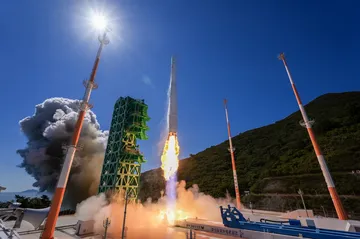
金秀彬报道:韩国第五次发射国产“罗利”(Nuri)火箭,国防承包商韩华航空航天公司参与程度的扩大,凸显了韩国在提升其太空雄心方面对私营部门依赖度的日益增加。
Korea launched its homegrown Nuri rocket for a fifth time, with the expanded involvement of defense contractor Hanwha Aerospace underscoring the increasing reliance on the private sector to boost the country’s space ambitions.
据航天机构称,火箭于当地时间12点25分从韩国西南部的古礼郡发射升空,在约12分41秒后进入目标轨道。此次火箭搭载了创纪录的15颗卫星,并成功将其中除一颗外的所有卫星部署入轨。
The rocket blasted off at at 12:25 p.m. local from Goheung in the country’s southwest, reached its target orbit in about 12 minutes and 41 seconds, the space agency said. The rocket carried a record 15 satellites, and successfully deployed all but one satellite in orbit.
韩国航空航天管理局在声明中表示,周三的成功发射“进一步提升了该运载火箭的发射可靠性,同时再次确认了韩国独立的航空航天能力和自主航天实力”。
Wednesday’s successful launch “has further enhanced the vehicle’s launch reliability while reaffirming South Korea’s independent aerospace capabilities and autonomous astronautics prowess,” the Korea AeroSpace Administration said in a statement.
尽管起步较晚,此次发射标志着韩国在成为更大太空强国的雄心道路上又迈出了关键一步。该国于2024年成立了新的航天机构,并计划为私营企业建立发射设施。
The launch marks another key step forward in South Korea’s ambitions to become a bigger space power despite its late start. The country opened a new space agency in 2024 and plans to set up a launch facility for private companies.
在周三的发射任务中,韩华航空航天公司的职责范围扩大至包括发射准备和运营,其负责控制中心22个发射控制台中的20个。这家国防承包商此前是主发动机的主要开发商,并于2025年获得了“罗利”火箭技术的完全独家权利。
For Wednesday’s launch, Hanwha Aerospace Co.’s responsibilities were expanded to include launch preparations and operations, as it handled 20 of the 22 launch consoles at the control center. The defense contractor secured full exclusive rights to Nuri technology in 2025, having previously been the main engine developer.
“罗利”是韩国首枚国产航天运载火箭,于2021年首飞,次年实现首次成功飞行。这些发射任务属于一项价值2.6万亿韩元(约合18亿美元)的计划,在2027年前还将进行另一次发射。
The Nuri is South Korea’s first homegrown space vehicle, debuting in 2021 and achieving its first successful flight the following year. The launches are part of a 2.6 trillion won ($1.8 billion) program, with one more launch due before 2027.
“罗利”是一枚一次性使用的火箭,但韩国航空航天研究院正与包括韩华航空航天、Vitzro Nextech和汉阳ENG公司在内的私营企业合作,开发可重复使用火箭技术。
Nuri is a single-use rocket but the Korea Aerospace Research Institute has been working with private companies including Hanwha Aerospace, Vitzro Nextech and Hanyang ENG Co Ltd to develop reusable rocket technology.
上个月,它表示已开始组装一枚试验性可复用火箭。这枚长12.2米的演示飞行器将由一台8吨推力发动机提供动力。根据韩华航天的一份声明,其首次试飞计划于2028年进行,旨在发射后约90秒内达到500米的高度。
Last month, it said it had begun assembly of a trial reusable rocket. The 12.2-meter-long demonstration vehicle will be powered by an eight-ton engine. Its first test flight is targeted for 2028 and aims to reach an altitude of 500m within roughly 90 seconds of launch, according to a statement by Hanwha Aerospace.
制造可复用火箭是埃隆·马斯克旗下巨头SpaceX凭借其“猎鹰9号”飞船所掌握的技术,而行业竞争对手在这方面却举步维艰。
Building reusable rockets is something Elon Musk’s juggernaut SpaceX has mastered with its Falcon 9 spacecraft, even as competitors in the industry have struggled.
7月,中国首次在海上成功回收了一级轨道级可复用助推器,这使得该火箭的设计者中国航天科技集团成为继SpaceX和蓝色起源之后,第三家成功展示该技术的公司。
In July, China landed an orbital-class reusable booster at sea for the first time, making China Aerospace Science and Technology Corp., the designer of the rocket, the third company to successfully showcase the technology following SpaceX and Blue Origin.