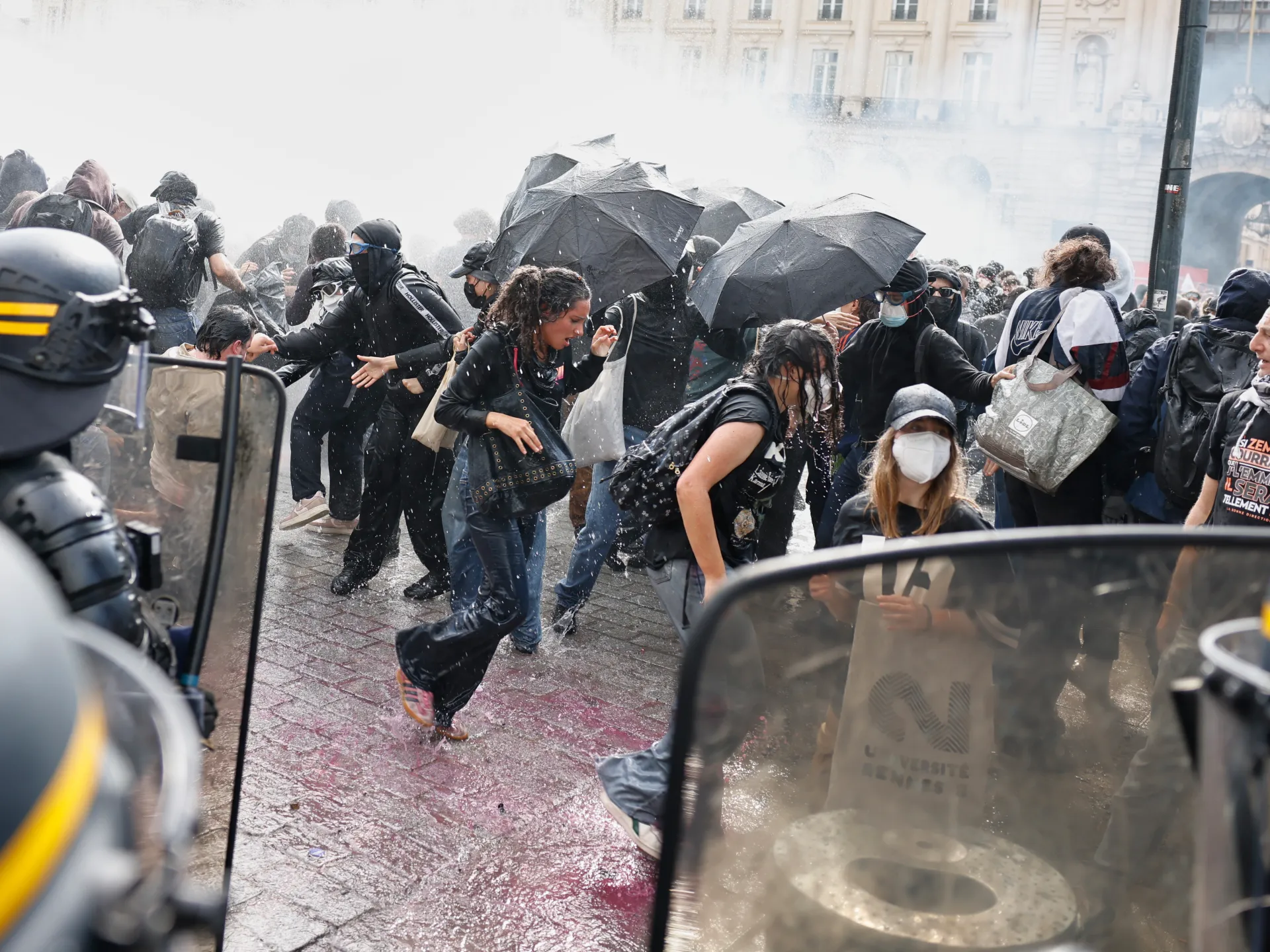
针对学校内的各种状况,包括教室过度拥挤和师资短缺等问题,抗议活动已持续超过两周,且丝毫没有停歇的迹象。
for more than two weeks over conditions in schools, including overcrowded classrooms and staff shortages, and they show no sign of stopping.
这场骚乱始于9月21日,当时巴黎郊区克雷泰伊的一所学校遭到学生封锁。一周之内,抗议活动便蔓延至全国,学生与警察之间爆发了激烈冲突。
The unrest began on September 21 when pupils blockaded a school in the Paris suburb of Creteil, and within a week, their protest had spread across the country with students and police clashing violently.
9月29日,示威活动与全国性的公共部门罢工同时发生,教师与其他国家雇员一道,共同反对政府提出的冻结薪资的提议。此后,已有超过6100人被逮捕。
September 29 the demonstrations coincided with a nationwide public sector strike, in which teachers joined other state workers against a proposed pay freeze. More than 6,100 people have since been arrested.
在政府面临债务不断上升、被迫控制支出的压力下,半岛电视台将探讨法国在教育领域的投资规模、其与欧洲其他国家的对比情况,以及相较于医疗和国防领域的支出水平。法国在教育上投入了多少?
With the government under pressure to rein in spending as its debt rises, Al Jazeera looks at how much France invests in education, how it compares with the rest of Europe and how it measures up against what the country spends on healthcare and defence. How much does France spend on schooling?
根据欧盟统计机构欧洲统计局的最新数据,法国公共教育支出占其国内生产总值(GDP)的5.1%。这一数字并未包含家庭支付学费等私人支出。
According to the latest data from Eurostat, the European Union’s statistics agency, France’s public spending on education amounts to 5.1 percent of its gross domestic product (GDP). That figure does not include private spending, such as school fees paid by families.
法国国民教育部采用了一个更广泛的指标,即“国内教育支出”,该指标统计了所有用于教育的资金,无论其来源是国家、地方政府、企业还是家庭。除了教学支出外,它还涵盖了成人教育和继续教育,以及学校餐食、寄宿和交通等相关费用。
The French Ministry of National Education uses a broader measure, known as domestic expenditure on education, which counts all the money that goes into education, whether from the state, local authorities, businesses or households. As well as teaching, it covers adult and continuing training and related costs such as school meals, boarding and transport.
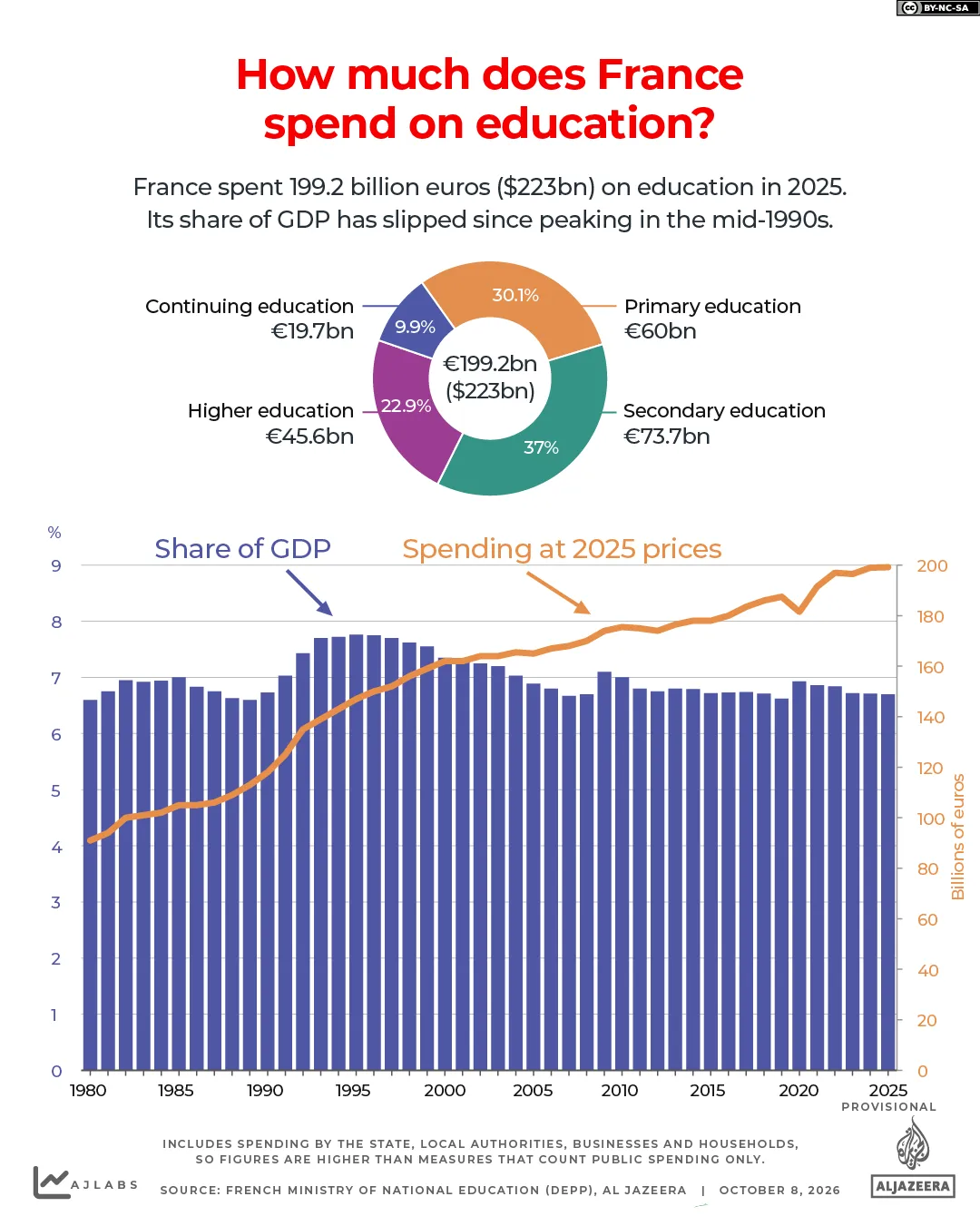
根据教育部的初步数据,按照这一指标计算,法国2025年在教育上的支出为1992亿欧元(2230亿美元),相当于其GDP的6.7%,比2024年增加了24亿欧元。
By this measure, France spent 199.2 billion euros ($223bn) on education in 2025, equivalent to 6.7 percent of its GDP and 2.4 billion euros more than in 2024, according to provisional ministry figures.
即使考虑通货膨胀因素,自1980年以来,法国的教育支出已增长了一倍多。但经济也在同步增长,因此教育支出占GDP的比例如今已低于20世纪90年代中期。
Spending has more than doubled since 1980, even after accounting for inflation. But the economy has grown too, so education spending’s share of GDP is lower today than it was in the mid-1990s.
据法国教育部统计,中等教育领域的支出占比最高,总额达737亿欧元,占教育总支出的37%;其次是初等教育,支出额为600亿欧元,占比30%。高等教育支出为456亿欧元,占比23%;成人及继续教育领域的支出则为197亿欧元,占比10%。其他欧洲国家在教育领域的投入情况如何?
Secondary education accounted for the largest share of spending at 73.7 billion euros (37 percent), followed by primary education at 60 billion euros (30 percent), higher education at 45.6 billion euros (23 percent) and adult and continuing education at 19.7 billion euros (10 percent), according to the National Education Ministry. How much do other European countries spend on education?
根据欧盟统计局的数据,2024年欧洲各国中,瑞典的教育支出占国内生产总值的比例最高,达7.3%;冰岛紧随其后,占比为7%。比利时、爱沙尼亚和芬兰的教育支出占比均为6.3%。
Among European countries, Sweden spends the largest share of its GDP on education at 7.3 percent in 2024, followed by Iceland (7 percent) and Belgium, Estonia and Finland (6.3 percent each), according to Eurostat.
教育投入最少的国家则包括爱尔兰(2.7%)、希腊(3.9%)、罗马尼亚和意大利(均为4%),英国与西班牙的占比也均为4.1%。
The lowest spenders are Ireland (2.7 percent), Greece (3.9 percent), Romania and Italy (4 percent each), and the United Kingdom and Spain (4.1 percent each).
法国的教育支出占GDP的比重为5.1%,与荷兰、斯洛伐克并列第13位,这一数值也高于欧盟4.8%的平均水平。
At 5.1 percent, France is joint 13th, level with the Netherlands and Slovakia, and above the EU average of 4.8 percent.
不过,高于平均水平的教育投入并未帮助法国规避许多发达国家都面临的共性问题。根据经合组织最新发布的《教育概览》报告,经合组织成员国普遍面临教师短缺的困境。
But above-average spending has not shielded France from a problem affecting much of the developed world. Teacher shortages are growing across countries in the Organisation for Economic Co-operation and Development, according to the OECD’s latest Education at a Glance report.
许多国家并未任由教师岗位空缺,而是安排那些资质尚未完全达标的人员填补空缺。在2024至2025学年,经合组织成员国中,有9%的初等及中等教育教师尚未取得完全合格的资质。
Rather than leaving posts empty, many countries are filling them with teachers who lack full qualifications. In the 2024-2025 school year, 9 percent of primary and secondary teachers across the OECD were not fully qualified.
在法国,这一问题在中等教育阶段表现得最为明显:约有11%的中学教师资质不达标,而小学阶段这一比例还不到3%。此外,法国初中班级的平均学生人数达26人,高于经合组织23人的平均水平。
In France, the strain is most visible in secondary schools. About 11 percent of secondary teachers are not fully qualified, compared with less than 3 percent in primary schools. Furthermore, lower secondary classes average 26 pupils, compared with 23 across the OECD.
这一情况与学生们在近期抗议活动中反映的情况相符:班级规模过大,缺勤的教师也得不到及时补充。
That echoes what pupils have been saying during the latest protests Classes are large, and absent teachers are not being replaced.
一些学生还提到学校校舍破旧、桌椅短缺,部分学校甚至存在鼠患问题。他们表示,今年法国遭遇的极端热浪进一步加剧了这些年久失修的校舍所存在的问题,许多校舍根本没有安装空调。
Some also described dilapidated buildings, a shortage of tables and chairs and, in some schools, rodent infestations. The intense heatwaves that hit France this year exacerbated existing problems in neglected buildings, many of which have no air conditioning, students said.
教师们的处境同样堪忧。仅有4%的教师认为自己的职业在社会上受到重视,这一比例在所有受访国家中最低,也远低于22%的经合组织平均水平。教育支出发生了怎样的变化?
Teachers also feel undervalued. Only 4 percent said their profession is valued in society, the lowest share of any country surveyed and far below the OECD average of 22 percent. How much has spending changed?
联合国教科文组织的历史数据显示,法国的教育支出占GDP的比重从2017年的5.5%降至2022年的5.3%,不过在有相关数据的29个欧洲国家中仍位列第九。2020年这一比例曾短暂升至5.7%,但这主要是经济受疫情影响导致GDP基数下降所致,并非教育投入有所增加。
Historical UNESCO data showed France’s education spending slipped from 5.5 percent of GDP in 2017 to 5.3 percent in 2022 although it remained the ninth-highest among 29 European countries with data. A brief rise to 5.7 percent in 2020 reflected the pandemic shrinking the economy, not extra spending.
法国属于教育支出占比下降的14个国家之一。挪威和丹麦的降幅最为显著,而斯洛伐克、斯洛文尼亚、立陶宛及捷克共和国的增幅则最大。这些国家还将资金用于哪些方面?
France was one of 14 countries where the share fell. Norway and Denmark saw the steepest drops while Slovakia, Slovenia, Lithuania and the Czech Republic recorded the biggest rises. What else are these nations spending on?
此次抗议活动恰逢法国全国范围内的公共部门罢工,起因是政府拟定的2027年预算方案计划节省540亿欧元(约合613亿美元)。法国总统马克龙领导的政府正试图控制庞大的公共赤字。
The protests have coincided with nationwide public sector strikes over the government’s proposed 2027 budget which seeks 54 billion euros ($61.3bn) in savings as French President Emmanuel Macron’s government tries to rein in a large public deficit.
工会及公共部门工作人员尤其反对冻结公职人员薪资的计划,该措施预计可节省约20亿欧元(约合22.7亿美元)。
Unions and public sector workers object in particular to a plan to freeze state employees’ salaries, which is expected to save about 2 billion euros ($2.27bn).
根据世界银行与联合国教科文组织2022年的数据,在整个欧洲,多数国家在教育领域的投入均高于国防领域;而在教育、国防与医疗这三大领域里,医疗支出占国民收入的比重最高。2022年,法国的医疗支出占GDP的比重达11.9%,这一比例在欧洲位居前列。
Across Europe, most governments spend more on education than on defence, but healthcare takes the largest share of national income of the three, according to 2022 data from the World Bank and UNESCO. France spent 11.9 percent of its GDP on healthcare in 2022, one of the highest shares in Europe.