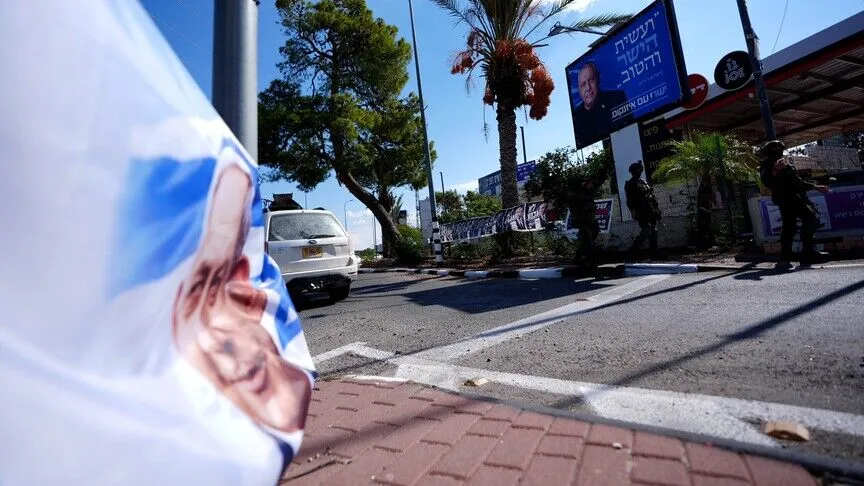
周五公布的一项民意调查显示,以色列的犹太反对派若想组建替代本雅明·内塔尼亚胡总理的政府,将需要阿拉伯议员的支持,而大多数以色列人反对阿拉伯政党加入下一届政府。
Israel’s Jewish opposition would need the support of Arab lawmakers to form an alternative government to Prime Minister Benjamin Netanyahu’s, while a majority of Israelis oppose Arab parties joining the next government, according to a poll published Friday.
民调结果显示,在距离选举还有17天的情况下,无论是内塔尼亚胡的阵营还是犹太反对派,都无法单独组建政府。
Poll results indicate that neither Netanyahu’s bloc nor the Jewish opposition would be able to form a government on its own in the election scheduled for 17 days from now.
这种情况可能会导致几个月后再次举行选举,如果内塔尼亚胡无法组建政府,他可能更倾向于这一选择。
Such a scenario could lead to another election several months later, an option Netanyahu may prefer if he fails to form a government.
以色列《晚报》(Maariv)公布的一项民调显示,如果今天举行选举,内塔尼亚胡的阵营和犹太反对派将在120个席位的议会中各赢得52个席位。
A poll published by the Israeli newspaper Maariv showed that, if elections were held today, Netanyahu’s bloc and the Jewish opposition would each win 52 seats in the 120-member Knesset.
阿拉伯政党将获得12个席位,而由约阿兹·亨德尔(Yoaz Hendel)领导的“预备党”(Reserve Party)将赢得4个席位,但尚未宣布支持哪个阵营。组建政府需要120个席位的议会中至少61名议员的支持。
Arab parties would secure 12 seats, while the Reserve Party, led by Yoaz Hendel, would win four without having declared which bloc it would support. A government requires the support of at least 61 lawmakers in the 120-seat Knesset.
大多数犹太反对党领导人拒绝与阿拉伯议员合作,以组建替代内塔尼亚胡政府的政府。
Most leaders of the Jewish opposition parties have rejected cooperation with Arab lawmakers to form an alternative government to replace Netanyahu’s.
席位分配方面,根据民调,内塔尼亚胡的52席阵营将包括:其领导的利库德集团(Likud)20席,伊塔马尔·本-格维尔(Itamar Ben-Gvir)的“犹太力量党”(Jewish Power)8席,“联合托拉犹太教党”(United Torah Judaism)和“沙斯党”(Shas)各7席,比撒列·斯莫特里赫(Bezalel Smotrich)的“宗教犹太复国主义党”(Religious Zionism)6席,以及奥弗·温特(Ofer Winter)的“阿姆查以色列党”(Amcha Israel)4席。
Seat distribution According to the poll, Netanyahu’s 52-seat bloc would comprise his Likud party with 20 seats, Itamar Ben-Gvir’s Jewish Power with eight, United Torah Judaism and Shas with seven each, Bezalel Smotrich’s Religious Zionism with six and Ofer Winter’s Amcha Israel with four.
犹太反对派的52个席位将分配如下:加迪·艾森科特(Gadi Eisenkot)的“亚沙尔党”(Yashar)21席,纳夫塔利·贝内特(Naftali Bennett)的“团结党”(Together)13席,亚伊尔·戈兰(Yair Golan)的“民主党”(Democrats)9席,以及阿维格多·利伯曼(Avigdor Liberman)的“以色列是我们的家园党”(Yisrael Beiteinu)9席。
The Jewish opposition’s 52 seats would be divided among Gadi Eisenkot’s Yashar party with 21, Naftali Bennett’s Together party with 13, Yair Golan’s Democrats with nine and Avigdor Liberman’s Yisrael Beiteinu with nine.
阿拉伯政党将赢得12个席位,其中优素福·贾巴林(Yusuf Jabareen)领导的“联合名单”(Joint List)获得7席,曼苏尔·阿巴斯(Mansour Abbas)的“联合阿拉伯名单”(United Arab List)获得5席。亨德尔的“预备党”将获得4个席位,且未承诺支持任何一方。
结果显示,如果两大阵营之间的僵局持续,阿拉伯政党的支持可能使犹太反对派得以组建政府。
Arab parties would win 12 seats, with the Joint List led by Yusuf Jabareen taking seven and Mansour Abbas’ United Arab List securing five. Hendel’s Reserve Party would take four seats without committing to either bloc. The results indicate that support from Arab parties could enable the Jewish opposition to form a government in the event of a continued tie between the two main blocs.
多数民众反对阿拉伯政党加入政府。调查显示,59%的以色列人反对阿拉伯政党在选举后加入政府,支持这一做法的占36%,另有5%表示不确定。
Majority oppose Arab parties joining government The poll found that 59% of Israelis oppose an Arab party joining the government after the election, compared with 36% who support such participation, while 5% said they did not know.
相比之下,53%的受访者支持极端正统派哈雷迪政党加入下一届政府,反对者占41%,另有6%未作决定。
By comparison, 53% supported the participation of an ultra-Orthodox Haredi party in the next government, while 41% opposed it and 6% were undecided.
首选总理。在净雅胡·内塔尼亚胡与以色列前军队总司令加迪·艾森科特之间的一对一对决中,46%的受访者表示更倾向于艾森科特担任总理,支持内塔尼亚胡的占40%,另有14%未给出明确答案。
Preferred prime minister In a direct contest between Netanyahu and former Israeli army chief Gadi Eisenkot, 46% said they preferred Eisenkot as prime minister, compared with 40% for Netanyahu, while 14% gave no clear answer.
以色列总理并非直接选举产生,而是能够组建并获得至少61名议员支持的人选。
Israel’s prime minister is not directly elected but is the person able to form a government backed by at least 61 lawmakers.
当受访者被要求在多位总理候选人中进行选择时,内塔尼亚胡获得38%的支持率,其次是艾森科特(24%)和本内特(14%)。所有其他候选人的支持率均未超过10%。
When respondents were asked to choose among several candidates for prime minister, Netanyahu received 38%, followed by Eisenkot with 24% and Bennett with 14%. All other candidates received less than 10% each.
《马阿里夫报》称,该调查由私营的拉扎尔研究所在700名以色列人的随机样本中进行,误差幅度为3.7个百分点。
Maariv said the poll was conducted by the private Lazar Research Institute among a random sample of 700 Israelis, with a margin of error of 3.7 percentage points.