
(NEXSTAR)——一份新的联邦报告概述称,虽然与去年相比,部分家庭今冬取暖开支可能略有减少,但其他家庭可能面临20%或更高的涨幅。
(NEXSTAR) – While some households may spend slightly less on heating their homes this winter compared to last year, others may see price hikes of 20% or more, a new federal report outlines.
美国能源信息管理局(EIA)本周发布了《冬季燃料展望》,预测家庭取暖成本和能源消耗支出。该报告考虑了四种最常用的取暖燃料、全美预期平均气温,以及可能具有历史意义的厄尔尼诺天气模式(稍后详述)。
The U.S. Energy Information Administration this week released its Winter Fuels Outlook, offering projections of how much households will spend on heating costs and energy consumption. It takes into account the four most common heating fuels used and anticipated average temperatures across the U.S., as well as the potentially historic El Niño weather pattern (but more on that in a moment).
EIA认为,能源价格和当地天气预报将影响您今冬的取暖支出。不过,该机构总体预测,依靠天然气或丙烷取暖的家庭“今冬能源支出将减少”。报告称,这主要得益于燃料成本下降。使用电力或燃油取暖的家庭则不那么幸运。
Energy prices and the local forecast impact just how much you will spend on heating your home this winter, the EIA contends. However, the agency overall projects that those who rely on either natural gas or propane to heat their homes “will have lower energy expenditures this winter.”That’s driven by lower fuel costs, according to the report. Households using electricity or heating oil won’t be as lucky.
EIA的展望显示,11月至明年3月期间,使用天然气取暖的家庭支出可能比去年减少约9%,为各燃料类型中降幅最大。使用丙烷的家庭成本可能下降约3%。
The EIA’s outlook suggests that, between November and March, those who use natural gas to heat their homes could spend about 9% less than they did last year, the largest dip across any fuel type. Those using propane may see a roughly 3% decline in costs.
对于依靠电力取暖的家庭,成本今冬可能上涨约4%。使用燃油取暖的家庭——约占美国家庭的3%——EIA预测价格将比去年飙升约21%。展望指出,地区气温可能影响这些平均变化幅度。
Among homes relying on electricity, the cost may rise by about 4% this winter. In homes that use heating oil — about 3% of U.S. households — the EIA projects prices will jump by about 21% over last year. The outlook notes that regional temperatures could have an impact on those average changes.
EIA表示,虽然南部、中西部和东北部预计气温“与去年持平或偏暖”,但西部今冬可能更冷,导致部分类别支出上升。
While “similar or warmer temperatures” are anticipated across the South, Midwest and Northeast, the EIA says the West could be in for a colder winter this year, causing some categories to swing higher.
仅在西部,使用天然气或电力取暖的家庭账单可能分别比去年上涨约7%和9%。EIA报告显示,其他地区的同比变化幅度远不如西部剧烈:美国能源信息署(EIA)表示,今年的厄尔尼诺天气模式正在形成有记录以来最强的一次,“可能导致气温出现大幅偏离我们的预测。”
In the West alone, households using natural gas or electricity could see their bills rise by about 7% and 9%, respectively, over last year. The year-over-year change is not nearly as drastic among other regions, the EIA report shows: The EIA said this year’s El Niño weather pattern, which is shaping up to be the strongest in recorded history, “could lead to large temperature variations from our forecast.”
今年的厄尔尼诺酷似1997年的厄尔尼诺,厄尔尼诺及其对应的拉尼娜通常在冬季月份达到峰值强度。今年,厄尔尼诺预计将在10月至12月之间达到峰值。上个月,预报员表示,在此期间,“有75%的几率发生历史性事件,其强度将超过1950年以来之前的厄尔尼诺事件。”每当厄尔尼诺在冬季月份达到峰值强度时,它对北美天气的影响最大。
El Niño looking a lot like 1997 El Niño and its counterpart La Niña typically reach peak strength in the winter months. This year, El Niño is expected to peak between October and December. Last month, forecasters said that during that timeframe, “there is a 75% chance of a historic event that would exceed the strength of previous El Niño events dating back to 1950.”Whenever El Niño reaches peak strength in the winter months, it has its largest impact on weather in North America.
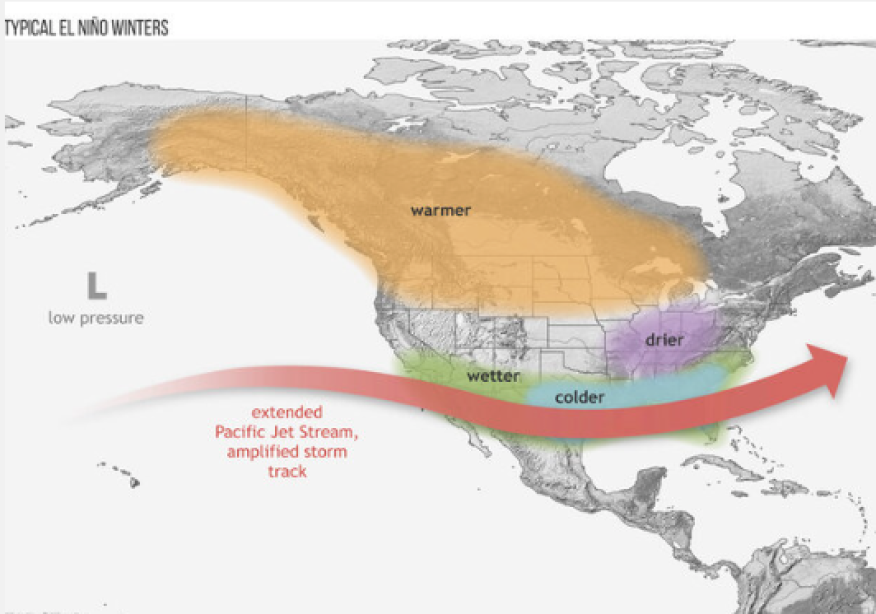
厄尔尼诺通常给北部和俄亥俄河谷带来更温暖、干燥的天气。同时,该国南部地区预计将迎来更潮湿的冬季,雨雪增多。具体的分界线每年都在变化,取决于急流的位置。根据国家气象局的说法,厄尔尼诺年份高潮洪水也可能成为更大的问题,尤其是在西海岸。
El Niño usually brings warmer, dry weather up north and to the Ohio Valley. Meanwhile, the southern half of the country can expect a wetter winter, with more rain and snow. The exact dividing line moves year to year, depending on the position of the jet stream. High-tide flooding may be a bigger problem during El Niño years as well, according to the National Weather Service, and especially on the West Coast.
通过观察信风模式,哥伦比亚大学气候科学家阿扎尔·埃桑在9月的媒体简报会上表示,今年的大气演变看起来与1997年相似,当时形成了有记录以来最强的厄尔尼诺之一。
Looking at trade wind patterns, Columbia University climate scientist Azhar Ehsan said in a September media briefing that this year’s atmospheric evolution looks similar to that of 1997, when one of the strongest-ever El Niños formed.
这个超强厄尔尼诺导致了从海岸到海岸的混乱天气。东北部遭遇冰风暴袭击,而东南部和加利福尼亚州则被洪水般的暴雨浸透。致命龙卷风也横扫佛罗里达州。
The super-strong El Niño contributed to chaotic weather from coast to coast. While the Northeast was hit with ice storms, the Southeast and California were drenched with flooding rain. Deadly tornadoes also tore across Florida.
1997年异常天气的一个好处是,全国取暖费用比正常年份低10%。这种节省在2026年可能会受欢迎,因为能源成本已飙升。
One upside of the weird weather in 1997 was that heating costs were 10% lower nationwide compared to a normal year. That sort of savings might be welcome in 2026, as energy costs have soared.
国家能源援助主任协会最近的一份报告称,预计美国家庭今年冬天平均将花费超过1000美元用于取暖。
A recent report from the National Energy Assistance Directors Association said U.S. households are projected to spend, on average, more than $1,000 to heat their homes this winter.