一场重要的能源会议将于周日在利雅得继续举行,尽管胡塞武装对该市哈立德国际机场的袭击造成12人死亡、309人受伤,沙特阿拉伯民用航空总署如是称。
A major energy conference is going ahead in Riyadh from Sunday despite a Houthi attack on the city’s King Khalid International Airport that killed 12 people and injured 309, according to Saudi Arabia’s General Authority of Civil Aviation.
沙特阿拉伯能源部周日表示,第25届世界石油理事会能源大会已在利雅得开幕。第17届国际能源论坛(IEF)部长级会议将在此次会议的边会上举行,该会议被称为利雅得能源周,将持续到周四。
Saudi Arabia’s Ministry of Energy said on Sunday that the 25th World Petroleum Council Energy Congress has begun in Riyadh. The 17th International Energy Forum (IEF) Ministerial will be held on the sidelines of the conference, called Riyadh Energy Week, which is to run until Thursday.
但作为IEF共同主办国的意大利将通过视频连线参加会议。另一共同主办国尼日利亚将派代表参加此次活动。
But Italy, the cohost of the IEF, will join the meeting via videolink. Nigeria, the other cohost, is sending a representative to the event.
IEF汇集了68个国家,这些国家占全球石油和天然气供需的90%以上。其成员包括沙特阿拉伯、美国和俄罗斯。此次会议的召开正值美以对伊朗的战争扰乱能源流动,促使各国政府重新评估其能源安全。
The IEF brings together 68 countries that account for more than 90 percent of global oil and gas supplies and demand. Its members include Saudi Arabia, the United States and Russia. The meeting comes as the US-Israel war on Iran has disrupted energy flows and pushed governments to reassess their energy security.
在这篇可视化解析中,半岛电视台探讨了世界能源的来源、中东的能源产量以及哪些国家拥有战略储备以备不时之需。世界能源来自哪里?
In this visual explainer, Al Jazeera looks at where the world’s energy comes from, how much is produced in the Middle East and which countries have strategic reserves to fall back on. Where does the world’s energy come from?
能源为我们供暖、为汽车提供动力、照亮灯光并驱动生产我们所购买商品的工厂。它来源于石油、煤炭和天然气等化石燃料,也包括核能和可再生能源。
Energy heats our homes, fuels our cars, keeps the lights on and runs the factories that make what we buy. It comes from fossil fuels such as oil, coal and gas as well as nuclear power and renewables.
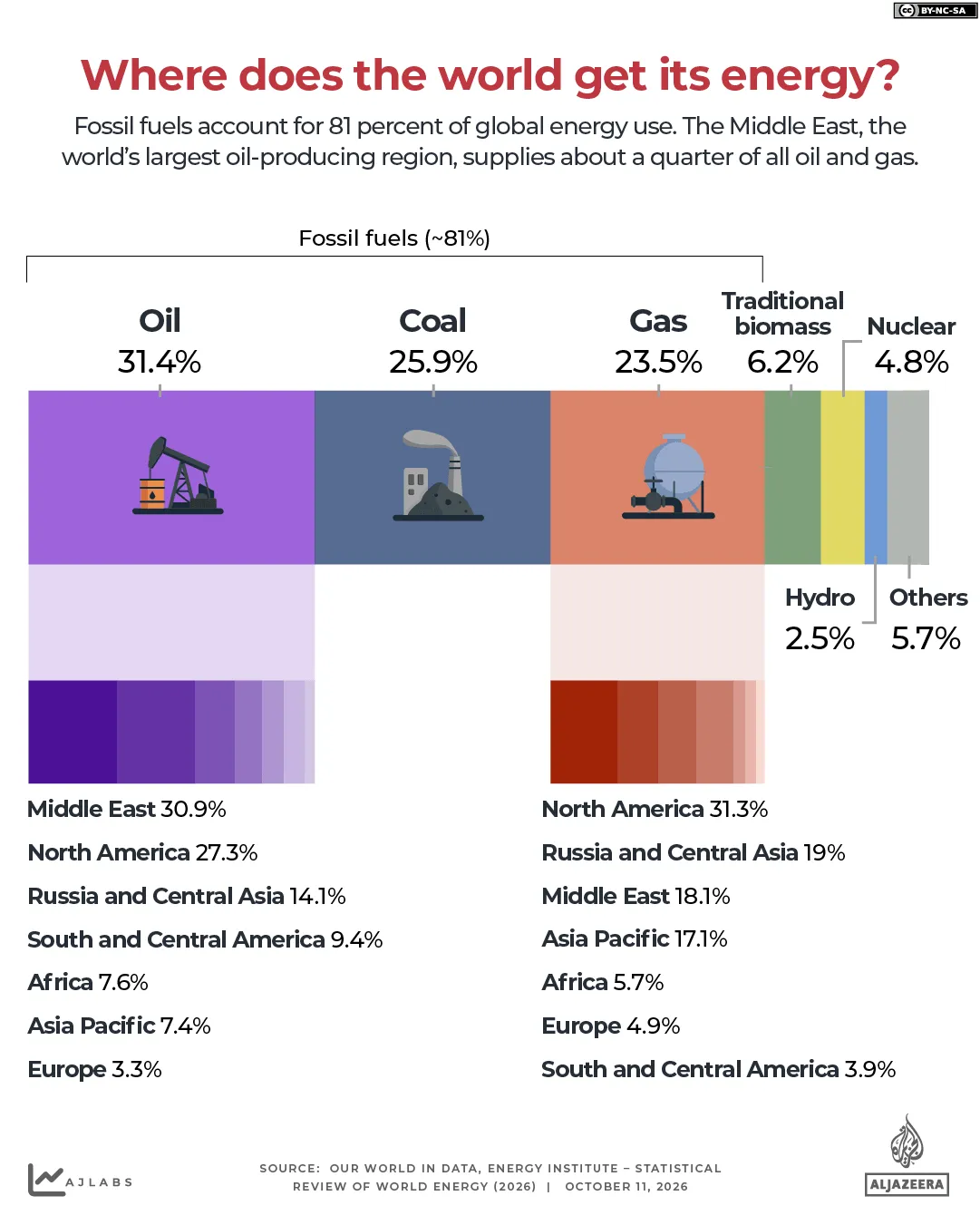
尽管可再生能源增长迅速,但化石燃料仍占全球能源消耗的近81%。石油是最大的能源来源,占31.4%,其次是煤炭,占25.9%,天然气占23.5%。传统生物质、核能和其他能源占剩余部分。
Despite rapid growth in renewables, fossil fuels still account for nearly 81 percent of global energy consumption. Oil is the largest source at 31.4 percent, followed by coal at 25.9 percent and natural gas at 23.5 percent. Traditional biomass, nuclear power and other sources make up the rest.
能源生产高度集中在少数地区,因此任何一个地区的扰动都会在全球市场中产生连锁反应。
Production is concentrated in a handful of regions, so disruptions in any of them ripple through global markets.
中东是全球最大的石油生产地区,北美是最大的天然气生产地区。俄罗斯和中亚也是石油和天然气的主要生产地区。
The Middle East is the largest oil-producing region, and North America is the largest natural gas producer. Russia and Central Asia are also major producers of both.
中东能源如何到达世界 中东对能源市场的重要性也体现在其地理位置上。三条狭窄的水道将其生产者与世界各地的消费者连接起来。
How Middle East energy reaches the world The Middle East’s importance to energy markets is also about geography. Three narrow waterways connect its producers with consumers around the world.
在伊朗战争之前,全球海运石油贸易的约27%和液化天然气贸易的近20%经过阿拉伯半岛东侧的霍尔木兹海峡。
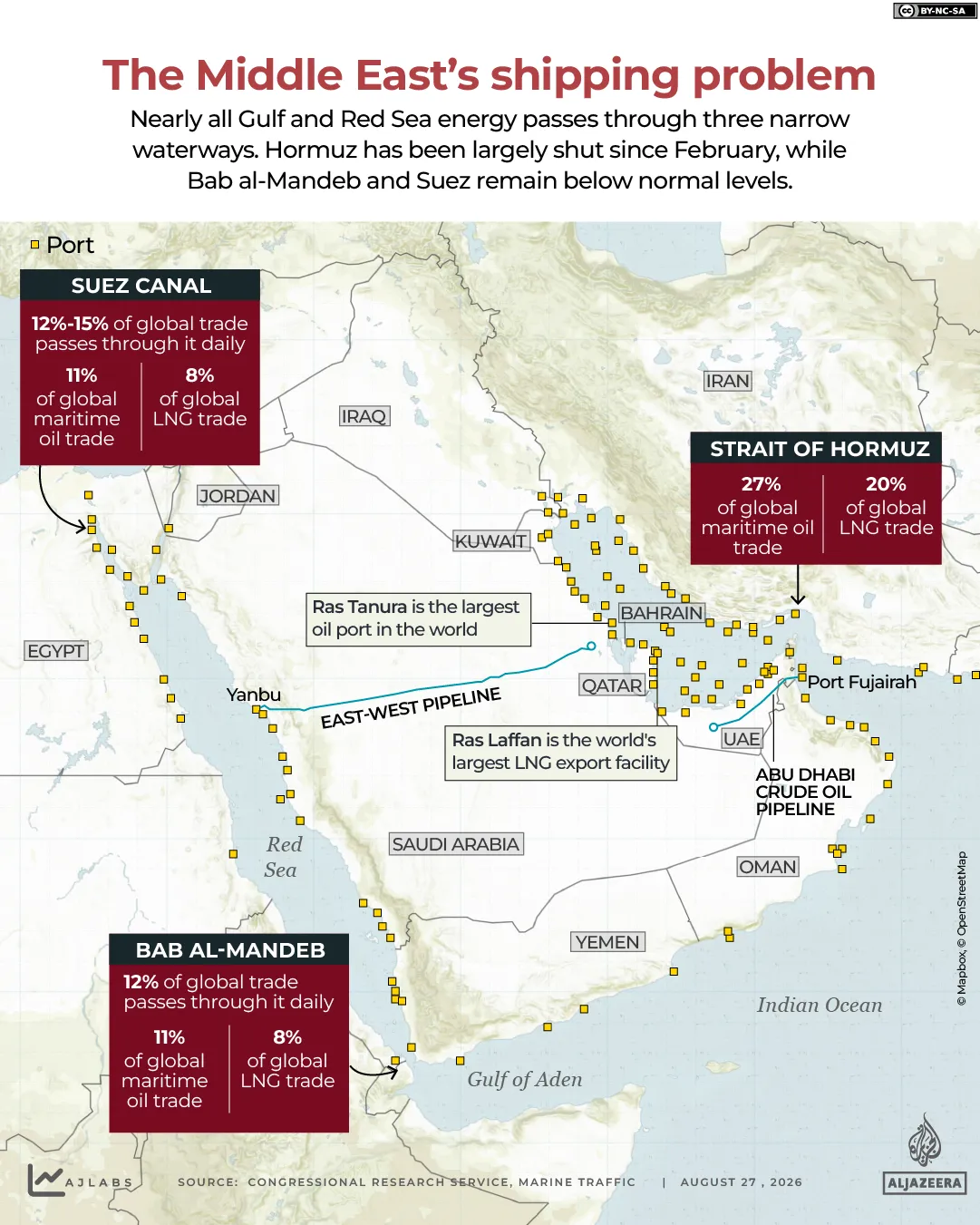
Before the Iran war, about 27 percent of global seaborne oil trade and almost 20 percent of liquefied natural gas trade transited through the Strait of Hormuz on the eastern side of the Arabian Peninsula.
在半岛的西侧,巴布-曼德布海峡将红海与亚丁湾连接起来,苏伊士运河则将红海与地中海连接起来。随着伊朗战争蔓延到中东其他地区以及也门内战的升级,这两条水道的交通量有所减少,迫使一些能源货运被迫绕行非洲进行更长的航线。
On the peninsula’s western side, the Bab al-Mandeb strait links the Red Sea with the Gulf of Aden, and the Suez Canal connects the Red Sea with the Mediterranean. As the Iran war has spilled over into other areas of the Middle East and Yemen’s civil war has ramped up, traffic has been reduced through both the strait and canal, forcing some energy shipments on longer routes around Africa.
“这是我们第一次真正看到一个关键通道出现重大收缩,”吉布森船舶经纪公司(Gibson Shipbrokers)咨询与研究部门主管理查德·马修斯(Richard Matthews)表示,该公司总部位于伦敦,是一家船舶经纪和海事咨询服务机构。
“That’s probably the first time we’ve really seen a major constriction of a chokepoint,” said Richard Matthews, director of consultancy and research at Gibson Shipbrokers, a London-based shipbroking and maritime advisory service.
他告诉半岛电视台,霍尔木兹海峡与其他关键通道的不同之处在于:“没有替代的海上航线。虽然有一些管道,但没有替代方案,这就是为什么它在货运量方面如此重要的原因。”海湾港口是该地区能源踏上前往世界其他地区旅程的起点。哪些国家最依赖中东石油?
He told Al Jazeera that what makes the Strait of Hormuz different from other chokepoints is “there is no alternative maritime route. There are some pipelines, but there’s no alternative, which is why it’s been so significant in terms of cargo volume.”Gulf ports are where much of the region’s energy begins its journey to the rest of the world. Which countries rely most on Middle East oil?
在供应链的下游,人们和企业正通过基本生活成本的上升感受到这种中断的影响。
Further down the supply chain, people and businesses are feeling the disruption through the rising cost of essentials.
依赖海湾石油、天然气和肥料的国家面临价格上涨、货物运输等待时间延长以及寻找其他供应商的需求。即使有些交易使货物得以继续流动,额外的成本也在沿着供应链向下传递。
Countries that rely on oil, gas and fertiliser from the Gulf face higher prices, longer waits for shipments and the need to find other suppliers. Even where deals have kept goods moving, the extra costs are being passed down the chain.
厄立特里亚和马达加斯加是对中东石油依赖程度最高的国家,各自约有90%的石油供应来自该地区。它们之后依次是巴基斯坦(78%)、日本(77%)和肯尼亚(77%)。
Eritrea and Madagascar are the most dependent on Middle Eastern oil, each sourcing about 90 percent of their supply from the region. They are followed by Pakistan (78 percent), Japan (77 percent) and Kenya (77 percent).
天然气比石油更难以替代,因为大部分天然气以液化天然气的形式从卡塔尔和阿拉伯联合酋长国经霍尔木兹海峡运输。
Gas has been even harder to replace than oil because most of it travels as liquefied natural gas from Qatar and the United Arab Emirates through the Strait of Hormuz.
依赖这些船运的国家正在为燃料和电力支付更高的费用,并争夺日益减少的货源。储存能力有限的贫困进口国在寻找替代方案方面遇到的困难最大。
Countries that depend on these shipments are paying more for fuel and electricity and competing for a smaller pool of cargoes. Poorer importers with little storage have struggled the most to find alternatives.
依赖中东天然气最多的国家主要位于亚洲。韩国使用的天然气中有31%来自该地区,其次是印度(29%)、巴基斯坦(27%)和台湾(26%)。谁拥有最大的紧急石油储备?
The countries that rely most heavily on Middle Eastern gas are mostly in Asia. South Korea sources 31 percent of the gas it uses from the region, followed by India (29 percent), Pakistan (27 percent) and Taiwan (26 percent). Who has the largest emergency oil reserves?
各国会储备紧急石油,以防供应被切断或减少,这些储备一直是战争期间世界的主要缓冲。但如今这一缓冲正在变薄。
Countries keep emergency oil stocks for when supplies are cut off or reduced, and these have been the world’s main cushion during the war. That cushion is now wearing thin.
能源行业领袖警告称,西方国家几乎没有剩余可释放的石油,美国战略石油储备已降至1982年以来的最低水平。
Western countries have little left to release, energy industry leaders warned, and the US Strategic Petroleum Reserve is at its lowest level since 1982.
“估计表明,目前仅剩下不到60亿桶的商业库存,且绝大多数实际上无法使用,”沙特阿美公司首席执行官阿明·纳赛尔周一在伦敦能源情报论坛上表示。
“Estimates suggest less than 6 billion barrels of commercial inventories remain today with the vast majority not practically available,” Amin Nasser, head of Saudi Aramco, told the Energy Intelligence Forum in London on Monday.
国际能源署负责协调其成员国的紧急石油储备,3月份释放了创纪录的4亿桶石油。目前该机构正准备再释放1亿桶原油和柴油,以缓解飙升的柴油价格,尽管其中部分可能是3月释放但尚未进入市场的石油。
The International Energy Agency, which coordinates emergency stocks for its members, released a record 400 million barrels of oil in March. It is now preparing to release another 100 million barrels of crude and diesel to ease soaring diesel prices although some of this may be oil from the March release that has yet to reach the market.
墨西哥湾的一场风暴和沙特阿拉伯的袭击正在再次威胁供应,使油价维持在每桶100美元以上。
A storm in the Gulf of Mexico and attacks in Saudi Arabia are now threatening supplies again, keeping oil prices above $100 a barrel.
在此次释放之前,中国拥有远超其他国家的石油储备,估计为14亿桶,超过其余国家储备总和。美国位列第二,储备为4.13亿桶,日本紧随其后,储备为2.63亿桶。
Before this year’s releases, China held by far the largest reserves, an estimated 1.4 billion barrels, more than the rest of the list combined. The US was second with 413 million barrels, followed by Japan with 263 million.