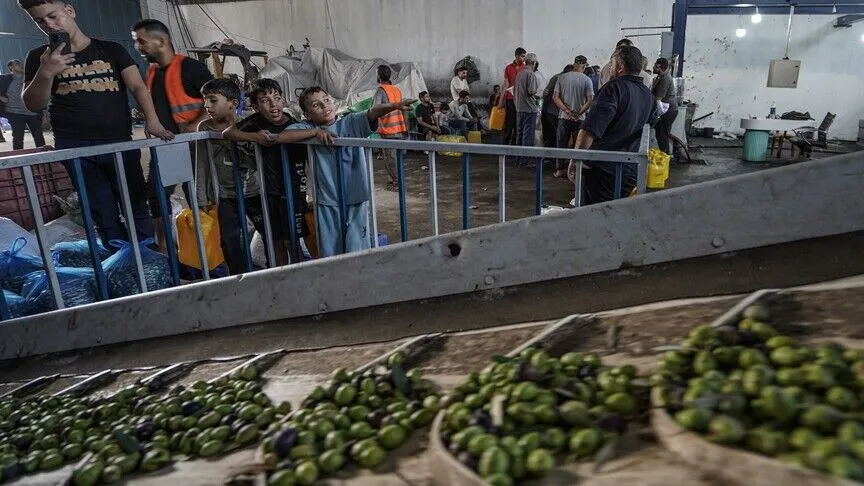
加沙农业部估计战争给农业部门造成的损失超过30亿美元。加沙的巴勒斯坦农民今年正面临艰难的橄榄收成,因为产量下降、大片农田受损,且许多橄榄林因位于以色列军队控制的区域或所谓的“黄线”以外而无法进入。
Gaza Agriculture Ministry estimates agricultural sector losses from war at more than $3B Palestinian farmers in Gaza are facing a difficult olive harvest this year as production declines, large areas of agricultural land remain damaged and many groves are inaccessible because they lie in areas controlled by the Israeli army or beyond the so-called “yellow line.”
在可以进入的农田上,尽管缺乏化肥、灌溉水和农业物资,且劳动力、运输和压榨成本更高,农民们仍在继续采摘橄榄,并将其从树叶和树枝中分离出来。
On accessible farmland, farmers continue picking olives and separating them from leaves and branches despite shortages of fertilizer, irrigation water and agricultural supplies, as well as higher labor, transportation and pressing costs.
这些压力使得许多家庭无法储存他们通常的年度橄榄油和橄榄储备。
The pressures have left many families unable to store their usual annual supplies of olive oil and olives.
7月13日,加沙农业部估计,自2023年10月8日开始的以色列种族灭绝战争给农业部门造成的损失超过30亿美元,其中包括14.9亿美元的直接损失和15.9亿美元的间接损失。
On July 13, Gaza’s Agriculture Ministry estimated losses to the agricultural sector from Israel’s genocidal war, which began on Oct. 8, 2023, at more than $3 billion, including $1.49 billion in direct damage and $1.59 billion in indirect losses.
加沙中部代尔巴拉赫的农民卡迈勒·巴拉卡表示,橄榄树的产量大幅下降。
Kamel Baraka, a farmer from Deir al-Balah in central Gaza, said olive tree yields had fallen significantly.
“战前一棵产约100公斤(220.4磅)橄榄的树,现在产量不超过20(44磅)到30公斤(66磅),”巴拉卡对阿 Anadolu 通讯社表示。他补充说,这代表着约70%至80%的降幅。
“A tree that produced around 100 kilograms (220.4 pounds) of olives before the war now produces no more than 20 (44 pounds) to 30 kilograms (66 pounds),” Baraka told Anadolu. That represents a decline of around 70% to 80%, he added.
“曾经为农民、商人跟工人提供重要收入来源的季节,如今由于当前的情况和基本农业物资的短缺,勉强只能满足一些家庭的需求,”巴拉卡说。
“A season that once provided an important source of income for farmers, traders and workers now barely meets the needs of some families because of current conditions and shortages of essential agricultural supplies,” Baraka said.
“橄榄种植需要持续的照料、化肥、灌溉以及其他变得越来越难以获得的投入,”他补充说。严重破坏 农田的破坏和通行限制也直接减少了收成。
“Olive cultivation requires constant care, fertilizer, irrigation and other inputs that have become increasingly difficult to obtain,” he added. Massive damage Damage to farmland and restrictions on access have also directly reduced the harvest.
“加沙中部东部地区的大片橄榄林位于农民无法到达的地带,特别是萨拉丁街以东和‘黄线’周边,”巴拉卡说。
“Large areas of olive groves in eastern parts of central Gaza lie in zones farmers cannot reach, particularly east of Salah al-Din Street and around the ‘yellow line,’” Baraka said.
“黄线”是加沙地带内部的一条虚拟分界线,以色列军队根据美国总统唐纳德·特朗普旨在结束战争的计划的第一阶段撤退至该线,根据该计划,停火协议已于2025年10月10日生效。它将加沙东部仍由以色列军队控制的区域与该线以西允许巴勒斯坦人活动的区域隔开。
The “yellow line” is a notional line inside the Gaza Strip to which the Israeli army withdrew under the first phase of US President Donald Trump’s plan to end the war, under which a ceasefire took effect on Oct. 10, 2025. It separates areas in eastern Gaza that remain under Israeli army control from areas west of the line where Palestinians are allowed to move.
“代尔巴拉赫、布赖杰和马加齐的农民在前往曾是橄榄主要产地的农田时面临困难,”巴拉卡说。
“Farmers in Deir al-Balah, Bureij and Maghazi face difficulty reaching agricultural land that had been a major source of olive production,” Baraka said.
他说,萨拉丁街以西可用的农田不足以满足居民对橄榄油和橄榄的需求。
He said available farmland west of Salah al-Din Street is insufficient to meet residents’ needs for olive oil and olives.
战前,收获准备工作通常提前一个月左右开始,农民安排工人并准备采摘和运输设备,而各家庭则为接下来的一年储存橄榄和油。
Before the war, preparations for the harvest began about a month in advance, with farmers arranging workers and preparing equipment for picking and transport, while families stored olives and oil for the year ahead.
随著产量下降和成本上升,这些准备工作已经减少,一些农民现在只收集足够家庭消费的橄榄和少量的销售量。
Those preparations have declined as production falls and costs rise, with some farmers now collecting only enough olives for household consumption and limited quantities for sale.
成本翻三番 农民们还在艰难应对急剧上涨的运输和压榨成本,以及储存橄榄油所需容器的短缺。
Costs triple Farmers are also struggling with sharply higher transportation and pressing costs, as well as shortages of containers needed to store olive oil.
“压榨橄榄的成本已经上升到战前的三倍左右,”巴拉卡说,并补充说这一增长给那些因产量下降而收入已经减少的农民带来了更大的压力。
“The cost of pressing olives has risen to around three times what it was before the war,” Baraka said, adding that the increase has placed further pressure on farmers whose incomes have already fallen because of lower production.
“战前,橄榄榨油厂的老板经常把收成从农场运到压榨设施,而现在农民们即使为少量的橄榄也难以为继地寻找运输工具,”他补充说。
“Before the war, olive press owners often transported harvests from farms to pressing facilities, while farmers now struggle to find transportation even for small quantities,” he added.
抽水和灌溉树木的成本上升,加上化肥、劳动力和储存容器的短缺,使得保护收成和储存油变得越来越困难,特别是对于那些依靠农业满足食物需求的家庭而言。
Higher costs for pumping water and irrigating trees, combined with shortages of fertilizer, labor and storage containers, have made preserving the harvest and storing oil increasingly difficult, particularly for families that depend on farming for their food needs.
“橄榄季节曾经是农民改善生计和确保全年粮食供应的机会,现在却成了一个令人精疲力竭的季节,只能为他们中的许多人提供他们所需的一小部分,”巴拉卡说。
“The olive season, once an opportunity for farmers to improve their livelihoods and secure food supplies for the year, has become an exhausting season that provides many of them with only a fraction of what they need,” Baraka said.
据加沙农业部称,自2023年10月8日以色列种族灭绝战争爆发以来,加沙的农业部门遭受了广泛破坏。
Since Israel’s genocidal war began on Oct. 8, 2023, Gaza’s agricultural sector has sustained widespread damage, according to the Agriculture Ministry.
该部表示,在总共182,247亩(45,033英亩)的农田中,已有158,909亩(39,267英亩)受损,约占87%,这大幅减少了农作物产量和提供粮食的能力。
The ministry said 158,909 dunams (39,267 acres) of agricultural land have been damaged out of a total 182,247 dunams (45,033 acres), or around 87%, sharply reducing crop production and the capacity to provide food.
据巴勒斯坦官方统计,这场战争还导致超过7.4万名巴勒斯坦人死亡、17.5万多人受伤,并摧毁了该飞地约90%的基础设施。
The war also has killed more than 74,000 Palestinians and injured over 175,000 others, according to Palestinian figures, also destroying about 90% of the enclave's infrastructure.