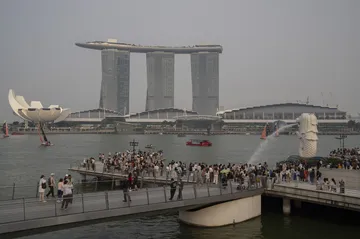
过去几个月,随着厄尔尼诺现象助长印尼森林和灌木丛的燃烧,东南亚地区笼罩在一片浓雾之中。追究火灾责任的困难源于一个更为深刻且难以穿透的法律阴影。
A cloud of haze has descended across Southeast Asia over the past few months as a brutal El Niño helps incinerate forest and scrub in Indonesia. Obscuring responsibility for the fires stems from a much deeper and more impenetrable legal pall.
烟雾已经蔓延至整个地区,导致马来西亚学校停课,航班被迫改航,而新加坡——这个本身没有任何土地正在燃烧的城邦——却遭受了全球最严重的空气污染。如果当前趋势持续下去,这一事件可能演变成自2015年毁灭性山火以来东南亚地区最严重的一次。
The smoke has spread across the region, forcing schools to close in Malaysia, diverting flights, and giving tiny Singapore — which has no dry lands of its own aflame — the worst air pollution in the world. If current trends persist, this episode may turn into the worst in Southeast Asia since devastating wildfires in 2015.
在新加坡——该地区最富裕的国家——人们谈论此事时,常把整个情况描述为“天灾”:火灾只是发生了,没有人能确定究竟谁该负责。更为深入的分析则将责任归咎于该地区最大国家的顽固不化。当新加坡于2014年通过一项法律,威胁对造成雾霾的公司处以数百万美元罚款时,印尼拒绝合作导致该法律无法实施。对这个城邦而言,对其巨邻的克制已成为外交的智慧之举。
To hear the way this is talked about in Singapore, the region’s wealthiest country, the whole situation is an act of God: Fires just happen, and no one can be sure exactly who is responsible. A more sophisticated diagnosis blames intransigence in the region’s largest country. When Singapore passed a law in 2014 threatening millions of dollars in fines for companies causing haze, Indonesia’s refusal to cooperate made it impossible to implement. For the city-state, discretion toward its giant neighbor has become the better part of diplomacy.
当然,准确辨认谁点燃了东南亚的森林大火并不容易,但这是因为该地区的法律充斥着巨大且显而易见的漏洞。在印尼和新加坡官方互相指责当前糟糕局面的情况下,小农和企业可以继续破坏生态环境,而无需面对任何严肃的追责要求。
It’s certainly hard to discern precisely who is responsible for lighting Southeast Asia’s forest fires, but that’s because laws across the region are riddled with huge and obvious loopholes. With officialdom in Indonesia and Singapore blaming each other for the grim state of affairs, smallholders and businesses can get on with despoiling the landscape without anyone making a serious claim to accountability.
问题的核心在于印度尼西亚的油棕、木材及造纸产业呈现出高度分散的特征。在这些行业中,大型企业掌控着棕榈油加工厂、纸浆厂等关键供应链环节,同时也拥有大量种植园。与马来西亚的种植园企业(如SD Guthrie Bhd.)大多将总部设在吉隆坡的情况不同,印度尼西亚的许多大型企业却选择在新加坡上市或设立总部——新加坡是该地区最主要的资本市场及私人财富管理中心。
The central problem lies in the fragmented nature of Indonesia’s oil palm, timber and paper industries. In each case, large companies control key supply nodes, such as palm oil mills and pulp factories, as well as significant plantation estates. While Malaysia’s plantation companies such as SD Guthrie Bhd. are mostly headquartered in Kuala Lumpur, many of Indonesia’s largest businesses are listed or headquartered instead in Singapore, the leading capital market and private wealth hub in the region.
在这些大型企业之下,还存在着一个错综复杂的供应商网络。以油棕产业为例,其中包含了数以百万计的小农户,他们大多是贫困的农村居民,仅拥有几公顷土地,土地权属也时常不明确,且很少受到政府林业部门的严格监管。他们的收成往往要经过中间商的转手才能送达加工厂。相比之下,造纸用木主要来自大型林业特许经营区,这些区域的权属情况及其与大型生产商之间的关系往往缺乏透明度。
Beneath these giants is a complicated network of suppliers. In palm oil, that includes millions of smallholders — often poor rural farmers managing just a few hectares, sometimes with uncertain rights to their land and under far less scrutiny from government forestry officials. Their crops frequently pass through intermediaries before reaching the mills. Pulpwood, by contrast, comes predominantly from large forestry concessions, whose ownership and relations with the major producers aren’t always transparent.
农业综合企业既从自身监管较为严格的种植园采购原料,也会从外部供应商处采购,而后者的环保措施则很难被准确评估。
Agribusiness companies source materials both from their own, more closely monitored plantations, and from outside suppliers whose environmental practices can be much harder to establish.
由此便产生了长期存在的治理漏洞。2015年,印度尼西亚多地发生森林火灾,给该地区经济造成14亿美元的损失,还导致10万人丧生。为此,新加坡试图对六家企业提起法律诉讼。然而其中两起案件最终被撤销;在另外四起案件中,雅加达方面也拒绝配合新加坡当局对相关企业负责人的问询请求。此外还有观点认为,由于印度尼西亚的信息自由法限制,那些用于划定特许经营区边界、从而将企业责任与卫星图像所显示的火灾热点区域联系起来的地图资料也无法被提供。面对种种阻力,新加坡最终只能让这些诉讼案件不了了之。
The result is a chronic governance gap. Singapore attempted to bring legal action against six companies over the 2015 fires, which cost the economy $1.4 billion and led to 100,000 deaths across the region. But two of the cases were dropped, and in the other four, Jakarta refused to cooperate with Singaporean authorities’ requests to question a director. It’s similarly argued that maps that would be needed to establish concession boundaries, and thus link liability with the clear evidence of fire hotspots provided by satellite imagery, cannot be handed over because of Indonesia’s freedom of information laws. Faced with this pushback, Singapore allowed the cases to disappear into limbo.
这种被动的做法是不可接受的。四起未解决的案件并不涉及晦涩偏远的公司,而是涉及亚洲浆纸公司的主要供应商,而亚洲浆纸公司是印尼威贾家族控制的森林马商业帝国的一部分。该家族旗下另一家企业——金光集团有限公司——长期以来一直嵌入新加坡的企业界。
That’s an unacceptably passive approach. The four unresolved cases didn’t involve obscure and remote companies, but major suppliers to Asia Pulp & Paper, part of the Sinar Mas business empire controlled by Indonesia’s Widjaja family. Another business associated with the family, Golden Agri-Resources Ltd., has long been embedded in Singapore’s corporate establishment.
如果新加坡认真对待这一问题,它将利用印尼对其金融部门的依赖。在新加坡寻求上市、贷款或资本的种植园公司应被要求提供其特许经营权和供应商的最新地图。新加坡可以采用欧盟目前对棕榈油所采用的基本原则:产品必须可追溯到其种植的地块,而不是消失在一个工厂里,在那里负责任种植的果实可能与来源不明的供应混在一起。
If Singapore were serious about tackling this problem, it would leverage Indonesia’s reliance on its financial sector. Plantation companies seeking listings, loans or capital there should be required to provide up-to-date maps of their concessions and suppliers. Singapore could impose the same basic principle that the European Union is now applying to palm oil: Produce must be traceable to the plots where it was grown, rather than disappearing into a mill where fruit farmed responsibly can be mixed with supplies of murkier provenance.
将其转化为双方斗争正是一个方便的借口,因为它允许两国在海峡两岸互相指责。然而事实是,在这两个国家中,有些群体从破裂的现状中获利,而绝大多数人则必须承受窒息、刺眼的后果——更不用说雨林本身,它每年都在变得更加萎缩和退化。新加坡2014年法律的后果表明,雾霾的责任可以像雾霾本身一样有效地漂移和分散到国际边界之外。如果2026年的污染灾难能带来任何好处,让我们希望它能带来最终能够让从雨林燃烧中获利的人承担责任的规则。
Turning it into a bilateral fight is a convenient excuse precisely because it allows both countries to point fingers across the Strait. The truth, though, is that groups in each of them do well off the broken status quo, to the detriment of the vast majority who must live with the choking, eye-watering consequences — not to mention the rainforest itself, which is more shrunken and degraded with each passing year. The aftermath of Singapore’s 2014 law proved that responsibility for haze can drift and disperse over international borders quite as effectively as the smog itself. If anything good can come out of the pollution disaster of 2026, let’s hope it’s rules that can finally deliver accountability to those who profit from the burning of the rainforest.