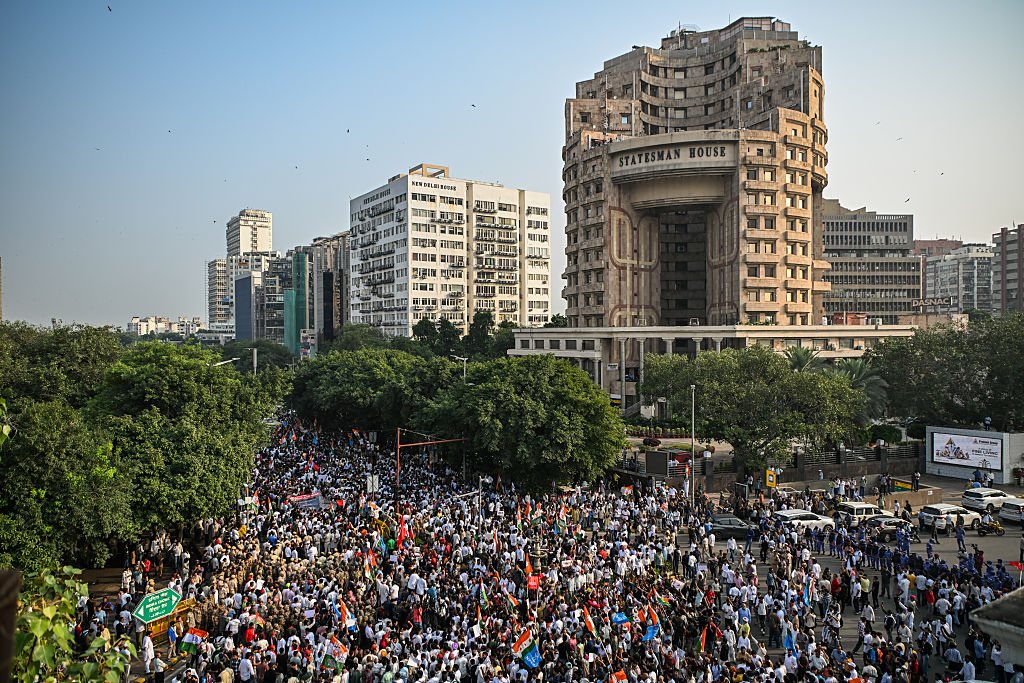
周六,印度首都新德里陷入围困。印度政府部署了超过2万名警察和准军事人员,封锁了市中心,并暂停了互联网接入。到傍晚时分,已有超过7000人被警方拘留,其中包括印度反对党领袖、律师和记者。尽管进行了镇压,周一仍有数千人在德里集会抗议,且抗议力度更大。
On Saturday, New Delhi, the Indian capital, was under siege. The Indian government deployed more than 20,000 police and paramilitary personnel, barricaded the city center, and suspended internet access. By evening, more than 7,000 people were detained by the police, including leaders from India’s opposition parties, lawyers, and journalists. Despite the crackdown, thousands turned out in Delhi on Monday to protest with even greater vigor.
此次镇压行动旨在阻止在新德里传统抗议地点Jantar Mantar举行的计划性抗议。抗议活动围绕两项核心诉求展开:要求印度首席选举委员辞职,以及撤销全国范围内被称为“特别强化修订”(SIR)的进程。
The repressive effort sought to deter a planned protest at Jantar Mantar, a traditional protest site in New Delhi. The protest centered on two core demands: the resignation of India’s chief election commissioner and the rollback of a nationwide process known as Special Intensive Revision (SIR).
首席选举委员是国家选举机构的负责人,由以总理为首的委员会提名后任命。SIR名义上旨在清理和更新选民名单,但已从名单中剔除1.3亿印度人——这一数字超过美国中期选举中有资格投票人数的一半。
The chief election commissioner heads the national electoral body and is appointed on the recommendation of a committee headed by the prime minister. The SIR ostensibly seeks to clean up and update the electoral rolls but has removed 130 million Indians from the rolls—more than half the number of Americans eligible to vote in the midterm elections.
问题的确始于2025年夏天。当时,印度多个州即将举行州立法机构选举。在这些选举之前,选举委员会宣布在这些州进行选民名册修订,理由是需要“清理”选民名册。众多选民将被要求通过提供指定清单中的一份或多份文件来证明其公民身份和上榜资格。选举委员会官员将审查这些文件,并决定是否接受或拒绝。
The troubles truly began in the summer of 2025. Several Indian states were about to hold elections for their state legislatures. Ahead of those elections, the Election Commission announced an electoral revision in those states, citing the need to “clean up” electoral rolls. Numerous voters would be required to prove that they were citizens and entitled to be on the rolls by producing one or more documents from a select list. Election Commission officials would scrutinize the documents and either accept or reject them.
司法回避 民间团体和政治活动人士于2025年6月在印度最高法院对拟议的选举修订提出了及时挑战。他们质疑选举委员会进行如此规模选举修订的权力。印度的选举法确实授权选举委员会在特定选区对选民名单进行修订,前提是它以书面形式记录其理由。请愿人认为,该法并未赋予选举委员会要求已在名单上的选民重新证明其资格的全面权力。
Judicial avoidance Civil society groups and political activists promptly challenged the proposed electoral revisions before the Supreme Court of India in June 2025. They questioned the power of the Election Commission to undertake electoral revisions at such a scale. India’s election law does authorize the commission to undertake a revision of electoral rolls in specific electoral constituencies, provided it records its reasons in writing. The petitioners argued that it does not grant the Election Commission overarching power to require voters already on the rolls to prove their eligibility afresh.
请愿人还认为,选举委员会可接受的文件清单具有排他性,将导致大规模剥夺选举权。在印度,获取政府签发的文件在很大程度上取决于种姓、阶级和性别。许多人根本缺乏必要的文件,或缺乏应对官僚程序以获取这些文件的能力。
The petitioners also argued that Election Commission’s list of acceptable documents was exclusionary and would result in large scale disenfranchisement. In India, access to documents issued by the government depends heavily on caste, class and gender. Many people simply lack necessary documents or the ability to navigate the bureaucracy to obtain them.
数月来,最高法院未就如此规模的选举修订的合法性作出裁决,使得该行动成为既成事实。相反,它与选举委员会就印度选民必须提供哪些文件才能保持在选民名单上进行了长期的法庭谈判。关于印度国家数字身份文件Aadhaar是否会被接受,展开了长期辩论。
For months, the Supreme Court did not rule on the legality of electoral revisions on such a vast scale, allowing the exercise to become a fait accompli. Instead, it engaged in prolonged courtroom negotiations with the Election Commission over which documents Indian voters would have to provide to remain on the electoral rolls. There was an extended debate on whether Aadhaar, India’s national digital identity document, would be accepted.
但即使法律辩论仍在继续,选民名单上的排除情况仍在增加。在印度东部邦西孟加拉邦,印度总理纳伦德拉·莫迪领导的印度人民党(BJP)从未赢得过州级选举,有九百万人——约占选民总数的12%——发现自己被排除在选民名单之外。
But even as the legal debates continued, exclusions from electoral rolls mounted. In the eastern Indian state of West Bengal, where Prime Minister Narendra Modi’s Bharatiya Janata Party (BJP) had never won a state election, nine million people—around 12% percent of the electorate—found themselves excluded from the rolls.
面对这些排除,且仍不愿裁定SIR的合法性,最高法院采取了前所未有的步骤:建立了一整套行政机器——由司法官员组成的法庭来审理被排除选民的上诉。当请愿人警告这些法庭可能需要数年,甚至数十年才能处理完所有上诉时,最高法院法官实际上表示,只要被排除的人最终能够重新登记选民名单,他们在即将到来的选举中不投票也是可以的。
Faced with these exclusions, and still unwilling to rule on the legality of the SIR, the Supreme Court took the extraordinary step of creating an entire administrative machinery: tribunals staffed by judicial officers to hear appeals from excluded voters. When the petitioners warned that these tribunals would take years, if not decades, to resolve all the appeals, the Supreme Court judges effectively said that it was fine for excluded people to note vote in the upcoming election as long as they would eventually be put back on the rolls.
西孟加拉邦的选举在使用新选民名单的情况下进行,印度人民党(BJP)获胜。SIR可能存在问题的一个迹象是:在西孟加拉邦,约90%的被排除选民的上诉最终得到裁决后,这些选民最终被重新登记到选民名单上。也就是说,每十个被排除的选民中就有九人是被错误地移除。然而,尽管每个州的排除人数达到百万级别,最高法院仍指出,数据并未显示“系统性剥夺选举权”。
The West Bengal election went ahead using the new electoral rolls and the BJP won. One indication of how flawed the SIR may have been was that around 90% of the voters in West Bengal, whose appeals were decided, were eventually restored to the rolls. Nine out of every ten excluded voters had been wrongfully removed. Yet even as exclusions numbered in the millions in each state, the Supreme Court noted that the data did not indicate “systemic disenfranchisement.”
未受约束的官僚最终,当最高法院终于在2026年夏季作出判决时,它维持了整个过程。它肯定了选举委员会按照其认为合适的方式进行选民名单修订的广泛权力。
Unchecked bureaucrats Eventually, when the Supreme Court finally issued its judgment in the summer of 2026, it upheld the entire exercise. It affirmed the wide powers of the Election Commission to conduct the electoral revisions as it saw fit.
反对该行动的一个核心论点是:通过要求所有选民——包括已经在选民名单上的人——重新证明其资格,选举委员会实际上把每个人都视为 presumptively 不具备投票资格。这是对权力的严重不成比例行使,特别是因为选举委员会本可以采取更为比例适当的方法。
A central argument against the exercise was that by requiring every elector, including those already on the electoral rolls, to prove their eligibility afresh, the Election Commission was treating each individual as presumptively ineligible to vote. This was a grossly disproportionate exercise of power, particularly because more proportionate methods were available to the election commission.
法院也驳回了这一论点,我认为,这实际上使选举委员会免于必须按比例行事的要求。正如法律学者瓦苏德夫·德瓦达桑所指出的,该判决的效果是制造了一类“永久性”被剥夺选举权的人群——他们根本无法参与政治生活。
The court rejected this argument too and, I believe, effectively immunized the commission from the requirement to act in a proportionate manner. As the legal scholar Vasudev Devadasan noted, the judgement had the effect of creating a "permanent class" of disenfranchised persons who simply cannot participate in political life.
后果很快显现:西孟加拉邦的新印度人民党政府多次威胁,要切断因通过SIR被排除在选民名单之外的人的福利待遇。虽然最高法院指出SIR并非旨在确定公民身份,但到2026年夏天,这种区分变得难以维持。
The consequences soon became apparent: the new BJP government in West Bengal threatened, on more than one occasion, to cut off welfare benefits for people excluded from the electoral rolls through the SIR. Although the Supreme Court noted that the SIR was not meant to determine citizenship, by the summer of 2026, that distinction was becoming difficult to sustain.
除了对人民福利权利的威胁之外,还有广泛报道的案例显示,因申请人通过SIR被排除在选民名单之外,导致护照续签被拒。
Beyond the threat to people’s welfare entitlements, there were widely reported cases of passport renewals being denied because applicants had been excluded from the electoral rolls through the SIR.
2020年,印度政府试图建立全国公民登记册(NRC)的努力曾受到广泛批评,因为它将迫使每个人向国家当局证明自己的公民身份,并导致广泛排斥。全国范围内针对它的抗议爆发后,NRC被搁置。SIR如今似乎是通过后门引入NRC的一种方式。
In 2020, the Indian government’s attempts to create a National of Citizens (NRC) had been widely criticized because of how it would force every individual to prove their citizenship to state authorities, and lead to widespread exclusion. After widespread protests across the country against it, the NRC was shelved. The SIR now appeared to be a way of introducing the NRC through the backdoor.
随着SIR在多个州推进——每个州都出现大规模排除——一些模式开始显现:弱势和边缘化群体以及宗教少数派(尤其是穆斯林)被不成比例地排除;即使具备所需文件的选民也因算法被排除,理由是诸如父母子女之间任意年龄差距之类的“逻辑不一致”,而这些标准因州而异,具有任意性。
As the SIR proceeded across multiple states—with large-scale exclusions in each—patterns began to emerge: disproportionate exclusions among vulnerable and marginalized people and of religious minorities, especially Muslims; and the use of algorithms to exclude even voters who possessed the required documents, citing "logical discrepancies" such an arbitrary age gap between parent and child, judged by arbitrary criteria that varied from state to state.
其他令人不安的事实也随之浮出水面。在某些社区,人们大量提交预填好的表格,试图通过质疑其公民身份来将穆斯林排除在选民名单之外。印度的选举法允许第三方对任何人被列入选民名单提出异议。
Other disturbing facts also came to light. In certain neighborhoods, people had submitted pre-filled forms in bulk, seeking to have Muslims removed from off the electoral rolls by questioning their citizenship. India’s electoral law allows third parties to object to anyone’s inclusion on the electoral rolls.
在德里,一些知名人物被遗漏出选民名单引发公众愤怒。选举委员会随后推出了一个“VIP通道”,通过该通道他们的名字可以被恢复,从而形成了一个阶级特权的两层制度。
In Delhi, the omission of some prominent people from the rolls provoked public outrage. The Election Commission then introduced a “VIP portal” through which their names could be restored, creating a two-tier system of class privilege.
一位坚韧的记者。在此背景下,印度快报记者Ritika Chopra在九月最后一周发表的一篇调查报道宛如炸弹般震撼了公众。她的报道显示,尽管选举委员会的决定理论上应由其三名委员通过协商一致作出,但首席选举委员却一直单方面做出决定,常常在其他委员的反对意见下强行推进,有时甚至根本不让其他委员参与。
A tenacious reporter Against this backdrop, an investigative report by Ritika Chopra, a journalist with the Indian Express newspaper in the last week of September, landed like a bombshell. Her report showed that although the Election Commission’s decisions were supposed to be taken by consensus among its three commissioners, the chief election commissioner had been taking them unilaterally, often over the objections of, and sometimes without involving, the other commissioners. (The Election Commission responded by describing differing “views and observations” as part of “deliberation in any institution.”)
(选举委员会对此回应称,不同的“看法和观察”是“任何机构内部协商的一部分”。)随后又有更多报道陆续出现,记录了更多单方面决策、由私营企业构建的不透明算法,以及选举委员会内部权力日益集中——该委员会如今拥有增删选民的权力。这显然背离了印度设计用于防止恶意决策的分散式选举制度。
More reports followed, documenting more unilateral decisions, opaque algorithms built by private corporations, and the increasing centralization of authority within the Election Commission to add or remove voters. It was a clear departure from India’s decentralized electoral system, which is designed to guard against decisions made in bad faith.
这些报道点燃了积压已久的愤怒,尤其是针对首席选举委员的愤怒。根据印度选举法,选举委员由一个委员会任命,而该委员会中政治行政机关占据二比一的多数;实际上,这些委员是行政任命。最高法院在2023年试图改革这一制度,但随后的立法绕过了其努力。法院随后将对该立法的质疑搁置一旁。所有这些共同解释了为何首席选举委员成为公众愤怒的主要焦点。
These reports crystallized latent anger, particularly against the chief election commissioner. Under Indian electoral law, election commissioners are appointed by a committee in which the political executive holds a two-to-one majority; they are, in effect, executive appointments. The Supreme Court’s 2023 attempt to reform this system was bypassed by subsequent legislation. The court then left a challenge to that legislation on the back burner. All of this explains why the chief election commissioner became the primary focus of public anger.
SIR的故事既是印度大规模剥夺选民权利的记录,也是一场制度危机的缩影。两种失败在此交汇:一是未能在法律和宪法层面巩固选举委员会的独立性;二是尽管有剥夺选民权利的证据摆在面前,最高法院仍未采取干预行动。这两者共同导致了德里的激烈民众抗议以及印度政府的镇压行动。
The story of the SIR is both an account of large-scale voter disenfranchisement in India and one of institutional crisis. Two failures converged: the failure to entrench the Election Commission’s independence in law and in the Constitution, and the failure of the Supreme Court to intervene despite evidence of disenfranchisement placed before it. Together they culminated in the furious popular protests in Delhi and the Indian government’s crackdown.
这个故事的结局还很难预料。投票权是人们经过艰苦努力才争取到的,因此一旦失去这种权利,人们会感到非常痛苦。历史表明,一旦人们对那些本应保护投票权的机构失去信任,要重新赢得他们的信任将变得极其困难。印度的选举公正性目前仍笼罩在阴影之下;要消除这一阴影,就必须进行紧迫的、系统的改革。然而,这些改革是否真的能够实施,仍然充满不确定性。
It is difficult to see how this story ends. The right to vote is hard won and its loss keenly felt. History shows that once people lose confidence in the institutions meant to protect that right, restoring their trust is exceedingly difficult. A long shadow hangs over electoral integrity in India. Lifting it will require urgent, systemic reforms. Whether those reforms will come remains uncertain.