在资本密集型行业中,金钱是推动初创企业规模化并压倒竞争对手的武器,因此金融家们往往拥有很大影响力。
In a capital-intensive industry where money is the weapon that catapults startups to scale and overwhelms rivals, financiers can have a lot of sway.
私人信贷贷款人正是基于这种逻辑,才向AI数据中心运营商开出巨额支票,因为这些运营商仅为让一吉瓦的算力上线,就可能需要花费高达300亿美元。他们不满足于获得双位数的收益率,有些人还在尝试股权投资,希望能获得更大的上行空间。
This must be what private credit lenders are banking on as they write big checks to AI data center operators, who will need to spend as much as $30 billion just to bring a gigawatt of computing power online. Not content with earning double-digit yields, some are also dabbling with equity investment, with the hope of capturing more upside.
公开市场的投资者现在开始质疑,AI数据中心开发商究竟能否创造出真正的股东价值。这些公司被称为“新云”(neoclouds),他们购买处理芯片,然后将其租给需要算力来构建和运行AI模型的客户。
Public investors are now pushing back, asking whether AI data center developers can generate much shareholder value at all. Known as neoclouds, these companies buy processing chips and then lease them to customers that need computing power to build and run AI models.
总部位于悉尼的Firmus Grid Ltd.上周失败的300亿美元首次公开募股(IPO)是第一次现实检验。Blackstone Inc.是Firmus的最大股权投资者之一,持有该公司6.7%的股份。8月份,Blackstone参与了一轮估值超过105亿美元的20亿美元融资,此前几个月它曾主导了一项100亿美元的债务融资安排。据报道,该投资公司谈判了多种条款以保护其股权利益,以防IPO未能实现或上市后表现不佳。
Sydney-based Firmus Grid Ltd.’s failed $30 billion initial public offering last week was the first reality check. Blackstone Inc. is one of Firmus’ largest equity investors, owning 6.7% of the company. In August, it participated in a $2 billion funding round with a valuation of more than $10.5 billion, months after leading a $10 billion debt financing facility. The investment firm reportedly negotiated a wide range of clauses to protect its equity interests, in the event that an IPO fails to materialize or tanks upon listing.
随后是AirTrunk的案例。2024年,Blackstone以其有史以来在亚洲的最大规模投资收购了AirTrunk。周二,有消息称,这家澳大利亚数据中心运营商正在推迟其在新加坡计划中的房地产投资信托(REIT)首次公开募股。AirTrunk曾考虑为其REIT提供大约6%的收益率,高于此前设想的5.5%。但考虑到全球投资者只需购买美国国债就能获得超过5%的收益且无需承担那么多风险,这一回报率显然不够有吸引力。
And then came AirTrunk, acquired in 2024 in what was Blackstone’s biggest-ever investment in Asia. On Tuesday, news broke that the Australian data center operator is delaying a planned IPO of a real estate investment trust in Singapore. AirTrunk had considered offering a roughly 6% yield for its REIT, up from a previously envisaged 5.5%. That was not lucrative, considering that global investors can earn more than 5% from the US Treasuries without all that risk.
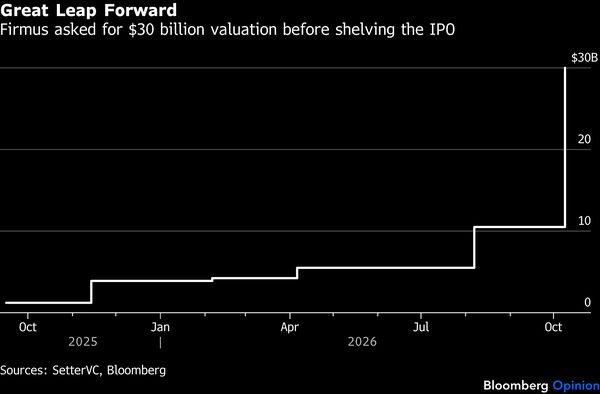
当然,Firmus 的 300 亿美元要价天文数字,这不仅是因为它的估值仅相隔两个月就飙升了。其 912 兆瓦的管道项目中,仅有 46 兆瓦已建成。相比之下,作为新云模式先驱的 CoreWeave Inc. 将在年底前拥有超过 1.85 吉瓦的容量,其市值为 450 亿美元。
Granted, Firmus’ $30 billion ask was astronomical, not the least because it was a huge leap in valuation from just two months earlier. Of its 912 megawatt pipeline, just 46MW had been built. By comparison, CoreWeave Inc., a pioneer of the neocloud model, will have more than 1.85 gigawatts of capacity by year-end; it has a market value of $45 billion.
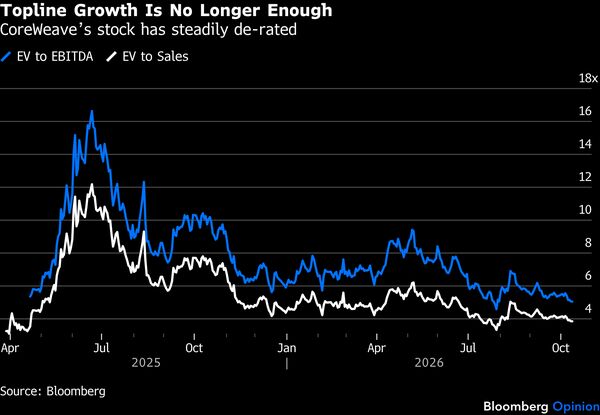
然而,数据中心的问题比 Firmus 的失调报价更为根深蒂固。仅仅强调积压和管道已不再足够。过去,投资者使用更适用于快速扩张企业的估值指标,将公司的企业价值与其收入相比较,或与其息税折旧及摊销前利润相比较。但新云估值一直在稳步下降,这表明股市现在不再愿意仅凭快速的收入增长来给予回报。
The problem with data centers is more deep-rooted than Firmus’ tone-deaf offering, however. Highlighting backlogs and pipelines is no longer enough. In the past, investors used valuation metrics more suited to fast-expanding firms, comparing a company’s enterprise value to its revenue, or earnings before interest, taxes, depreciation and amortization. But neocloud valuations have been steadily falling, a sign that stock markets are now less willing to reward rapid revenue growth on its own.
相反,投资者开始询问 AI 数据中心何时能够实现盈亏平衡。例如,CoreWeave 预计今年将产生 76 亿美元的息税折旧及摊销前利润,但仍在亏损自由现金流。它计划在资本支出上花费高达 390 亿美元,远超其自身收入。
Rather, investors are asking when AI data centers can break even. Case in point: CoreWeave is expected to generate $7.6 billion EBITDA this year, but is still bleeding free cash flow. It plans to spend as much as $39 billion in capital expenditure, a lot more than what the company earns.
投资者也开始看到技术与融资之间的错位。虽然债务是固定的,开发商需对还款负责,但其设备的价值却不是固定的。处理芯片的折旧周期为三到六年,若芯片因技术过时而价值下降过快,新云企业可能需要计提减值。在还清债务后,股东还能剩下多少残余价值?
Investors are also starting to see a mismatch between technology and financing. While the debt is fixed and the developer is on the hook for repayments, the value of their equipment is not. Processing chips are on a three- to six-year depreciation schedule, and neoclouds might have to book impairments if the chips lose their technological relevance too quickly. After paying off their debt, how much residual value is there left for shareholders?
这是 Blackstone 必须做好准备的问题,因为它仍需变现其股权持股。AirTrunk 计划于 2027 年上市;Lambda 也是如此,这是 Blackstone 最近投资的一家后期独角兽。鉴于市场情绪转变如此之快,这家管理着 1.3 万亿美元资产的资产管理公司在 AI 数据中心方面的交易正显得摇摇欲坠。
This is a question Blackstone must prepare for, since it still needs to monetize its equity stakes. AirTrunk is planning to go public in 2027; so is Lambda, another late-stage unicorn it has recently invested in. Given how fast sentiments are turning, the $1.3 trillion asset manager’s AI data center deals are looking shaky.