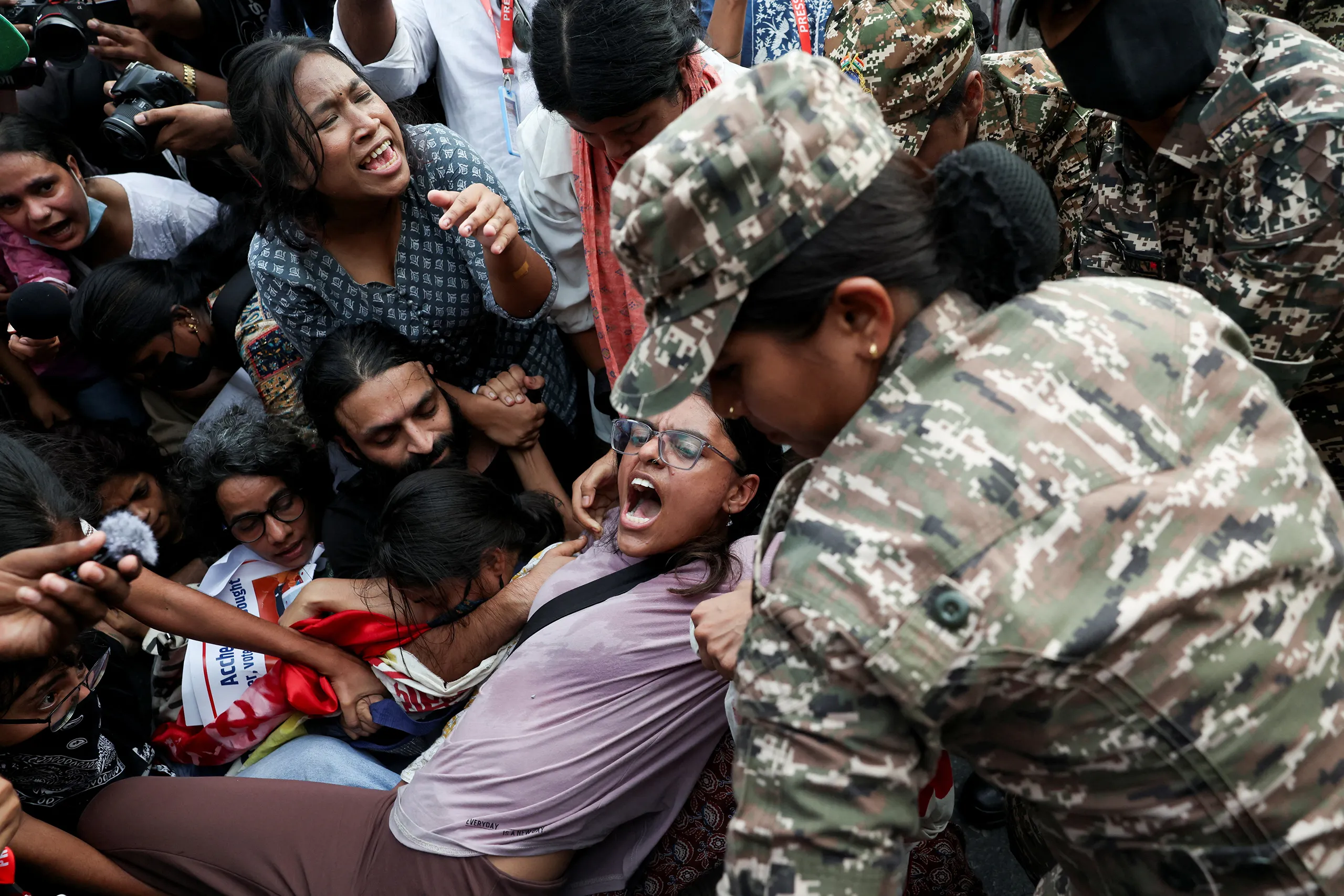
上周末,在印度政府令人震惊的武力展示中,数千名反政府抗议者在新德里被捕。当局尚未说明有多少千人被拘留,但他们在周日释放了被称为“小强民众党”(Cockroach Janta Party)的抗议运动领导人。在过去几个月里,纳伦德拉·莫迪及其领导的印度人民党(B.J.P.)政府面临着广泛的动乱,印度年轻人举行了规模巨大的游行示威,要求对国家的教育体制进行改革,并导致教育部长于7月辞职。
This past weekend, in a shocking show of force by the Indian government, thousands of anti-government protesters were arrested in New Delhi. Authorities have not said how many thousands were taken into custody, but they released the leaders of the protest movement, known as the Cockroach Janta Party, on Sunday. For the past several months, the government of Narendra Modi and his Bharatiya Janata Party (B.J.P.) have faced widespread unrest, with enormous demonstrations of young Indians demanding reforms to the country’s education system, leading to the resignation of the Minister of Education, in July.
然而,在最近一段时间里,小强民众党的抗议活动集中于政府一项令人震惊的决定:将超过一亿人从选民名册中除名。政府声称此举旨在消除名册上的不一致和重复情况,但它将这一过程交由选举委员会全权处理,而该委员会的负责人实际上是由莫迪选定的。我最近通过电话采访了活动人士兼政治学家约根德拉·亚达夫,他是旨在保护印度民主的公民社会组织“团结印度运动”(Bharat Jodo Abhiyaan)的国家召集人。
More recently, however, the C.J.P.’s protests have centered on the government’s astonishing decision to remove more than a hundred million people from voter rolls. The government has claimed that this is intended to eliminate discrepancies and duplicates from the rolls, but it has left the process in the hands of the election commission, whose head was effectively chosen by Modi. I recently spoke by phone with Yogendra Yadav, an activist and political scientist, and the national convener of Bharat Jodo Abhiyaan, a civil-society group that was established to protect Indian democracy.
在我们的交谈中——为了篇幅和清晰度进行了编辑——我们讨论了莫迪政府是否应该对这些抗议感到恐惧、印度民主不确定的未来,以及亚达夫本人在周末抗议中被捕的情况。
During our conversation, which has been edited for length and clarity, we discussed whether the Modi government should fear the protests, the uncertain future of Indian democracy, and the circumstances of Yadav’s own arrest at this weekend’s protests.
是什么让过去几天的抗议活动与以往针对莫迪政府的抗议活动有所不同?
What has made the past several days of protests different from previous protests against the Modi government?
与众不同之处在于,此次抗议的参与者主要是未隶属于任何组织或任何意识形态的青年。过去的零星抗议主要是部门性的。2020年,少数群体抗议《公民身份修正法案》。2021年,农民进行抗议。还有种姓较低和土著人群体的抗议。但所有这些都是部门性抗议,由具有特定部门属性的组织领导。它们都具有一定的能量。其中一些动员规模很大,比如农民抗议。但它们都不是跨部门的。
What is different above all is the participation of youth unaffiliated with any organization or any ideology. The sporadic protests in the past were primarily sectoral. Minority groups protested against the Citizenship Amendment Act in 2020. Farmers protested in 2021. You had lower-caste and Indigenous people protesting. But all these were sectoral protests, led by organizations that were section-specific. All of them had energy. Some of them had huge mobilization, like the farmers. But none of them were cross-sectional.
此次抗议具有跨部门性,因为它跨越了地理界限。它跨越了社会界限。而且它特别吸引青年。从许多方面来看,它也跨越了政治界限,因为抗议者不一定来自反对印度人民党的背景。事实上,印度人民党最担心的是,抗议者中有相当大比例的人来自长期支持莫迪先生的家庭。这些是中产阶级、上层种姓的青年,他们一直是印度人民党的基本盘。正是这一发展让印度人民党最为担忧,也是这一时刻与众不同的原因。
This one is cross-sectional, in that it cuts across geographies. It cuts across social boundaries. And it specifically attracts the youth. It also, in many ways, cuts across political boundaries, in that the protesters are not necessarily from anti-B.J.P. backgrounds. In fact, what worries the B.J.P. most is that a very significant proportion of the protesters come from families that have supported Mr. Modi for quite some time. These are middle-class, upper-caste youths, who have been bastions for the B.J.P. This development is what worries the B.J.P. most, and this is what makes this moment so very different.
您提到许多抗议者具有中产阶级和上层种姓身份。是否存在这样的担忧:抗议过于聚焦于这些身份人群的诉求?
You mentioned the middle-class and upper-caste identity of many of the protesters. Is there a concern that the protests are too focussed on the concerns of people with these identities?
不,我应该澄清一下我所说的话。我当时说的是,抗议活动包括中产阶级和高种姓的青年,他们在过去几乎完全缺席。这并不意味着它由所谓的中产阶级和高种姓抗议者主导。事实上,青年抗议活动的关键领袖之一来自小强民众党(Cockroach Janta Party),他的名字叫阿比吉特·迪普克(Abhijeet Dipke),是一名达利特人,也就是以前被称为“不可接触者”的人。
No. I should clarify what I said. What I said was that the protests include middle-class and upper-caste youth, who were almost entirely absent in the past. It does not mean that it’s dominated by the so-called middle-class and upper-caste protesters. In fact, it so happens that one of the key leaders of the youth protest from the Cockroach Janta Party, whose name is Abhijeet Dipke, is a Dalit, which is to say ex-Untouchable.
他作为达利特人的身份实际上确保了达利特社群的大量参与。如果你看看街头青年的参与情况,它包括从中间阶层到下中层阶级最低阶层的人。
And his being a Dalit has actually insured significant participation from the Dalit community. If you look at the participation of the youth on the streets, it includes people from the middle to the lowest rung of the lower middle class.
你之所以没有看到印度社会底层三分之一人群的大量参与,是因为他们大多数人无法设法来到城市地区参加抗议活动。但是,由于这一中产阶级群体一直是印度人民党(B.J.P.)的堡垒,该群体的大量参与这一事实让印度人民党感到极其担忧。这并不是说那些长期以来一直反印度人民党其他阶层不见了,他们只是现在不再是唯一的阶层,而这正是截然不同的关键所在。
The reason you don’t have substantial participation from the bottom one-third of Indian society is that most of them can’t manage to come to urban areas to participate in the protests. But, because this middle-class section has been the bastion of the B.J.P., the fact that there is significant participation from this section is of enormous worry to the B.J.P. This is not to say that the other sections that have been anti-B.J.P. for quite some time are missing, they are just not the only sections now, and that makes all the difference.
几个月前的许多抗议活动都聚焦于教育体制改革,这些抗议活动似乎与更近期的这些抗议活动有些无缝地融合在一起,后者更多地聚焦于被从选民名册中除名的庞大数量的印度人。你能谈谈选民名册问题以及它是如何激励人们的吗?
The protests several months ago, many of which were focussed on reforms to the education system, seem to have melded somewhat seamlessly with these more recent protests, which are more focussed on the gigantic number of Indians who have been removed from voter rolls. Can you talk about the voter-roll issue and how it is motivating people?
首先作一个澄清。是的,7月份抗议活动的导火索是教育,但正如大多数观察家所注意到的那样,教育问题只是少数抗议者的实际关切。示威活动演变成对教育、就业和普遍生计问题的愤怒和焦虑的更广泛表现。因此,其驱动力要深得多。
One clarification, to begin with. Yes, the trigger for the protests in July was education, but, as most observers noticed, the education question was the operating concern for only a minority of the protesters. The demonstrations became a more widespread manifestation of anger and anxiety about education, employment, and general livelihood issues. So the driving force was much deeper.
同样地,在当前抗议的案例中,首席选举专员的行为、选举委员会的运作,以及被称为特别强化修订(S.I.R.)的剥夺选举权行动,再次成为引发更广泛焦虑、愤怒和对政权不满的导火索。
Similarly, in the case of the current protests, the behavior of the chief election commissioner, the functioning of the election commission, and the disenfranchisement exercise called the special intensive revision (S.I.R.) are again acting as triggers for much wider anxiety, anger, and dissatisfaction with the regime.
我不认为参与其中的每个人实际上都理解S.I.R.是什么。人们普遍认为选举不公平。因此,这是一场关于选举诚信的广泛运动,而S.I.R.恰好成为其焦点。
I don’t imagine that everyone who’s joining it actually understands what the S.I.R. is. There is a generalized sense that elections are unfair. So it’s a broad movement about electoral integrity, of which S.I.R. happens to be a focal point.
现在,具体谈谈S.I.R.:从人数来看,这是世界历史上规模最大的剥夺选举权行动之一。如果你看看历史上主要的剥夺选举权行动,脑海中浮现的例子是美国南北战争后的十九世纪。但当时涉及的人数与印度目前正在发生的情况相比微不足道。你能具体说明到底做了什么吗?
Now, specifically on the S.I.R.: By sheer numbers, this is one of the largest-ever exercises of disenfranchisement in the history of the world. If you look at major exercises of disenfranchisement, the one example that comes to mind is the nineteenth century in the U.S., after the Civil War. But the numbers involved then were tiny compared to what’s happening in India right now. Can you explain specifically what has been done?
这项被称为 S.I.R. 的演习,表面上是对选举规则的常规修订。但在该常规程序的掩护下,启动了一项非凡的机制,该机制完全颠覆了印度选民登记的结构,并剥夺了数百万选民的选举权。在近期历史中,印度一直是一个选民登记由州政府发起的国家。个人不承担责任。也就是说,有人会来到你家,把你登记在选民名单上,进行实地核查,然后你就进入了选民名单。
This exercise, which is called S.I.R., pretends to be a routine revision of electoral rules. But, under the guise of this routine procedure, an extraordinary mechanism has been launched, which has completely inverted the structure of voter registration in India, and disenfranchised millions of voters. In recent history, India has been a country where voter registration is state-initiated. The burden is not on the individual. So, someone comes to your house, puts you on the voters list, does physical verification, and you’re on the voters list.
S.I.R. 的这一版本转移了责任。在印度历史上,这是第一次要求个人填写表格并在一个月内提交。如果你没有提交,就会自动被从选民名单中删除。这在印度历史上从未发生过。在印度,如果你已经在选民名单上,除非你被删除或去世,否则你将继续留在名单上。现在,即使你过去五十年一直在选民名单上,也毫无意义。你必须自己重新申请。
This version of the S.I.R. shifted the onus. For the first time in the history of India, you were required to fill out a form and submit it by a certain date, within a month. If you did not, you were automatically off the voters list. This has never happened in India before. In India, if you were already on the voters list, then you continue to be on the voters list unless you are removed or unless you are dead. Now, even if you had been on the voters-list board for the last fifty years, it carried no weight. You had to yourself afresh.
另一点是,印度是一个公民身份文件记录非常薄弱的国家。印度政府从未向任何公民发放过类似公民身份证的文件。历史上,选民名单的登记是基于公民身份的推定。如果你居住在印度,则默认你是公民,除非有人能提供证据证明你不是。
Another thing is that India is a country with very poor documentation of citizenship. The government of India has never issued anything like a citizenship certificate to any citizen, ever. Historically, electoral-roll registration was based on a presumption of citizenship. If you lived in India, you were presumed to be a citizen unless someone could give evidence that you were not.
S.I.R. 演习完全推翻了这一假设。现在的推定是,除非你证明自己是印度公民,否则你不被视为印度人。这几乎是在邀请剥夺选举权,尤其是对贫困人口和缺乏文件记录的人。
The S.I.R. exercise completely overturned that assumption. Now the presumption is that you are not an Indian, unless you certify that you are an Indian. This is almost an invitation to disenfranchisement, especially for the poor and the undocumented.
我们对被踢出选民名单的人了解什么,以及政府为何可能希望他们被踢出?据报道,被删除的人数达到1.3亿。
What do we know about the people who have been kicked off the voter rolls, and why the government may have wanted them kicked off? The number of people removed has been reported at a hundred and thirty million.
这个数字是当前的估计值,后续很可能会发生变化。这是因为我们知道目前仍处于草案阶段,在各州经历草案阶段之后,数据通常都会下降。因此,我猜测它最终会降至大约1.15亿。现在,这1.15亿人原本就已经在选民名册上,而他们的名字已经被删除了。我们应该关注的简单数字是“失踪选民”的数量。就印度的成年人口而言,政府对成年人口的官方估计是10.3亿。
That number is the current estimate, which is likely to change. It is because we know that this is the draft stage, and in each state after the draft stage, the figures go down. So, my suspicion is that it’ll come down to something like a hundred and fifteen million. Now, this is a hundred and fifteen million people who were already on the voter rolls, and whose names have been deleted. The simple figure we should look at is the number of missing voters. For the adult population of India, the government’s official estimate of the adult population is 1.03 billion.
当选民重新登记(S.I.R.)开始时,据说选民数量为9.95亿。现在这一数字将下降到大约8.8 million(译者注:原文如此,按前后文逻辑实为8.8亿)。因此,这大约是一个1.5亿的缺口。例如,在2024年,这两个数字之间的缺口还不到1000万。所以现在你可以看到,这个数字是当年的十倍以上,这才是真正的丑闻。
When the S.I.R. started, the number of voters was said to be 995 million. It will now be down to something like 880 million. So that is about a 150-million deficit. In 2024, for example, the deficit between those two numbers was less than ten million. So now you see it is more than ten times that, and that is the real scandal.
现在,关于你提出的关于这些被排除者的特征的问题:这1.5亿人是否都是出于政治原因而被故意挑选出来的?不,事实并非如此。我们面对的是两类排除情况。
Now, to your question about what we know about their characteristics: Is it that all the hundred and fifty million were deliberately chosen on the basis of their politics? No, that’s not the case. We are dealing with two types of exclusions.
一种是结构性的,另一种则是政治性的和有针对性的。结构性的排除在于,一旦你将选民登记的责任转嫁给民众,并宣称除非提交文件,否则就会被除名。我们从世界各地的情况中了解到,这样做将剥夺穷人、教育程度较低的人,特别是印度的外来务工人员的选举权。这些人最有可能遭受最大的损害。这并不一定意味着他们所有人都是印度人民党(B.J.P.)的反对者,但我们确实知道,鉴于印度的总体投票模式,印度人民党在社会中相对弱势群体中的表现往往会稍差一些。
One is structural, and the other is political and targeted. The structural exclusions are that the moment you shift the onus for voter registration onto the people, and say that, unless you submit documents, your name is out. We know from all over the world that this will always disenfranchise the poor, the less educated, and, especially in India, migrants. These are the people who are likely to suffer the most. This does not necessarily mean that all of them are non-B.J.P. voters, but we do know that, given the over-all pattern of voting in India, the B.J.P. tends to do a little worse among the less privileged sections of society.
因此,如果他们的选票被不成比例地削减,那么总的来说,这将在客观上对印度人民党稍有优势。
So, if their votes are disproportionately cut out, then, on balance, it’ll work slightly to the B.J.P.’s advantage.
我们还知道,由于这种结构性原因,女性被删除的频率更高。印度的人口性别比例一直存在问题,而我们选民名册的性别比例甚至比这还要低。选举委员会一直在努力改善这一状况。然而,特别密集修订(S.I.R.)逆转了这一进程,我们知道,在实施了特别密集修订的几乎每一个邦,选民名册中的性别比例都大幅下降。
We also know that women are deleted more often for this structural reason. India has had a problem of low gender ratio in population, and our gender ratio for voter lists has been even lower than that. And the Election Commission has made efforts to improve it. However, the S.I.R. has reversed that process, and we know that in almost every single state where the S.I.R. has happened, the gender ratio in the electoral rolls has dropped substantially.
第二点是有针对性的选民删除。当我们审视那些并非在所有邦、而是在少数地方发生的有针对性的删除时,这些删除过度地针对了穆斯林。这些显然是印度人民党(BJP)的目标,因为印度人民党不指望能从他们那里获得选票。因此,其全部目的就是尽可能降低穆斯林选民的比例。
The second thing is targeted voter deletion. When we look at targeted deletions, which have not happened in all states, but which have happened in a few places, the deletions are excessively targeted at Muslims. Those are clearly the target of the B.J.P., as the B.J.P. does not expect to get votes from them. And so the whole point is to reduce the proportion of Muslim voters as much as you can.
是的,你刚才提到了《公民身份修正案》,这是莫迪政府在莫迪此前的任期内试图采取类似行动的一次尝试。
Yes, and you mentioned the Citizenship Amendment Act earlier, which was an attempt by the Modi government, in a previous Modi term, to do something similar.
是的,这种意图一直都存在。该《公民身份修正案》其实并不是为了将穆斯林从选民名册中剔除。它是为了阻止身为穆斯林的外国人进入印度。
Yes, the intent has always been there. The C.A.A. was not actually about removing Muslims from the voters list. It was about preventing foreigners who are Muslims from coming into India.
莫迪政府的最新尝试显然是将目标对准了身在印度且已在选民名册上的人。其中最鲜明的例子来自西孟加拉邦,该邦最近举行了一场印度人民党极其渴望赢下的议会选举。孟加拉邦有百分之二十七是穆斯林——我们还应该说,西孟加拉邦长期以来对印度人民党一直相当敌视,对吧?
The latest attempt by the Modi government is clearly targeting those who are in India and are on the voters list. The sharpest example of that comes from West Bengal, which recently had an assembly election that the B.J.P. was very desperate to win. Bengal is twenty-seven per cent Muslim—We should also say that West Bengal is a state that, for a long time, has been pretty hostile to the B.J.P., right?
是的。所以,印度人民党非常急切地想要进入那里。而它能够做到的唯一方法就是减少穆斯林人口的比例,而当然,它做不到这一点。那么,把他们从选民名单上除名呢?这就是西孟加拉邦使用《特别调查报告》所做的事情,而印度人民党因此获胜。进行了各种各样的删除,但最具争议的是删除了270万选民。我们知道被删除的穆斯林选民人数极其不成比例。
Yeah. So, the B.J.P. was quite desperate to get in there. And the only way it could do so was to reduce the share of the Muslim population, which, of course, it can’t. So what about throwing them off the voters list? This is what the S.I.R. was used for in Bengal, and the B.J.P. won. All kinds of deletions took place, but the most controversial was a deletion of 2.7 million voters. We know the number of Muslim voters deleted was extremely disproportionate.
因此,很明显,其目的就是减少孟加拉邦选民名单上的穆斯林人口,从而削弱穆斯林的政治影响力,而印度人民党在这方面已经成功了。您能谈谈您在印度过去反腐败抗议中的角色吗?
So clearly the point was to reduce the Muslim population, and thus the political power of Muslims in Bengal’s voters list, and the B.J.P. has succeeded at that. Can you talk about your role in past anti-corruption protests in India?
在2012年之前,我一直是一名学者,在一个社会科学研究所工作。而在2011年和2012年,当印度爆发反腐败运动——在印度被称为“安娜运动”时,我支持了这场运动。这场运动促成了一个名为“普通人党”的政党的成立,我随后加入了该党。该党在德里这个城市州取得了非同寻常的选举成功。但不久之后,该党——曾呼吁政治转革——开始采纳既有政党的做法。于是我们中的一些人进行了抗议,而在一种典型的斯大林式清洗中,我们被驱逐出党。
I was an academic until 2012, working in a social-science research institute. And, in 2011 and 2012, when India had the anti-corruption movement, which in India was called the Anna Andolan movement, I supported that movement. That movement led to the creation of a political party called Aam Aadmi Party, which I joined. The Party had unusual electoral success in the city-state of Delhi. But very soon the Party, which called for the transformation of politics, started adopting the ways of existing political parties. And then some of us protested and, in a classic Stalin-style purge, we were thrown out.
许多评论家认为这场运动促成了莫迪的上台,但这在历史上可能并不准确。
Many commentators think that movement facilitated Mr. Modi’s arrival, but that is probably not historically accurate.
但我们从这场运动中学到的教训是,你需要广泛的团结。让公民聚在一起至关重要。但党内必须存在对基本规范的某种意识形态承诺。如今的一个类比是,这场抗议再次从政党框架之外浮现出来,这在印度通常就是如此。但其主要能量,迟早会转化为改革政党结构的动力。因此,1974年,你有JP运动,它导致了人民党的崛起,该党在紧急状态之后击败了英迪拉·甘地。青年运动所创造的这种能量需要被政治化。但必须小心,以免它导致政治过程本身的偏离、分散或丧失合法性。
But the lesson that we learned from that movement is that you need broad-based unity. Getting citizens together is critical. But a certain ideological commitment to basic norms must be there, within the Party. One parallel today is that this protest is once again emerging from outside the framework of political parties, which is what usually happens in India. But its principal energy, sooner or later, will feed into transforming the political-party structures. So, in 1974, you had the J.P. movement, which led to the rise of the Janata Party, which defeated Indira Gandhi after the Emergency. This energy created by the youth movement needs to be politicized. But care has to be taken so that it doesn’t lead to diversion or distraction or delegitimation of the political process itself.
当然。但我记得2013年和2014年我在德里,回过头来看,当时对国大党政府腐败的关注程度让我想起了美国在2016年大选期间对希拉里·克林顿电子邮件的关注。
Sure. But I can remember being in Delhi in 2013 and 2014, and, looking back, the sheer amount of focus on the corruption of the Congress Party government reminded me of the focus, in the U.S., on Hillary Clinton’s e-mails during the 2016 election.
是的,我同意。印度人民党非常娴熟地利用了这种能量。但之所以能够利用它,是因为当时的政府无能,而我们这些负责引导这种能量以对抗它的人证明自己是无能的。
Yes, I would agree. B.J.P. very deftly utilized that energy. But it was able to utilize it because the then government was inept, and those of us who were in charge of channelling that energy against it proved to be incompetent.
我知道你做过一些民意调查工作,但令我震惊的是,印度的民意调查竟然如此之少。尽管如此,基于我们从国际机构获得的有限民意调查数据,莫迪在过去十二年里一直保持着高人气。我没有理由对此表示怀疑。但我们是否知道这些抗议活动对政府人气产生了什么影响?我的意思是,你可以参考最近州选举的结果,但州选举似乎也不能完全被信任。
I know you’ve done some work on polling, but it’s shocking to me how few polls there are in India. Still, based on the limited polling data we do have from international groups, Modi has been consistently popular over the past twelve years. I don’t have any reason to doubt that. But do we have any idea about how these protests have affected the government’s popularity? I mean, you could point to the results of recent state elections, but it seems like the state elections can’t entirely be trusted either.
我只有猜测,除此之外一无所有。作为曾经进行了二十年民意调查的人,我确保自己花时间走上街头,与普通人交谈,除了进行随机科学调查之外。如今我们没有那些民意调查,但我仍然在一线,收集人们情感的感知。基于此,我可以看出,这肯定、肯定导致了印度人民党(B.J.P.)受欢迎程度的严重削弱,也削弱了莫迪个人的受欢迎程度,而印度人民党的每一项行动都印证了这一点。
All I have are guesses and no more. As someone who did polling for twenty years, I made sure I spent time on the street, speaking to ordinary people, in addition to randomized scientific surveys. Today, we don’t have those polls, but I am still on the ground and gathering a sense of how people feel. So, based on that, I can see that this has definitely, definitely led to some very serious erosion in the B.J.P.’s popularity, as well as Mr. Modi’s personal popularity, and every action of the B.J.P. confirms that.
印度人民党肯定能够获得质量不错的调查数据。他们知道支持率正在下降。这就是他们采取这些行动的原因。我们有数据来佐证这一点吗?不幸的是,没有。我的意思是,大多数民意调查只关注选举。
The B.J.P. definitely has access to decent-quality survey data. They know that support is eroding. This is why they are taking the kind of steps that they are taking. Do we have some data to back it up? Unfortunately not. I mean, most of the opinion polls are focussed only on elections.
看来你所说的意思是,你知道印度人民党在私下进行民意调查,而他们过去几个月所采取的一些举措——比如解雇教育部长——表明了他们的担忧。
It seems like what you are saying is that you know that the B.J.P. is doing polling privately, and that some of the moves they’ve made in the last few months, like firing the education minister, signal their concern.
是的。此外,政府在社交媒体宣传方面出现了官方转变。总理召开了内阁会议,要求所有内阁部长请专注于社交媒体。这在报纸上有报道。此外,看看政府对昨天在德里市发生的事情的反应。除非你知道这次抗议活动非常、非常受欢迎,除非你真的害怕数十万人可能会涌来,否则你不会动员全国准军事力量上街。他们昨天所做的事,不管从哪个角度看都是非同寻常的。
Yes. And then there is an official shift by the government toward social-media outreach. The Prime Minister had a cabinet meeting and asked all the cabinet ministers to please focus on social media. This was reported in the newspapers. Also, look at the government’s response to what happened yesterday in the city of Delhi. You don’t mobilize the entire paramilitary force of the country on the streets of Delhi unless you know that this particular protest is very, very popular, and unless you are really scared that hundreds of thousands of people are likely to descend. What they did yesterday was extraordinary by any stretch.
因此,这些都是一个惊慌失措的政权的迹象,这个政权知道自己正在失去人气。你周六在德里现场。你能简要谈谈当时发生了什么吗?
So these are signs of a panic-stricken regime, which knows it is losing popularity. You were on the ground in Delhi on Saturday. Can you just talk briefly about what happened?
没有正式的宵禁,但情况类似宵禁。如果警察发现有三个年轻人在走路,他们就会直接把人抓起来,塞进警车,然后开走。我当时和一个叫尼哈·博拉的人在一起,她已经成为青年偶像,来自一个左翼学生组织;还有普拉尚特·布尚,他是一位著名的反腐败活动家和律师。我们突然聚集在一起,在警察赶到之前,我们设法开始行走。有一道路障,学生们把它掀开了。第二道路障他们躲过了。于是我们设法在大约四十五分钟到一个小时的时间里走了大约两公里,之后才终于被一道巨大的路障挡住。
There was no formal curfew, but it was a curfew-like situation. If the police spotted three young people walking, they would just grab them, put them in a police van, and drive away. I was there with this person called Neha Bora, who has emerged as a youth icon, and is from a left-wing student organization, as well as Prashant Bhushan, a leading anti-corruption activist and lawyer. We gathered suddenly, and before the police could reach us, we all managed to start walking. There was one barricade, and the students threw it off. The second barricade they dodged. And so we managed to walk about two kilometres in about forty-five minutes or maybe an hour before we were finally blocked by a massive barricade.
我们在那儿坐下,在那儿抗议,警察非常粗暴地一个接一个地把我们带走。我就是其中之一。我当时在人群中间。突然,四名警察开始把我拖走。我问他们,为什么?显然,他们没有答案。他们把我拖着、拉着,塞进一辆公交车,结果发现他们把我塞错了车。然后他们把我从车里拉出来,又塞进一辆警车。这和成千上万抗议者所经历的事情没有太大区别。然后,在晚上9点,我被送到德里最偏僻的角落,在没有正式逮捕、没有正式指控、也没有被告知释放原因的情况下被释放了。
We sat down there, protested there, and the police very brutally picked us up one by one. I was one of them. I was in the middle of the crowd. Suddenly, four police officers started dragging me. And I asked them, Why? Obviously, they had no answer. They dragged me, pulled me, and shoved me into a bus, only to realize that they had shoved me into the wrong bus. Then they pulled me out of the bus, and they shoved me into a police van. And that’s not very different from what happened to thousands and thousands of protesters. Then, at 9 , I was driven to the remotest corner of Delhi and released without any formal arrest, without any formal charge, without being told why I was released.
我想以此结束,并询问你对政府如此回应的感受——部分原因可能是他们感到害怕。更令人不安的想法,我认为,是他们可能正是出于这种本性才这样回应——我说的“他们”,是指总理,也是指负责监督这一切的内政部长阿米特·沙赫——因为这就是他们的本性。他们喜欢这样回应,因为他们不喜欢看到有人反对他们,而且他们喜欢逮捕人。
I want to end by asking you about your feeling that the government is responding in such a way in part because they may be scared. The more disquieting thought, I think, is that they might be responding this way—and by “they” I’m thinking of the Prime Minister, and also of Amit Shah, the Minister of Home Affairs, who would be overseeing all this— because this is who they are. And they like responding this way because they don’t like seeing opposition to them, and they like arresting people.
嗯,他们本性就是专制的,是的。他们不喜欢任何异议,是的。但这种比例,或者说失衡程度,令人惊讶,甚至按他们自己的标准来看也是如此。在我看来,这与抗议涉及一个对他们维持权力至关重要的机构有关。
Well, they are authoritarian by their temperament, yes. They don’t like any dissent, yes. But the proportionality of it, or the disproportionality of it, is astonishing, even by their own standards. And, to my mind, this has to do with the fact that the protests concern an institution which is key to their continuation in power.
印度有一则寓言,讲的是一位国王,他的心灵寄居在一只鹦鹉体内。这意味着,无论你对国王做什么想要杀死他,国王都不会受到影响,因为他的生命实际上寄居在那只鹦鹉里。这个寓言在印度反复被提及。而选举委员会恰好就是那只鹦鹉。任何触碰鹦鹉的行为,实际上就是在触碰国王。
There is this Indian fable of a king whose heart resided in a parrot. This meant that no matter what you did to kill the king, the king would be unaffected, because his life actually resided in the parrot. That’s a fable being talked about in India again and again. The election commission happens to be that parrot. And anything that touches the parrot is touching the king.