在军事史的大部分时期,任务成功与失败的关键在于基础条件,包括充足的厕所设施以防止疾病传播媒介滋生。
For much of recorded military history, the through line between mission success and failure came down to the basics, including adequate latrine facilities to keep disease vectors at bay.
尽管技术发生了巨大变化,这一范式仍然成立,这也是为什么美国陆军和海军联手确保系统正常运行 — — 即使是在北极的极寒环境中。
Despite massive technological shifts, that paradigm still holds, which is why the U.S. Army and Navy have teamed up to keep systems operational — even in the extreme cold of the Arctic.
随着国防部希望在远北地区实现更强的作战能力,这些低温可能对设备和机械(包括厕所)造成严重破坏,冰成为头号敌人。
As the Department of Defense eyes greater operability in the far north, these low temperatures can wreak havoc on equipment and machinery (and toilets), with ice becoming enemy No. 1.
因此,海军设施工程与远征作战中心(NAVFAC EXWC)和寒冷地区研究与工程实验室(CRREL)开始与两军合作,研发一种可快速部署的三箱式刚性墙体庇护所系统,该系统可在零下50华氏度的温度下使用。
Which is why the Naval Facilities Engineering and Expeditionary Warfare Center, or NAVFAC EXWC, and the Cold Regions Research and Engineering Laboratory, or CRREL, began working with both branches to field a rapidly deployable Triple Container rigid-wall shelter system usable in temperatures as low as -50 degrees Fahrenheit.
已部署的版本可在零下15华氏度的温度下运行。根据陆军最近的一份声明,团队专注于不同的热包裹、隔热材料和其他组件的配置,以确保套件中特别容易开裂和冻结的部件 — — 如软管、阀门、气囊和泵 — — 能够承受更低温度的考验。
The already fielded version can operate in temperatures as low as -15 degrees Fahrenheit. The team focused on different configurations of thermal wrappings, insulation and other components to ensure that parts of the kit’s components that are particularly vulnerable to cracking and freezing — hoses, valves, bladders and pumps — were able to withstand the greater threshold for cold, according to a recent Army release.
根据该声明,结果远超预期,基于TRICON的系统在零下65华氏度的温度下仍能保持运行。
The result, per the release, far exceeded the objectives, with the TRICON-based system staying operational down to -65 degrees Fahrenheit.
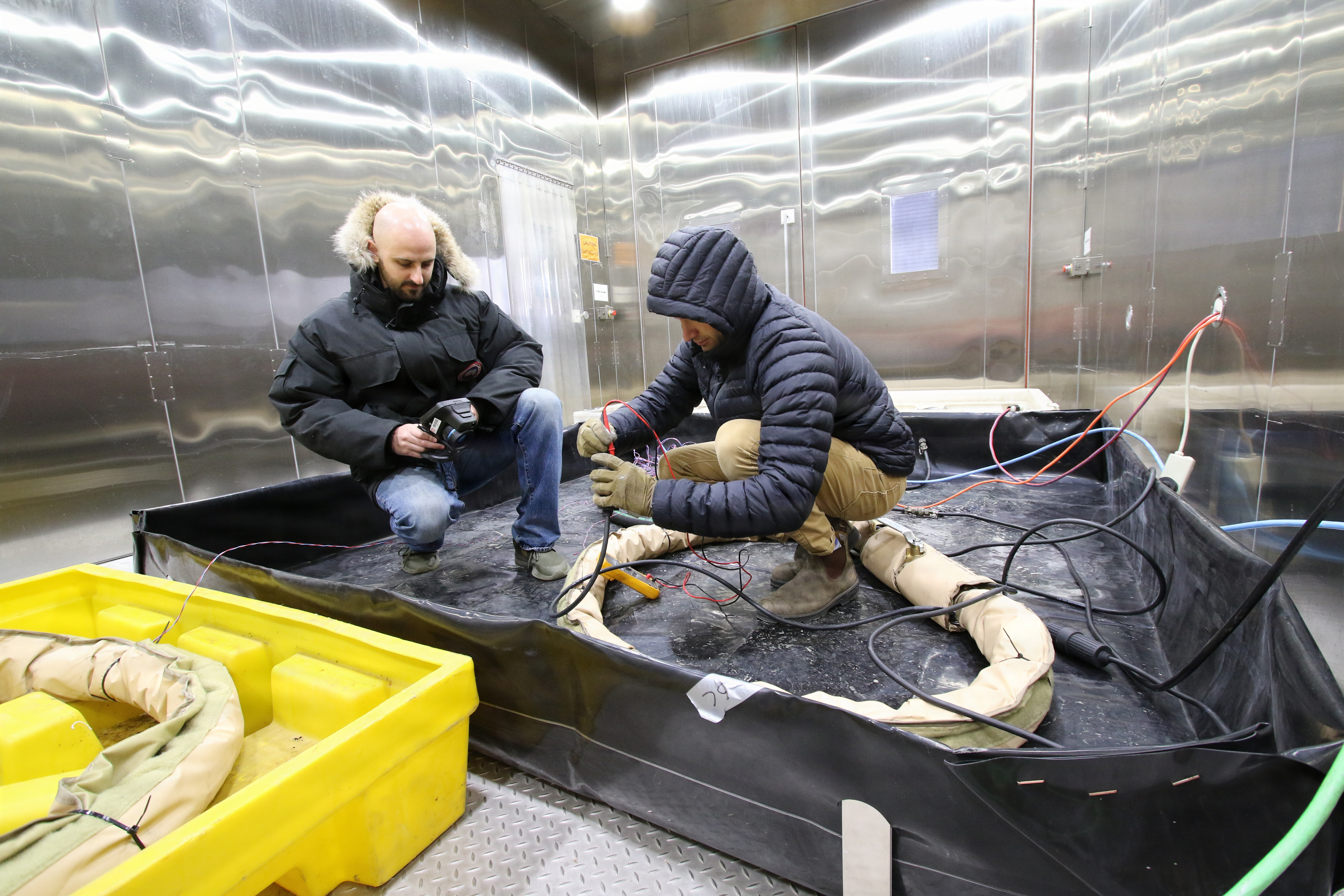
测试在位于新罕布什尔州的CRREL极寒室进行,该设施面积为288平方英尺,能够达到零下90华氏度的温度,正如声明所述。虽然军事单位通常需要等到阿拉斯加冬季达到峰值才能模拟类似条件,但受控环境使研究团队能够创造出与真实世界相似的条件。
Testing took place in CRREL’s New Hampshire-based Extreme Cold Chamber, a 288-square-foot cold room capable of reaching temperatures as low as -90 degrees Fahrenheit, per the release. While military units typically have to wait until the Alaskan winter reaches its peak to simulate similar conditions, the controlled environment allowed the research team to create conditions similar to those of the real world.
“我们的武装部队在极寒和艰苦的条件下生活和执行任务,因此这些设施投入使用对他们在北极和其他高纬度环境服役期间的身心健康至关重要,”美国陆军工程师研究与发展中心下属七大实验室之一——寒区研究与工程实验室的研究化学家丹·塔格博士说。
“Our armed forces live and operate in extremely cold and difficult conditions, so having these facilities operational is important for their physical and mental health while serving in the Arctic and other high-north environments,” said Dr. Dan Tague, a research chemist at CRREL, one of seven U.S. Army Engineer Research and Development Center laboratories.
2024年,国防部发布《北极战略》,引述称:“重大地缘政治变化推动了对北极采取这一新战略方法的必要性,包括俄罗斯全面入侵乌克兰、芬兰和瑞典加入北约联盟、中华人民共和国与俄罗斯合作日益加深,以及气候变化影响的加速。”报告指出,该地区已成为“战略竞争的场所”,也是美国意图建立更持久存在的空间。
In 2024, the DoD released its “Arctic Strategy,” citing “Major geopolitical changes are driving the need for this new strategic approach to the Arctic, including Russia’s full-scale invasion of Ukraine, the accession of Finland and Sweden to the NATO Alliance, increasing collaboration between the People’s Republic of China (PRC) and Russia, and the accelerating impacts of climate change.”The region, according to the report, had become “a venue for strategic competition,” and a space where the United States intends to build a more persistent presence.
据海军设施工程系统司令部远征作战中心远征技术部项目经理詹姆斯·皮尔金顿介绍,基于TRICORN的系统取得的最新成果,除了为驻扎在北极的军事人员提供显而易见的舒适条件——厕所!洗衣!淋浴!——还为整个美军提供了扩大的作战覆盖范围。
The latest successes with TRICORN-based systems provide, beyond the obvious comforts for personnel stationed in the Arctic — Toilets! Laundry! Showers! — an expanded operational footprint for the U.S. military as a whole, according to James Pilkington, a project manager in NAVFAC EXWC Expeditionary Technical Department.
“这从地理位置和持续时间两方面扩大了基地营地的作战范围,”皮尔金顿说。“进而延伸军力态势。”
“This extends the operational range of base camps in terms of geographic locations and durations,” said Pilkington. “In turn [it] extend[s] force posture.”