印度进口商目前正成为该国央行的矛头所指,随着其支撑卢比的最新努力从金融市场扩大至实体经济。
India’s importers are now in the crosshairs of the central bank, as its latest efforts to shore up the rupee expand from financial markets to the economy.
印度清算公司(Clearing Corp. of India)的数据显示,进口商在9月积累了创纪录数量的货币对冲,这表明他们在卢比今年下跌近6%之后,正为进一步走弱做准备。衡量其需求的远期美元买入量今年飙升了44%,平均每月达到640亿美元,而2025年与之相比有所不同。
Importers accumulated a record amount of currency hedges in September, a sign they’re bracing for more weakness after the rupee’s near 6% decline this year. Forward dollar purchases, a gauge of their demand, soared 44% to an average of $64 billion a month this year, compared with 2025, data from the Clearing Corp. of India show.
对印度央行而言,这一激增表明,遏制针对卢比的投机性押注已不再足够。尽管该央行通过海外侨民存款计划筹集了133亿美元,并在近四年里首次上调了关键政策利率,但该货币仍向着1美元兑97卢比的方向下滑。分析师表示,跌破这一关口可能会打开通往100这一曾被认为不可想象的水平的道路。
For the RBI, the surge shows why curbing speculative bets against the rupee is no longer enough. The currency slid toward 97 to a dollar even after the central bank raised $133 billion through a diaspora deposit program and lifted its key policy rate for the first time in nearly four years. A break below that mark could open the path toward 100, a once-unthinkable level, analysts said.
ICICI证券初级交易公司(ICICI Securities Primary Dealership Ltd.)研究主管阿·普拉桑纳(A. Prasanna)表示:“印度央行认为,大量的对冲活动,特别是在衍生品方面,是投机活动。他们正在采取自认为会产生预期效果的措施,当发现并非如此时,他们就会迈出下一步。也许整体战略尚未到位。”周二晚些时候,行长桑杰·马尔霍特拉(Sanjay Malhotra)在接受《金钱控制》(Moneycontrol)采访时表示,该央行观察到货币衍生品中存在显着的投机成分,且外汇市场对印度经济变得“过度悲观”。
“The RBI believes that a lot of hedging activity, especially on the derivatives side, is speculative activity,” said A. Prasanna, head of research at ICICI Securities Primary Dealership Ltd. “They are taking steps that they think should yield some desired results, and when they find that’s not the case, they’re going to the next step. Maybe a holistic strategy is not in place yet.”In an interview to Moneycontrol late Tuesday, Governor Sanjay Malhotra said the central bank had observed a significant speculative element in currency derivatives and that forex markets were becoming “unduly pessimistic” about India’s economy.
印度央行的举措正在产生影响。卢比周二上涨0.5%,收于1美元兑95.2838卢比,延续了前一个交易日1%的涨幅。
The RBI’s moves are having an impact. The rupee jumped 0.5% to close at 95.2838 per dollar on Tuesday, adding to a 1% gain in the previous session.
周末公布的这些举措将每月需要约100亿美元原油进口资金的国营炼油厂排挤出市场,并提高了企业的对冲成本。这些举措表明,为了控制一门已连续九年下跌的货币,印度央行正在深入这个价值4万亿美元的经济体采取多大的干预力度。
The steps unveiled over the weekend take state-owned oil refiners, which need about $10 billion a month for crude imports, out of the market and make hedging more expensive for companies. The moves show how far the RBI is reaching into the $4 trillion economy to bring a currency in its ninth year of decline under control.
“这些措施应能阻止石油进口商的美元需求进入市场,并限制其他贸易流动和套期保值活动产生的需求,”印度证券交易委员会(资本市场监管机构)前董事会成员Ananth Narayan表示。
“The measures should keep dollar demand from oil importers out of the market and restrict demand arising from other trade flows and hedging activity,” said Ananth Narayan, a former board member of the Securities and Exchange Board of India, the capital markets regulator.
此次打击标志着印度储备银行(RBI)防御措施的显著扩大,其自2013年“缩减恐慌”以来最严厉的一些措施如今已延伸至需要美元进行日常业务的企业。卢比走弱会推高印度的进口账单,同时削弱为融资其经常账户赤字所需的外国资本流入。
The crackdown marks a significant widening of the RBI’s defense, with some of its toughest steps since the 2013 taper tantrum now reaching firms that need dollars for daily business. A weaker rupee inflates India’s import bill while deterring foreign capital needed to finance its current-account deficit.
根据彭博经济学(Bloomberg Economics)的估计,印度的贸易赤字可能在9月份扩大至约300亿美元,其中净石油进口账单从8月份的99亿美元升至108亿美元。
India’s trade deficit likely widened to about $30 billion in September, with the net oil-import bill climbing to $10.8 billion from $9.9 billion in August, according to Bloomberg Economics’ estimates.
通过抑制美元需求,RBI旨在打破这一循环,在不 solely 依赖高利率的情况下应对进一步的货币疲软。
By curbing dollar demand, the RBI aims to break that loop and tackle further currency weakness without relying only on high interest rates.
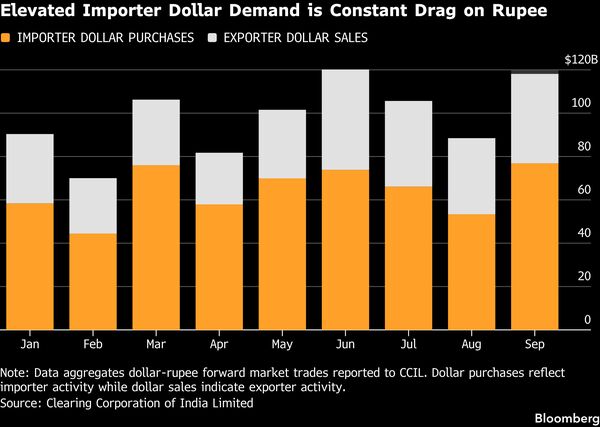
远期市场凸显了这一挑战。远期美元买入主要反映进口商活动,9月份达到768亿美元,超过出口商的美元卖出额413亿美元,清算所数据显示。买入额也超过了3月份的759亿美元——这一水平曾促使RBI此前采取广泛措施以遏制美元需求。
The challenge is clear in the forward market. Forward dollar purchases, largely reflecting importer activity, reached $76.8 billion in September, exceeding exporter sales of $41.3 billion, clearinghouse data show. Purchases also topped March’s $75.9 billion, a level that contributed to the RBI’s earlier sweeping measures to blunt dollar demand.
对冲需求的激增也指向一个更深层次的问题。进口商对卢比贬值已结束缺乏信心,尽管过去两年卢比已下跌13%。尽管央行进行了有力干预,这种疲软仍在持续。在此次最新行动之前,RBI曾将银行的岸内净敞口限制为每日1亿美元。它还曾要求银行停止向客户提供离岸卢比产品,但后来撤回了该限制。
The rush to hedge also points to a deeper problem. Importers have little confidence the rupee’s slide is over after a 13% drop in the past two years. That weakness has persisted despite the central bank’s forceful interventions. Before the latest action, the RBI had limited banks’ net onshore exposure to $100 million a day. It also asked them to stop offering offshore rupee products to clients, a curb it later withdrew.
周六的措施包括一项风险准备金要求,即贷款人必须为任何超过200万美元的外汇衍生品交易预留相当于卢比金额的20%。已取消的远期合约不得再重新预订,而无基础资产的衍生品交易限额已从1亿美元削减至500万美元。
Saturday’s steps included a risk reserve requirement under which lenders must set aside 20% of the rupee equivalent for any forex derivative transaction exceeding $2 million. Canceled forward contracts can no longer be rebooked, while the limit on derivative transactions without an underlying asset was cut to $5 million from $100 million.
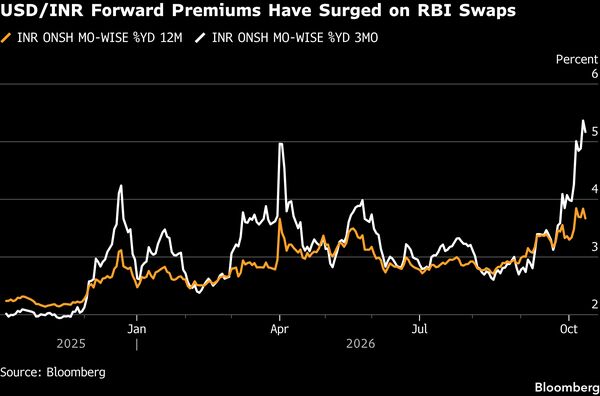
对于企业而言,这意味着对冲卢比的成本将增加。IDFC First银行估计,新的准备金要求可能使对冲成本上升约1.5%。与此同时,银行已向监管机构寻求对新规适用性的澄清,美元-卢比远期汇率在过去两个交易日出现剧烈波动。
For companies, that means hedging the rupee will cost more. IDFC First Bank estimates the new reserve requirement could raise hedging costs by about 1.5%. Meanwhile, banks have sought clarification from the regulator on the applicability of the new norms, with dollar-rupee forward rates swinging sharply over the past two sessions.
据巴克莱银行(Barclays Plc)称,进口商可能选择更小规模的对冲或缩短到期期限。一些需求可能转向离岸市场,而推迟对冲的企业可能在付款到期时更接近实际付款时间购买美元,花旗集团(Citigroup Inc.)经济学家表示。虽然这可能在短期内抑制远期市场需求,但它不会减少由昂贵石油和外资流出所产生的美元需求。
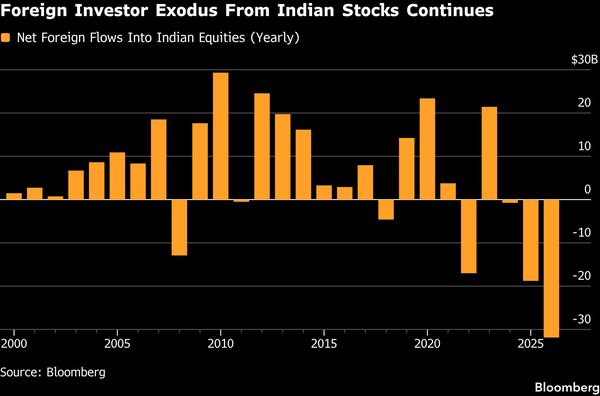
Importers may opt for smaller hedges or shorten maturities, according to Barclays Plc. Some demand may move offshore, while firms that delay hedging may buy dollars closer to when payments are due, Citigroup Inc. economists said. While that may curb forward-market demand in the near term, it won’t reduce the need for dollars created by expensive oil and foreign fund outflows.
“这些限制可能旨在遏制投机性需求,但它们也会对真实需求方产生影响,”野村控股(Nomura Holdings Inc.)亚洲(除日本外)首席经济学家索纳尔·瓦尔马(Sonal Varma)表示。
“The restrictions may be aimed at deterring speculative demand, but they will also have a fallout on those with genuine demand,” said Sonal Varma, chief economist for Asia ex-Japan at Nomura Holdings Inc.
虽然最新措施暂时稳住了卢比,但如果油价和全球债券收益率继续攀升,更大的考验将随之而来。
While the latest measures have steadied the rupee for now, the bigger test will come if oil prices and global bond yields keeping climbing.
“这些行动可能会威慑或延迟一些卢比做空行为,但它们不会鼓励资本流入,”纳拉扬(Narayan)表示。“使合理的外汇风险管理变得更加繁琐,也在一定程度上逆转了印度数十年的市场自由化进程。”
“These actions may deter or delay some rupee short-selling but they do not encourage capital inflows,” said Narayan. “Making reasonable forex risk management more cumbersome also reverses part of India’s decades-long market liberalization.”