
人们常说,一个系统的目的就是它的所作所为,这意味着判断一个系统不应看其宣称的目标,而是看其结果。基于这一逻辑,中国、印度、俄罗斯、沙特阿拉伯以及其他少数国家在最近一轮国际气候谈判中的目的,就是让地球变得更加炎热。
They say the purpose of a system is what it does, meaning you should judge it not by its stated goals but by its results. On that basis, the purpose of China, India, Russia, Saudi Arabia and a handful of other countries in the latest round of international climate talks is to make the planet much hotter.
联合国气候科学家大会——政府间气候变化专门委员会(IPCC)本周在埃塞俄比亚亚的斯亚贝巴开会。他们议程上的重中之重是敲定第七次全球气候状况详尽评估报告(即AR7)的时间表。科学家们希望在2028年底前完整提交这份报告,以便在当年的联合国气候变化大会(即COP33)上发布。中国、印度、俄罗斯、沙特阿拉伯和其他国家则希望将该报告的部分或全部内容推迟到2029年发布。
The Intergovernmental Panel on Climate Change (IPCC), the United Nations’ confab of climate scientists, is meeting this week in Addis Ababa, Ethiopia. High on their agenda is the timing of their seventh exhaustive assessment of the state of the world, known as AR7. The scientists would like to deliver this report in full by late 2028, making it available for that year’s UN climate conference, known as COP33. China, India, Russia, Saudi Arabia and other countries want to delay some or all of that report until 2029.
为什么这个时间安排如此重要?因为COP33是全球计划认真审视各国落实2015年具有里程碑意义的《巴黎气候协定》目标进展的节点,当时各方一致同意,争取将全球变暖幅度控制在比工业化前平均水平高出最多2摄氏度(3.6华氏度)、理想情况下高出1.5摄氏度(2.7华氏度)的范围内。如果这些国家能够获得来自政府间气候变化专门委员会——一个得到世界上所有国家认可的可靠来源的最新气候科学成果,那么这次“全球盘点”将更有意义。
Why does this timing matter? Because COP33 is when the world is scheduled to take a hard look at every country’s progress on meeting the goals of the landmark 2015 Paris climate agreement, when everybody agreed to try to limit global heating to 2 degrees Celsius (3.6 Fahrenheit) above preindustrial averages at worst, 1.5C (2.7F) at best. This “stocktake” will be more meaningful if those countries have fresh climate science, hot off the presses, from the IPCC, one body every country in the world agrees on as a reliable source.
如果没有政府间气候变化专门委员会的最新报告(该报告几乎肯定会极其详细地表明各国未能兑现《巴黎协定》的承诺),这些国家加大努力的压力就会减小。当然,2028年还会有许多其他科学研究可供参考,但没有一份具备政府间气候变化专门委员会的权威背景。
Without a fresh IPCC report, which will almost certainly show in great detail that countries are failing to meet their Paris promises, there will be less pressure on those countries to step up their efforts. There will be lots of other science available in 2028, of course, but none of it with the IPCC pedigree.
还有一个非常现实的风险,即在推动推迟科学研究之后,许多国家将以这种延迟为借口,在气候行动上继续拖延。毕竟,到2028年,最新的政府间气候变化专门委员会评估报告将已经陈旧五年之久。非营利研究机构“气候分析”首席执行官兼高级科学家比尔·黑尔对《碳简报》表示,阻挠政府间气候变化专门委员会的时间表将是“一个重大的历史倒退,并将被用来削弱国际气候进程和《巴黎协定》”。
And there’s a very real risk that, after pushing to delay the science, many of these countries will cite that very delay as an excuse to keep dragging their feet on climate action. After all, the latest IPCC assessment will be a musty five years old in 2028. Thwarting the IPCC’s timeline would be a “major historical break and one which would be used to weaken the international climate process and Paris agreement,” Bill Hare, the chief executive officer and senior scientist of Climate Analytics, a nonprofit research group, told Carbon Brief.
无论如何,可能很快就为时已晚了。据《碳简报》报道,关于这一时间表的争斗已经持续了三年多,是新评估周期开始与达成报告时间表协议之间历时最长的一次延迟。科学家们需要在今年年底前解决这个问题,以便他们能够开始规划未来几年的工作和预算。但亚的斯亚贝巴的谈判迄今毫无进展。
It might soon be too late anyway. The fight over this timeline has already dragged on for more than three years, by far the longest delay between the start of a new assessment cycle and an agreement on report timing, according to Carbon Brief. Scientists need this settled by the end of the year so they can start planning and budgeting for the years to come. But talks in Addis Ababa have gone nowhere so far.
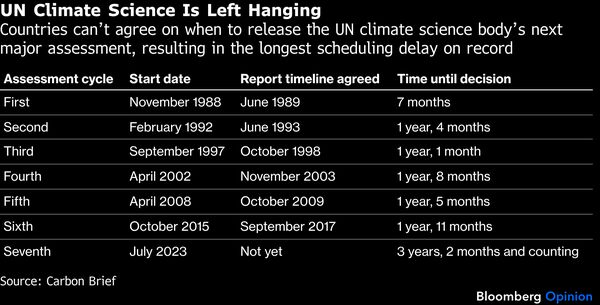
印度和其他发展中国家争辩称,他们需要延期,以便有更多时间进行自己的分析。迄今为止,气候科学一直由发达国家主导,这增加了产生偏见的风险。这些可能是合理的论点。但由于俄罗斯和沙特阿拉伯这两个以阻挠气候行动著称的产油国对此表示热烈赞同,这种合理性大打折扣。
India and other developing countries argue they need a delay so they’ll have more time to do their own analysis. Climate science has been dominated by developed countries so far, raising the risk of bias. These may be legitimate arguments. But that legitimacy is weakened by the enthusiastic agreement of Russia and Saudi Arabia, petrostates known for throwing sand in the gears of climate action.
联合国应对气候变化的方法繁琐而令人沮丧。它也可能是有效的:在《巴黎气候协定》签署后,摆脱加热地球的化石燃料的政治压力有所增加。这种压力促使污染国和企业采取真正的措施来遏制排放,从而避免了一些最灾难性的变暖情景。
The UN’s approach to dealing with climate is byzantine and frustrating. It can also be effective: Political pressure for a transition away from planet-heating fossil fuels picked up after the Paris climate accord. That pressure motivated polluting countries and businesses to take real steps to curb emissions, which prevented some of the most apocalyptic possible heating scenarios.
这种压力最近有所减弱,世界各国的政客都在气候问题上走回头路,要么是以应对失控的能源价格为由,要么是出于纯粹的意识形态。由于其否认气候变化的总统,长期担任联合国气候领袖的美国已不再参与政府间气候变化专门委员会的工作。推迟联合国最重要的科学报告,将只是这一趋势中的又一个黯淡步伐。
That pressure has abated lately, with politicians worldwide backtracking on climate, either in the name of addressing runaway energy prices or because of pure ideology. The US, long a UN climate leader, is no longer involved in the IPCC at all, thanks to its climate-change-denying president. Delaying the UN’s premier science report would just be another grim step in this trend.
《巴黎协定》将升温控制在1.5摄氏度的宏伟目标已经一去不复返,到2028年这一点可能会痛苦地显现出来。届时,世界大部分地区将为导致这种失败的延误感到后悔。但仍有机会避免更多的失望。
The Paris stretch goal of 1.5C is long gone, which will likely be painfully apparent by 2028. At that point, much of the world will rue the delays that caused such failure. But there’s still a chance to avoid even more disappointment.