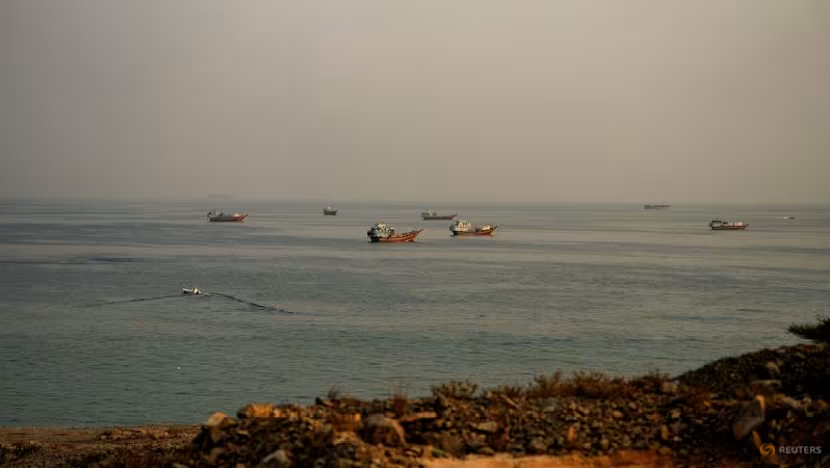
新加坡:自美国于2月28日袭击伊朗以来,霍尔木兹海峡一直处于中断状态。封锁的持续时间导致所有形式能源及其衍生品的供应遭受前所未有的干扰。油价和天然气价格大幅上涨广泛蔓延,推高了通胀。
SINGAPORE: The Strait of Hormuz has been disrupted since the US attacked Iran on Feb 28. The duration of the closure has caused unparalleled disruption to supplies of all forms of energy sources and their derivatives. Sharp rises in the prices of oil and gas have spread widely, fuelling inflation.
东南亚依赖海湾地区的原油进口占比超过一半,其中菲律宾和越南的依赖度超过90%。七个月过去了,仍无结束迹象,此时评估该地区经济表现以及为缓解成本而实施的政策成效,正当其时。
Southeast Asia relies on the Gulf region for more than half of its crude oil imports, with the shares for the Philippines and Vietnam exceeding 90 per cent. Seven months later and with no end in sight, it is timely to take stock of how the region is faring economically, and to assess the efficacy of policies implemented to mitigate costs.
对于能源进口国(文莱和马来西亚除外),宏观经济传导机制始于贸易条件恶化,即进口价格相对于出口价格上涨。这立即给国际收支带来压力,反映出一国国际贸易和投资流动及货币储备的整体状况恶化。
The macroeconomic transmission mechanism for energy-importing countries (all except Brunei and Malaysia) starts with a terms-of-trade deterioration, as import prices rise relative to export prices. This immediately strains the balance of payments, reflecting a decline in the overall condition of a country’s international trade and investment flows and currency reserves.
持续的动荡还耗尽了财政资源,因为进口能源账单和社会补贴激增。七个月后,较贫穷的国家,特别是柬埔寨、老挝、缅甸和东帝汶等最不发达国家(LDCs)面临外汇储备减少,限制了其进口能力。
The ongoing turmoil has also drained fiscal resources as imported energy bills and social subsidies balloon. After seven months, the poorer countries, especially the Least Developed Countries (LDCs) of Cambodia, Laos, Myanmar and Timor Leste face dwindling foreign exchange reserves that limit their capacity to import.
本币可能面临贬值压力,这会推高进口价格并可能加剧通胀。恶性循环可能随之形成,最终导致滞胀——经济停滞和失业率上升与通胀升高并存的双重困境。
Local currencies can come under pressure to depreciate, which raises import prices and can exacerbate inflation. A vicious cycle can ensue, culminating in stagflation – the double jeopardy of economic stagnation and higher unemployment alongside higher inflation.
增长强劲 迄今为止,东南亚大多数国家的经济增长保持强劲。这是因为人工智能繁荣为参与电子供应链的国家,特别是马来西亚、泰国、新加坡和越南,提供了巨大的增长动力。
ROBUST GROWTH So far, economic growth in most of Southeast Asia has remained robust. This is because the artificial intelligence boom has provided a massive growth injection to countries involved in the electronics supply chain, particularly Malaysia, Thailand, Singapore and Vietnam.
这些国家也受益于与供应链从中国转移以最小化美国关税相关的投资。这些增长推动因素与诸如厄尔尼诺现象对农业的影响等负面因素共存,使得对美伊冲突对经济增长影响的评估变得复杂。
These countries have also benefitted from investments associated with supply chains relocating from China to minimise US tariffs. The presence of these growth boosters, alongside negative factors such as the El Nino effect on agriculture, complicates evaluations of the impact of the US-Iran conflict on economic growth.
对于东南亚地区,亚洲开发银行(ADB)曾在2025年12月预测2026年增长率为4.4%,但如今预测增长将达到4.7%。这一上调表明,人工智能热潮不仅抵消了冲突和厄尔尼诺的负面影响,而且超过了这些影响。
For the Southeast Asian region, Asian Development Bank (ADB) had in December 2025 forecasted 4.4 per cent growth for 2026, but now it foresees growth reaching 4.7 per cent. This upgrade demonstrates how the AI boom is more than offsetting the negative effects from the conflict and El Nino.
它还凸显了,该冲突更多是一种福利冲击而非增长冲击,通胀削弱了购买力,特别是低收入家庭的购买力,并拉大了贫富差距。
It also highlights how the conflict is less of a growth shock than a welfare shock, with inflation reducing purchasing power, especially of low-income households, and widening rich-poor gaps.
在2025年至2026年的预测之间,尽管通胀急剧上升,东南亚发展中地区(不包括新加坡)的增长预计仅会略有变化。然而,菲律宾和最不发达国家可能会出现两方面的恶化:增长放缓和通胀上升。
Between 2025 and the forecast for 2026, developing Southeast Asia’s (excluding Singapore) growth is expected to change only slightly despite a sharp rise in inflation. However, the Philippines and the LDCs could see deteriorations in both: reduced growth and increased inflation.
对穷人的不成比例负担 通胀通过削弱穷人高度依赖以满足基本需求的可支配收入,对穷人造成不成比例的负担。这些逆境在安全网有限的贫困国家中会被进一步放大。
DISPROPORTIONATE BURDEN ON THE POOR Inflation disproportionately burdens the poor by diminishing the disposable income they heavily depend on to meet basic needs. These adversities are compounded in poorer countries with limited safety nets.
政府已在经济放缓的背景下应对通胀压力,但其政策选择可能会加剧社会后果。一种常用的缓解社会影响的方法是通过增加化石燃料补贴来保持低油价,但这进一步加重了财政负担。
Governments have responded to the inflationary pressures amid economic slowdown, but their policy choices could compound the social consequences. One commonly deployed method to mitigate the social effects is by increasing fossil fuel subsidies to keep pump prices low, but this further strains fiscal resources.
印度尼西亚和马来西亚,价格上限仍然保留,从而显著增加了补贴部分和对公共财政的成本。泰国和越南允许部分价格上涨,但加强了燃油价格稳定措施,同时削减燃油税。在这些国家,补贴和减税措施针对性不强,降低了其惠及最贫困群体的有效性,同时增加了预算成本。
donesia and Malaysia, price caps have been retained, thereby significantly increasing the subsidy element and the cost to public coffers. Thailand and Vietnam allowed some price increases but intensified fuel-price stabilisation measures while cutting fuel taxes. In these countries, the subsidies and tax cuts are poorly targeted, reducing their effectiveness in reaching the most indigent, while raising budgetary costs.
菲律宾试图将援助针对受影响最严重的人群,重点帮助交通、农业和渔业领域的低收入工人。然而,提供的支持非常有限,未能完全抵消价格的急剧上涨。
The Philippines tried to target its assistance to those most affected, focusing on low-income workers in transport, agriculture and fisheries. However, the support provided was minimal and did not fully offset the sharp price increases.
将价格机制的扭曲降至最低,符合向可再生能源转变的长期目标。菲律宾表明,不实施化石燃料补贴更符合绿色转型。
Minimising distortions to the price mechanism aligns with the aspired longer-term shift towards renewable energy. The Philippines shows that refraining from fossil fuel subsidies is more congruous with the green transition.
货币压力 虽然价格上限可能推迟宏观经济影响,但允许价格完全传导至零售价将产生即时的通胀和货币压力。然而,这些压力可以通过不同方式缓解。菲律宾中央银行菲律宾央行被迫三次加息,但未能防止比索跌至历史低点。
CURRENCY PRESSURES While price caps may delay macroeconomic impacts, allowing full pass-through to retail prices will produce immediate inflationary and currency pressures. However, these pressures can be mitigated through different means. The Philippines’ central bank, Bangko Sentral ng Pilipinas, was forced to raise interest rates thrice, but it did not prevent the peso from falling to all-time lows.
尽管加息,货币贬值仍可能提升通胀预期,同时抑制投资和消费,从而增加滞胀风险。与菲律宾类似,新加坡也允许价格完全传导至零售价,但通过动用其庞大的外汇储备实现货币升值,从而控制了通胀。
Currency depreciation despite interest rate increases can raise inflationary expectations while dampening investment and consumption, thus increasing the risk of stagflation. Like the Philippines, Singapore also allowed full pass-through to retail prices, but managed inflation through currency appreciation by employing its substantial foreign exchange reserves.
缅甸的政治危机和老挝的债务危机正在削弱它们应对燃油价格冲击宏观影响的能力,尽管与人工智能数据中心相关的电力需求增加在一定程度上抵消了老挝的影响。
Myanmar’s political crisis and Laos’ debt crisis are impairing their ability to mitigate the macro impacts of the fuel price shock, although increased demand for electricity associated with AI data centres is a partial offset for Laos.
柬埔寨的低债务水平和广泛的美元化正在起到抑制通胀的缓冲作用,但其与泰国的边境关闭正在影响燃料和肥料供应,以及跨境旅游流量,这进一步加剧了因喷气燃料价格上涨而导致的国际旅游放缓。
Cambodia’s low debt levels and widespread dollarisation are acting as inflation buffers, but its border closure with Thailand is affecting fuel and fertiliser supplies, as well as cross-border tourism flows, compounding an international travel slowdown induced by higher jet fuel prices.
菲律宾和上述最不发达国家正承受霍尔木兹海峡关闭带来的最严重宏观经济和社会影响。这并非巧合,因为这些国家也是经济上最脆弱的国家,金融资源有限,贫困率最高。
The Philippines and the above LDCs are suffering the worst macroeconomic and social impacts from the Strait of Hormuz closure. It is no coincidence that these countries are also the most economically vulnerable, with limited financial resources and the highest poverty rates.
随着冲击持续超过七个月,滞胀的风险将日益增加,对穷人福利的影响可能是不可逆转的。这些国家以及印度尼西亚正面临财政脆弱性上升,甚至主权债务困境的风险,这将进一步限制它们应对诸如厄尔尼诺现象等演变中断的能力。
The longer the shock persists past the seven-month mark, the greater the risk of stagflation, with irreversible effects on the welfare of the poor. These countries, along with Indonesia, face rising fiscal vulnerability and even the risk of sovereign debt distress, which would further constrain their capacity to respond to evolving disruptions like the El Nino effects.
菲律宾是对海湾地区石油依赖程度最高的国家,而最不发达国家则既直接又间接地暴露于风险之中,因为它们依赖泰国等第三国获取精炼燃料。尽管泰国和越南也高度依赖海湾地区,但由新技术和地缘政治变化推动的投资热潮正在抵消冲突带来的负面增长影响。
The Philippines is the most oil-dependent on the Gulf region, while the LDCs are exposed both directly and indirectly, through their dependence on third countries like Thailand for refined fuel. Although Thailand and Vietnam are also heavily reliant on the Gulf region, an investment boom driven by new technologies and shifting geopolitics is outweighing the negative growth impacts from the conflict.
除了增长数据表现良好之外,当前危机的实际影响主要体现在社会和分配层面,尤其是对贫困国家中的弱势群体产生了特别不利的影响。
Beyond the buoyant growth numbers, the real effects of current crises are mainly social and distributional, with especially adverse impacts on the vulnerable in poor countries.
詹杨·梅农是新加坡伊萨克·尤索夫伊沙克研究院区域经济研究项目的访问高级研究员。此评论首发于该院的博客《福尔克拉姆》。
Jayant Menon is a Visiting Senior Fellow in the Regional Economic Studies Programme at the ISEAS - Yusof Ishak Institute. This commentary first appeared on ISEAS - Yusof Ishak Institute’s blog, Fulcrum.