
大多数加拿大人认为联邦政府应有权结束劳工罢工,但在具体做法上存在分歧,与此同时,总理马克·卡尼正寻求将劳工部长用于干预部分纠纷的一项有争议权力固化下来。
Most Canadians believe the federal government should be able to end a labor strike but are divided over how it should be done, as Prime Minister Mark Carney seeks to entrench a controversial power used by the labor minister to intervene in some disputes.
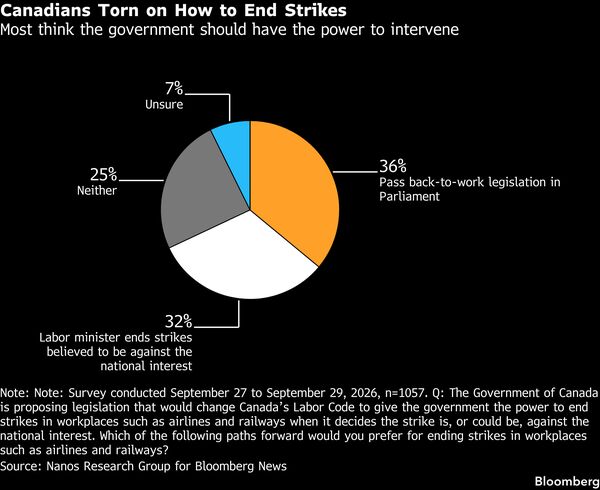
彭博社委托纳诺斯研究集团进行的一项民调显示,32%的加拿大人支持赋予联邦劳工部长权力,以结束被认为违背国家利益的罢工;36%的人表示政府应通过复工立法方可做到这一点;另有25%的受访者认为政府根本不应被允许结束罢工。
A poll conducted by Nanos Research Group on behalf of Bloomberg News found 32% of Canadians support giving the federal labor minister the power to end strikes that are believed to be against the national interest, while 36% said the government should have to pass back-to-work legislation to do so. Meanwhile, 25% of respondents said the government should not be allowed to end strikes at all.
劳工团体反对卡尼政府提出的立法草案,该草案对《加拿大劳工法典》第107条的使用设定了条件。近年来,劳工部长曾多次援引该条款,指示一个准司法机构解决涉及空乘人员、邮政工人以及铁路和港口员工的纠纷——而无需经历通过复工立法这一政治敏感度极高的过程。
Labor groups have pushed back against proposed Carney government legislation that puts conditions on the use Section 107 of the Canada Labour Code to end strikes. In recent years, labor ministers have invoked the provision to direct a quasi-judicial body to resolve disputes involving flight attendants, postal workers and rail and port employees — without having to go through the politically fraught process of passing back-to-work legislation.
政府表示,拟议修改将提高动用第107条结束罢工的门槛;但多个工会认为,政府正在通过立法形式将一项本不应拥有的权力固化下来,变本加厉。
The government has said that the proposed changes will raise the bar for ending strikes using Section 107, while several unions have argued that the government is doubling down on a power it should not have by enshrining it in law.
商业团体长期呼吁政府在结束劳资纠纷中发挥更积极的作用,理由是罢工造成巨大的经济成本和不确定性,这两者都可能阻碍投资。
Business groups have long called on the government to play a more active role in ending labor disputes, arguing that strikes carry significant economic costs and cause uncertainty, both of which could discourage investment.
纳诺斯研究集团创始人尼克·纳诺斯表示,民调结果表明,政府的解决方案在政治上并非“稳操胜券”。他说,这意味着政府必须付出努力,才能在该问题上赢得加拿大人的支持。
Nik Nanos, the founder of Nanos Research, said the poll results suggest the government’s solution is not a “slam dunk” politically. That means it will have to put in work to win over Canadians on the issue, he said.
18至24岁的年轻人最不支持赋予劳工部长结束罢工的权力,也是最倾向于认为政府不应扮演任何角色的群体。
Young people between the ages of 18 and 24 were the least likely to support giving the labor minister the power to end a strike and the most likely to say that the government should not be allowed to play a role.
该民意调查于9月27日至29日进行,共访问1057名受访者,其准确度在19次中有18次(即95%)的置信水平下,误差范围为正负三个百分点。
The poll was conducted between Sept. 27 and 29 with 1,057 respondents, as is considered accurate within three percentage points, 19 times out of 20.