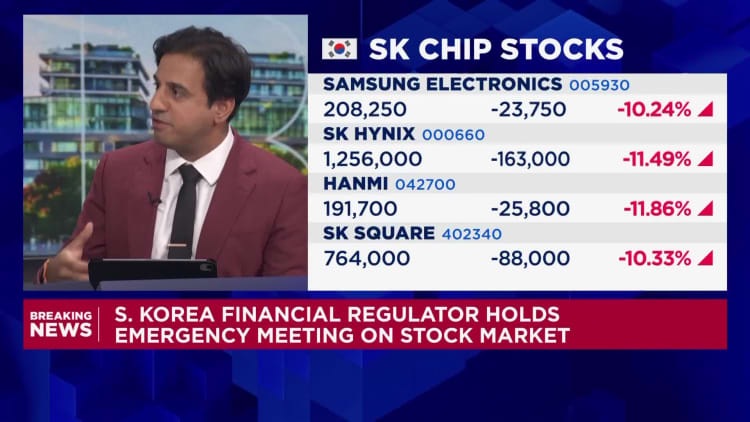
存储芯片股票本周在更广泛的股市动荡中遭受了特别严重的打击。两个担忧正在加剧压力 — — 关于中国竞争是否威胁到存储芯片行业老牌企业的争论,以及市场何时可能出现供过于求的猜测。
Memory chip stocks have taken a particularly bad beating this week amid broader equity market turmoil. Two concerns are adding to the pressure — the debate over whether Chinese competition is threatening memory incumbents and speculation about when the market could become oversupplied.
过去五天,SK海力士股价暴跌26%,三星电子股价暴跌22%,美光科技股价下跌约11%。
Over the last five days, SK Hynix has plunged 26%, Samsung has tanked 22% and Micron has dropped around 11%.
中国担忧 初期的不安情绪出现在本周初,当时中国领先的存储芯片制造商长鑫存储技术(CXMT)宣布计划推出基于新架构的服务器内存产品。
China worries The initial jitters came at the start of the week after China's leading memory chipmaker ChangXin Memory Technologies, or CXMT, announced plans to roll out a server memory product based on new architecture.
CXMT的设计将实现更高的存储密度,引发人们担忧,这一突破可能导致中国公司从三星、SK海力士和美光等竞争对手那里夺走全球市场份额。
CXMT's design would allow higher storage density, raising concerns that the breakthrough could result in the Chinese company taking global market share from rivals Samsung, SK Hynix and Micron.
然而,多位分析师对CXMT能否扩大这种先进技术的产能表示质疑。
However, a number of analysts questioned whether CXMT would be able to scale the production of such an advanced technology.
“问题当然在于任何架构变更……你可以制造芯片,但良率是多少?如果你的良率只有50%,那你实际上是在把一半的芯片扔进垃圾桶,因为它们根本无法正常工作,”Quilter Cheviot全球技术研究主管Ben Barringer周三在CNBC的《Squawk Box Europe》节目中表示。
"The issue, of course, was with any architectural change ... you can make the chips, but what yield are you getting? If you're only getting a 50% yield, you're literally putting half the chips in the bin because they don't work very well," Ben Barringer, global head of technology research at Quilter Cheviot, told CNBC's "Squawk Box Europe" on Wednesday.
Rosenblatt Securities高级研究分析师Kevin Cassidy也表示,CXMT的进展不太可能向市场增加更多内存供应。
Kevin Cassidy, a senior research analyst at Rosenblatt Securities, also said the developments at CXMT are unlikely to add more supply of memory onto the market.
“我们认为这根本不会改变供需方程式,”Cassidy对CNBC表示。2029年可能出现供过于求?
"We don't think this is going to swing the supply-demand equation at all," Cassidy told CNBC. Oversupply by 2029?
交易者们也在讨论《每日商务报》一篇观点专栏的评论,该报是韩国的重要出版物。专栏中一位记者呼吁该国政府为人工智能热潮的放缓做好准备,并寻找并发展下一个主要的增长引擎。
Traders are also discussing comments from an opinion column in Maeil Business Newspaper, a prominent South Korean publication, in which a reporter urged the country's government to prepare for a slowdown in the AI boom and to identify and develop the next big growth engine.
作者表示,首尔国立大学教授黄某以及韩国半导体产业协会执行董事安基贤预计将看到“新供应的洪流”,这将把内存市场变成“红海”,根据CNBC的翻译。到2030年,“超级周期可能结束,行业可能进入衰退”,作者说。
The writer said that two people — Professor Hwang of the Seoul National University and Ahn Ki-hyun, executive director of the Korea Semiconductor Industry Association — expect to see a "flood of new supply" that will turn the memory market "into a red ocean" in 2029, according to a CNBC translation. By 2030, "the supercycle could be over and the industry could enter a downturn," the writer said.
SpaceX和特斯拉CEO埃隆·马斯克在X平台的一篇帖子中回应了这篇文章,称中国“将在2028年生产大量RAM”。随机存取存储器(RAM)由SK海力士、三星、美光以及中国的长鑫存储等公司生产。
SpaceX and Tesla CEO Elon Musk responded to the article in a post on X, saying that China "will be making a LOT of RAM in 2028." Random access memory (RAM) is produced by the likes of SK Hynix, Samsung and Micron as well as CXMT in China.
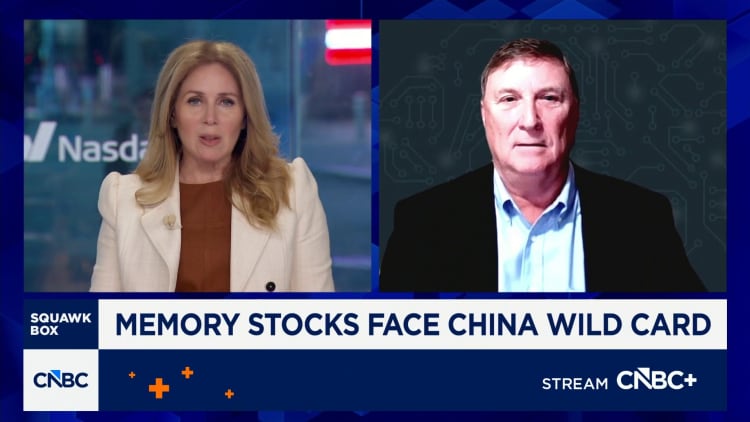
2029年RAM的过剩供应将对内存股票构成另一个逆风,导致价格下跌和利润空间被压缩。但这一遥远的预测尚未得到其他分析师的呼应。
An oversupply of RAM in 2029 would pose yet another headwind for memory stocks, with lower prices and a squeeze on profit margins. But a forecast that far out hasn't been echoed by other analysts.
通常,内存芯片的最大客户是消费电子公司,因为内存是智能手机和笔记本电脑等设备的关键组件。
Typically, the biggest customers for memory chips have been consumer electronics companies, because memory is a key component of devices like smartphones and laptops.
但随着AI热潮加速发展,内存也成为英伟达芯片和数据中心供应链其他部分的关键组件。需求增加导致供应紧张,进而引发前所未有的价格上涨。
But with the AI boom picking up pace, memory has also become a key component of Nvidia chips and other parts of the data center supply chain. With demand increasing, supply has tightened, leading to unprecedented price rises.
这导致三星、SK海力士和美光——这三家最大的内存制造商——股价出现大幅上涨。但投资者的一个关键问题是,行业典型的繁荣-衰退周期是否终于发生了改变。
That has led to huge rallies in the share price of Samsung, SK Hynix and Micron, the three biggest memory makers. But a key question for investors is whether the industry’s typical boom-and-bust cycle is finally changing.
内存价格传统上在需求超过供应时飙升,随后随着制造商提高产能和市场出现过剩而回落。投资者正在努力判断这一周期是否不再存在,或者是否发生了根本性变化。
Memory prices have traditionally surged when demand outstrips supply, only to fall as manufacturers ramp up production and the market becomes oversupplied. Investors are trying to work out if that cycle no longer exists or whether there has been a fundamental change.
目前,所有主要内存制造商都在扩大产能的过程中,但建造一座工厂并使其投入运营通常需要三到五年时间。
All of the major memory makers are currently in the process of expanding capacity, but it takes around three to five years for a factory to be built and come online.
这导致许多分析师预测,短缺情况要到2028年才会缓解 — — 但这不一定会导致价格大幅下跌。
That has led many analysts to forecast that the shortage won't ease until 2028 — but that might not necessarily lead to huge price declines.
Counterpoint Research预计,另一种关键内存类型DRAM的价格将在2028年相比2027年下降约23%。然而,与2025年相比,DRAM价格仍将上涨约230%。
Counterpoint Research sees the price of DRAM, another key type of memory, falling around 23% in 2028 compared with 2027. However, the DRAM price would still be up around 230% compared to 2025.
“目前的内存市场被认为正处于‘新常态’时代,下行周期将与以往不同,”Counterpoint Research的高级研究分析师Jeongku Choi对CNBC表示。
"The current memory market is considered to be in a 'New Normal' era, and the down cycle will differ from previous ones," Jeongku Choi, senior research analyst at Counterpoint Research, told CNBC.
“供应商和买家签订为期3至5年的长期协议(LTAs),涉及大额预付款,并设定明确的上下价格限制以确保一致性。因此,即使出现下行周期,也不太可能出现过去那样的急剧下跌。”
"Suppliers and buyers enter into 3- to 5-year Long-Term Agreements (LTAs), involving substantial upfront payments and established upper and lower price limits to ensure consistency. Consequently, even if a down cycle occurs, it is not expected to show the same sharp decline seen in the past."