新德里 -- 印度最新的青年领导的抗议活动可能标志着Z世代参与政治方式的转折点,因为年轻抗议者表示,印度首都最近的警方镇压行动加强了他们挑战当局的决心,他们认为这些当局正在削弱他们基本的宪法投票权和其他权利。
NEW DELHI -- India's latest youth-led protests could mark a turning point in how Gen Z engages in politics, as young protesters say a recent police crackdown in India's capital has strengthened their determination to challenge authorities they believe are undermining their basic constitutional voting and other rights.
分析人士警告称,这种愤怒可能转化为持久的青年政治动员。他们表示,很大程度上取决于学生团体能否维持集体行动,以及莫迪政府是否能够回应他们的诉求。
Analysts warn that this anger can translate into lasting youth political mobilization. Much will depend on whether student groups can sustain collective action and whether the Modi government addresses their concerns, they say.
这一问题在10月10日变得突出,当时警方阻止抗议者前往新德里指定的抗议地点——詹塔尔曼塔尔,并在一场要求选举委员会主席吉亚内什·库马尔辞职的集会之前拘留了数千人——根据当地报道,约为7000人。
The question came into focus on Oct. 10, when police blocked protesters from reaching Jantar Mantar, Delhi's designated protest site, and detained thousands -- around 7,000 according to local reports -- ahead of a rally demanding the resignation of Chief Election Commissioner Gyanesh Kumar.
蟑螂人民党(CJP)是一个青年领导的运动,该运动曾在六月领导了针对试卷泄露的抗议活动,如今再次走上街头,与学生团体和民间社会组织并肩作战,这一次的焦点是选民名单中所谓的不规范情况。
The Cockroach Janata Party (CJP), a youth-led movement that spearheaded protests over examination-paper leaks in June returned to the streets alongside student groups and civil society organizations, this time focusing on alleged irregularities in voter lists.
当前的动员围绕着选举委员会对选民名单的特别强化修订(SIR)展开,这一行动已导致约1.3亿人被删除。选举委员会表示,这一过程旨在识别已故选民、重复条目以及其他不再具备资格的人。批评者称,符合资格的选民被排除在外,并对选举公平性提出了担忧。
The current mobilization centers on the election commission's special intensive revision (SIR) of electoral rolls, an exercise that has removed around 130 million people. The commission says the process is intended to identify deceased voters, duplicate entries and other people no longer eligible. Critics said eligible voters have been excluded, and have raised concerns about electoral fairness.
抗议者在新德里蟑螂人民党的旗帜集会上喊口号,时间为10月16日。
Protesters chant slogans at a flag rally by the Cockroach Janta Party in New Delhi, Oct. 16.
“你们在要求那些一直在这里生活的人证明他们的身份。这是否意味着莫迪执政的印度人民党将决定谁可以投票?”贾米亚米利亚伊斯兰大学28岁的博士生、全印度学生协会成员萨乌拉布·特里帕蒂对《日经亚洲》说道。
"You are asking people, who have been living here since forever to prove their identity. Does that mean Modi's ruling Bharatiya Janata Party will decide who will vote?" Saurabh Tripathi, a 28-year-old doctoral student at Jamia Millia Islamia and a member of the All India Students' Association, told Nikkei Asia.
他说青年动员“反映了人们对政府对独立机构影响的更广泛担忧,这种担忧不仅限于选举公平,还延伸到大学、农民和工人。”
He said youth mobilization "reflects wider concerns about government influence over independent institutions, extending beyond electoral fairness to universities, farmers and workers."
“直到有人承担责任之前,没有人会安宁,”特里帕蒂说。“这不仅是针对这个政府,而是为了拯救真正的民主。”
"Now, until there is accountability, no one will rest," Tripathi said. "This is not just against this government but to save actual democracy." CJP founder Abhijeet Dipke, who was briefly held by authorities last Saturday, was reportedly arrested on Saturday after being detained again the previous day while heading to a protest. The rally swelled through Friday evening, with demonstrators holding national flags.
CJP创始人阿比吉特·迪普克上周六曾被当局短暂扣留,据报道,他在前一天被再次拘留后,于周六前往抗议活动途中再次被捕。抗议活动在周五晚上规模不断扩大,示威者手持国旗。
Abhijeet Dipke, founder of the Cockroach Janata Party, center, and Neha Bora, national president of the All India Students' Association, left in white, hold a news conference in New Delhi on Oct. 15.
蟑螂人民党创始人阿比吉特·迪普克(中)和全印学生联盟全国主席尼哈·博拉(左,白衣)于10月15日在新德里举行新闻发布会。
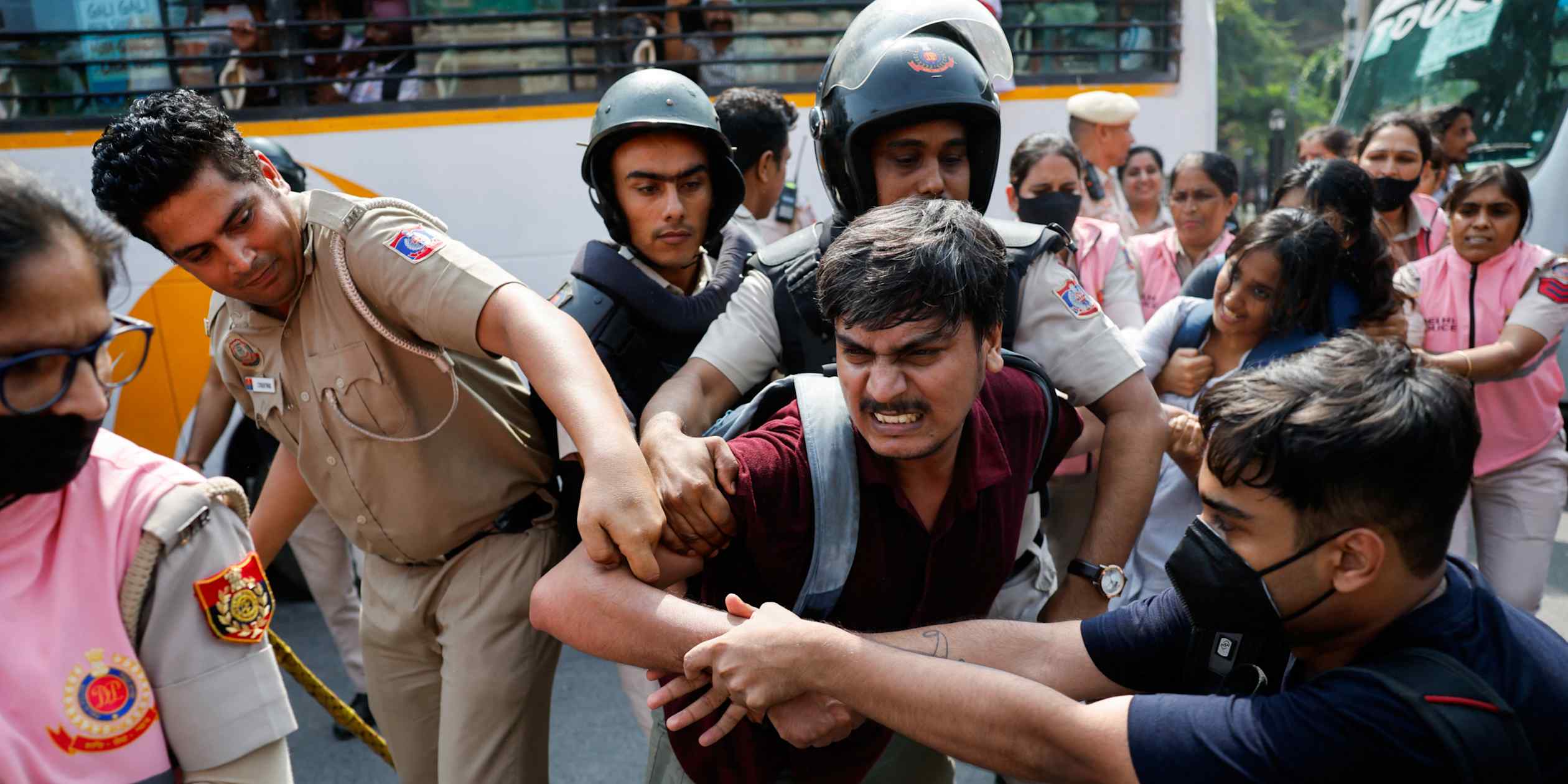
For Annapoorna, a 22-year-old Delhi University student, the Oct. 10 crackdown strengthened her determination to remain politically engaged. She alleged that officers pulled women from buses by grabbing their hair, beat protesters and seized phones to delete videos of large demonstrations in New Delhi.
对于22岁的德里大学学生安娜普尔纳而言,10月10日的镇压加强了她继续参与政治的决心。她称警方通过抓头发将女性从公交车上拽下,殴打抗议者,并没收手机以删除新德里大规模示威的视频。
"People are really angry and when we see our friends being beaten and brutalized for demanding accountability, then we can't really be silent or give up on speaking about our rights," she told Nikkei Asia.
“人们真的很生气,当我们看到朋友因要求问责而被殴打和虐待时,我们真的无法保持沉默或放弃谈论我们的权利,”她对《日经亚洲》说。
Social media has become central to how Indian youth document their recent experiences with Delhi police. It is used to challenge and ridicule pro-government television coverage. Platforms that helped Prime Minister Narendra Modi build his political image are now being used by youth to mock the administration and circulate videos beyond the reach of traditional news outlets.
社交媒体已成为印度青年记录他们近期与德里警察经历的核心方式。它被用来挑战和嘲笑亲政府电视台的报道。那些曾帮助纳伦德拉·莫迪总理塑造政治形象的平台,如今被青年用来嘲讽政府并传播传统新闻媒体触及不到的视频。
A protester reacts as she tries to stop a police bus carrying detained protesters during a protest organized by the Cockroach Janta Party, in New Delhi, Oct. 10.
一名抗议者在试图阻止一辆载有被拘留抗议者的警察巴士时做出反应,此次抗议由蟑螂人民党在新德里于10月10日组织。
Ebaad Rehman, a 24-year-old student who traveled from Kerala to attend the Oct. 10 rally, said he was detained and held on a bus for about an hour before someone pushed the door, allowing him to run off.
24岁的学生Ebaad Rehman从喀拉拉邦前来参加10月10日的集会,他说自己被拘留并在一辆公交车上被关押了大约一个小时,直到有人推开车门,他才得以逃脱。
"What scares me is how the government is getting the confidence to do all these things," he told Nikkei Asia. He also said friends who had supported Modi were shocked by the crackdown on young protesters.
“让我害怕的是,政府似乎越来越有信心做所有这些事情,”他对《日经亚洲》说。他还说,曾支持莫迪的朋友们对针对年轻抗议者的镇压感到震惊。
Political analyst Asim Ali said the movement could expand beyond student concerns to address broader questions about elections and democratic institutions. Its future, he said, "would depend partly on who leads it as its focus widens."
政治分析师阿西姆·阿里表示,这场运动可能超越学生议题,扩展到涉及选举和民主制度的更广泛问题。他表示,其未来“部分取决于谁来领导它,随着其焦点的扩大。”阿里将其可能的发展轨迹与印度过去的学生运动进行了比较,当时草根抗议逐渐发展为涉及反对党的更广泛的政治运动。他建议,既定的政治团体和学生组织应发挥“更大的作用,以使当前的动员得以持续。”阿里还说:“镇压也改变了一些年轻人对印度人民党的看法。”
Ali compared its possible trajectory with past student movements in India when grassroots agitation grew into wider political campaigns involving opposition parties. He suggested that established political groups and student organizations should play "a larger role if the current mobilization is to endure." "The crackdown has also changed how some young people view the BJP," Ali said.
“被拘留者中有一些是中产阶级印度教青年,”他说,“这是该党一直宣传为支持其阵营的群体。”在他看来,他们参与抗议凸显了假设曾支持执政党的年轻人将继续在政治上保持一致的局限性。
"Some of those detained were middle-class Hindu youths," he said, "a group the party has portrayed as supportive of it." Their participation in protests, in his view, highlights the limits of assuming that young people who have supported the ruling party will remain politically aligned with it.
抗议者在新德里10月11日的蟑螂人民党抗议活动中,安保人员将他们拘留时做出反应。
Protesters react as security personnel detain them during a Cockroach Janta Party protest in New Delhi on Oct. 11.
德里大学教授阿普尔瓦南德·贾表示,镇压不太可能完全阻止年轻抗议者,尽管未来的动员可能会采取不同的形式。
Apoorvanand Jha, a Delhi University professor, said the crackdown was unlikely to deter young protesters altogether, although future mobilization might take a different form.
“年轻人感到震惊,他们正在努力制定策略,”他对《日经亚洲》表示,并补充说:“大规模示威可能会转向小型团体——我认为他们不会轻易放弃。”“街头抗议为年轻人提供了自由、团结和目标感,”他说,并预测镇压经历将使年轻抗议者继续参与政治,即使大规模示威变得较少。
"Young people are shocked, and they are trying to figure out their strategy," he told Nikkei Asia, adding: "Large demonstrations could give way to smaller groups -- I don't think they will abandon it easily." "Street protests have offered young people a sense of freedom, solidarity and purpose," he said, predicting that the crackdown experience will keep younger protesters involved in politics, even if large demonstrations become less frequent.
事实上,正如新德里的学生特里帕西所说:“街头是保护民主之母的唯一途径。”古鲁塔莱因·雷哈巴尔是本文的撰稿人。
Indeed, according to Tripathi, the student in New Delhi, "The street is the only way to protect the mother of democracy." Quratulain Rehbar is a contributing writer.