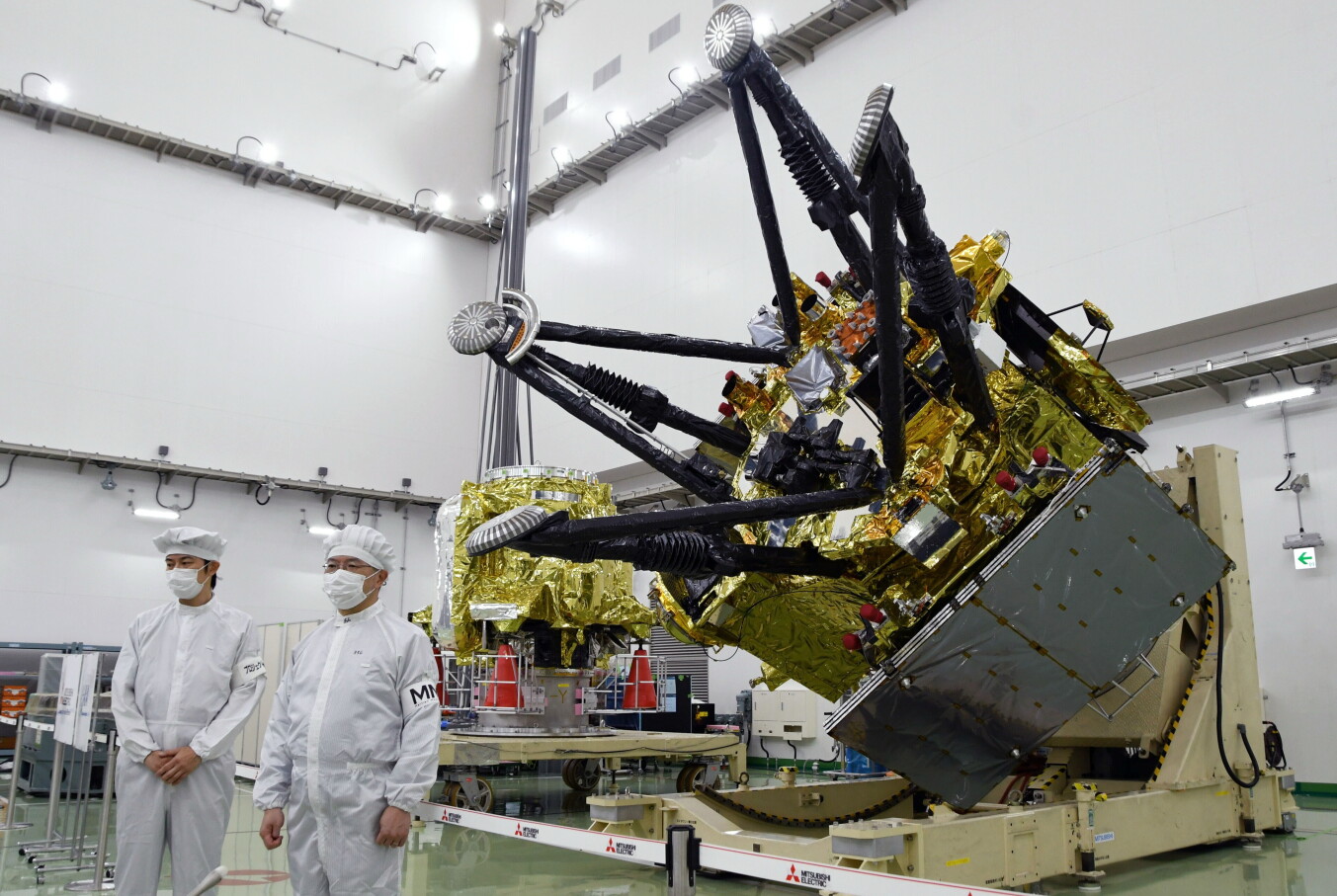
日本正发射一艘航天器,开展一项开创性任务,旨在从火星的卫星福博斯采集样本并带回地球。
Japan is launching a spacecraft on a groundbreaking mission to bring back samples from Phobos, one of Mars' moons.
Mari Yamaguchi 东京 — — 日本将发射一艘航天器,执行全球首个从火星卫星福博斯采集样本并带回地球的任务。福博斯是环绕火星运行的两颗小型、土豆形状的卫星之一。科学家们希望此次任务能够提供线索,以了解福博斯及其更小的兄弟卫星戴莫斯是如何形成的,甚至有望揭示太阳系中生命起源的奥秘。该任务预计将持续五年。
日本宇宙航空研究开发机构(JAXA)周二使用日本新型主力火箭H-3发射该航天器,正值美国、中国及其他国家考虑向火星派遣宇航员之际。
MARI YAMAGUCHI TOKYO — Japan is set to launch a spacecraft on the world’s first mission to bring back samples from Phobos, one of the two small, potato-shaped moons orbiting Mars Scientists hope the mission, which is expected to take five years, will provide clues to how Phobos and its smaller sibling Deimos formed, and hopefully even shed light on the origins of life in the solar system. The Japan Aerospace Exploration Agency’s launch of the spacecraft Tuesday on a new Japanese mainstay H-3 rocket comes as the United States, China and others consider sending astronauts to Mars.
MMX项目经理川胜康裕表示,福博斯的样本将为科学家提供有用数据,以评估是否可将火星卫星作为未来载人火星任务的基地。
Samples from Phobos will provide useful data for scientists to consider using a Martian moon as a base for a future manned mission to the planet, said MMX project manager Yasuhiro Kawakatsu.
“尽管它们可能具有重要意义,但火星的卫星从未被完全研究过,”川胜说。“它们被称为太阳系中最重要的未被攀登的山峰。”日本领导这项国际任务,任务包括来自美国国家航空航天局(NASA)及其他国家航天机构的设备和通信支持。
“Despite their potential importance, Martian moons have never been fully investigated,” Kawakatsu said. “They are known as the most important unclimbed mountains in the solar system.”Japan leads the international mission that includes equipment and communications support from NASA and other national space agencies.
JAXA旨在研究火星卫星的形成过程。自20世纪60年代以来,已有数十次任务被送往火星,但其卫星大多仍然是个谜。福博斯和戴莫斯的名称源自希腊神话中战神阿瑞斯(罗马对应为火星)之子 — — 恐惧与恐怖的拟人化人物。
JAXA aims to study how Mars’ moons formed Since the 1960s, dozens of missions have been sent to Mars, but its moons largely remain a mystery. Phobos and Deimos take their names from the Greek mythological personifications of fear and terror, sons of the war god Ares, whose Roman counterpart is Mars.
俄罗斯曾多次尝试登陆福博斯,包括2011年的一次任务,但均以失败告终。
Multiple Russian attempts to land on Phobos, including one in 2011, have failed.
一个关键问题将是它们是如何形成的,以及它们由什么物质构成。一些科学家认为,这两颗布满不规则陨石坑的天体可能是大型天体撞击火星后形成的碎片残余。另一些科学家则认为,这些卫星可能是来自其他地方的小行星。JAXA官员认为,福博斯的样本将能提供答案。
A key question will be how they formed and what they are made of. Some scientists think the two irregular crater-pocked bodies could be remnants of debris formed after a large celestial object crashed into Mars. Others say the moons could be asteroids that have come from elsewhere. JAXA officials think samples from Phobos will provide answers.
“通过分析(火卫一)土壤样本,我们几乎可以肯定能够得出结论,”MMX任务的首席研究员藏本清志表示。
“We can almost certainly come to a conclusion by analyzing (Phobos) soil samples,” MMX principal investigator Kiyoshi Kuramoto said.
科学家选择从火卫一采集样本,主要是因为火卫一比火卫二更靠近火星,因此可能包含更多关于火星的信息。日本宇宙航空研究开发机构(JAXA)官员表示,预计来自火星的物质将占从火卫一采集物质的约0.1%。
Scientists chose to collect samples from Phobos mainly because the moon is closer to Mars than Deimos and therefore may have more information about the planet. Material from Mars is expected to make up about 0.1% of the material collected from Phobos, JAXA officials say.
火卫一直径约为20至30公里(10至20英里),每天绕火星运行三次,轨道距离约为6000公里(3700英里)。
Phobos, about 20 to 30 kilometers (10 to 20 miles) in diameter, orbits Mars at a distance of about 6,000 kilometers (3,700 miles) three times a day.
藏本清志表示,火卫一的样本也可能有助于揭示火卫二的起源,因为科学家认为这两颗卫星有相似的起源。该任务还包括飞掠火卫二并进行观测的计划。
Samples from Phobos could also shed light on the origin of Deimos as the two moons are believed to have similar roots, Kuramoto said. The mission also includes plans to fly by Deimos and collect observations.
MMX任务将花费3年时间研究火卫一。前往红色星球的旅程将十分漫长——在地球与火星最近的时候,两者相距5500万公里(3400万英里)。
MMX will spend 3 years studying Phobos It will be a long journey to reach the red planet, 55 million kilometers (34 million miles) away from Earth at their closest point.
在H3火箭发射后,航天器将在一年后抵达火星区域。随后,它将在火卫一附近飞行三年,以收集数据并采集样本,然后计划于2031年返回地球。
After launching on the H3 rocket, the spacecraft will arrive at the Mars region a year later. Then it will fly near and around Phobos for three years to collect data and gather samples from the moon before returning home in 2031.
MMX由三个模块组成——分别用于推进、探测和返回——总重约5吨。只有第三个模块会返回地球,样本将储存在一个胶囊中。
MMX is made up of three modules — for propulsion, exploration and return — and weighs about 5 tons. Only the third module will return home, with the samples stored in a capsule.
航天器将携带13种仪器,其中包括由法国和德国共同研发的将登陆月球的探测车,以及美国国家航空航天局(NASA)的采样装置和用于测量伽马射线的仪器,还有欧洲航天局的深空通信设备。日本的辐射监测仪将收集数据,以帮助未来的载人火星探测。
The spacecraft will carry 13 instruments, including a rover jointly developed by France and Germany that will land on the moon, as well as a NASA sampling device and instrument to measure gamma rays, and the European Space Agency’s deep space communication device. A Japanese radiation monitor will collect data that can help a future manned Mars exploration.
该任务将从火卫一采集月球样本。法德联合研发的探测车“Idefix”将首次登陆火卫一。在大约2029年的100天任务期间,它将探测火卫一的表面,以协助随后日本的土壤采样工作。
The mission will collect moon samples from Phobos The French-German rover Idefix lands on Phobos first. During a 100-day mission in around 2029, it will explore the surface of the moon to help the subsequent Japanese soil-sampling.
MMX稍后着陆后,JAXA科学家计划采用美日两种方法进行两次采样,从火星卫星火卫一采集至少10克(0.35盎司)土壤。
Once the MMX lands some time later, JAXA scientists aim to collect at least 10 grams (0.35 ounces) of soil from the moon from two sampling attempts using U.S. and Japanese methods.
NASA的采样装置利用加压气体将表面尘土吹入容器,而JAXA的取芯方法将从约2厘米(不到1英寸)的深度采集样本。
NASA’s sampling device uses pressurized gas to lift surface dust into a container, and JAXA’s coring method will collect samples from a depth of about 2 centimeters (less than 1 inch).
第一次尝试中,MMX将同时使用两台设备采集地表和地下样本,并在第二次着陆时采集额外的地下样本。
In the first attempt, the MMX will collect surface and underground samples using both devices, and take additional underground samples in the second landing.
科学家表示,从多个地点采集样本,能增加从火星获取过去微生物生命潜在痕迹的机会。
Scientists say collecting samples from multiple locations increases the chances of obtaining any potential traces of past microbial life from Mars.
样本将存放在一个耐热舱内,该舱设计用于承受进入地球大气层的高温。预计该舱将在澳大利亚着陆,随后被送回日本。
The samples will be stored in a heat-protected capsule designed to survive reentry into Earth’s atmosphere. It’s expected to land in Australia before being sent back to Japan.
日本的两次隼鸟号任务曾带回小行星样本,分别在2010年和2020年。
Japan’s two Hayabusa missions returned asteroid samples, the first in 2010 and again in 2020.
火卫一的极低重力是一个挑战。探测器必须根据车辆提供的地形数据,选择一个相对平坦的着陆点,并在两小时内完成采样。
The moon’s extremely low gravity is a challenge The spacecraft has to choose a relatively smooth and level site for its landing based on topographical data provided by the rover, and then collect samples within two hours.
在布满坑洞、重力仅为地球两千分之一的火卫一上着陆是一项挑战。
Landing on the pockmarked moon, which has just one two-thousandth of Earth’s gravity, is a challenge.
为尽量减少着陆时的弹跳,MMX的探测模块配备了带有减震功能的四足着陆装置。
To minimize bouncing at touchdown, the MMX’s exploration module is equipped with four-legged landing gear with shock absorption features.
JAXA表示,该车辆配备了可在低重力环境下获得抓地力、翻倒后能自行复位、并能“以蜗牛般的速度”移动的轮子。
The rover has wheels that can get traction in low gravity, right itself if it tips over, and move “at a snail’s pace,” JAXA said.