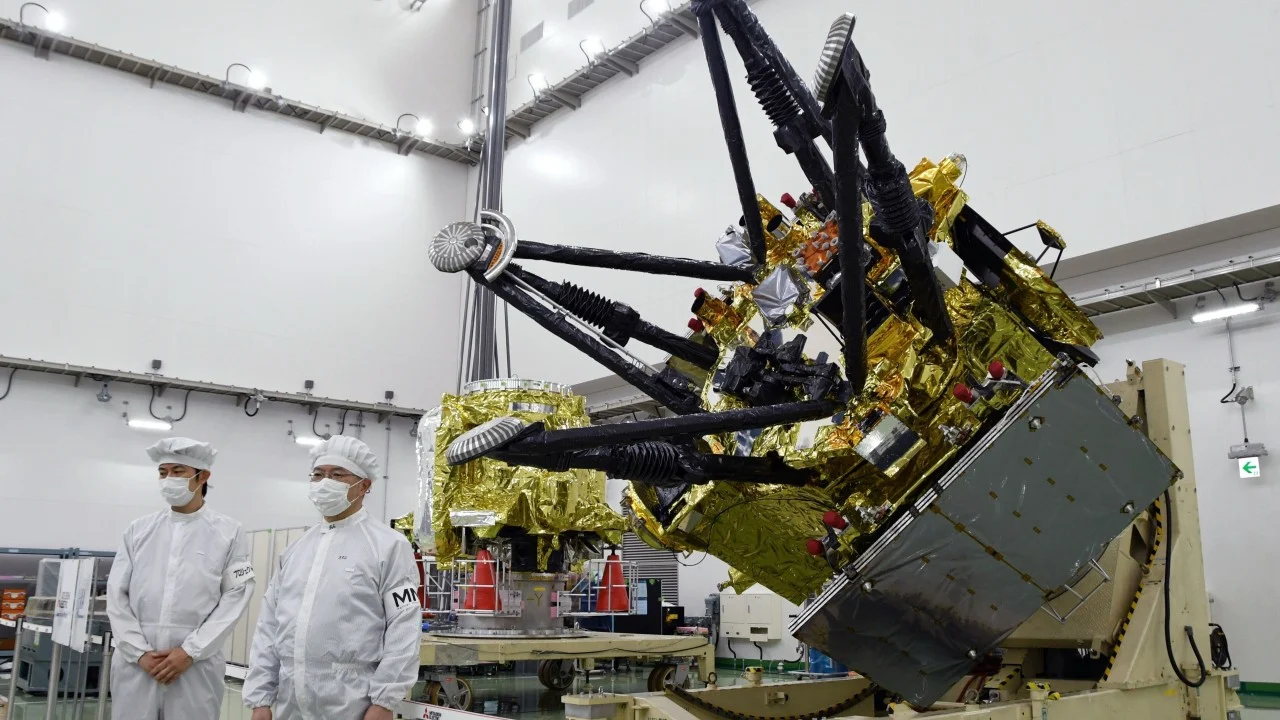
日本科学家正在准备一项前往火星卫星的任务,旨在采集样本,以帮助揭开太阳系起源和地球生命之谜,此举旨在实现首次往返火星区域的探测。
Japanese scientists are readying a mission to Mars’s moons to retrieve samples that could help unlock the origins of the Solar System and life on Earth, in what aims to be the first round trip to the Martian region.
无人驾驶的火星卫星探测(MMX)探测器是美国和欧洲航天机构以及众多大学和科技公司合作的成果,也可能为未来人类探索奠定基础。
The uncrewed Martian Moons eXploration (MMX) probe, a collaboration with US and European space agencies as well as numerous universities and tech companies, could also help lay the groundwork for eventual human exploration.
据日本宇宙航空研究开发机构(JAXA)称,搭载MMX探测器的旗舰H3火箭计划于周二凌晨4点41分从种子岛航天中心发射。
The flagship H3 rocket carrying the MMX is set to blast-off from the Tanegashima Space Center Tuesday at 4.41am, according to the Japan Aerospace Exploration Agency (JAXA).
“能够参与如此宏大的任务令人兴奋不已,”JAXA H3火箭团队项目经理有田诚在发射前两天对记者表示。
“Being able to be involved in such a grand mission is incredibly exciting,” Makoto Arita, project manager of JAXA’s H3 rocket team, told reporters two days before the launch.
航天器将于明年8月左右抵达火星附近,届时它将先绕火星的一颗卫星——福博斯运行,随后着陆并在火星空间范围内运行三年期间,从表面采集至少10克物质。
The spacecraft will arrive near Mars around August next year, where it will orbit one of its moons, Phobos, before landing and collecting at least 10 grams of material from the surface during three years of operating within the Martian sphere.
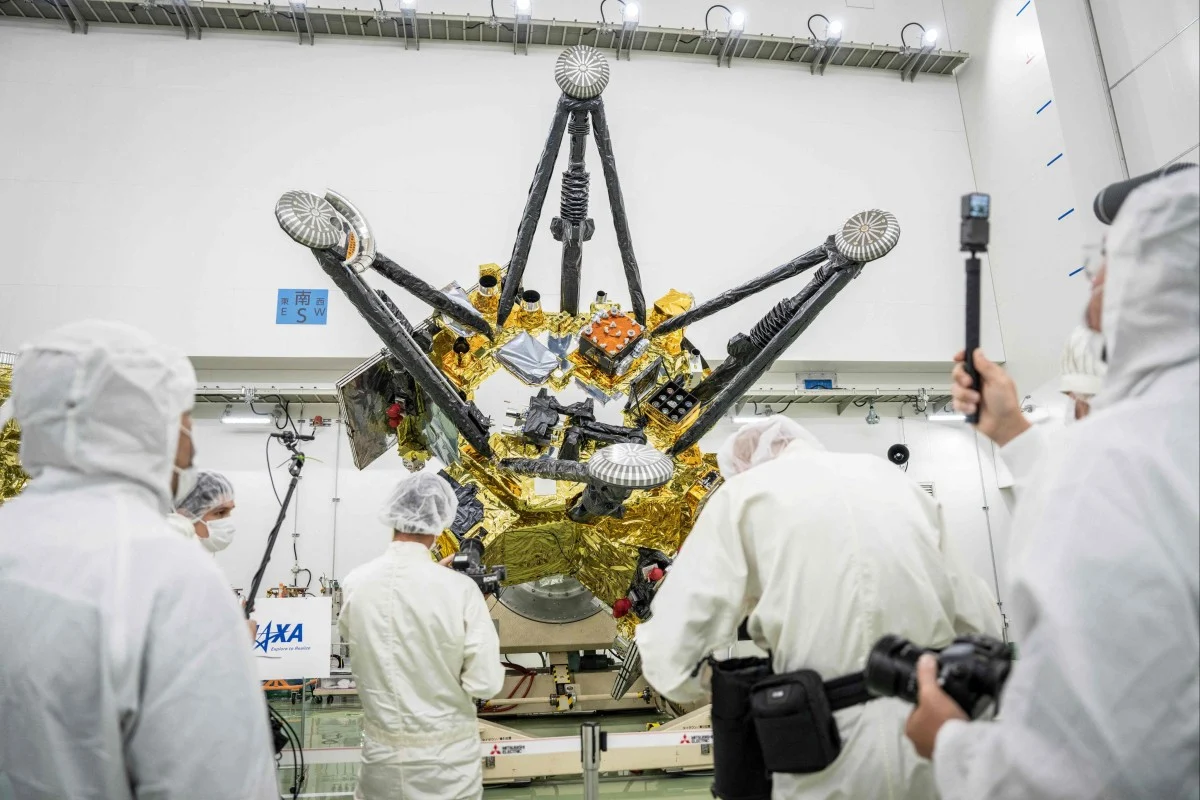
一辆名为IDEFIX的探测车——这是漫画《阿斯特里克斯》中主角狗狗的法语名称——将首先进行表面观测,以确保安全着陆。
A rover dubbed IDEFIX – the French name for the comic hero Asterix’s dog – will first conduct surface observations aimed at ensuring a safe landing.
“从福博斯采样当然是世界首次,但这也意味着……这是首次往返火星系统,”MMX项目经理川胜康裕表示。
“The sampling [from] Phobos is of course the world’s first, but it means … this is the first round trip to the Martian system,” MMX’s project manager Yasuhiro Kawakatsu said.
JAXA表示,该任务还将探索利用福博斯作为“天然空间站”的可能性,通过确定往返火星的要求来实现——这对载人火星探索“至关重要”。
JAXA said the mission will also explore the possibility of using Phobos as a “natural space station” by establishing the requirements for a round trip to Mars – something “essential for crewed Mars exploration”.
任务还将观测火星的另一颗卫星戴莫斯,尽管不会在此着陆,随后返回地球。
It will also observe the Red Planet’s moon Deimos, although it will not land on it, before returning to Earth.
撞击或捕获 JAXA希望此次任务能揭示火星及其两颗卫星的形成过程,这是理解太阳系如何诞生的关键知识。
Impact or capture JAXA hopes the mission will reveal how Mars and its two moons formed, a key piece of knowledge in working out how the Solar System was born.
关于火星卫星起源的一种理论——即“巨型撞击”假说——认为它们是在一颗天体与火星相撞后形成的。
One theory for the origin of the Martian moons – the “giant impact” hypothesis – is that they formed after a celestial body collided with Mars.
与此同时,“捕获”假设认为,这些卫星是被火星引力捕获的小行星。
The “capture” hypothesis, meanwhile, postulates that the moons are asteroids captured by Mars’s gravity.
确定哪种理论正确将有助于揭示“宜居环境如何在类地行星上形成”,JAXA 表示,这里指的是离太阳最近的四颗岩石行星——水星、金星、地球和火星。
Determining which theory is correct will help reveal “how a habitable environment for life might have arisen on the terrestrial planets”, JAXA said, referring to the four rocky worlds closest to the Sun – Mercury, Venus, Earth and Mars.
“MMX 将揭示将水、挥发性物质和有机化合物从外太阳系输送到内部岩石行星区域的运输机制——这些过程可能在使这些行星变得宜居方面发挥了关键作用,”法国天体物理学家帕特里克·米歇尔(Patrick Michel)表示,他正在参与 IDEFIX 项目。
“MMX will shed light on the transport mechanisms that delivered water, volatiles, and organic compounds from the outer Solar System to the inner rocky planet region – processes that may have played a key role in making these worlds habitable,” said Patrick Michel, a French astrophysicist working on IDEFIX.
“如果火卫一和火卫二确实是这些早期输送系统的残余物,它们可能蕴含着生命起源的线索,或者更准确地说,蕴含着使生命在岩石行星上出现的关键物质的输送线索,”他说。深陷“引力井”MMX 是与法国国家空间研究中心(CNES)、德国航空航天中心(DLR)、美国国家航空航天局(NASA)、欧洲航天局(ESA)以及约 20 所大学和科技公司合作的项目。
“If Phobos and Deimos are indeed remnants of these early delivery systems, they may hold clues to the origins of life itself, or, to be more correct, to the transport of the materials that were key to the emergence of life on rocky planets,” he said. Deep in the ‘gravity well’MMX is a collaboration with France’s National Centre for Space Studies (CNES), the German Aerospace Centre (DLR), Nasa, the European Space Agency (ESA), and about 20 universities and tech companies.
航天器着陆腿的研发尤为困难,因为火卫一的引力极其微弱,JAXA 科学家表示。
The development of the spacecraft’s landing legs was particularly difficult, as gravity on Phobos is extremely weak, JAXA scientists say.
日本的无人智能月球探测器(SLIM)——即“月球狙击手”——在 2024 年着陆在地球月球表面后倾倒,但仍然传回了数据,并度过了数个两周的月夜。
Japan’s uncrewed Smart Lander for Investigating Moon (SLIM) – the “Moon Sniper” – tipped over after touching down on Earth’s Moon in 2024, but still transmitted data and survived several two-week lunar nights.
日本也有从太空带回样本的经验,包括 JAXA 的无人探测器“隼鸟-2”(Hayabusa-2),它在 2020 年从距离地球几亿公里的小行星上采集了 5.4 克岩石和尘埃样本并带回地球。
Japan also has experience in bringing back samples from space, including JAXA’s uncrewed Hayabusa-2, which returned 5.4 grams of rock and dust collected from an asteroid several hundred million kilometres from Earth in 2020.
关于即将开展的任务,“我们必须非常接近火星并返回,”川胜告诉记者,“这意味着需要逃离火星强大的引力。”火卫一距离火星表面约 6000 公里。“深入我们所说的‘引力井’是困难的,”川胜说。
On the coming mission “we have to travel very close to Mars and return”, which means escaping the planet’s heavy gravity, Kawakatsu told reporters. Phobos orbits about 6,000 kilometres above the Martian surface. “Going deep into what we call the ‘gravity well’ is difficult,” Kawakatsu said.
中国的任务 美国和中国航天机构一直在竞争,以成为首个将火星表面的岩石样本送回地球的国家。
China’s mission US and Chinese space agencies have been racing to be the first to return rock samples from Mars’s surface back to Earth.
美国宇航局的毅力号漫游车自2021年以来一直在火星上巡游,已经采集了样本。
Nasa’s Perseverance rover, which has been roaming the Red Planet since 2021, has already collected samples.
然而,该任务在特朗普总统政府时期,因美国国会一月份的投票而实际上被取消。
The mission, however, was effectively cancelled by the administration of President Donald Trump following a vote by the US Congress in January.
与此同时,中国宣布其天问-3号航天器计划于2028年左右发射,希望尽早在2031年前将火星样本送回地球——这可能早于MMX的返回。
China, meanwhile, has announced its Tianwen-3 spacecraft is scheduled for launch around 2028 and hopes to return Mars samples to Earth as early as 2031 – potentially before the MMX’s return.
日本宇宙航空研究开发机构(JAXA)的科学家表示,火卫一的沙子和岩石可能比火星本身提供更广泛的样本种类,特别是如果它是由一颗天体与火星相撞形成的。
JAXA scientists say sand and rocks from Phobos may offer a wider variety of samples than those on the planet itself, especially if it was formed by a collision between a celestial body and Mars.