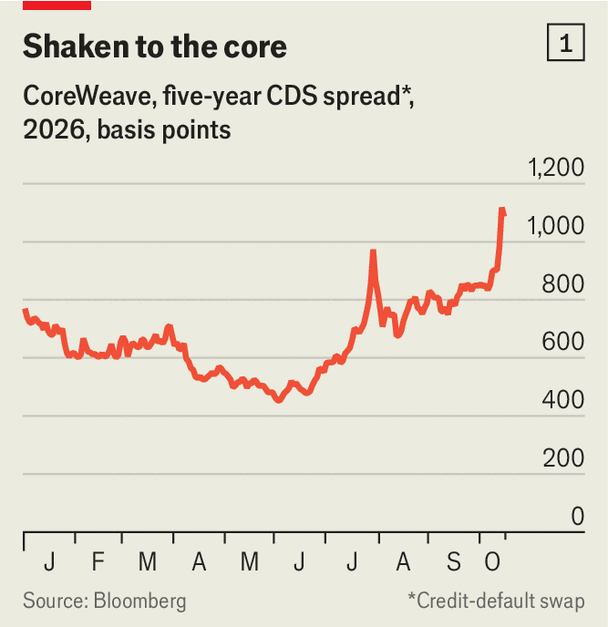
信贷市场正瞄准CoreWeave。自7月以来,由“新云”公司发行的五年期债券价格已下跌16%。该公司出租数据中心容量用于人工智能模型。该债券的收益率现在为15%——这一水平通常与财务困境中的公司相关联——而7月份为10%。信用违约掉期的价格暗示,CoreWeave在未来五年内无法偿还债务的概率已升至60%以上(见图1)。
Credit markets are coming for CoreWeave. The price of a five-year bond issued by the “neocloud”, which rents out data-centre capacity for artificial-intelligence models, has fallen by 16% since July. The bond’s yield is now 15%—a level associated with companies in financial distress—up from 10% in July. The price of credit-default swaps offering insurance against a CoreWeave default implies that the probability of the company being unable to service its debts in the next five years has risen above 60% (see chart 1).
投资者日益担心,人工智能热潮核心的公司将无法产生足以偿债的现金流,以应对其巨额债务。这些担忧已从信贷市场蔓延,也导致股市出现波动:科技股占比高的纳斯达克指数在大幅下跌后,如今已回落至5月中旬的水平。投资者正在将债务规模日益扩大、透明度降低、风险日益增加的情况计入定价。
Investors increasingly worry that the companies at the heart of the AI boom will be unable to generate the cashflows necessary to service their vast debts. These concerns have spilled over from credit markets to cause a wobble in the stock market, too: having fallen sharply, the tech-heavy NASDAQ index is now back to where it was in mid-May. Investors are pricing in a debt stock that is getting bigger, more opaque—and increasingly risky.
不仅是CoreWeave让人眉头紧锁。其竞争对手“新云”公司——包括Nebius和TeraWulf——的债券收益率也在上升。这些企业高度依赖债务。在十家公开上市的“新云”公司中,只有两家实现盈利。该集团的合并借款总额达1000亿美元,是其年收入的三倍。其中,570亿美元的债务是在今年发行的。
It is not just CoreWeave causing furrowed brows. Yields on the bonds of its rival neoclouds, including Nebius and TeraWulf, are also rising. These businesses live on debt. Of the ten neoclouds that are publicly listed, only two are profitable. The combined borrowings of this group, at $100bn, are triple its annual revenues. Of that debt, $57bn-worth has been issued this year.
而这些金额仅为快速增长的人工智能相关债务总规模的一小部分。甲骨文公司曾是软件经销商,如今转型为云服务提供商,目前已累计借款1690亿美元,其中250亿美元是在今年发行的。软银和SpaceX作为另外两家具有雄心勃勃的云计划的公司,自今年1月以来又新增了910亿美元的债务。
And those sums are only a small part of the fast-growing stock of AI-related debt. Oracle, a software pedlar turned cloud provider, has now racked up $169bn of borrowings, with $25bn-worth issued this year. SoftBank and SpaceX, two other companies with big cloud ambitions, have taken out a further $91bn of debt since the start of January.
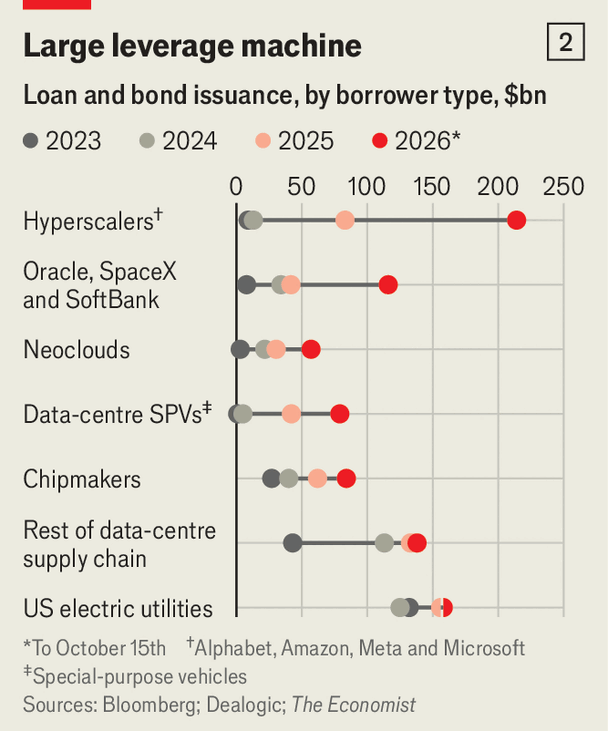
然后是美国四家所谓的超大规模云计算公司——Alphabet、亚马逊、微软和Meta——它们在2026年共计借款2140亿美元,而去年全年为830亿美元。特殊目的载体(SPVs)发行的数据中心债务额外增加了790亿美元,其中大多数是云服务提供商与金融机构之间的合资企业。此外,英伟达等芯片制造商及半导体供应链中的其他公司借款了840亿美元。
Then there are America’s four bigger so-called hyperscalers—Alphabet, Amazon, Microsoft and Meta—which have borrowed $214bn between them in 2026, up from $83bn in all of last year. An additional $79bn of data-centre debt has been issued by special-purpose vehicles (SPVs), most of which are joint ventures between cloud providers and financial institutions. On top of this is the $84bn borrowed by chipmakers such as Nvidia and others in the semiconductor supply chain.
再加上其他提供数据中心设备的公司以及美国电力公用事业公司发行的债务——这些公司也在为跟上人工智能热潮而不得不进行投资——到目前为止,今年借款总额已升至近8500亿美元——大约是同一批公司在2023年发行债务总额的四倍(见图2)。它们的资产负债表合计承担超过3万亿美元的债务。
Add the amount issued by other companies providing data-centre gear and America’s electricity utilities, which are also having to invest to keep up with the AI boom, and the total borrowed so far this year rises to nearly $850bn—roughly four times the amount the same group of companies issued in 2023 (see chart 2). Together their balance-sheets carry over $3trn of debt.
不久之前,人工智能热潮是由这些超大规模云计算公司的现金流融资的。但如今的投资规模已经超过了它们其他业务所能承受的范围,也远远超过了消费者和企业目前在人工智能上的支出。摩根大通银行预计,从现在到2030年,将有约5.5万亿美元的资本支出用于支持该技术,其中四分之三将通过债务融资。借款人正在转向富有创意的融资策略,并广泛寻求各类贷款人。
Not long ago the AI boom was financed by the cashflows of the hyperscalers. But investment has grown beyond what can be paid for by their other businesses, and far beyond what consumers and enterprises are so far spending on AI. JPMorgan Chase, a bank, expects around $5.5trn in capital spending to support the technology between now and 2030, with three-quarters of it funded by debt. Borrowers are turning to imaginative financing strategies, and tapping all manner of lenders.
债券仍然是一个受欢迎的选择,包括Alphabet在2月份发行的320亿美元规模的大额债券。即使是这些日常工具,然而,所需的规模也意味着发行者必须想出创新办法。外国信贷市场正日益受到青睐。到目前为止,今年五大云服务提供商——即超大规模云计算公司四家加上甲骨文——发行的债券中,约有30%是以外币计价的,包括欧元、英镑和日元。
Bonds, including whoppers such as Alphabet’s $32bn offering in February, remain a popular choice. Even for these everyday instruments, however, the scale required means issuers must get creative. Foreign credit markets are increasingly sought out. So far this year about 30% of bonds issued by the five biggest cloud providers—meaning the hyperscaler quartet plus Oracle—have been in non-dollar currencies, including euros, pounds and yen.
同时,其他工具也日益流行。特殊目的载体(SPV)如今已司空见惯。其中一个例子是Sopaipilla,这是Meta主导的项目(并以一种糕点命名)。它由位于得克萨斯州埃尔帕索的十个数据中心组成,这些数据中心合计将提供大约1吉瓦的算力。该场地由一家名为Wurldwide的控股公司所有,而Wurldwide又由Meta持有20%股份,以及资产管理巨头BlackRock持有剩余80%股份。Wurldwide于8月发行了130亿美元债务,用于资助该园区的建设,而Meta已同意租用该园区20年。
At the same time, other instruments are growing in popularity. SPVs are now commonplace. One example is Sopaipilla, a project masterminded by Meta (and named after a pastry). It consists of ten data centres in El Paso, Texas, which together will provide roughly a gigawatt of computing power. The site is owned by a holding company, called Wurldwide, which in turn is owned by Meta, with a 20% stake, and BlackRock, an asset-management giant, which holds the remaining 80%. Wurldwide issued $13bn of debt in August to fund the building of the campus, which Meta has agreed to lease for 20 years.
此类结构满足了诸多需求。BlackRock及其客户获得了由Meta担保的稳定收入流,而Meta则能够将债务留在资产负债表之外。信用评级机构已为该SPV给出的评级比Meta低一个档次。
Such structures tick plenty of boxes. BlackRock and its clients get a stream of steady income guaranteed by Meta, which in turn gets to keep the debt off its balance-sheet. Credit-rating agencies have given the SPV a score one notch below Meta’s.
以芯片作为担保的融资方式——即利用数据中心中部署的硅片作为抵押品——也正在兴起。据称,SpaceX正在寻求通过这种方式获得400亿美元融资,以便从英伟达采购更多芯片。通常,芯片担保融资是通过SPV安排的。甲骨文正在与私募市场巨头Apollo和投资银行高盛进行谈判,以资助一项大规模半导体采购,这些半导体将由一个独立实体持有并租给甲骨文。作为渴望获得更大算力控制权的两家领先模型制造商,Anthropic和OpenAI据报道正在谈判类似安排,以直接采购大量芯片。
Chip-backed financing, which entails using the silicon deployed in a data centre as collateral, is also on the rise. SpaceX is said to be looking to secure $40bn of funding using the approach in order to purchase more chips from Nvidia. Often chip-backed financing is arranged through an SPV. Oracle is in talks with Apollo, a private-markets giant, and Goldman Sachs, an investment bank, to fund a big purchase of semiconductors that will be held by a separate entity and leased to Oracle. Anthropic and OpenAI, two leading model-makers that are eager to gain greater control over their computing capacity, are reportedly negotiating similar arrangements to procure large amounts of chips directly.
Fitch信用评级机构的Roelof Steenkamp表示,芯片担保融资使风险评估“变得无比复杂”。此类安排的一个后果是,数据中心的建筑和内部芯片,以及场地的电力来源(如果有自备电源的话),可以各自由不同层级的债务来融资。
Chip-backed financing makes assessing risk “infinitely more complicated”, says Roelof Steenkamp of Fitch, a credit-rating agency. A consequence of such arrangements is that a data-centre’s bricks and mortar and the chips inside it, as well as the site’s power source (if it has its own), can each be financed by a separate layer of debt.
除此之外,还有不算债务但接近债务的义务。根据研究机构CreditSights的数据,五大云服务提供商在资产负债表上的租赁负债合计超过2500亿美元。此外,已达成但尚未开始的租赁协议价值达1.2万亿美元。还有向供应商采购产品的承诺,价值额外增加1.5万亿美元。
On top of this are the obligations that are not quite debt, but close to it. The five biggest cloud providers have lease liabilities on their balance-sheets totalling over $250bn, according to CreditSights, a research firm. A further $1.2trn-worth of leases have been agreed but are yet to commence. Then there are commitments to purchase products from suppliers worth an additional $1.5trn.
另一层复杂性来自于AI领域中资产负债表更大、更健康的公司所提供的担保,以保障他人的债务。英伟达在这方面尤为积极,愿意为客户购买其芯片所使用的最高达3000亿美元债务提供担保,以防客户无法偿还债权人。谷歌母公司Alphabet和博通(为云服务提供商和模型开发商定制芯片的公司)也向部分客户提供了此类担保。这些安排使得投资者更难判断风险究竟在哪里,以及损失可能蔓延到何种程度。
A final complexity comes from the backstops that companies in the AI nexus with bigger and healthier balance-sheets are offering to guarantee the debts of others. Nvidia has been particular enthusiastic in this regard, placing itself on the line to cover as much as $300bn of debt used to purchase its chips if customers are unable to repay their creditors. Alphabet and Broadcom, which develops custom chips for cloud providers and model-makers, have also provided backstops to some customers. Such deals make it even more difficult for investors to determine where the risks lie, and how far losses might spread.
谁面临风险?简短的答案是:所有人。各类金融机构都持有AI相关债务,部分原因在于此类债务规模巨大。大型资产管理公司是最大的买家。例如,全球最大的债券基金管理公司之一——PIMCO,购买了Meta在路易斯安那州Hyperion数据中心园区发行的270亿美元债券中的180亿美元部分。随后,这些债券被转售给机构投资者,如养老基金和保险公司。
Who is exposed? The short answer is everyone. All types of financial firms are holding AI debt, partly because there is so much of it. Large asset managers have been the biggest buyers. For example, Pimco, one of the world’s biggest bond-fund managers, bought $18bn-worth of the $27bn bond issued for Meta’s Hyperion data-centre campus in Louisiana. Tranches were then sold on to institutional investors, such as pension funds and insurance firms.
私募信贷提供商,包括阿波罗和黑石,正在推动许多更具创新性的交易。有时这些贷款会被 syndicate 给机构投资者,其中包括由私募信贷提供商控制的保险公司:据报道,阿波罗在六月向博通提供的贷款中,有一大部分最终出现在了阿波罗旗下保险公司Athena的账簿上。对冲基金也涌入了AI债务市场,尤其对新兴云服务提供商(neoclouds)表现出浓厚兴趣。
Private-credit providers, including Apollo and Blackstone, are spearheading many of the more creative deals. Sometimes the loans are syndicated to institutional investors, including insurers controlled by the private-credit providers: a sizeable chunk of the debt Apollo lent to Broadcom in June reportedly ended up on the books of Athena, Apollo’s insurance arm. Hedge funds have also piled in to the market for AI debt, showing particular interest in the neoclouds.
尽管近期市场出现波动,但总体而言,投资者尚未对债务激增产生恐慌。今年发行的与人工智能相关的债券中,只有约15%的价值属于垃圾债券状态。此外,尽管现有的各种兜底措施使得人工智能债务的审查变得更加困难,但像英伟达这样的公司拥有充裕现金的资产负债表,有助于吸收任何冲击。10月15日,英伟达首席执行官黄仁勋捍卫了CoreWeave的前景,该公司部分债务由英伟达担保,他指出其“资本成本实际上正在随时间下降”。
Despite the recent market wobble, investors on the whole are not yet panicking about the debt binge. Only about 15% of the value of AI-related bonds issued this year have junk status. And although the various backstops in place make the stock of AI debt more difficult to interrogate, the cash-rich balance-sheets of companies like Nvidia would help to absorb any shock. On October 15th Jensen Huang, Nvidia’s boss, defended the prospects of CoreWeave, some of whose debts his company has guaranteed, arguing that its “cost of capital is actually decreasing” over time.
然而,风险依然潜伏。一项威胁来自借贷成本的上升。海湾战争、持续的通胀以及对公共债务增长的担忧导致近几个月来政府债券收益率快速攀升,从而推高了企业借款人的利率。为支持人工智能繁荣而发行的债务规模本身也起到了一定作用。对于资金雄厚的超大规模云服务提供商而言,这是一种痛苦;而对于像CoreWeave这样财务较为脆弱的借款人——其利息支出已经占年收入的四分之一——这可能证明是致命的。
Even so, dangers lurk ahead. One threat is from rising borrowing costs. War in the Gulf, persistent inflation and anxiety over the growth of public debt have caused yields on government bonds to climb rapidly in recent months, pushing up interest rates for corporate borrowers. The scale of debt issued in support of the AI boom has itself played a part. For the deep-pocketed hyperscalers, that is a source of pain; for shakier borrowers like CoreWeave—whose interest bill already soaks up a quarter of annual revenue—it could prove deadly.
更大的威胁在于,如果人工智能的需求出现停滞。来自企业卡片提供商Ramp的数据显示,自7月以来,其客户在人工智能上的支出已趋于平稳,因为企业正试图控制不断上升的成本。增长放缓反过来可能导致Anthropic或OpenAI无限期推迟其备受期待的公开上市计划,这可能促使投资者重新评估其对人工智能的敞口。人工智能债务规模越大,其脆弱性就越高——一旦出现崩盘,后果也将更加严重。■
The bigger threat would be if demand for AI were to stagnate. Data from Ramp, a provider of corporate charge cards, shows that spending on AI among its customers has flatlined since July, as businesses try to contain spiralling costs. Softening growth, in turn, might lead Anthropic or OpenAI to delay indefinitely their much-anticipated public listings, which could cause investors to rethink their exposure to AI. The bigger the tower of AI debt grows, the more vulnerable it will become—and the graver the consequences should it come crashing down. ■