
把它称为“极客思维”。过去几年,硅谷一直相信,谁打造出最智能的人工智能系统,谁就能统治整个行业。如今,这种计算开始看起来是误导性的。
Call it the nerd mindset. Silicon Valley has spent the last few years believing that whoever built the smartest artificial-intelligence system would rule the industry. Today, that calculation is starting to look misguided.
帕米·奥尔森(Parmy Olson)撰文:构建人工智能模型的成本在上升,而使用它们的成本在下降。人工智能公司的收入增长令人印象深刻,但也在放缓。这不一定意味着泡沫破裂,但确实表明,真正的权力正日益掌握在分发和支撑技术的公司手中:微软公司(Microsoft Corp.)、谷歌母公司Alphabet Inc.和亚马逊公司(Amazon.com Inc.)等云巨头。
By Parmy Olson The cost of building AI models is going up, and the price of using them is going down. AI companies’ revenue growth has been impressive, but it’s also slowing. That doesn’t necessarily mean a bursting bubble, but it does look like the real power increasingly lies with the companies that distribute and power the technology: cloud giants like Microsoft Corp., Alphabet Inc. and Amazon.com Inc.
这三家科技巨头自2026年初以来股价平均上涨了10%,它们掌握着人工智能销售所依赖的基础设施、客户关系和分销渠道。无论企业使用Claude、旧版ChatGPT,还是来自中国的更便宜的开放权重模型,它们都能获利。但OpenAI或Anthropic则不然。
This trio of the Big Tech establishment, whose shares have risen an average of 10% since the start of 2026, controls the infrastructure, customer relationships and distribution channels through which AI is sold. They can profit whether a business uses Claude, or an older version of ChatGPT, or a cheaper open-weight model from China. That’s not the case for OpenAI or Anthropic.
后者正筹备在11月进行首次公开募股(IPO),目标估值达2万亿美元,这将是检验投资者对人工智能热潮持续兴趣的最大考验。问题在于:Anthropic最近向投资者透露,其第三季度收入为168亿美元,环比增长约50%,而今年早些时候这一增速曾达到140%。
The latter is on the runway to an initial public offering in November; it’s aiming for a $2 trillion valuation in what will be the biggest test of continued investor appetite for the AI boom. The problem: Anthropic recently told investors that its third-quarter revenue was $16.8 billion, a quarter-on-quarter growth rate of around 50%, compared with 140% earlier this year.
在X平台上,你会看到对这一消息的恐慌。一位热门财经评论者称Anthropic的数据为“疯狂般的急剧下降”,并补充道:“一切结束了”,语气带有威胁意味。
Go on X and you’ll find hysteria over this news. A popular financial commenter calls Anthropic’s numbers a “crazy sharp” deceleration. “It’s over,” they add, ominously.
实际上,这几乎算不上灾难。按季度增长50%计算,年收入将增长约五倍,三年内将增长约130倍。困难在于如何维持这种增长,因为每增加一个季度就需要数十亿美元的新增收入。
Actually, it’s hardly a disaster. At 50% quarterly growth, sales would increase roughly five times in a year and 130 times in three years. The hard part is sustaining it, as each additional quarter requires billions more in new revenue.
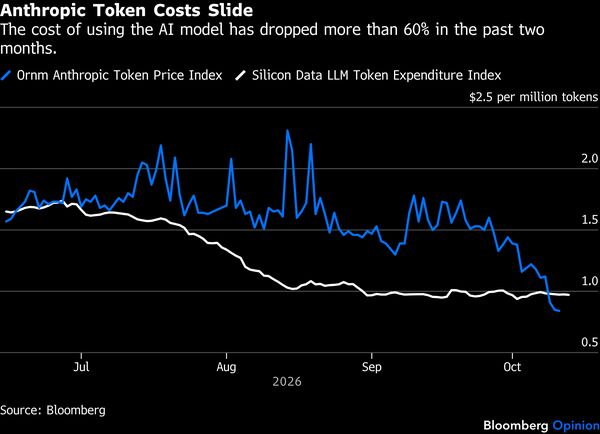
问题的复杂性在于,最强大的前沿模型建造成本极高。Citadel Securities在8月份发布的一张图表凸显了OpenAI和Anthropic所面临的痛苦经济陷阱:运行AI所需的算力成本越来越高,而所谓的token价格却在下降,使得使用AI变得更加便宜。
Compounding the problem is the fact that the most powerful frontier models cost a fortune to build. A chart published by Citadel Securities in August highlighted the painful economic trap faced by OpenAI and Anthropic: The computing power needed to run AI is becoming more expensive, while so-called token prices have fallen, making it much cheaper to use.
该图表的作者持乐观态度,认为更便宜的AI正促使企业更多地使用这项技术,足以支撑对所有昂贵底层算力的需求——AI支持者常将这一现象称为杰文斯悖论。
The authors of the Citadel chart were optimistic, saying that cheaper AI was leading companies to use the technology more, enough to sustain demand for all that expensive, underlying compute — AI boosters often point to this phenomenon, known as Jevons paradox.
但随着越来越多的企业选择“足够好”的AI而非最佳AI,对Anthropic和OpenAI能否维持这种增长速度持乐观态度变得更加困难。根据对200家企业进行调查的Enterprise Technology Research的数据,更便宜的开放权重模型目前占企业AI token使用量的三分之一以上,而一年前这一比例为23%。受访者预计,这一比例将在未来12个月内达到41%。
But it gets harder to be optimistic about Anthropic and OpenAI sustaining that pace of growth when more businesses are opting for AI that is just good enough, rather than the best. Cheaper, open-weight models now account for more than a third of enterprise AI token usage, up from 23% a year ago, according to Enterprise Technology Research, which surveyed 200 companies in September. Respondents expected that share to reach 41% in the next 12 months.
此外,过去一年里,Anthropic的两大客户——微软和Meta Platforms Inc.——为降低天文数字的token成本,已减少对Claude的内部使用,转而采用各自的专有解决方案。
And over the past year, two major Anthropic customers — Microsoft and Meta Platforms Inc. — have cut back on their internal use of Claude in favor of their own proprietary solutions in an attempt to bring down astronomical token costs.
所有这些因素使得领先AI公司的前景更加扑朔迷离,尤其是在他们所获得的收入与OpenAI和Anthropic预计将在2030年底前在数据中心、芯片和算力上共计投入的1.3万亿美元之间存在巨大差距的情况下。
That all makes the future look more hazy for the leading AI companies, particularly in the face of a yawning gap between the money they’re bringing in, and the collective $1.3 trillion that OpenAI and Anthropic are expected to spend on data centers, chips and computing power through the end of 2030.
这预示着硅谷其他地区将出现一连串多米诺骨牌效应式的灾难性倒塌吗?当投资者已经向AI基础设施及其债务融资投入巨额资金——这已经对债券市场产生了二阶影响——而在任何人能够可靠计算回报之前,某种程度的修正似乎是不可避免的。
Does that spell a catastrophic sequence of falling dominoes for the rest of Silicon Valley? Some sort of correction seems inevitable when investors have committed such enormous sums to AI infrastructure and the debt financing it — which is already having second-order effects on the bond market — before anyone can reliably calculate the returns.
如果 Anthropic 和 OpenAI 的增长进一步放缓导致信心崩塌,云计算公司也不会完全免疫。他们已经向前沿人工智能公司和数据中心投入了数十亿美元,以运行其服务。使用更便宜的模型也会压缩他们的利润空间。
And if further growth struggles at Anthropic and OpenAI lead to a collapse in confidence, the cloud companies won’t be entirely immune either. They’ve invested billions of dollars in frontier AI firms and data centers to run their services. The use of cheaper models will also squeeze their margins.
但就应对即将到来的风暴而言,成熟的云计算巨头也远比新来者处于更有利的位置。他们在人工智能之外拥有盈利业务,与企业客户保持长期关系,并且无论哪种模式最终胜出,都有能力赚钱。
But when it comes to weathering a coming storm, the established cloud giants are alsofar better placed than the newcomers. They have profitable businesses outside AI, longstanding relationships with corporate customers and the ability to make money whichever model comes out on top.
回想一下互联网泡沫时期,许多投资者血本无归,因为公司无法快速将为支持繁荣而铺设的昂贵光纤电缆变现。该基础设施的利用时间比许多人预期的要长。
Recall that in the dot-com era, many investors lost their shirts because companies couldn’t quickly monetize expensive fiber-optic cables that had been installed to support the boom. That infrastructure just took longer than many expected to be utilized.
如果人工智能牛市走出类似的路径,最大的赢家可能是具有最强韧性的公司 — — 不是试图造就机器神的山姆·奥特曼或达里奥·阿莫代伊,而是那些能够负担得起等待它出现的公司。
If the AI bull run follows a similar path, the biggest winners may be the companies with the most resilience — not the Sam Altmans or Dario Amodeis trying to build a machine god, but the ones who can afford to wait for it.