
在数十亿美元政府补贴的支持下,印度的高科技制造业既赢得了喝彩,也招致了批评。
High-tech manufacturing in India, backed by billions of dollars in government subsidies, has attracted both cheerleaders and critics.
乐观者指出,苹果公司决定建立替代供应链,以对冲中国相关风险。如今,四分之一的iPhone产自金奈附近的工厂,雇佣了数万名工人。怀疑者则反驳说,这些制造大部分只是最终的组装——即附加值很低的“拧螺丝”工作。他们认为,像越南这样规模小得多的经济体出口的商品却更多,这表明总理纳伦德拉·莫迪的“印度制造”倡议仍然噱头多于现实。
Optimists point to Apple Inc.’s decision to build an alternative supply chain to hedge against China. A quarter of all iPhones now roll out of factories near Chennai, employing tens of thousands. Skeptics counter that much of this manufacturing is mere final assembly — screwdriver work that adds little value. The fact that a much smaller economy such as Vietnam exports more merchandise, they argue, shows that Prime Minister Narendra Modi’s Make in India initiative remains more hype than reality.
要平息这场争论,一种方法是考察手机——可以说是莫迪时代最大的制造业成功故事——并统计印度出口什么、进口什么。结论比双方所暗示的都更为微妙。印度工厂不再只是简单的“装箱工”:它们将电子元件插入电路板并组装机壳,在生产过程中占据了越来越大的份额。
One way to settle the debate is to examine mobile phones — arguably the biggest manufacturing success story of the Modi years — and tally what India exports and what it imports. The verdict is more nuanced than either side suggests. Indian factories are no longer mere box packers: They plug electronics into circuit boards and assemble chassis, capturing a growing share of the production process.
但这些收益是有代价的。劳动者每多赚一美元,纳税人可能仍要支付超过1美元的补贴。除非本地化能够在没有这种国家支持水平的情况下生存下去,否则印度的制造业成功将仍然容易受到其背后政治决心任何减弱的影响。
But those gains come at a price. For every additional dollar going to workers, taxpayers are probably still paying over $1 in subsidies. Unless localization can survive without that level of state support, India’s manufacturing success will remain vulnerable to any weakening of the political resolve behind it.
要看清机遇与风险,不妨拆开一部手机。印刷电路板组件、摄像头模组、触摸屏和玻璃盖板构成了手机物料成本的大头。如果印度真的在向价值链上游移动,那么成品手机的出口增长应该超过其所需零部件的进口增长。
To see the opportunity and risk, take apart a phone. Printed circuit board assemblies, camera modules, touchscreens, and glass covers make up the bulk of a handset’s bill-of-materials cost. If India is genuinely moving up the value chain, exports of finished phones should outpace the imports of the components that go into them.
然而,衡量这一进展却很棘手。手机出口在贸易数据中易于识别;而零部件进口则不然。微芯片可能最终用于手机、电动汽车、太阳能电池板或智能电表。相机、充电器和适配器也有多种用途。前印度储备银行行长拉古拉姆·拉詹及其合著者拉胡尔·乔汉和罗希特·兰巴在2023年进行数据分析时,为应对这种模糊性,他们测试了三种情形。
Measuring that progress, however, is tricky. Phone exports are easy to identify in trade data; component imports not so much. Microchips may end up in phones, electric vehicles, solar panels or smart meters. Cameras, chargers and adapters have multiple uses, too. When former Reserve Bank of India Governor Raghuram Rajan and co-authors Rahul Chauhan and Rohit Lamba crunched the numbers in 2023, they dealt with this ambiguity by testing three situations.
他们假设含有此类双用途零部件的进口类别中,有40%、60%或80%用于手机制造。在所有情形下,印度的手机贸易余额仍为逆差。他们总结道:“总之,我们绝不能声称成品手机出口的增长是印度制造能力的证据。”
They assumed that 40%, 60% or 80% of imports in categories containing such dual-use components went into mobile phones. Under every scenario, India’s mobile-phone trade balance remained negative. “In sum, we certainly cannot claim the rise in exports of finished cell phones is evidence of India’s prowess in manufacturing,” they concluded.
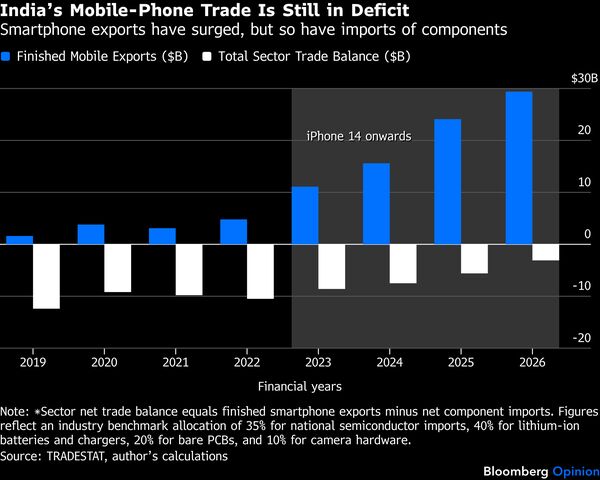
三年后,我的分析表明,贸易余额仍处于逆差状态。但有一点重要的变化发生了。在合理假设下——即有多少进口零部件最终用于手机而非太阳能电池板、电动汽车或其他产品——零部件进口与手机出口之间的差距已经缩小。出口的扩张不再像以前那样大量耗费国家的外汇。这使得将“印度制造”仅仅视为华丽的螺丝刀组装变得更难以成立。印度正在更深入地融入全球电子产品供应链。更相关的问题是:这一进展是否值得纳税人所付出的代价?
Three years later, my analysis shows that the trade balance is still in deficit. However, something important has changed. Under reasonable assumptions about how many imported parts end up in phones rather than solar panels, EVs or other products, the gap between component imports and handset exports has narrowed. The expansion of exports is no longer draining as much hard currency from the country as it used to. That makes it harder to dismiss “Make in India” as glorified screwdriver assembly. India is inserting itself deeper into the global electronics supply chain. The more relevant question is a different one: Has that progress been worth what taxpayers have paid for?
正如拉詹及其同事所预测的那样,印度供应商已经深入到子组件层面。但正如他们当时所警告的那样,若缺乏国内生产的存储器、处理器、镜头、显示屏和电池,本地价值提升的空间仍然有限。
Indian suppliers have dug deeper into sub-assemblies, as Rajan and his colleagues predicted. But just as they warned back then, without domestic memory, processors, lenses, displays, and batteries, the scope for local value addition remains limited.
评估这种增值不能只看贸易数据。印度是全球最大的智能手机市场之一,因此许多在本地制造的手机从未跨越国界。要更好地判断制造能力深化到了什么程度,得看工厂实际在做什么。
Evaluating that value addition requires more than just trade data. India is one of the world’s largest smartphone markets, so many locally made phones never cross a border. A better indication of how manufacturing capabilities have deepened comes from what factories are actually doing.
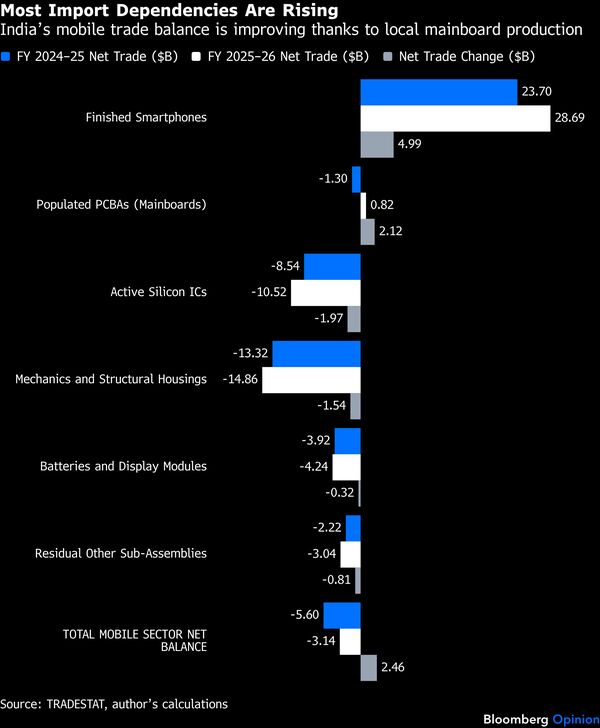
以苹果为例。凭借iPhone 14,印度将落后中国的生产时差缩短至两个月,而此前为六到九个月。iPhone 15是首款在印度制造、并在全球首发日同步销售的苹果设备。包括富士康科技集团在内的供应商已沿价值链向上移动,从进口成品电路板转为在本地贴装元器件。仅主板生产一项,就推动2025至2026财年间的贸易差额实现了21亿美元的扭转。
Consider Apple. With iPhone 14, India shortened its production lag behind China to two months, from six to nine months previously. The iPhone 15 was the first Apple device built in India for Day One global sales. Suppliers including Foxconn Technology Group have moved up the value chain, from importing finished circuit boards to mounting components locally. Mainboard production alone drove a $2.1 billion turnaround in the trade balance between fiscal years 2025 and 2026.
贸易差额接下来走向如何,目前难以断言。随着数据中心吸纳存储芯片产能,手机所用半导体正变得越来越贵。与此同时,受低价入门级机型主导,印度今年的手机需求正在萎缩。即便计入存储成本上涨,这也可能降低元器件进口账单。但全球智能手机销售疲软也可能拖累出口。
It’s hard to say where the trade balance goes from here. As data centers soak up memory-chip capacity, semiconductors used in phones are becoming more expensive. Meanwhile, India’s own handset demand is shrinking this year, led by cheaper, entry-level devices. That could reduce the component import bill, even after accounting for higher memory costs. But softer global smartphone sales could weigh on exports, too.
更大的担忧在于人工智能可能对财政账单造成的影响。五年前,印度开始向手机组装商支付其手机发票总值的4%至6%,以补偿基础设施薄弱和其他成本劣势。如今,纳税人可能还要为它们缓冲一场由人工智能引发的全球价格冲击,而正是这项技术正在威胁入门级软件岗位——那恰恰是印度中产阶级向上流动的引擎。按4%的支付比例计算,发票金额仅仅因芯片价格上涨而每增加10亿美元,补贴账单就会自动增加4000万美元。
A bigger worry is what artificial intelligence could do to the fiscal bill. Five years ago, India began paying phone assemblers 4% to 6% of their gross handset invoice values to compensate for poor infrastructure and other cost disadvantages. Now taxpayers may also end up cushioning them against a global price shock caused by AI, the same technology that’s threatening entry-level software jobs — the very engine of the nation’s middle-class mobility. At a 4% payout rate, every $1 billion increase in invoice values driven merely by chip price inflation automatically adds $40 million to the subsidy bill.
新德里的应对之策是加倍推进供应链升级。它已专门拨款134亿美元用于建设本土半导体产业。问题在于,五年前提供的100亿美元补贴只催生了封装其他地方制造芯片的工厂。自行制造先进芯片要难得多,需要尖端技术、巨额资本,以及愿意忍受多年回报不确定的投资者。
New Delhi’s response is to double down on moving up the supply chain. It has earmarked another $13.4 billion to build a domestic semiconductor industry. Trouble is, the $10 billion in subsidies offered five years ago only spawned factories that package chips made elsewhere. Making advanced chips themselves is vastly harder, requiring cutting-edge technology, enormous amounts of capital and investors willing to endure years of uncertain returns.
印度在这三方面都仍然欠缺。即便是塔塔集团——苹果的关键本地合作伙伴,也是印度唯一一座半导体晶圆厂背后的企业——也深陷一场混乱的公司控制权争夺战。其最大股东质疑的事项之一,就是管理层进军电子产业这一举措极其消耗资本。
India remains short of all three. Even Tata Group — Apple’s key local partner and the company behind the nation’s only semiconductor fab — is mired in a messy corporate battle for control. Its largest shareholder is questioning, among other things, the capital-guzzling nature of management’s push into electronics.
很少有国家能成功完成这一转型。马来西亚在20世纪70年代就追逐芯片封装和PCB组装,但在1992年达到中上等收入水平后便停滞不前。相比之下,韩国和台湾则借助半导体跻身富裕经济体之列。印度不应把数十亿美元押在追赶一部快速移动的高科技制造业自动扶梯上。它应当立志成为世界设计中心和工程车间,同时把财政资源投向卫生、教育、气候变化——以及服装、鞋类和玩具等能够雇用数百万人的劳动密集型产业。
Few countries manage this transition successfully. Malaysia chased chip packaging and PCB assembly in the 1970s, yet it stalled after reaching upper-middle-income status in 1992. South Korea and Taiwan, by contrast, rode semiconductors into the ranks of rich economies. India shouldn’t bet billions on catching a fast-moving high-tech manufacturing escalator. It should aspire to be the world’s design center and engineering workshop, while directing fiscal resources toward health, education, climate change — and toward labor-intensive industries such as clothing, footwear and toys that can employ millions.
中国的模式尤其难以复制。苹果在中国的成功,建立在富士康的台湾创始人郭台铭与中国地方政府合作时展现出的灵活手腕之上——他能够把稻田变成巨型工厂。印度臃肿的官僚体系和谨慎的富豪们,将难以匹敌那种速度、规模和冒险精神的组合。
China is an especially difficult model to replicate. Apple’s success there was built with the dexterity with which Foxconn’s Taiwanese founder Terry Gou, working with Chinese provincial governments, could turn paddy fields into mega-factories. India’s cumbersome bureaucracy and its cautious tycoons will struggle to match that combination of speed, scale and risk-taking.
所以,苹果不会把印度变成世界下一个工厂。它可以帮助印度获得宝贵的制造能力,并更深入地融入全球供应链。但是,为了再造一个中国而向供应商支付越来越高的补贴,不太可能是一笔划算的交易。
So no, Apple won’t turn India into the world’s next factory. It can help India acquire valuable manufacturing capabilities and move deeper into global supply chains. But paying its suppliers ever-larger subsidies in the hope of recreating China is unlikely to be a winning trade.