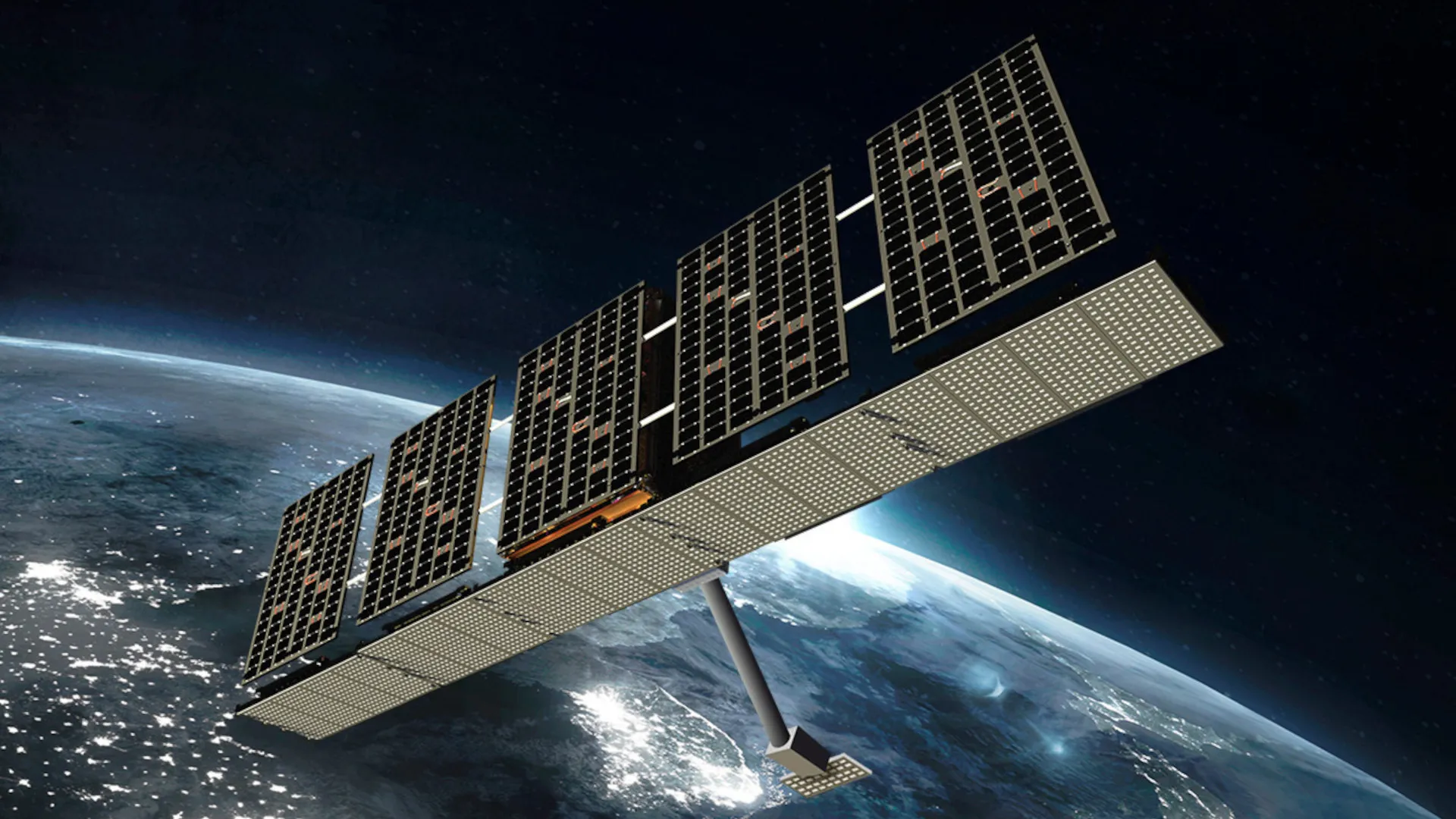
一颗俄罗斯卫星“Kosmos 2612”可能与一颗属于美国商业图像服务提供商ICEYE的卫星相距仅约85英尺(26米)处掠过。对于这两颗以数千英里每小时的速度在太空中运行的卫星来说,这样的近距离接近无疑非常危险。几周前,ICEYE-X36就已经开始逐渐靠近其“追踪者”(即Kosmos 2612)的轨道位置;目前这两颗卫星似乎正在逐渐远离彼此。不过,这一事件清楚地表明了未来太空冲突的可能性正在不断增加。
A Russian satellite, Kosmos 2612, may have passed within approximately 85 feet (26 meters) of a U.S.-registered satellite belonging to commercial imagery provider ICEYE . This would be an extraordinarily close and potentially dangerous pass-by for two objects in space traveling at thousands of miles per hour. For weeks beforehand, ICEYE-X36, which would be of special interest to Russia , had already found itself in increasingly close orbital alignment with its pursuer. The two satellites now look to be drifting further and further apart, but the episode has been a clear sign of what is to come as the potential for conflict in space only continues to grow .
来自SatelliteMap.Space与OrbitalRadar.com网站的公开太空追踪数据显示,今天UTC时间16时07分左右,“宇宙2612号”(亦称Cosmos 2612,缩写为K2612)与“ICEYE X36”卫星发生了极为接近的一次交汇。私营太空服务公司LeoLabs今日也向TWZ表示,虽然无法“证实或反驳其他数据源所公布的结论”,但“有极大把握判定这两颗卫星的距离已缩短至约500米(1,640英尺)以内”。近期以来,“宇宙2612号”与“ICEYE X36”的近距离交会频率正逐渐增加。
Publicly available space tracking data from the satellitemap.space and orbitalradar.com websites show that Kosmos 2612 (also written sometimes Cosmos 2612 and abbreviated K2612) and ICEYE X36 had their especially close encounter at approximately 16:07 UTC today . Private space services company LeoLabs also told TWZ today that it could not “confirm or contradict what other data sources have stated publicly,” but that it has “high-confidence that the objects came within approximately [emphasis in the original] 500 meters [1,640 feet] of each other.”Kosmos 2612 had been making progressively closer passes by ICEYE X36 in recent days.
这段短视频记录了今天上午“ICEYE-X36”(编号59103)与“宇宙2612号”(编号68762)在多云天气下飞越南美洲时的情形。pic.twitter.com/t8RhwmKcV4— s2a systems (@s2a_systems) 2026年10月18日6/x请注意,虽然ICEYE-X36是芬兰制造的,但(与其他所有权转移的ICEYE卫星一样)它已不再是芬兰的。它目前在美国注册,但可能现在是乌克兰所有/租赁的。
Short time-lapse of part of this morning’s first pass of ICEYE-X36 (59103) and COSMOS 2612 (68762) over South America under partly cloudy skies. pic.twitter.com/t8RhwmKcV4 — s2a systems (@s2a_systems) October 18, 2026 6/x Note that while ICEYE-X36 was Finnish built, it is (like other ICEYE sats who's ownership transferred) no longer Finnish. It is registered in the US but might be Ukranian owned/leased now. — Dr Marco Langbroek (@Marco_Langbroek)
— 马可·朗布鲁克博士 (@Marco_Langbroek) 2026年10月17日“COSMOS 2612 从数百公里外靠近 ICEYE-X36,达到极近距离。随后它在 ICEYE-X36 周围机动,长时间保持靠近,然后开始远离,”LeoLabs 在一份今日更新并提供给 TWZ 的情况评估报告中也如此表示。“最新观测显示,航天器正强烈偏离,证实近距离活动已经结束。”
October 17, 2026 “COSMOS 2612 closed from hundreds of kilometers away to extreme proximity to ICEYE-X36. It then maneuvered around ICEYE-X36, remained nearby for an extended period, and then began moving away,” LeoLabs also stated in a report assessing the situation, which was updated today and provided to TWZ . “The latest observations show the spacecraft strongly diverging and confirm that the close-proximity activity had ended.”LeoLabs’ broader assessment here is supported by data from other publicly available sources, as seen below.
LeoLabs 的更广泛评估得到了其他公开可用数据的支持,如下所示。
UPDATE: Cosmos 2612 appears to have maneuvered following a close approach with the ICEYE satellite.
更新:Cosmos 2612 在与 ICEYE 卫星近距离接近后似乎进行了机动。
The latest TLEs show 2612 in a larger orbit that will drift away with no further maneuvers.
最新的 TLE 显示 2612 正处于一个更大的轨道上,该轨道将使其漂移远离,且不会有进一步的机动。
In this animation, I fit an impulsive burn to bridge 2612’s previous TLE to its most…pic.twitter.com/RBqGDvVH9H — Adam Cohen (@AdamCohen8)
在此动画中,我使用冲量燃烧来衔接 2612 之前的 TLE 与其最新的 TLE…… pic.twitter.com/RBqGDvVH9H— Adam Cohen (@AdamCohen8) 2026年10月18日额外背景按地面标准,此前提到的任何距离可能都不算特别近,更不用说令人担忧了。然而,对于未涉及方直接协调的太空操作来说,这绝对是异常的。作为参考点,2020 年,另一颗俄罗斯卫星 Kosmos 2542 曾距离 USA 245(一颗 KH-11 间谍卫星)仅 150 至 300 公里(93 至 186 英里),并成为一则重大国际新闻。
October 18, 2026 Additional context None of the distances stated earlier may seem especially close, let alone worrisome, by terrestrial standards. However, this is absolutely abnormal for operations in space that are not being directly coordinated by the parties involved. As a point of reference, in 2020, another Russian satellite, Kosmos 2542, came within 150 to 300 kilometers (93 to 186 miles) of USA 245, a KH-11 spy satellite, and became a major international news story .
“我们已知晓情况并密切跟踪,”ICEYE 美国分部的一位发言人今日早上对 TWZ 表示。“我们的星座架构旨在确保连续性和韧性。”
“We are aware of the situation and tracking it closely,” a spokesperson for ICEYE’s U.S.-based division told TWZ this morning. “Our constellation architecture is designed for continuity and resilience.”
ICEYE 成立于芬兰,但如今在全球设有办事处。该公司专注于通过类似 ICEYE X36 这样的卫星合成孔径雷达(SAR)提供影像,该卫星于 2024 年发射。
ICEYE was founded in Finland, but now has offices globally. The company specializes in providing imagery via synthetic aperture radar (SAR) from satellites like ICEYE X36, which was launched in 2024.
SAR(合成孔径雷达)的优势在于无论白天黑夜、无论天气恶劣或浓烟等其他遮挡物,都能捕捉到图像。与可见光谱成像相比,SAR 通常可见的细节类型存在一些权衡。在与俄罗斯的持续冲突中,乌克兰当局多年来一直利用 ICEYE 的图像,包括用于瞄准目的。过去曾有报道称 ICEYE X36 一直在乌克兰政府的直接控制下运作,但这一点尚未得到证实。
SAR has the benefit of being able to capture images day or night, and regardless of bad weather or other obscurants like heavy smoke. There are trade-offs in terms of the kinds of details typically visible via SAR compared to what is seen in visual spectrum imagery. Ukrainian authorities have been utilizing ICEYE imagery for years now , including for targeting purposes , as part of the ongoing conflict with Russia. There have been reports in the past that ICEYE X36 has been operating more directly under the control of the Ukrainian government, but this has not been confirmed.
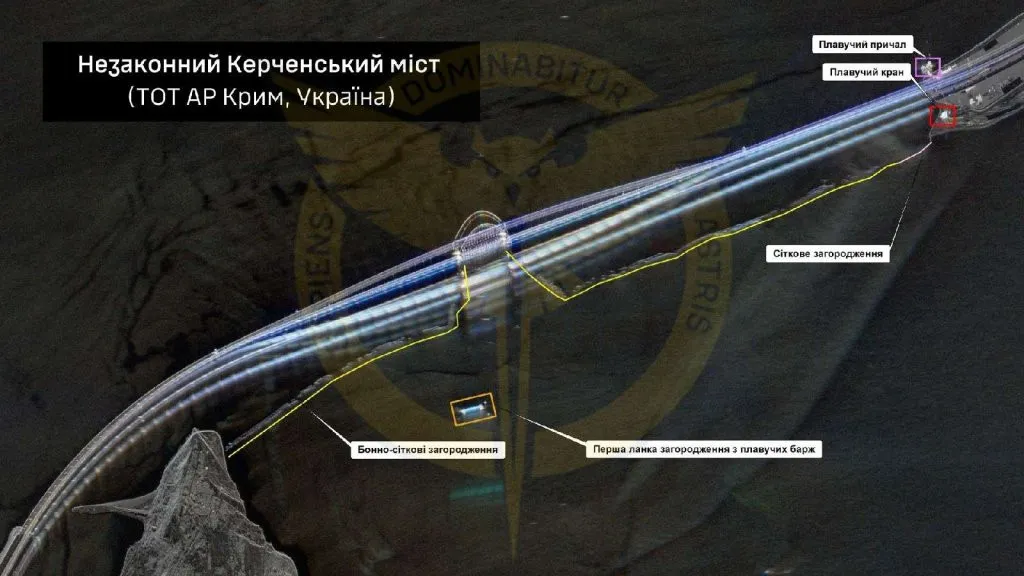
乌克兰国防部情报总局(更广为人知的缩写是 GUR)此前发布了这张高度战略性的刻赤大桥的 SAR 图像,该桥连接着被占领的克里米亚半岛和无可争议的俄罗斯领土,并称该图像来自 ICEYE。GUR Kosmos 2612 是俄罗斯军方于 4 月 17 日通过一枚 Soyuz-2.1b 火箭发射的六颗卫星(Cosmos 2609 至 Cosmos 2614)之一。这些卫星的确切用途和配置尚未得到证实。然而,它们似乎是所谓的“检查员”类型,能够与其他太空物体会合并近距离机动。我们稍后会再讨论这个问题。
The Main Directorate of Intelligence of the Ministry of Defense of Ukraine (better known by the acronym GUR) previously released this SAR image of the highly strategic Kerch Bridge that links the occupied Crimean Peninsula to undisputed Russian territory, which it said came via ICEYE. GUR Kosmos 2612 is one of six satellites (Cosmos 2609 through Cosmos 2614) the Russian military launched via a single Soyuz-2.1b rocket on April 17. The exact purpose and configuration of these satellites are unconfirmed. However, they appear to be so-called inspector types capable of rendezvousing and maneuvering close to other objects in space. We will come back to this later on.
可以确定的是,Kosmos 2612 在过去三周内一直在故意机动,以极近的距离跟踪 ICEYE X36。
What is clear is that Kosmos 2612 has spent the past three weeks deliberately maneuvering to extremely closely shadow ICEYE X36.
“从 2026 年 9 月 30 日开始的两个多星期里,Kosmos 2612 执行了一系列新的机动,使其重新回到共面轨道,并使其高度与这颗商业卫星几乎相同,”位于华盛顿特区的战略与国际研究中心(CSIS)智库的航空航天安全项目副主任兼高级研究员克莱顿·斯沃普(Clayton Swope)和研究助理尚塔尔·李(Chantal Li)在上周四发布的对局势的分析中写道。
“Over two weeks beginning on September 30, 2026, Cosmos 2612 executed a series of new maneuvers that brought it back into coplanar alignment and placed it at nearly the same altitude as the commercial satellite,” Clayton Swope, Deputy Director of the Aerospace Security Project and Senior Fellow at the Center for Strategic and International Studies (CSIS) think tank in Washington, D.C., along with Research Assistant Chantal Li, wrote in an analysis of the situation just last Thursday.
根据当前的轨道要素,俄罗斯 #KOSMOS 2612 卫星目前距离 #ICEYE-X36 仅 1-2 公里(0.6 英里至 1.2 英里),德尔夫特理工大学(荷兰)航天工程学院空间情报学讲师 Marco Langbroek 周六在 X 平台的推文中写道:“基于当前要素,它可能在几小时后以米级距离接近后者。这是一次未经同意的 #RPO(近距离操作)。”
“According to current orbital elements, the Russian #KOSMOS 2612 satellite is now within 1-2 km [0.6 miles to 1.2 miles] of #ICEYE-X36,” Dr. Marco Langbroek, currently a lecturer on Space Situational Awareness at the Faculty of Aerospace Engineering of Delft Technical University in the Netherlands, wrote in a thread on X on Saturday. “Based on current elements, it might come within meters of the latter within a few hours from now. This is an #RPO [ rendezvous and proximity operation ] without consent.”2/x
2/x起初我对 #ICEYEX36 是否为有意目标存疑,但从 9 月 30 日起 #Kosmos2612 的一系列机动明显设计为使两物体极度接近并同步轨道周期、轨道高度和离心率:pic.twitter.com/BhIoi8Rtbe— Dr Marco Langbroek (@Marco_Langbroek) October 17, 2026“新的 TLE 显示 K2612 在 10 月 16 日执行了机动,目前与 ICEYE X36 的距离保持在 5 公里(3.1 英里)以内,”美国天文学家、前哈佛-史密森尼天体物理中心成员 Jonathan McDowell 周六在 X 平台的一系列推文中写道:“据我所知,这是首例 LEO(低轨道)两颗活跃卫星的近距离操作,其中一颗卫星所有者未给予批准。”
Initially I was skeptic whether #ICEYEX36 really was an intentional target: but a series of manoeuvers by
McDowell 随后补充称:“近距离飞越的确曾发生,但我认为那是‘匹配速度向量’的近距离飞越,而非真正的近距离操作。”
“这次我们观测到的最先进且可能危险的非合作 RPO 是有史以来最具挑战性的,”LeoLabs 公司技术解决方案副总裁 Adam Marsh 此前对 Breaking Defense 表示。前所未有的轨道机动正如先前Kosmos 2542与USA 245的互动所凸显的那样,在轨道上对卫星进行紧密跟踪绝非新鲜事。过去,美国政府以及俄罗斯和其他国家都曾被观察到从事此类活动。与此同时,Kosmos 2612与ICEYE X36之间究竟有多接近,以及它们在紧密对齐状态下停留了多长时间,至少可以说是非常罕见的。
— Dr Marco Langbroek (@Marco_Langbroek) October 17, 2026 “New TLEs [two-line elements] show that K2612 made a manuever [sic] on Oct 16 and is now stationkeeping within 5 km [3.1 miles] or less of ICEYE X36,” Jonathan McDowell, an astrophysicist and astronomer, who previously worked for the Harvard-Smithsonian Center for Astrophysics and has long been tracking objects of interest in orbit, also wrote in a series of posts on X on Saturday. “To my knowledge this is the first LEO [low Earth orbit] rendezvous of two active satellites where the owner of one of the sats did not give approval.”McDowell later clarified that “close passes” of objects in orbit had certainly occurred previously, “but not I think rendezvous [sic] (matching velocity vector).”“This is the most advanced and potentially dangerous uncooperative RPO we’ve observed,” Adam Marsh, LeoLabs vice president for technical solutions, separately told Breaking Defense .
LeoLabs的报告指出:“需要注意的是,‘红色’对‘蓝色’的交互,如这次事件,在低地球轨道(LEO)中相对少见。”同时,“这并不是一次常规的会合或‘飞掠’。该过程包括受控接近、相对位置的变化、近距离盘旋、额外的小型机动以及受控离开。这种行为符合复杂的会合及近距离作战(RPO)模式。”
Unprecedented orbital maneuvering As underscored by the previous interaction of Kosmos 2542 and USA 245, close shadowing of satellites in orbit is certainly nothing new. The U.S. government, as well as Russia and others, have been observed engaging in this kind of activity in the past. At the same time, just how close Kosmos 2612 got to ICEYE X36, and how long they spent in close alignment, are, at the very least, highly unusual.
此外,还有其他迹象表明,Kosmos 2612与ICEYE X36之间刚刚发生的事情可能遵循某种俄罗斯的操作手册,这种手册也可能被用于轨道反卫星攻击的前奏。
“It’s important to note that ‘red’ on ‘blue’ engagements, such as this, are relatively uncommon in Low Earth Orbit (LEO),” LeoLabs’ report points out. At the same time, “this was not a routine conjunction or ‘fly by.’ The sequence included a controlled approach, changes in relative position, close-proximity loitering, additional small maneuvers, and a controlled departure. The behavior is consistent with sophisticated rendezvous and proximity operations (RPO).”
在4月发射后的几周内,Kosmos 2610、2611、2612、2613和2614都已移动至多颗ICEYE卫星共享的轨道平面。其中三颗随后对ICEYE X36进行了近距离飞越,但起初它们都没有与该卫星保持同步。据路透社上周报道,ICEYE首席执行官拉法尔·莫德热夫斯基表示:“公司后来移动了其卫星,促使俄罗斯进行了进一步的机动[ sic ]。”俄罗斯卫星接近ICEYE:时间线的深入观察。追踪数据来源:@LeoLabs_Space。分析来自COMSPOC SSA。
On top of this, there are other signs that what just happened between Kosmos 2612 and ICEYE X36 may follow a Russian playbook of sorts that could also be used in a prelude to an on-orbit anti-satellite attack. Within weeks of their launch in April, Kosmos 2610, 2611, 2612, 2613, and 2614 had all moved orbital planes shared by multiple ICEYE satellites. Three of them subsequently made close passes by ICEYE X36, specifically, but none of them initially kept station with it. ICEYE CEO Rafal Modrzewski did say “the company later moved its satellite, prompting further Russian manoeuvres [sic],” according to a story Reuters published last week. Russian satellites approaching ICEYE: a closer look at the timeline. Tracking data via @LeoLabs_Space . Analysis via COMSPOC SSA.
4月16日,俄罗斯从普列塞茨克发射了六颗机动卫星(宇宙2609-2614)。其中五颗——宇宙2610、2611、2612、2613和2614……pic.twitter.com/ISoToOptnp— COMSPOC_OPS (@COMSPOC_OPS) 2026年7月15日再往前追溯一步:在2020年“Kosmos 2542”卫星被发现在跟踪“USA 245”卫星之前,就有报道称美国的那颗间谍卫星改变了其轨道。这一变化很可能是受到另一颗俄罗斯卫星“Kosmos 2543”的影响。不过,这一说法至今仍未得到官方证实。
On April 16, Russia launched six maneuverable satellites (Cosmos 2609-2614) from Plesetsk. Five of them — Cosmos 2610, 2611, 2612, 2613, and 2614…pic.twitter.com/ISoToOptnp — COMSPOC_OPS (@COMSPOC_OPS) July 15, 2026 To take a step even further back, before Kosmos 2542 was caught shadowing USA 245 in 2020, there were reports that the U.S. spy satellite had shifted its orbit. This was possibly prompted by the movements of another Russian ‘inspector,’ Kosmos 2543. This does not appear to have ever been confirmed.
2019年11月,“Kosmos 2542”卫星曾释放出“Kosmos 2543”卫星。2020年7月23日,美国军方表示他们观察到“Kosmos 2543”发射了一个较小的物体,称这是对一种太空反卫星武器的测试。随后,时任美国太空军最高指挥官约翰·“杰伊”·雷蒙德将军在接受《时代》杂志采访时透露,美国军方早在2017年就注意到俄罗斯的这类卫星(这些卫星被形象地称为“俄罗斯套娃式卫星”)同样具备“武器系统的特征”。
While in space, Kosmos 2542 had deployed Kosmos 2543 in November 2019. Then, on July 23, 2020, the U.S. military said that it had detected Kosmos 2543 itself launching a smaller object in what it described as a test of a space-based anti-satellite weapon . In a subsequent interview with Time , then-Chief of Space Operations Gen. John “Jay” Raymond, U.S. Space Force’s top uniformed officer, disclosed that American forces had first observed Russian “nesting doll” satellites – a reference to traditional Russian matryoshka dolls – similarly demonstrating the “characteristics of a weapon system” in 2017.
多年来,美国官员一直警告称:俄罗斯不断增加的这类卫星实际上具有双重用途。这些卫星表面上是用来监测本国在轨卫星的运行状态(以防它们出现故障),但实际上它们具备多种攻击能力——无论是通过发射弹丸进行攻击,还是通过其他非动能手段进行破坏。这些攻击方式包括:利用机械臂对目标卫星造成损害或将其拖出轨道;喷洒有害物质来损坏卫星的光学系统或太阳能电池板;以及使用电子战手段进行干扰。这些卫星本身也可能成为真正的武器,在接到指令后直接撞击目标。
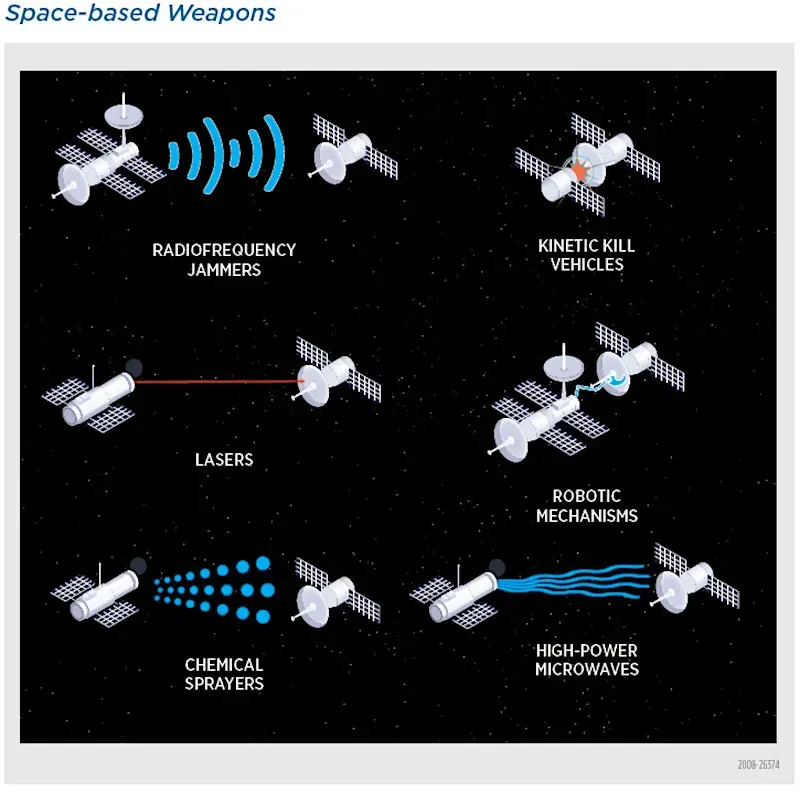
U.S. officials have been warning for years that Russia’s growing array of inspector-type satellites , ostensibly designed to examine other assets the country has in orbit if they break down or otherwise malfunction, are inherently dual-purpose in nature. Beyond launching projectiles, a host of other modes of attack, kinetic and non-kinetic, are enabled by the underlying ability of a spacecraft to maneuver very close to other objects in orbit and hold that position. This includes the use of grappling arms to cause damage or just tow a satellite out of orbit, spraying aerosols to harm or impair optics and solar panels, and electronic warfare jamming. A satellite could turn out to be the weapon itself, becoming a kinetic interceptor that smashes into its target on command.
美国国防情报局(DIA)发布了一张图表,详细说明了在轨攻击的各种可能方式。
A U.S. Defense Intelligence Agency graphic highlighting some of the ways on-orbit attacks can be carried out. DIA
一颗卫星在轨道上紧密跟随另一颗卫星,也能实现多种情报收集方式。图像和信号发射的收集可以提供关于目标能力和脆弱性的重要细节,以及它在特定情境下的使用方式。
One satellite shadowing another closely in orbit allows various kinds of intelligence gathering, as well. Collection of imagery and signal emissions can offer valuable details about a target’s capabilities and vulnerabilities, as well as how it is being used in a particular context.
正如LeoLabs全球雷达网络所观测到的,并由我们团队分析的那样,COSMOS 2612展示了一系列能力,这些能力可用于检查、表征、跟踪或潜在地干扰另一艘航天器,”根据LeoLabs的报告所述。“这些行动需要规划、机动性、精确导航和大量燃料。它们也可能表明使用了能够测量另一艘航天器相对位置的载荷传感器。”
“As observed by LeoLabs Global Radar Network and analyzed by our team, COSMOS 2612 demonstrated a sequence of capabilities that could be used to inspect, characterize, shadow, or potentially interfere with another spacecraft,” according to LeoLabs’ report. “These actions require planning, maneuverability, precise navigation, and significant fuel. They may also indicate the use of onboard sensors capable of measuring the relative position of another spacecraft.”
Kosmos 2612与ICEYE X36之间刚刚发生的事情凸显了,仅仅是攻击的可行威胁本身就可能造成干扰。仅仅迫使一颗成像收集卫星偏离位置,就可能阻止其在预期区域上方进行收集,或者至少无法以最有效的方式进行收集。
What has just transpired between Kosmos 2612 and ICEYE X36 highlights how just a viable threat of attack can be disruptive in its own right. Simply forcing an imagery-gathering satellite out of position could prevent it from collecting over an intended area, or at least doing so in the most effective manner.
此外,卫星进入轨道后仅拥有有限的燃料用于机动。在太空中的骚扰迫使它们以高于预期的速度消耗这种有限资源,可能会降低它们的总体运行寿命预期,进一步限制其有效性,并使其更容易受到攻击或事故的影响。太空碎片是一个日益增长的危害,卫星越来越需要躲避它。
Furthermore, satellites only have a limited amount of fuel with which to maneuver in any way after reaching orbit. Harassment in space that forces them to burn off that finite resource at a higher-than-expected rate could reduce their total operational life expectancy, as well as further limit their effectiveness and make them more vulnerable to attacks or accidents. Debris in space is a steadily growing hazard that satellites increasingly need to dodge.
美国等国一直在积极推进轨道加注能力的发展,以帮助解决这些问题。上个月,美国官员还震惊地承认,目前轨道上存在未明确说明的美国武器系统,表面上是为了应对来自俄罗斯以及中国日益增长的威胁而进行的防御行动。这两个国家以及其他一些国家一直在积极研发和部署各种反卫星能力,无论是在大气层内还是外层。
The United States, among others, has been actively pursuing on-orbit refueling capabilities to help address these issues. Last month, American officials also made the bombshell admission that there are unspecified U.S. weapon systems in orbit now, ostensibly for defensive purposes amid growing threats from Russia, as well as China . Both of those countries, among others, have been actively developing and fielding various anti-satellite capabilities inside and out of the Earth’s atmosphere .
“我们只能猜测这次行动的目的,但它可能从单纯的威慑,到对一颗美国注册卫星的彻底破坏或破坏,任何事情都有可能,”CSIS的克莱顿·斯沃普今天在接受TWZ采访时直接表示,这是在考虑到关于宇宙2612号和ICEYE X36的最新进展。“也许这次行动目前被搁置了。然而,早在5月份就曾跟踪ICEYE X36的几颗其他卫星也可能被投入使用。”
“We can only speculate about the operation’s goal, but it could have been anything from simply intimidation to outright destruction or sabotage of a U.S.-registered satellite,” CSIS’ Clayton Swope told TWZ directly today in light of the new developments regarding Kosmos 2612 and ICEYE X36. “Perhaps the operation is on hold. There are, however, several other satellites that shadowed ICEYE X36 back in May that could be brought in[to] action too.”
归因及更广泛的影响需要指出的是,太空作为一个领域,本身就在归因任何形式的攻击时制造了复杂情况——如果发生的话。卫星确实会发生故障,有时会导致灾难性后果,但其原因并不总是明确的。
Attribution and broader ramifications It is important to point out that space, as a domain, inherently creates complications when it comes to attributing any form of attack , should one occur. Satellites do suffer mishaps, sometimes with catastrophic results, the causes of which are not always clear.
就在今年1月,一颗俄罗斯于2014年发射的检测卫星意外解体。大约在7月底左右,中国于今年3月刚发射不久的遥感卫星遥感五十号02星也在轨道上解体。9月13日,美国冷战时期的法拉赫三号侦察卫星(也称为USA 32)也遭遇了类似的命运。截至目前,尚未有确凿证据表明这些事件是敌对行动所致,而非某种事故。更新:活跃的中国卫星遥感五十号02号碎片。
Just in January, a Russian inspector satellite launched in 2014 appeared to break up unexpectedly. Sometime around the end of July, the Chinese reconnaissance satellite Yaogan 50-02 , which had only been launched some four months earlier, also broke up in orbit. On Sept. 13, a similar fate befell the U.S. Cold War-era Farrah III spy satellite , also known as USA 32. At the time of writing, no firm evidence has emerged to indicate any of these incidents were the result of hostile action rather than accidents of some kind. Update: Debris from active PRC satellite Yaogan 50-02. @S4S_SDA
@S4S_SDA目前已将中国活跃的遥感五十号02号卫星(68196 / 2026-051A)在2026年7月20日左右产生的62片碎片编目(参考我最初在Substack上的分析,链接在帖子中)。尽管……pic.twitter.com/1ecF68W8VQ— 空间域感知 (@shell_jim) 2026年10月12日美国32号(#19460)的一些录音,该卫星在2026年9月13日大约2113 UTC时在近地轨道上的碎片化已被美国太空部队–太空(S4S)确认。
has now cataloged 62 pieces of debris originating from the PRC's active Yaogan 50-02 satellite (68196 / 2026-051A) on around 20 July 2026 (ref my initial analysis on Substack, link in thread). In spite of the…pic.twitter.com/1ecF68W8VQ — Space Domain Awareness (@shell_jim) October 12, 2026 Some recordings of USA 32 (#19460), whose fragmentation in LEO on 13 Sep 2026 at approximately 2113 UTC was confirmed by U.S. Space Forces–Space (S4S).
到录音时,大量碎片已经分散在轨道的广泛区域。pic.twitter.com/gjRxCTPz2o— s2a系统 (@s2a_systems) 2026年9月16日“尽管COSMOS 2612行为背后的意图仍不确定,但该行为的故意性质、开展该行为所需的燃料以及其与西方商业成像卫星的接近程度使该事件具有战略意义,”LeoLab的报告指出。“此次事件及其展示的能力并不构成敌意。然而,它确实展示了可能用于情报收集、轨道检查、胁迫信号、干扰或为未来反空间行动做准备的能力。”
By the time of the recordings, a large number of fragments had already dispersed over a wide section of the track. pic.twitter.com/gjRxCTPz2o — s2a systems (@s2a_systems) September 16, 2026 “While the intention behind COSMOS 2612’s behavior remains uncertain, the deliberate nature of the activity, the fuel required to conduct this activity, and the proximity to a Western commercial imaging satellite make the event strategically important,” LeoLab’s report notes. “This event, and the capabilities demonstrated, do not establish hostile intent. It does, however, demonstrate capabilities that could support intelligence collection, on-orbit inspection, coercive signaling, interference, or preparation for future counterspace operations.”
如果不是高度可能的话,也非常可能,COSMOS 2612的近期活动将表明未来的一个趋势。武装力量在彼此靠近的情况下进行激进且可能危险的机动在大气层中并不罕见,尤其是在空中和海上。将这种战术的变体延伸到空间领域是合理的,特别是考虑到轨道能力在全球现代军事行动中日益发挥核心作用。这些作用包括预警、一般情报收集、武器制导、近实时通信等等。
It is very possible, if not highly probable, that Kosmos 2612’s recent activities will be indicative of a trend going forward. Aggressive and potentially dangerous maneuvering by armed forces in close proximity to each other is not uncommon within the atmosphere, especially in the air and at sea . Extending a variation of those tactics into the space domain would make sense, especially given the central role that capabilities in orbit increasingly play in modern military operations globally. Those roles extend to early warning, general intelligence gathering, weapons guidance, near-real-time communications, and beyond.
美国官员过去已经表示,美国在太空的资产常常成为“可逆攻击”的目标,即不会造成永久性损害的攻击。这也说明了,如果没有持续的效果或影响来引起关注,归因将变得困难。
American officials have already said in the past that American assets in space are routinely the target of “reversible attacks,” meaning ones that do not cause permanent damage. That also speaks to the difficulty of attribution if there is no lasting effect or impact to draw attention to.
近年来,美国政府长期垄断太空领域的局面也一直在稳步削弱,尤其是在中国大规模扩张其情报收集及其他卫星星座的背景下。像ICEYE这样的商业卫星影像及其他空间服务提供商所提供的规模和范围,进一步推动了太空能力的民主化,使得乌克兰等没有自己重要星座(甚至没有任何星座)的国家也能获得此类能力。
The U.S. government’s long-time monopoly on the space domain has also been steadily eroding in recent years , especially in light of China’s massive expansion of its intelligence-gathering and other satellite constellations. The scale and scope of what commercial satellite imagery and other space services providers, like ICEYE, offer today have led to a further democratization of space-based capabilities to countries like Ukraine that do not possess significant, if any, constellations of their own.
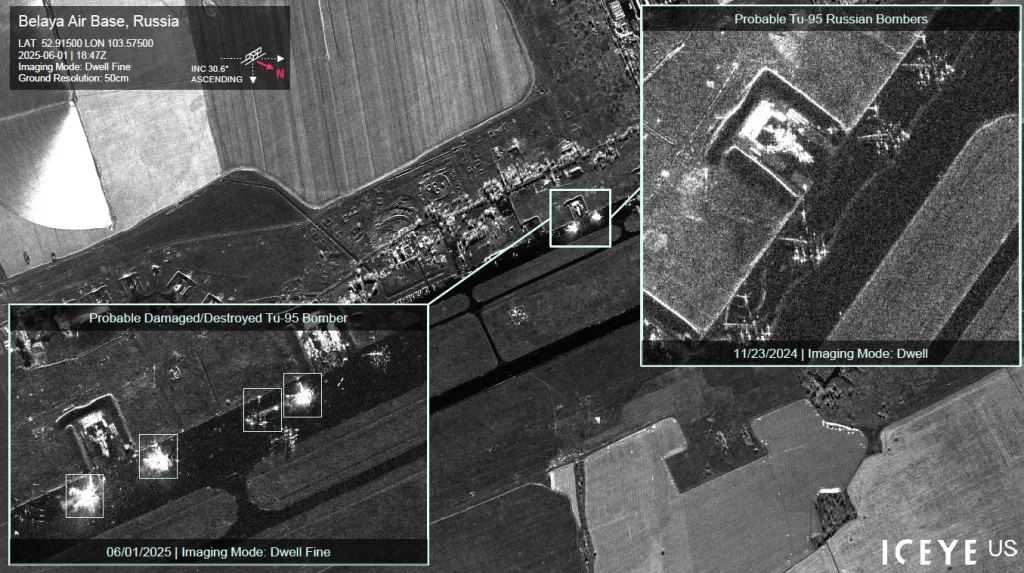
这张卫星图像显示,去年乌克兰发动袭击后,贝拉亚空军基地有多架俄军图-95“熊”式轰炸机受损或被摧毁,这表明了ICEYE所提供的商业服务内容。 发生的直接冲突,以确保其未来仍能保持优势。前述关于美国在轨武器的披露正是这些发展的体现,也反映了美国政策的转变,即更加公开其反太空能力。
This satellite image indicating multiple Russian Tu-95 Bear bombers having been damaged or destroyed at Belaya Air Base after a Ukrainian strike last year is indicative of what ICEYE provides commercially. Courtesy ICEYE All of this, in turn, has increasingly driven the U.S. military, specifically, to plan for more proactive operations and potential direct conflict in orbit to ensure it retains its edge going forward. The aforementioned disclosure of U.S. on-orbit weapons is indicative of those developments and an accompanying shift in U.S. policy to be more open about counter-space capabilities .
关于宇宙2612及其最近与ICEYE X36在轨道上的会合,尚可能有更多细节浮出水面,但这已经表明,太空正日益成为未来直接冲突的潜在热点。
More details may yet emerge about Kosmos 2612 and its recent rendezvous in orbit with ICEYE X36, but it already points to how space has become an increasingly likely potential zone for direct conflict going forward.