死亡和税收不是这个世界上唯一的确定性:关于两者之间正确关系的争议也是永恒的。英国保守党反对派承诺废除对家庭住宅的遗产税(IHT),并提高其他资产征收该税的起征点,称该税收不道德。该提议使其与工党政府在哲学上的分歧更加尖锐,后者被认为对财富持敌意,导致一系列超级富豪高调离开。欢迎来到这场持续数百年的辩论的最新篇章。
Death and taxes aren't the only certainties in this world: Controversy over the right relationship between the two is also a constant. Britain’s Conservative opposition has pledged to abolish inheritance tax (IHT) on family homes and raise the threshold at which it becomes payable on other assets, calling the levy immoral. The proposal sharpens the philosophical divide with a Labour government whose perceived hostility to wealth has led to a string of high-profile departures by the super rich. Welcome to the latest chapter in a debate that stretches back hundreds of years.
保守党领袖凯米·巴登诺赫将其政策呈现为原则问题。该党称征收人们用税后收入购买的资产的费用“在道德上是错误的”,并且是一种双重征税,因为它“仅仅因为他们去世就迫使他们向国家支付更多费用。”其目标是最终完全废除遗产税。巴登诺赫的影子财政大臣安德鲁·格里菲斯将这一承诺描述为对传统保守价值观——勤劳和抱负——的利好;工党议员则将该计划描述为对富裕少数群体的无端福利。
Tory leader Kemi Badenoch presents her policy as a matter of principle. The party says it’s “morally wrong” and a form of double taxation to impose charges on assets that people have bought with after-tax income and then “force them to pay even more to the state just because they have died.”The aim is to eventually abolish IHT altogether. Badenoch’s shadow Chancellor of the Exchequer Andrew Griffith framed the promise as a boon for the traditional Tory values of hard work and aspiration; Labour lawmakers have portrayed the plan as an unjustified handout to a rich minority.
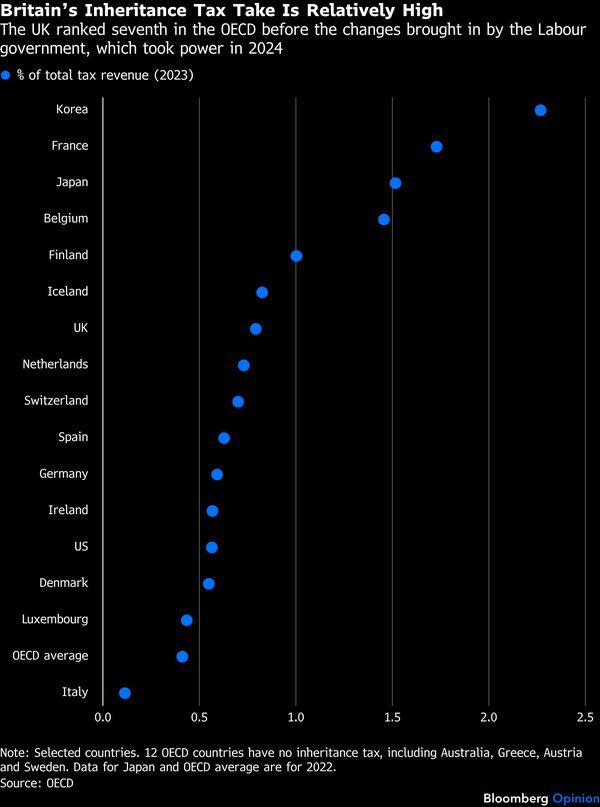
遗产税是否不道德是一种主观判断。但可以肯定的是,英国的遗产税负担相对于大多数同类经济体来说较高。英国的遗产税名义税率为40%,但由于起征点和免税额的差异,直接比较可能具有误导性。一个较少歧义的衡量标准是该税收占总税收的比例。基于此,2023年英国在经济合作与发展组织(OECD)38个成员国中遗产税负担排名第七。该组织的三分之一国家没有遗产税。
Whether IHT is immoral is a subjective judgment. What can be said for certain is that Britain’s toll is high relative to most peer-group economies. The UK’s headline rate of IHT is 40%, but comparisons can be misleading because of variations in thresholds and exemptions. A less ambiguous measure is the amount the levy brings in as a proportion of total tax revenue. On this basis, Britain had the seventh-highest burden among members of the Organisation for Economic Cooperation and Development in 2023. A third of the group’s 38 nations have no inheritance tax.
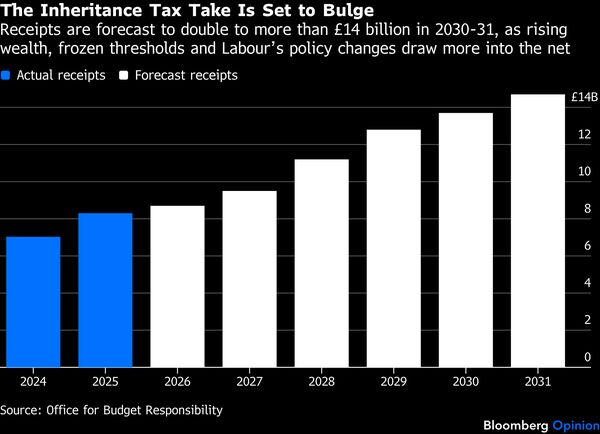
英国的遗产税收入有望大幅增加。根据独立的预算责任办公室(OBR)的预测,其在2023-24财年筹集的70亿英镑(93亿美元)预计将在2030-31财年增至147亿英镑,几乎翻倍。这部分原因是免税额度的冻结:主要的零税率额度32.5万英镑自2009年起实施,而用于向直系后代转让住宅房产的额外17.5万英镑免税额自2020年起一直有效。由于财富可以免税传给配偶,一对夫妻理论上可以将100万英镑传给继承人而无需缴纳遗产税。
Britain’s IHT take is poised increase significantly. The £7 billion ($9.3 billion) it raised in the 2023-24 financial year is projected to more than double to £14.7 billion in 2030-31, according to the independent Office for Budget Responsibility. That’s partly because of a freezing of tax-free thresholds: The main zero-rate band of £325,000 was introduced in 2009, and an additional £175,000 allowance for residential property passed on to direct descendants has been in place since 2020. Since wealth can be bequeathed to a spouse tax-free, a couple can potentially pass on £1 million to their inheritors without IHT being charged.
由于资产价值通常随时间增长,更多遗产因这种所谓的“财政拖累”而被纳入遗产税征税范围;如果这些免税额度自2020年以来一直跟上通胀,如今它们的合计价值应为130万英镑。工党已将这一冻结政策延长至2030-31财年,并对农业和商业房产的减免设定上限。此外,从明年起,未使用的定义缴费型养老金账户也将被计入遗产的估值,以用于遗产税目的。
Because asset values typically increase over time, more estates are drawn into the IHT net by this so-called fiscal drag; if these thresholds had kept pace with inflation since 2020, they would be worth a combined £1.3 million today. Labour has extended the freeze until 2030-31, as well as capping relief for agricultural and business property. It will also bring unused defined-contribution pension pots into the valuation of estates for IHT purposes from next year.
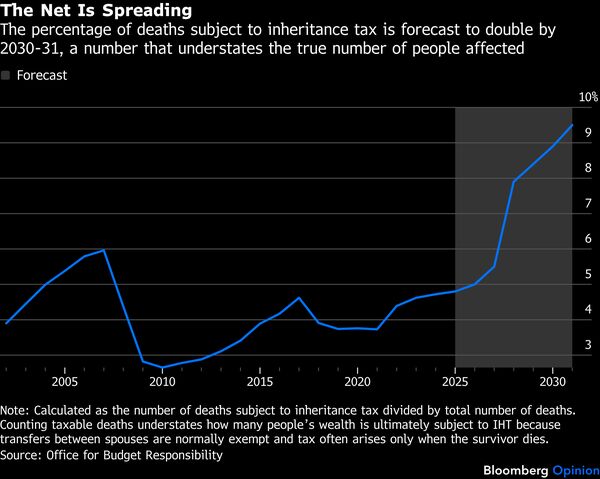
所有这些将导致受影响遗产数量激增。OBR预测,在2030-31财年,9.5%的死亡将导致遗产税义务,而2024财年这一比例为4.7%。值得注意的是,这一数据低估了实际受影响的夫妻和家庭比例,因为遗产税仅在第二次死亡时才产生。财政研究所(IFS)在2023年——即工党政策调整之前——曾估计,到2032-33财年,12%的人将在自身死亡或配偶死亡时产生遗产税义务。
All this will drive a surge in the number of estates affected. The OBR forecasts 9.5% of deaths will result in an IHT liability in 2030-31, up from 4.7% in 2024. Notably, this measure understates the real proportion of couples and families affected because tax arises only on the second death. The Institute for Fiscal Studies estimated in 2023 — before Labour’s policy changes — that 12% of people would have IHT due by 2032-33 either on their death or that of their spouse.
财政研究所高级经济学家斯图尔特·亚当表示,遗产税应纳遗产的比例在数十年里一直在5%左右波动。有趣的是,正如亚当所观察到的,这一比例经常有望显著升高至该水平以上,但政府通过定期调整政策,始终将其拉回较低水平。
The proportion of estates subject to inheritance tax has fluctuated at around 5% for decades, according to Stuart Adam, senior economist at the IFS. Intriguingly, it has often been on course to rise substantially above that level, as Adam observes, but hasn’t done so because governments have periodically enacted changes to bring the number back down.
这表明存在一个阈值,超过该阈值后政治阻力就会出现。这一点很容易理解。理论上,遗产税旨在防止资产传承导致亿万富翁投资者沃伦·巴菲特所说的“财富贵族”世袭化,这种世袭化会削弱机会平等并损害经济竞争力。它的设计初衷就是针对精英阶层,但随着征税范围的扩大,它越来越多地涉及普通中产阶级人士——虽然他们可能相对较为 privileged,但自己并不认为自己很富有。
This suggests there’s a threshold above which political resistance sets in. It’s easy to see why. Inheritance tax, in theory, is intended to prevent the passing down of assets from creating a hereditary “aristocracy of wealth,” in the words of billionaire investor Warren Buffett, that erodes equality of opportunity and damages economic competitiveness. It is by design aimed at an elite, but the more the net widens, the more it captures ordinary middle-class people who — while they may be relatively privileged — consider themselves far from being rich.
2009年,当32.5万英镑的零税率额度推出时,伦敦平均住房价值约为26.3万英镑。今年4月,这一数字升至55.3万英镑。即便是100万英镑,如今在伦敦许多地区也只能买到相当普通的房产。
In 2009, when the £325,000 nil-rate band was brought in, the average London home was worth about £263,000. In April this year, it was £553,000. Even £1 million only buys you a fairly ordinary property in many parts of the capital these days.
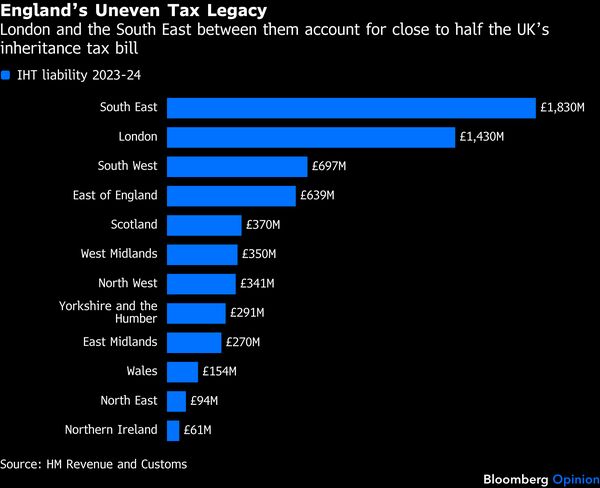
如果历史模式重演,保守党已经为自己赶上这股浪潮做好了准备。但我不认为这一点会让人过于自信。该提案无疑会在伦敦和东南地区引起共鸣,这些地区将从废除该税中获益最多。然而,在全国正面临财政压力和生活成本上升挤压的时候,向最富裕地区的一个(尽管在扩大)少数群体提供巨额减税是否真的符合时代潮流,这仍是另一个问题。
If the historical pattern repeats itself, the Conservatives have positioned themselves to catch the wave. But I wouldn’t be too confident that will happen. The proposal will certainly resonate in London and the South East, which would benefit the most from scrapping the levy. Whether a giant giveaway to a wealthy (albeit expanding) minority in the richest region is really in tune with the times when the country is preoccupied with fiscal pressures and a cost-of-living squeeze is another question.
遗产税长期以来一直被列为英国最不公平的税种之一,但这种反感是肤浅的:大多数选民并不认为削减遗产税是当务之急——可能是因为大多数人根本不需要缴纳这项税。
IHT regularly tops surveys of the UK’s most unfair taxes, but that antipathy is shallow: Most voters don’t see cutting it as a priority — probably because most don’t pay it.
对巴登诺赫的方案设计也存在质疑,该方案将取消传给后代的家庭住宅的遗产税,并将个人免税额提高至50万英镑。如果其目的是鼓励工作和财富创造,那么还有许多其他财政改革能够更有效地实现这一目标。与此同时,仅对房产免税而不对其他资产免税将扭曲投资决策,推高高端住房价格,使现有房主受益,却惩罚未来购房者。伦敦价值1亿英镑的“巨宫”业主真的还需要额外的减税吗?
There are questions over the design of Badenoch’s plan, which would abolish IHT on family homes passed on to offspring and raise the individual threshold to £500,000. If the idea is to encourage work and wealth creation, there are plenty of other fiscal changes that would do this more effectively. Meanwhile, exempting property but not other assets will distort investment decisions and push up prices of high-end housing, benefiting existing owners but penalizing future buyers. Do owners of London’s £100 million “giga mansions” really need an extra break?
将遗产税描述为道德使命也站不住脚。人们经常被双重征税——例如,当他们用收入购买已征增值税的商品时,或用于支付地方政府账单时。而且,你无法强迫亡者做任何事:遗产税是在死后对其遗产征收的。这把所有者依其意愿处置资产的权利与受益人接受资产的权利混为一谈,这种混淆解释了公众对遗产税敌意的很大一部分。
The casting of IHT as a moral mission is also dubious. People are double-taxed all the time — when they use income to buy goods on which value-added tax has been charged or to pay local-authority bills, for example. And you can’t force the dead to do anything: It’s their estate that gets taxed after death. This conflates the right of the owner to dispose of assets as he or she sees fit with the right of the beneficiary to receive them, a confusion that explains much of the public hostility toward IHT.
大多数人直觉上认为前者是私有财产权的基本原则。后者则不那么明确。通过劳动赚取50万英镑的人需要缴纳大量所得税;而继承父母50万英镑财富的人,在现行免税额下可能免税获得这笔财富。这公平吗?
Most people intuitively accept the first as being fundamental to private property rights. The second is less clear. Someone who earns £500,000 through working will pay a lot of income tax; someone who inherits £500,000 of parental wealth may receive it tax-free under the current allowances. Is that fair?
自公元6年奥古斯都皇帝征收5%遗产税以来,罗马元老院就一直在为遗产税争论不休。即便在中右翼阵营,也从未就遗产税本质上是否非法这一问题达成共识。现代经济学之父、18世纪思想家亚当·斯密正是支持遗产税概念的古典自由主义思想家之一。而温斯顿·丘吉尔在1924年担任保守党财政大臣时,曾称赞遗产税是“对懒惰富人阶层发展的一种必要纠正”。
Arguments have raged over inheritance tax ever since Roman senators protested the 5% levy brought in by Emperor Augustus in 6 AD. There isn’t any settled consensus even on the center-right that IHT is inherently illegitimate. Adam Smith, the 18th-century father of modern economics, is among classical liberal thinkers who supported the concept. And Winston Churchill, as Conservative chancellor in 1924, commended it as “a certain corrective against the development of a race of idle rich.”
这并非一个能够得出道德绝对结论的话题。真正的问题是遗产税是否定位恰当、由正确的人承担。废除遗产税不太可能成为推动保守党重新上台的流行运动。但有充分理由认为,目前的遗产税水平过高。
This isn’t a subject that lends itself to moral absolutes. The real question is whether IHT is pitched at the right level and paid by the right people. Abolition of inheritance tax is unlikely to be the popular crusade that propels the Tories back to power. But there’s a strong case to argue that the current toll is too high.