新加坡:随着最新变化的实施,希望子女进入母校就读的家长,在小学一年级注册的校友隶属阶段(第二阶段A)可能面临更激烈的竞争。
SINGAPORE: Parents who want their children to attend their alma mater could face more competition in the alumni affiliation phase of the Primary 1 registration exercise with the latest changes.
根据新方案,招生名额在180个或以上的小学,将为第二阶段C预留60个名额,较原本的40个增加。第二阶段C面向所有儿童开放,被视为竞争最激烈的阶段。
Under the new scheme primary schools with 180 vacancies or more will set aside 60 places for Phase 2C, up from 40. Phase 2C, which is open to all children, is considered the most competitive phase.
第二阶段C名额的增加,可能会减少第二阶段A的可用名额。第二阶段A优先考虑与学校有既有渊源的儿童,包括父母为校友的孩子。
This larger allocation in Phase 2C could reduce the number of places available in Phase 2A, which gives priority to children with existing ties to the school, including those whose parents are former pupils.
在一些最热门的学校,第二阶段C新增的几乎所有预留名额都将来自第二阶段A。
At some of the most in-demand schools, almost all the additional reserved spots in Phase 2C will come from Phase 2A.
亚洲新闻台(CNA)分析了明年小学一年级注册制度变化可能对家长和学校产生的影响。
CNA looked at how the changes in next year's Primary 1 registration might affect parents and schools.
根据教育部(MOE)2026年注册练习的数据,新框架可能导致部分热门学校的第二阶段A名额减少五分之一或更多。
Using the Ministry of Education's (MOE) figures from the 2026 exercise, the new framework could see Phase 2A spots at some popular schools drop by a fifth or more.
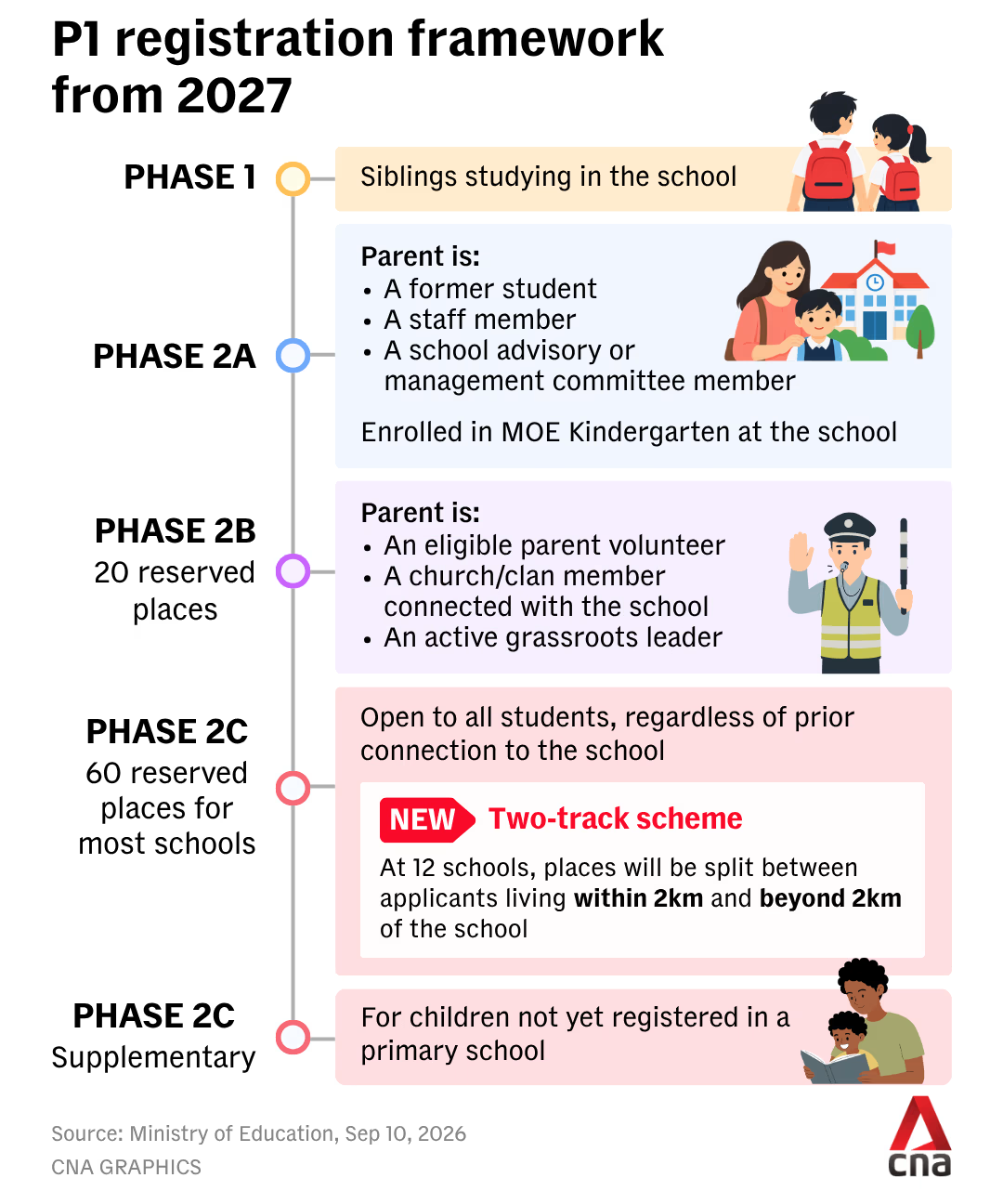
全新面貌的第二阶段A 第二阶段A紧随第一阶段——即在校生兄弟姐妹阶段——之后,并在第二阶段B——即家长志愿者、宗亲会和宗教团体等阶段——以及第二阶段C之前。
NEW-LOOK PHASE 2A Phase 2A comes immediately after Phase 1 – for siblings of existing students – and before Phase 2B – for parent volunteers, clans and religious organisations, among others – and Phase 2C.
今年,有35所学校在第二阶段A出现超额报名,即申请人数超过名额。
This year, 35 schools were oversubscribed in Phase 2A, meaning they received more applicants than places.
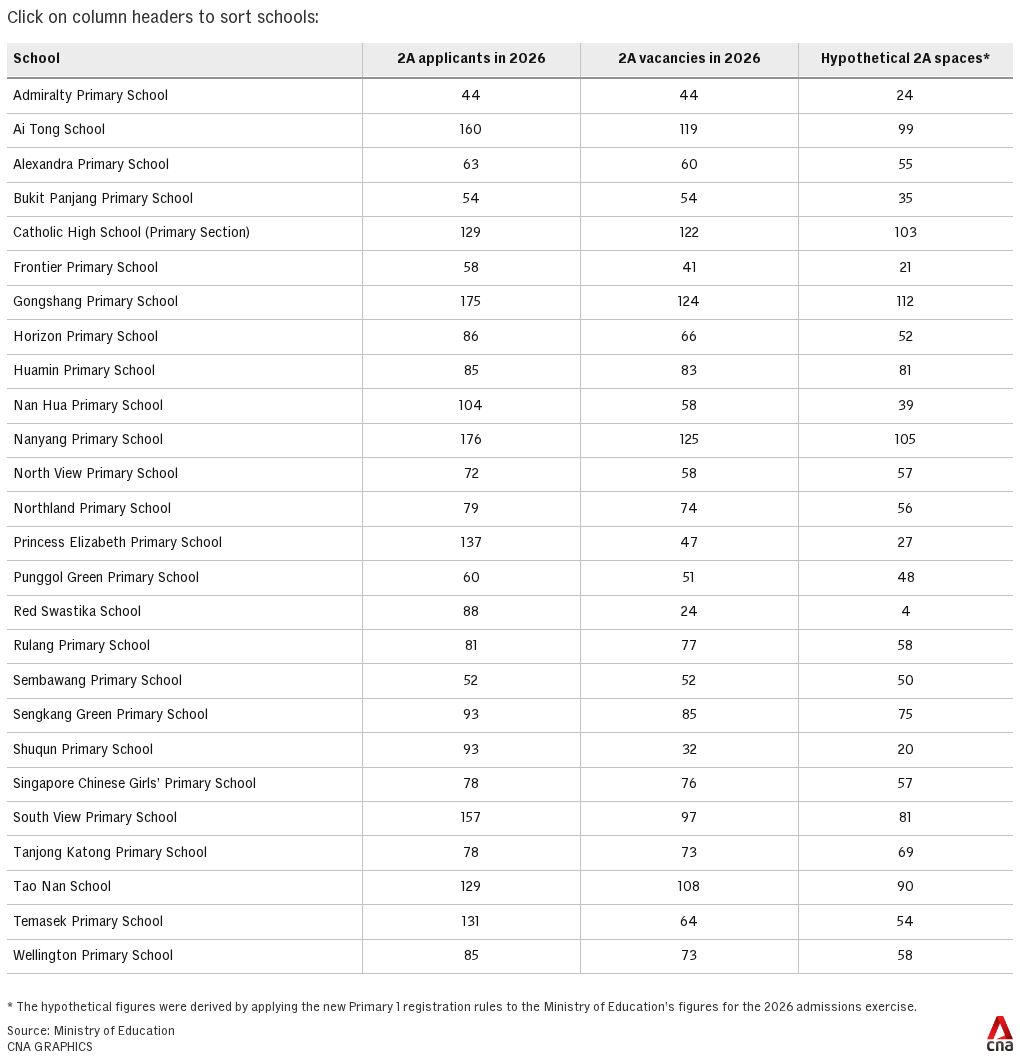
以下26所学校的第二阶段C名额少于60个,且第二阶段B预留了最低20个名额,这意味着第二阶段C的缺额很可能从第二阶段A中挪出:红十字学校(Red Swastika School)是2026年超额报名最严重的学校,24个名额吸引了88名申请人。
The following 26 schools had fewer than 60 spots in Phase 2C and the minimum 20 reserved spaces in Phase 2B, which means the shortfall in Phase 2C would likely come from Phase 2A: Red Swastika School was the most oversubscribed in 2026, with 88 applicants for 24 places.
该校在第二阶段C预留了40个名额。将其增至60个将从第二阶段A调出20个名额,仅剩4个名额供同样的88名申请人竞争。
It had 40 reserved places in Phase 2C. Raising that to 60 would move 20 places out of Phase 2A, leaving four spaces for the same 88 applicants.
其他热门学校如伊丽莎白公主小学(Princess Elizabeth Primary School)、树群小学(Shuqun Primary School)和培华长老会小学(Pei Hwa Presbyterian Primary School)的第二阶段A名额将减少逾25%。
Other in-demand schools like Princess Elizabeth Primary School, Shuqun Primary School and Pei Hwa Presbyterian Primary School would see a drop of more than 25 per cent in their Phase 2A places.
在伊丽莎白公主小学,137名申请者争夺47个第二阶段A类名额。根据新框架,该校将只有27个名额。
At Princess Elizabeth Primary, 137 applicants competed for 47 Phase 2A places. Under the new framework, it would have 27 spots.
这种挤压也可能影响一些在2026年第二阶段A类名额充足的学校——其中12所可能变得超额认购。美以美女子小学在第二阶段A类有93名申请者争夺95个名额。
The squeeze could also affect some schools that had enough Phase 2A places in 2026 – 12 of them may become oversubscribed. Methodist Girls’ School (Primary) had 93 applicants for 95 places in Phase 2A.
其第二阶段C类有41个名额,因此可能需要从第二阶段A类调拨18个名额、从第二阶段B类调拨1个名额以达到60个名额。这将为同样的93名申请者留下77个名额。
Its Phase 2C had 41 places, so reaching 60 may take 18 places from Phase 2A and one from Phase 2B. It leaves 77 for the same 93 applicants.
费尔菲尔德卫理小学有91名申请者争夺97个名额。其第二阶段C类有48个名额,因此可能有10个名额从第二阶段A类、2个名额从第二阶段B类调拨,剩下87个名额。
Fairfield Methodist School (Primary) had 91 applicants for 97 places. Its Phase 2C had 48 places, so 10 spaces could move from Phase 2A and two from Phase 2B, leaving 87.
这两所学校在第二阶段B类除了预留的20个名额外,还多出几个名额。
Both schools had a few more spaces in Phase 2B above the reserved 20.
扩大入学机会 这些变化是扩大第二阶段C类招生行动的最新举措,第二阶段C类面向所有儿童开放。
Widening access These changes are the latest in a series of moves to widen the Phase 2C exercise, which is open to all children.
此前,第二阶段C类的优先顺序基于距离,优先录取居住在学校1公里范围内的新加坡公民。这通常使其成为招生行动中竞争最激烈的阶段。
Previously, priority in Phase 2C was distance-based, given first to Singaporeans living within 1km of the school. This usually made it the most competitive phase of the exercise.
从明年的招生行动起,12所位于2公里范围内组屋比例低于40%的社区学校,也将把第二阶段C类名额平均分成两个轨道——一个面向居住在2公里范围内的申请者,另一个面向居住在2公里范围以外的申请者——两个轨道内均不设校舍距离优先权。
From next year's admissions exercise, 12 schools in neighbourhoods where public housing makes up less than 40 per cent of homes within 2km will also split their Phase 2C places into two equal tracks – one for applicants living within 2km and another for those living beyond that – with no home-school distance priority within either track.
在2022年招生行动前,第二阶段C类为学生预留的名额上限为20个。在当时调整方案时,教育部合并了第二阶段A1和A2,并将第二阶段C类预留名额翻倍至40个。
Before the 2022 exercise, the number of places reserved for pupils under Phase 2C was capped at 20. In adjusting the scheme then, the ministry merged Phases 2A1 and 2A2, and doubled the number of reserved places in Phase 2C to 40.
第二阶段A1优先录取父母为校友会成员、顾问委员会或管理委员会成员的孩子,而第二阶段A2优先录取就读于附属于该小学的教育部幼儿园、有兄弟姐妹曾在该小学就读、或父母曾在该校就读或任职的孩子。
Phase 2A1 gave priority admission to children whose parents are members of the school alumni or advisory or management committee, while Phase 2A2 prioritised children who were in MOE Kindergartens attached to the primary school, had siblings who had studied in that primary school, or parents who attended or work at the school.
2A1阶段于1999年推出,旨在鼓励校友和社区更大力地支持学校,但随着时间的推移,包括前学生和校友会在内的更多利益相关者为学校作出了贡献。
Phase 2A1 was rolled out in 1999 to encourage stronger alumni and community support for schools but, over time, more stakeholders like former students and alumni associations have contributed to schools.
对于2022年注册活动的变动,教育部当时表示,鉴于为2C阶段预留的名额增加将导致早期阶段的名额减少,重新审视2A1阶段和2A2阶段之间的“优先权细微差别”适逢其时。
For the changes to the 2022 exercise, MOE said at the time that reviewing the “fine differentiation of priority” between Phases 2A1 and 2A2 was timely, given that the increase in reserved places for Phase 2C would result in fewer places in the earlier phases.
折叠 几所在2A阶段和2C阶段经常出现超额报名的学校,在2B阶段也出现超额报名。
Collapse Several schools that are often oversubscribed in Phases 2A and 2C are also oversubscribed in Phase 2B.
例如,红十字学校和伊丽莎白公主小学都设有家长志愿者计划,或具有教会或宗族背景,在2026年注册活动中,这三个阶段均出现超额报名。
For example, both Red Swastika School and Princess Elizabeth Primary School have parent volunteer schemes or church or clan affiliations, and were oversubscribed in all three phases in the 2026 exercise.
2B阶段预留20个名额。这一上限从2014年注册活动开始实施,连同为2C阶段预留的20个名额,旨在确保更多名额提供给没有校友关系的家庭。“与生俱来的特权”新加坡管理大学社会学助理教授何杰奎琳表示,在新加坡教育系统的其他招生制度背景下,小学一年级注册制度“相当异常”。
Twenty places are reserved in Phase 2B. The cap was introduced from the 2014 exercise, together with 20 reserved places for Phase 2C, to ensure more spots were available to families without alumni connections. “BIRTHRIGHT PRIVILEGES”Assistant Professor of Sociology Jacqueline Ho from the Singapore Management University said the Primary 1 registration system is “quite anomalous” in the context of other admission systems in Singapore’s education system.
她补充说,小学一年级制度“直接将孩子的机会与其父母的校友身份或志愿服务挂钩,而非孩子自身的居住地或才能”。
The Primary 1 system “directly ties the child’s opportunities to their”, she added.
她说,每个阶段都有其自身的政策目标——2A阶段保留校园文化,2B阶段认可志愿者贡献,2C阶段维护开放准入。
Each phase has its own policy goal – Phase 2A retains school culture, Phase 2B recognises volunteer contributions and Phase 2C preserves open access, she said.
但她补充说,新加坡应质疑这些目标是否应由小学一年级注册程序来实现。
But Singapore should question whether these goals are for the Primary 1 registration process to accomplish, she added.
她说,例如,可以通过家长支持小组让家长参与进来,这些家长的孩子已经在校就读,而校友参与并不一定是保留校园文化的唯一途径。
For example, parents can be engaged through parent support groups for those whose children are already in the school and alumni engagement is not necessarily the only way to preserve school culture, she said.
何助理教授说,即使这些目标与小学一年级注册程序挂钩,问题在于该计划是否正在实现这些目标。
Even if these goals are attached to the Primary 1 registration process, the question is whether the scheme is achieving them, said Asst Prof Ho.
她补充说,一些校友让子女进入母校就读,是因为这样比在风险较大的2C阶段参与抽签更安全、更方便。
Some alumni send their children to their alma mater because it is safer and more convenient to avoid balloting in the riskier Phase 2C, she added.
“对一些家长来说,这可能是为了在制度中抢占先机,而不是为了传承校园文化,”她说。
“For some parents, it may be about getting ahead in the system rather than preserving school culture,” she said.
何助理教授补充说,教育部多年来实施的改革正朝着开放学校入学机会的方向发展。
The changes implemented by MOE over the years are moving towards opening up access to schools, added Asst Prof Ho.
但她表示,采取更激进的举措可能具有挑战性,因为社会仍习惯于这样一种观念:如果你是某校校友,你的子女理应获得该校学位。
But making more radical moves may be challenging because society is still used to the idea that if you are an alumnus of a school, your children are entitled to a place, she said.
国立教育学院政策、课程与领导力系副教授陈杰森表示,校友在校园文化中仍扮演着宝贵的角色,尤其是在历史悠久的学校里。
Alumni still play a valuable role in school culture, especially in well-established schools, said Associate Professor of Policy, Curriculum and Leadership Jason Tan from the National Institute of Education.
“例如,如果是一所全新的学校,重点可能在于建立凝聚力强的校园文化和认同感,”他说。
“For example, if you’re a brand new school, the emphasis may be on building up a cohesive school culture and identity,” he said.
陈副教授表示,校园文化是指塑造学校内部人员互动、行为和决策方式的共同价值观、信念、传统和不成文规则,并强调校园文化是随着时间发展形成的。
School culture refers to the shared values, beliefs, traditions and unwritten rules that shape how people interact, behave and make decisions within the school, said Assoc Prof Tan, highlighting that school culture develops over time.
他补充说,包括演讲日或校庆日在内的传统活动,也有助于校园文化的形成。
Traditions, including events like speech day or Founder’s Day, also contribute to school culture, he added.
他同意校友渊源只是构成校园文化的一部分,并补充说,教师、职员、学生、家长、校友和更广泛社区之间的关系都对此有贡献。
He agreed that alumni affiliation is only part of what makes up school culture, he said, adding that the relationships between teachers, staff, students, parents, alumni and the wider community all contribute to it.
“思考这个问题的一种方式是:这种延续性、校友子女在校就读的相对价值是什么?这肯定能在校园文化中发挥作用,”他说。
“One way of thinking about this is what is the relative value of having this sort of continuity, alumni having their children in the school? That can definitely play a part in school culture,” he said.
“但教育部似乎正在推动的——社会经济地位组合的更大多样性——与那之间的平衡点在哪里?”
“But what is the balance between that and having what MOE seems to be pushing for – a greater diversity in socioeconomic status mix?”
新加坡国立大学社会学副教授蔡文伟表示:“为什么校友子女能优先入学?这本身就是一个无法回答的问题,除了他们是校友子女这一事实之外。”他补充道,除了改善社会融合,最新的政策调整旨在削弱校友特权,因为这已成为争议的根源。
Associate Professor of Sociology Vincent Chua from the National University of Singapore said: “Why is it that children of alumni get to go in first? That in itself is a question that has no answer to it, other than the fact that they are children of alumni.”Aside from improving social mixing, the latest policy changes are meant to attenuate alumni privileges because it has become a source of contention, he added.
“仅仅因为你是曾就读于该校的人的孩子,就能比其他人优先入学,这是不公平的,”他补充道。
“It’s not fair that just because you are a child of a person who’s gone to the school before, you get to go in before other people,” he added.
他还表示,如果第二阶段A类(Phase 2A)报名人数超过名额的学校增多,包括那些原本就热门的学校,家长可能会改变对子女进入心仪学校几率的看法。蔡副教授说,如果他们知道入学几率降低,可能会考虑其他学校。他表示,多年来的渐进式调整预示着未来将有更多变革。
Should more schools be oversubscribed in Phase 2A, including already popular ones, parents may change how they view their odds of getting their children into a school of their choice, he added. If they know their chances of getting in are lower, they may consider other schools said Assoc Prof Chua. The incremental changes over the years signal that more changes are on the horizon, he said.
例如,一些小学与中学有隶属关系,这些中学又与初级学院有隶属关系。蔡副教授将其描述为“12年黄金管道”,并表示一些家长认为,如果能让孩子进入“正确”的小学,可能会为未来12年铺平道路。
For example, some primary schools are affiliated to secondary schools, which are in turn affiliated to junior colleges. Describing this as a 12-year golden pipeline, Assoc Prof Chua said some parents think that if they can get their children into the “right” primary school, it could pave the way for the next 12 years.
有了隶属中学或初级学院,这些孩子在全国性考试中可能会有“更轻松的时间”。
With an affiliated secondary school or junior college, these children may have an “easier time” at the national examinations.
“我们讨论的不是获得一个学位,而是发展轨迹。家长瞄准的是轨迹,而不仅仅是一个学位,”他说。
“We are not talking about getting a place, we are talking about trajectories. Parents are gunning for the trajectories, they are not just gunning for a place,” he said.
至于家长志愿者计划以及与宗亲会或教会的隶属关系,蔡副教授表示,这些是遗留下来的计划。
As for the parent volunteer scheme and affiliation with a clan or church, these are legacy schemes, said Assoc Prof Chua.
“问题在于,并非每个人都有时间和资源的奢侈去做志愿者。因此,志愿服务往往集中在某个特定的社会经济地位群体中,”他说。
“The issue arises when not everybody is able to have the luxury of time and resources to volunteer. So volunteerism tends to be focused on maybe a certain socioeconomic status group,” he said.
10月早些时候,教育部长李智升回应了国会议员要求给予家庭更多时间以适应新规则的提问。
Earlier in October, Education Minister Desmond Lee addressed questions from Members of Parliament calling for more time for families to adjust to the new rules.
他们指出,一些家庭可能已经根据现有的注册规则,在居住地、托育和入学方面做出了重大决定。
They pointed out that some families may have already made significant decisions on where to live, childcare and schooling based on the existing registration rules.
对于将在第二阶段C节引入双轨制的12所学校,教育部证实,在2026年小学一年级注册练习中,这些学校第二阶段C节成功申请者中,平均约有15%居住在组屋。
For the 12 schools that will introduce two tracks in Phase 2C, an average of about 15 per cent of successful Phase 2C applicants in the 2026 Primary 1 registration exercise live in public housing.
相比之下,所有其他小学第二阶段C节成功申请者中,居住在组屋的申请者占80%。
In comparison, applicants living in public housing make up 80 per cent of successful Phase 2C applicants for all other primary schools, MOE confirmed.
何助理教授表示,这12所学校新的双轨制第二阶段C节途径将创造更多增加多元性的潜力。
The new two-track Phase 2C pathway for the 12 schools will create more potential for increasing diversity, said Asst Prof Ho.
根据现行规则,不住在这些学校2公里范围内的孩子“几乎不可能”获得学位。
Based on the current rules, it is “virtually impossible” for children who do not live within 2km of these schools to get a spot.
她补充说,为了提高2公里范围外家长的申请知晓率和比例,可以通过幼儿园传播新方案的信息,让家长了解他们的选择。
To boost the awareness and proportion of parents applying from outside the 2km limit, information about the new scheme could be disseminated through preschools to educate parents on what their options are, she added.