
世界各地的政治温和派都在思考:民粹主义这个“精灵”能否重新装回瓶子里。英国正在发生的事情应当给他们带来希望。
Political moderates around the world are wondering whether the populist genie can be put back into the bottle. What’s happening in the UK should give them hope.
如今,许多民主国家要么沦为自恋者的任性妄为的俘虏(看看美国和阿根廷),要么濒临向极右翼投降的边缘(如法国和德国),在这种情况下,英国民粹主义势头的逆转令人鼓舞。在改革英国党(Reform UK)这种“让美国再次伟大”风格的政党与生态社会主义的绿党崛起了几年之后,英国政坛的两大巨头——工党和保守党——似乎正在强势回归。
With many democracies now hostage to the whims and caprices of narcissists (see the US and Argentina) or on the cusp of capitulation to the far right (as in France and Germany), the reversal in fortune for populism in Britain is encouraging. After a couple of years characterized by the rise of the MAGA-style Reform UK party and the eco-socialist Greens, the two big beasts of British politics, Labour and the Conservatives, appear to be making a comeback.
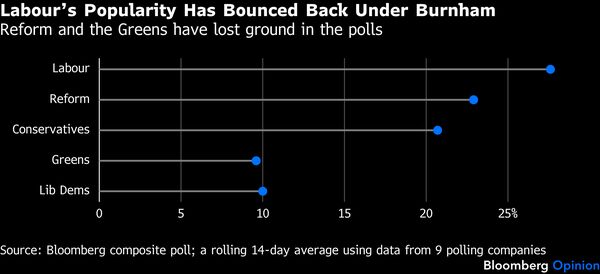
自从安迪·伯纳姆于7月就任工党首相以来,该党的声势有所好转;民调显示,工党现在显然是选民中最受欢迎的选择,这是自2025年3月以来的首次。与此同时,保守党领袖凯米·巴德诺赫从选举惨败中漫漫长征般的复苏似乎也开始见效;其党的支持率稳步上升,虽谈不上惊人,但一些主要民调机构现在已将保守党置于改革英国党之前,将奈杰尔·法拉奇领导的该党挤到了第三位。
Since Andy Burnham arrived as Labour prime minister in July, the party’s fortunes have improved; polls show it’s now clearly the most popular choice among voters for the first time since March 2025. Meanwhile, Tory leader Kemi Badenoch’s long march back from electoral oblivion also seems to be paying off; her party has risen steadily, if not spectacularly, with some leading pollsters now putting the Conservatives ahead of Reform, pushing Nigel Farage’s outfit into third place.
这一切与短短六个月前的情形截然不同,当时改革英国党经常享有两位数的领先优势,法拉奇似乎势不可挡,将在几年内以首相身份入主唐宁街10号。与此同时,在极具个人魅力的新领袖扎克·波兰斯基带领下,绿党乘着一股热情浪潮,一度跃居第二位。在一个长期由工党和托利党主导、实行两党制的国家(自由民主党只是个颇具“事后诸葛亮”意味的存在)里,这是一种非同寻常的局面;得益于英国的“领先者胜出”投票制,小党向来难以在选民中取得实质性进展。
It all feels very different from as recently as six months ago, when Reform regularly enjoyed double-digit leads and Farage seemed inexorably on course to enter 10 Downing Street as prime minister in a couple of years. At the same time, the Greens, under charismatic new leader Zack Polanski, were riding a wave of enthusiasm that saw his party move into second place. This was an extraordinary situation in a country long defined by a two-party system dominated by Labour and the Tories (with the Liberal Democrats a bit of an afterthought); thanks to Britain’s first-past-the-post voting system, smaller challenger parties have traditionally struggled to make headway with voters.
令我对这些左右两派的新兴势力感到不安的,并非它们预示着与主流政治的决裂。而是它们所主张的政策、阐述的世界观,坦率说,还有其领导人的举止风度,让我渴望回归常态政治。
What troubled me about these upstarts on the left and right wasn’t that they signaled a break from mainstream politics. It was the policies they espoused, the worldview they articulated and, frankly, the manner in which their leaders comported themselves that made me long for a return to business as usual.
显然,我并非孤例。伯纳姆政府三个月前上台,恰逢这两股民粹主义运动开始露出真面目。各种指控不绝于耳:改革党面临贪腐、种族主义和厌女症指控,绿党则被指控反犹太主义,两党均被质疑经济常识匮乏。面对投票给法拉奇或波兰斯基的现实后果,选民正回流至中间立场。
I clearly wasn’t alone. The emergence of the Burnham administration three months ago coincided with a period during which both populist movements have begun to show their true colors. Allegations have swirled: about corruption, racism and misogyny for Reform, antisemitism for the Greens, along with suspicions of economic illiteracy for each of them. Faced with the reality of what a vote for Farage or Polanski entails, the electorate is drifting back to the center.
对于其他地方寻求扭转局势原因并复制此经验的人而言,答案令人欣慰地简单:领导力。就在一百多年前,第一次世界大战结束、法西斯主义兴起的前夜,W·B·叶芝在诗作《第二次降临》中写道:“最好的人缺乏一切信念,而最坏的人 / 充满了狂热的激情。” 这一判断至今依然适用:当“最好的人”失职时,“最坏的人”便开始具有吸引力。
For those elsewhere seeking an explanation for the turnaround and a blueprint for repeating the trick, the answer is reassuringly simple: leadership. In his poem , written just over 100 years ago in the aftermath of World War I and prefiguring the rise of fascism, W.B. Yeats wrote of a time in which: “The best lack all conviction, while the worst / Are full of passionate intensity.”The same holds true today: It’s when “the best” fail that “the worst” begin to appeal.
伯纳姆的前任首相基尔·斯塔默为人正直,却是个糟糕的领导者;同样,保守党在2010年至2024年长期执政,最终令人深感失望,导致选民在将斯塔默推上台的选举中转而反对他们。法拉奇和波兰斯基在抨击“建制”政党、煽动追随者“烧毁这座房子”中找到了肥沃的土壤。
Burnham’s predecessor as prime minister, Keir Starmer, was a good man but a poor leader; likewise, the Tories in their long stretch in government between 2010 and 2024 had ultimately proved a profound letdown, leading voters to turn against them in the election that brought Starmer to power. Farage and Polanski found fertile ground in railing against the “establishment” parties, and inviting their followers to burn the house down.
过去几个月发生的事情,清楚地印证了历史的“伟人”理论。伯纳姆比斯塔默是一位更优秀、更有吸引力的政治家,他传递的希望信息、拥抱大胆变革的未来愿景,正在穿透当前弥漫的悲观情绪。巴德诺赫同样提升了表现,在议会和党代会舞台上表现强势,其政策开始引起选民共鸣——这些选民原本可能以为已对该党彻底失望。
What has happened in the last few months is a clear demonstration of the “great man” theory of history. Burnham is a better, more appealing politician than Starmer, and his message of hope and his vision of a future that embraces boldness and change are cutting through the prevailing pessimism. Badenoch, too, has raised her game, with punchy performances in Parliament and on the conference stage, and policies that are beginning to chime with voters who may have assumed they were finished with her party.
毫无疑问,强大的社会深层力量正在推动全球范围内对建制派的不满。移民、能源成本上升、公共债务攀升、生活成本高企、人口老龄化、气候危机、对公共服务需求与期待的增加——所有这些以及更多因素,解释了为什么破坏现状者会显得有吸引力。但英国发生的事情表明,我们不必沦为事件的俘虏,提供领导力的个人——尤其是那些寻求务实解决方案、或至少提供缓解当今问题途径的人——能够击败那些试图让我们互相对立的虚无主义者。
There are undoubtedly strong social undercurrents propelling dissatisfaction with the establishment worldwide. Migration, rising energy costs, mounting public debt, the cost of living, the aging population, the climate crisis, increased demand for and expectations of public services — all these and more explain why iconoclasts can seem appealing. But what’s happening in the UK shows that we need not be hostages to events, and that individuals providing leadership, particularly those seeking practical solutions or at least offering some amelioration of the problems of our age, can beat the nihilists who would pit us against each other.
所有这些都必须建立在一个现实基础之上:即使在英国,中间派的反击仍处于早期阶段。改革党和绿党绝未出局,仅凭少数民意调查不应被视为英国已放弃其与多党政治调情的决定性证据。
All this must be caveated with the reality that the centrist fightback is still at an early stage, even in the UK. Reform and the Greens are not out of the game by any means, and a handful of opinion polls shouldn’t be taken as definitive proof that Britain has abandoned its flirtation with multi-party politics.
但令人鼓舞的是,民粹主义者如今,嗯,不那么受欢迎了。最新的YouGov领袖民调显示,伯纳姆以+4的净评分轻松成为最受青睐的领袖,巴德诺赫以-15位居第二,自民党领袖戴维以-16紧随其后,波兰斯基和法拉奇分别以-37和-42垫底。因此迹象令人振奋,更广泛的信息——温和派不应放弃,中间路线能够且必须守住——对所有关心民主与体面的人来说都是振奋人心的。
But it’s encouraging that the populists are, well, not so popular these days. The latest YouGov leader polling shows Burnham is easily the most favored leader, with a +4 rating, followed by Badenoch at -15, Lib Dem leader Ed Davey at -16, and Polanski and Farage trailing with -37 and -42 respectively. So the signs are hopeful, and the wider message — that moderates shouldn’t give up, and that the center can and must hold — is heartening for all who care about democracy and decency.