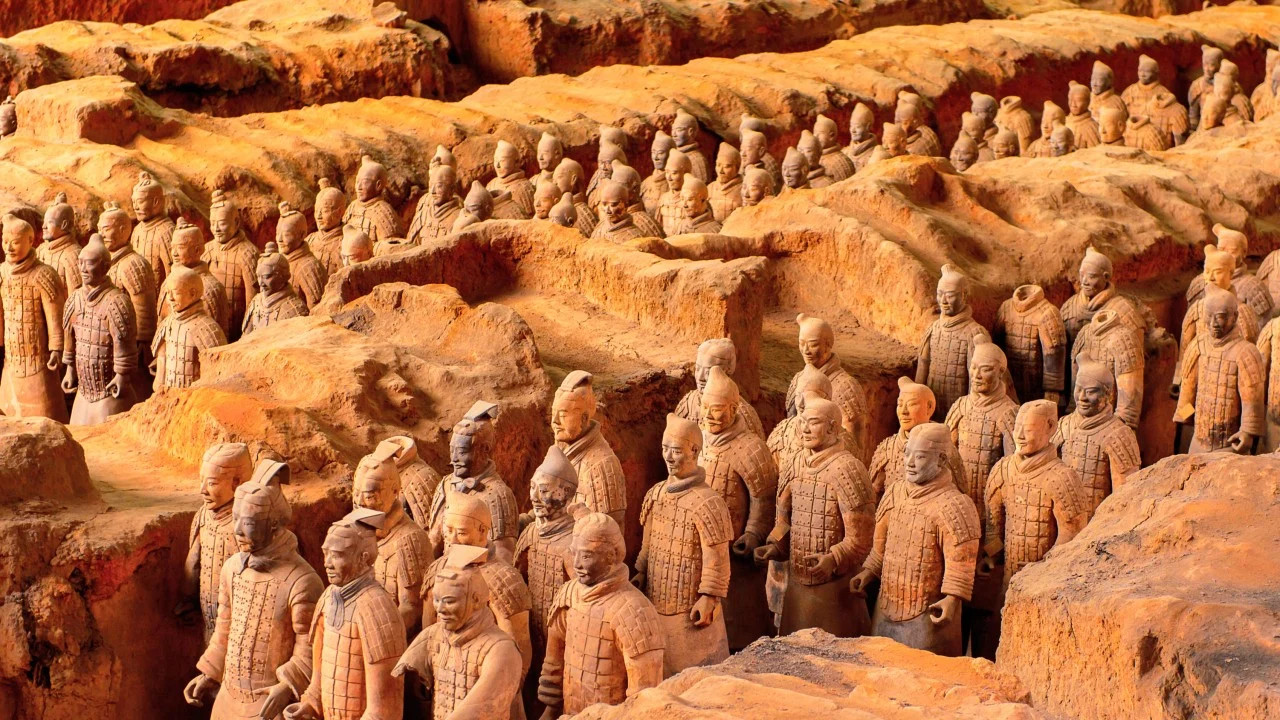
在中国最古老的城市之一西安东北约35公里处,地下约5米深的地方,埋藏着数千尊真人大小的兵马俑。
Some 5 metres underground near one of China’s oldest cities lies the life-size army of thousands of terracotta warriors.
这支兵马俑的用途是保护中国第一位皇帝秦始皇在来世。秦始皇于公元前210年去世后,兵马俑随他一同下葬。
The purpose of the army, located 35km northeast of historic Xian, was to protect China’s first emperor, Qin Shi Huang, in the afterlife. The Terracotta Army was buried with him after his death in 210BC.
如今,一项新研究显示,一部分兵马俑主要由成年女性和未成年人制作,而非此前认为的仅由男性制作。
Now, a new study shows that a portion of the terracotta warriors was largely made by adult women and minors, not solely by men as previously thought.
论文通讯作者、山东大学考古学院副教授沈静怡在10月13日发表于同行评审期刊《文化遗产杂志》的论文中写道:“这些发现挑战了长期以来的假设,即兵马俑制作完全依赖成年男性劳动力,为包括妇女和儿童在内的多元化劳动力队伍提供了首个定量生物学证据。”
“These findings challenge the long-held assumption that Terracotta Army production relied exclusively on adult male labour, providing the first quantitative biological evidence for a diverse workforce including women and children,” Shen Jingyi wrote in the paper published on October 13 in the peer-reviewed Journal of Cultural Heritage.
研究人员的模型估计,成年男性指纹约占总指纹的45%,成年女性指纹占近32.7%,剩余22.3%来自15岁以下未成年人——根据秦朝法律,15岁是成年门槛。
Shen, the corresponding author of the paper, is an associate professor at the School of Archaeology at Shandong University.
此前,考古学家认为秦朝(公元前221年-公元前207年)大规模手工业生产仅由成年男性承担。然而,关于兵马俑制作者缺乏直接证据。
The researchers’ model estimates that adult males accounted for about 45 per cent of the total fingerprints, adult females for nearly 32.7 per cent and the remaining 22.3 per cent came from minors under 15 years old – the legal threshold for adulthood under Qin dynasty law. Previously, archaeologists believed that large-scale handicraft production during the Qin dynasty (221-207BC) was undertaken only by adult males.
国家广播电视总台央视去年表示,秦始皇帝陵博物院的研究人员利用现代科学仪器,在40多尊出土兵马俑上发现了100多枚指纹。
However, there was a lack of direct evidence regarding the creators of the Terracotta Army.
虽然这是首次发现未成年人指纹,但当时仍认为工匠的指纹主要来自成年男性。
State broadcaster CCTV stated last year that, using modern scientific instruments, researchers at the Emperor Qin Shi Huang’s Mausoleum Site Museum had found over 100 fingerprints on more than 40 unearthed Terracotta Warrior figurines.
沈团队采取了不同的方法。她分析了秦始皇陵一号坑T23单元出土的36尊兵马俑上发现的79枚保存完好的指纹。
While it was the first time minors’ fingerprints were discovered, it was still believed that the artisans’ fingerprints were predominantly those of adult males. Shen’s team took a different approach.
为了区分男性和女性,研究人员使用了贝叶斯混合模型,该模型可以一次性分析整组指纹,而非试图对每一枚痕迹单独分类。
She analysed 79 well-preserved fingerprints found on 36 Terracotta Warriors in Unit T23 of Pit 1 of the Mausoleum of the First Qin Emperor.
研究人员还将古代指纹与不同年龄和性别的现代指纹数据进行了比对。
To distinguish between males and females, researchers used a Bayesian mixture model, which could analyse an entire group of fingerprints at once, rather than attempting to classify each trace.
每尊陶俑上留有1到5枚不同的指纹。这些指纹分布在俑身各处——头部、手臂、铠甲、手部、衣领甚至脚部——显然是在制作过程中无意留下的。
The researchers also compared ancient fingerprints with modern fingerprint data of different ages and genders. Each ceramic warrior bore between one and five distinct fingerprints.
其中,73枚指纹是在塑形、模制和组装过程中留下的,6枚是在将预制装饰件(如铠甲铆钉和腰带)压印到陶俑表面时形成的。
They were distributed across the figures – the head, arms, armour, hands, collar and even the feet – apparently left unintentionally during production.
科学家们对指纹进行了拍摄,并测量了平均纹脊宽度(MRB),该指标会随年龄增长而增加。
Of these, 73 fingerprints were left during the shaping, moulding and assembly processes, and six were formed when pre-made decorations, such as armour rivets and belts, were pressed onto the surface of the terracotta figures.
其他地区出土的文物以及秦代竹简等法律文献也支持沈团队的观点。
Scientists photographed the fingerprints and measured the mean ridge breadth (MRB), which increases with age.
加州大学圣塔芭芭拉分校中国历史教授安东尼·J·巴比耶里-洛(Anthony J. Barbieri-Low)于2007年撰写了该书,书中详细记述了当时的工匠群体。
Artefacts unearthed in other regions and legal documents such as Qin dynasty bamboo slips also support Shen’s viewpoint.
秦代出土的漆器铭文中包含(成年女性)、(年轻女性)和(年轻男性)等称谓,表明妇女和儿童在官方监管下参与了手工业生产。
Anthony J. Barbieri-Low, a professor of Chinese history at the University of California, Santa Barbara, wrote the book in 2007, which provides a detailed account of the artisan groups of that era.
据书中记载,身高不足1.5米(4.9英尺)的男性。身高不超过1.43米的女性。无法像那样在手工制品上署名,只能从事简单或卑微的劳动。
During the Qin dynasty, lacquerware inscriptions were unearthed, including (adult woman), (young woman) and (young man), indicating that women and children took part in craft production under state supervision. According to the book, is a male under 1.5 metres (4.9 feet) tall. is a female who is no taller than 1.43 metres. could not sign her name on handicrafts like and could do only simple or subservient work.
沈团队的研究发现表明,这批陶俑可能由女性和未成年工匠制作,尽管这未必能反映全体兵马俑工匠的分布情况。
The findings of Shen’s team suggest this batch of pottery figures may have been made by female and underage artisans, although it may not reflect the distribution of artisans among all Terracotta Warriors.
沈在论文结语中写道:“T23单元仅代表一号坑的一个局部区域,因此结果可能反映的是某个特定阶段或生产群体的劳动结构,而非整个工程。”
“Unit T23 represents only a localised area of Pit 1, so the results may reflect the labour structure of a specific phase or production group rather than the entire project,” Shen wrote at the end of the paper.
然而,这些考古证据和研究表明,兵马俑的制作者中,女性和未成年工匠的数量可能比传统认知的要多。兵马俑与秦始皇一同地下安睡了2200多年。
However, this archaeological evidence and research suggest that the Terracotta Army may have been made by a greater number of female and underage artisans than traditionally assumed. The terracotta figures have lain underground with Emperor Qin Shi Huang for more than 2,200 years.
1974年,几位村民在打井时发现了它们,随后兵马俑名扬天下。
In 1974, they were discovered by several villagers while digging a well, and later became known to the world.