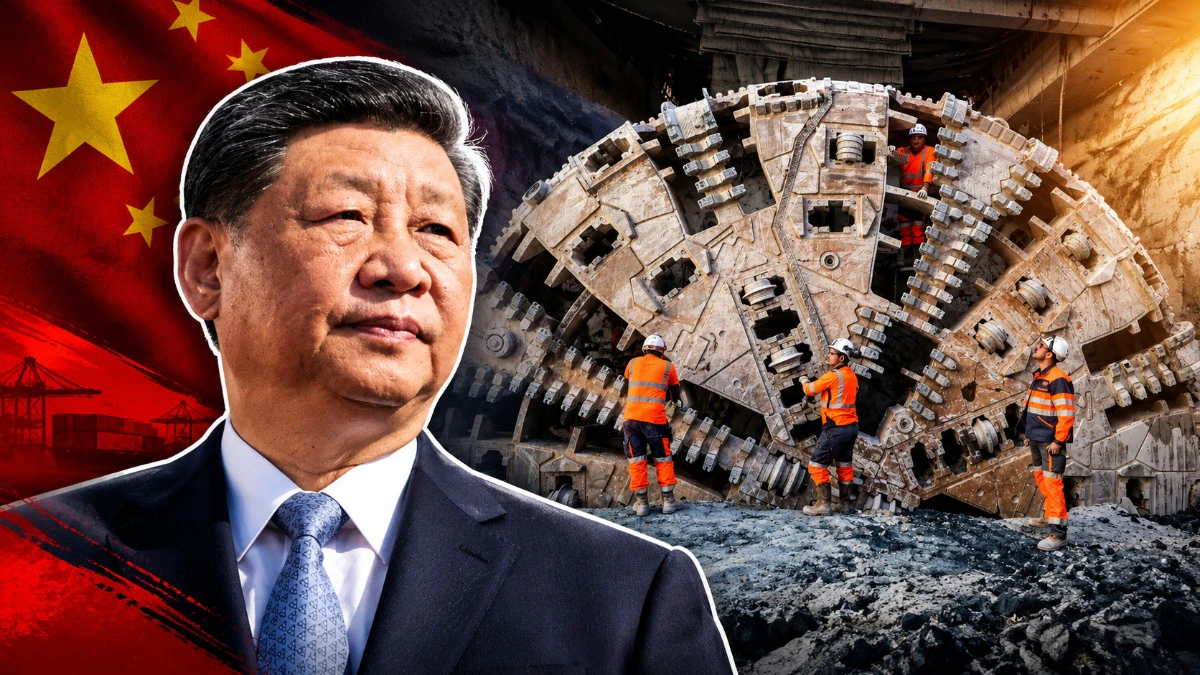
中国决定加强对隧道掘进机(TBM)的出口管制,这一举措暴露了印度在基础设施建设方面的脆弱性,其影响范围涵盖了从城市交通到喜马拉雅山地区的互联互通等多个领域。由于中国对该技术的控制日益严格(该技术对于地铁网络、高速公路和高铁建设至关重要),印度可能会再次面临供应链中断的风险。这些限制也引发了人们对印度在建设关键基础设施时是否必须依赖外国技术的长期担忧。
China's decision to tighten export controls on tunnel-boring machines (TBMs) has exposed a vulnerability in India's infrastructure ambitions, with implications for everything from urban transport to connectivity in the Himalayas. As Beijing tightens its grip on this technology that is essential for metro networks, highways and high-speed rail, India faces the prospect of renewed supply disruptions. The curbs have also raised longer-term concerns about India's ability to build critical infrastructure without being dependent on foreign technology.
尽管中国的限制措施不太可能阻碍那些依赖传统挖掘方法建设的边境公路隧道项目,但它们确实凸显了新德里在战略敏感地区扩大基础设施建设时发展本土制造业的紧迫性。
Although the Chinese restrictions are unlikely to halt the construction of major border road tunnels that rely on conventional excavation, they still highlight the need for New Delhi to develop a resilient domestic manufacturing base as it expands infrastructure in strategically sensitive regions.
中国商务部于10月19日宣布,对隧道掘进机及相关设备的出口管制将于11月18日正式生效。在宣布这一决定时,中国政府以“国家安全”和“防扩散”为由作为依据。隧道掘进机的制造技术主要集中在少数几个工业国家,包括德国、美国、日本和法国,而中国已成为全球最大的生产国。目前,中国占据了全球隧道掘进机市场的约70%份额,并生产了国内所需隧道掘进机总量的95%左右。
The Chinese Commerce Ministry on October 19 announced that export controls on tunnel-boring machines (TBMs) and related equipment would take effect on November 18. Beijing, while making the announcement, cited "national security" and "non-proliferation" obligations.TBM manufacturing is concentrated in a handful of industrial nations, including Germany, the US, Japan and France, with China emerging as the dominant global producer. Currently, China accounts for an estimated 70% of the global TBM market and manufactures around 95% of the machines used domestically.
这一举措使中国政府拥有了潜在的手段,可以在未来干扰印度的重大基础设施项目;尤其是在2024年出现过供应链问题(当时中国推迟了从本国工厂出口的隧道掘进机,其中包括由德国工程巨头赫伦克内希特公司制造的设备)之后。对印度来说,当务之急是保护项目的进度并实现供应链的多元化。
The move gives Beijing a formal lever to potentially disrupt India's major infrastructure projects, following supply difficulties in 2024, when China delayed shipments of tunnelling machinery manufactured at its facilities, including TBMs made by German engineering major Herrenknecht. For India, the immediate challenge is to protect project timelines and diversify supplies.
然而,更重要的问题是:新德里能否将这些新的限制措施转化为一个机会,借此发展自己在机械制造领域的能力?这些机械对于印度的基础设施建设和战略互联互通至关重要。更重要的是,印度能否在隧道掘进机(TBM)方面减少对中国的依赖?目前,中国主导着全球隧道掘进机市场,生产了全球约70%的隧道掘进机,以及印度国内95%的隧道掘进机。(
The bigger question, however, is that can New Delhi turn the latest restrictions into an opportunity to develop its own capabilities in machinery that will become increasingly important to its infrastructure and strategic connectivity? More importantly, can India wean itself off China when it comes to TBMs? China dominates the global tunnel-boring machine (TBM) market, producing about 70% of the world's machines and 95% of its own domestic units. (AI IllustrationSushim Mukul)CHINA'S CURBS AND INDIA'S BORDER INFRASTRUCTUREIndia's concerns extend beyond metro railways and urban road tunnels.
中国的限制措施与印度的边境基础设施印度的担忧不仅限于地铁铁路和城市道路隧道。自2020年加尔万冲突(导致20名印度士兵死亡)以来,新德里加快了道路、桥梁和隧道等基础设施的建设,以改善实际控制线(LAC)沿线地区的交通状况。这些项目在战略和军事上都具有极其重要的意义,尤其是在拉达克东部和阿鲁纳恰尔邦。如果没有完善的道路和隧道网络,印度将难以迅速应对任何新的边境危机。
Since the 2020 Galwan clashes, a major India-China border confrontation which resulted in the deaths of 20 Indian soldiers, New Delhi has accelerated the construction of roads, bridges, tunnels and other infrastructure to improve access to forward areas along the Line of Actual Control (LAC).These projects are strategically and militarily essential, particularly in eastern Ladakh and Arunachal Pradesh. Without a proper network of all-weather roads and tunnels, India's ability to respond swiftly to any fresh border crisis would be severely constrained."
“毫无疑问,中国的制裁措施是针对印度沿4056公里实际控制线(LAC)建设的战略基础设施项目的,”资深记者兼国防专家桑迪普·乌尼坦(Sandeep Unnithan)对《India Today Digital》表示。
There's no doubt that China's TBM sanctions are aimed at India's strategic infrastructure projects along the 4,056-km Line of Actual Control (LAC)," senior journalist and defence expert Sandeep Unnithan told India Today Digital.
虽然隧道掘进机对基础设施建设至关重要,但值得注意的是,印度在与中国接壤地区修建的隧道中,仍有很大一部分采用了传统的挖掘方法(如使用炸药)。以佐吉拉隧道为例,这条隧道是连接拉达克地区的重要交通通道,具有极强的抗恶劣天气能力。
But while TBMs are important for infrastructure development, it must be noted that a significant portion of tunnels built by India near its border with China relied more on conventional excavation methods, such as using explosives. Take for instance, the Zojila Tunnel, a critical all-weather link supporting access to Ladakh.
该项目于2026年6月通过采用新奥法(NATM)实现最终突破,该方法运用分步开挖、钻爆、锚喷支护及持续地质监测。
The project achieved its final breakthrough in June 2026 through use of the New Austrian Tunnelling Method (NATM), which uses sequential excavation, drilling and blasting, rock bolting, shotcrete and continuous geological monitoring.
同样,阿鲁纳恰尔邦的塞拉隧道改善了通往战略要地达旺地区的全天候连通性,也是采用新奥法建设。拉达克东部的夏约克隧道位于支援前线地区通达的路线上,则采用明挖回填法。
Similarly, the Sela Tunnel in Arunachal Pradesh, which improves all-weather connectivity to the strategically important Tawang sector, was constructed using NATM. The Shyok Tunnel in eastern Ladakh, on a route supporting access to forward areas, uses a cut-and-cover approach.
这些例子表明,中国的出口管制不应被自动解读为对每条边境隧道的直接威胁。极端海拔、多变岩层、涌水、地质断层、施工季节短以及重型机械运输维护困难,使得常规工法对此类项目更为实用。
These examples show why China's export controls should not automatically be interpreted as a direct threat to every border tunnel. Extreme altitude, variable rock formations, water ingress, geological faults, short working seasons and the difficulty of transporting and maintaining heavy machinery make conventional methods more practical for such projects.
然而,这并不意味着中方限制在战略上无关紧要。隧道掘进机(TBM)在横跨喜马拉雅山脉的长距离铁路和水电隧道中应用日益增多,改善了区域连通性,并可能强化支撑边境地区军事行动的更广泛后勤网络。
However, that does not make the Chinese restrictions strategically irrelevant. TBMs are increasingly used in longer railway and hydropower tunnels across the Himalayas, improving regional connectivity and potentially strengthening the wider logistics network that supports military operations in border areas.
北阿坎德邦的瑞诗凯诗-卡尔纳普拉亚格铁路项目即为重要例证。两台大型海瑞克(Herrenknecht)盾构机“湿婆号”(Shiv)和“沙克蒂号”(Shakti)在复杂的喜马拉雅地质条件下掘进了一段主要的双管隧道。
The Rishikesh-Karnaprayag railway project in Uttarakhand is an important example. Two large Herrenknecht TBMs, named Shiv and Shakti, excavated a major twin-tube section through challenging Himalayan geology.
此外,还有由梅加工程基建有限公司与德国海瑞克公司于2026年8月合作制造的“阿周那号”(Arjuna)盾构机。
There is also the Arjuna TBM, built by Megha Engineering and Infrastructures Limited in collaboration with Germany's Herrenknecht in August 2026.
这台盾构机(TBM)的设计目的是穿越桑贾伊·甘地国家公园(Sanjay Gandhi National Park)下方的玄武岩地层,用于孟买的塔内-博里瓦利双线隧道项目。此类项目表明,即使在主要毗邻实际控制线(LAC)的公路隧道中部署仍然有限,盾构机技术在困难山区地形和人口稠密地区也能发挥重要作用。因此,印度面临的风险是:直接依赖从中国进口盾构机的项目遭受干扰,以及随着国家扩大更广泛的铁路、水电和地下基础设施网络,持续依赖外国机械。
This TBM was designed to bore through the basalt formations beneath Sanjay Gandhi National Park for Mumbai's Thane-Borivali Twin Tunnel project. Such projects demonstrate that TBM technology can have an important role in difficult mountain terrain and highly populated regions, even if its deployment on primary LAC-adjacent road tunnels remains limited. So, the risk for India is disruption to projects that directly depend on imported TBMs from China and continued dependence on foreign machinery as the country expands its wider railway, hydropower and underground infrastructure network.
任何未来在战略山区项目中更多使用盾构机的转变,都会使国内能力变得更加重要。印度一直严重依赖外国制造的盾构机(TBM)来推动其大规模城市和边境基础设施建设热潮。(AI插图 Sushim Mukul)印度对盾构机的依赖已因中国导致延误印度在盾构机方面的脆弱性在2024年显现出来,当时联邦商业部长皮尤什·戈亚尔(Piyush Goyal)就赫伦克内特(Herrenknecht)在中国制造的盾构机供应延误问题,向时任德国副总理罗伯特·哈贝克(Robert Habeck)提出关切。
Any future shift towards greater TBM use in strategic mountain projects would make domestic capability even more important. India has maintained a heavy reliance on foreign-made Tunnel Boring Machines (TBMs) to drive its massive urban and border infrastructure boom. (AI IllustrationSushim Mukul)INDIA'S DEPENDENCE OF TBMs THAT HAS ALREADY CAUSED DELAYS BY CHINAIndia's vulnerability to TBMs became evident in 2024, when Union Commerce Minister Piyush Goyal raised concerns with then German Vice Chancellor Robert Habeck about delays in the supply of TBMs manufactured by Herrenknecht in China.
这一事件揭示了一个超越从中国公司购买设备的问题。即使机器是从德国制造商订购的,如果它是在中国的工厂生产,或依赖受出口管制的零部件,仍可能容易受到中国出口限制的影响。
The episode revealed a problem that is beyond buying equipment from Chinese companies. Even though the machine was ordered from a German manufacturer, it can still become vulnerable to Chinese export restrictions if it is produced at a facility in China or depends on components subject to export controls.
然而,这里有一个重要的注意点:据路透社引用的数据显示,印度从中国进口的掘进机械从2022-23财年的1800万美元降至2023-24财年的300万美元,随后跌至2024-25财年的50万美元,并在2025-26财年略微回升至80万美元。随着两国双边紧张局势有所缓和,印度于2026年3月收到了来自中国的延误盾构机。
However, an important point to note here is that India's imports of tunnelling machinery from China fell from $18 million in 2022-23 to $3 million in 2023-24, before dropping to $500,000 in 2024-25 and rising marginally to $800,000 in 2025-26, according to figures cited by Reuters. India received delayed TBMs from China in March 2026 as bilateral tensions somewhat eased between the two countries.
北京的新许可要求给印度增添了另一层不确定性。这种直接影响对于孟买-艾哈迈达巴德高速铁路走廊等项目尤为显著,该走廊包含一条长达七公里的海底隧道,以及主要城市道路隧道。在适宜条件下,盾构机可在人口稠密地区开挖,对地表干扰较小,并能比传统钻爆法提高安全性。印度从中国进口盾构机并非突然骤降,而是2020年边境冲突后开始的、蓄意分阶段实施的“脱钩”战略的结果。
Now, the new licencing requirements by Beijing introduce another layer of uncertainty for India. The immediate exposure is particularly significant for projects such as the Mumbai-Ahmedabad High-Speed Rail Corridor, which includes a seven-kilometre undersea tunnel, and major urban road tunnels. TBMs allow excavation in densely populated areas with less surface disruption and can improve safety compared with conventional blasting in suitable conditions. Rather than a sudden drop, the steep decline of India's Chinese TBMs import is the result of a deliberate, multi-phased decoupling strategy that began after the 2020 border clashes. (AI IllustrationSushim Mukul)INDIA'S TBM MANUFACTURING PUSH GAINS URGENCYIndia is stepping up efforts to reduce its dependence on imported tunnel-boring machines (TBMs) through domestic manufacturing, local assembly by foreign companies and indigenous design.
(AI插图 Sushim Mukul)印度推进盾构机国产制造更显迫切印度正加大力度,通过国产制造、外资企业本地组装及自主设计,减少对进口盾构机(TBM)的依赖。德国工程巨头海瑞克(Herrenknecht)于2007年在钦奈建立组装厂,在2022年7月至2023年7月期间,该厂为钦奈地铁二期制造了10台盾构机。根据海瑞克的官方披露,这些盾构机使用的零部件中,60%来自印度供应商,其余40%源自该公司在德国的工厂。
German engineering major Herrenknecht, which established an assembly facility in Chennai in 2007, manufactured 10 TBMs for Chennai Metro Phase 2 at the facility between July 2022 and July 2023. According to an official disclosure by Herrenknecht, 60% of the components used in the TBMs came from Indian suppliers, with the rest 40% sourced from the firm's facilities in Germany.
2025年,海瑞克在钦奈北部收购了12.4英亩土地,计划建设制造工厂,显示出对印度隧道掘进需求增长的信心。然而,本地组装并不等同于自主可控,因为关键部件、精密工程系统和先进控制系统可能仍依赖海外供应商。
In 2025, it acquired 12.4 acres in North Chennai for a planned manufacturing plant, signalling confidence in India's growing tunnelling demand. However, local assembly does not guarantee self-reliance, as critical components, precision-engineered systems and advanced controls might still depend on overseas suppliers.
国有企业印度土方机械有限公司(BEML)正在推进国产盾构机(TBM)研发,计划开发直径约6米至16.5米的机型,并将从直径约6.5米的原型机起步。中央政府拟推出的12亿美元建筑与基础设施装备制造激励计划,有望加速这一转型,在七年内吸引约18亿美元的新增投资。新德里面临的挑战在于,如何确保这些激励措施转化为关键零部件的国内生产、技术研发以及健全的供应商生态体系,而不仅仅是利用从国外采购的零部件扩大组装业务。
State-owned Bharat Earth Movers Limited (BEML) is pursuing indigenous TBM development, with plans for machines ranging from around six metres to 16.5 metres in diameter, beginning with a prototype of approximately 6.5 metres. The Centre's proposed $1.2 billion incentive scheme for construction and infrastructure equipment manufacturing could accelerate this transition, attracting an estimated $1.8 billion in fresh investment over seven years. The challenge for New Delhi is to ensure that these incentives translate into domestic production of critical components, technology development and a robust supplier ecosystem, rather than merely expanding assembly operations using components sourced abroad.
一台起重机在北京吊装一台直径16.07米的盾构机,用于北京东六环改造工程。公共政策研究员普拉奈·科塔斯坦在X平台发文指出,中国最新的限制措施短期内可能导致项目延期,但从长远看将促使制造商拓展中国以外的生产基地。“更大的教训是,中国不再是一个可靠的商业伙伴。印度的任务是让这种转移变得容易:提供可预期的审批、可靠的电力供应,以及为零部件提供快速通关,”总部位于班加罗尔的塔克沙希拉研究所副所长科塔斯坦表示。
A crane lifts a tunnel boring machine measuring 16.07 meters in diameter for the reconstruction project of Beijing's East Sixth Ring Road in Beijing, China. Public policy researcher Pranay Kotasthane, in a post on X, argued that the latest restrictions could create short-term project delays but encourage manufacturers to expand outside China in the longer term." The larger lesson is that China is no longer a reliable business partner. India's job is to make the move easy: predictable approvals, reliable power, and quick customs clearance for components," said Kotasthane, Deputy Director of the Bengaluru-based Takshshila Institution.
因此,面对中国最新的限制措施,从长远来看,印度必须建设涵盖设计、零部件制造和整机生产的国内自主能力。
Therefore, amid the latest curbs by China, India, over the longer term, must develop domestic capabilities that span design, component manufacturing and complete machine production.
BEML的计划、外国制造商的投资以及拟议的激励计划提供了基础,但其成败将取决于持续的执行力度。但正如资深记者兼国防专家桑迪普·乌尼坦对《印度今日》数字版所说,如果印度成功建立起国产盾构机制造基地,“20至30年后的印度将会感谢我们。”中国给了印度另一个理由,去质疑那些暴露于地缘政治决策之下的供应链的可靠性。
BEML's plans, foreign manufacturers' investments and the proposed incentive scheme offer a foundation, but their success will depend on sustained execution. But should it succeed in building a domestic TBM manufacturing base, as senior journalist and defence expert Sandeep Unnithan told India Today Digital, "The India of 20–30 years hence will thank us." China has given India another reason to question the reliability of supply chains exposed to geopolitical decisions.- Ends