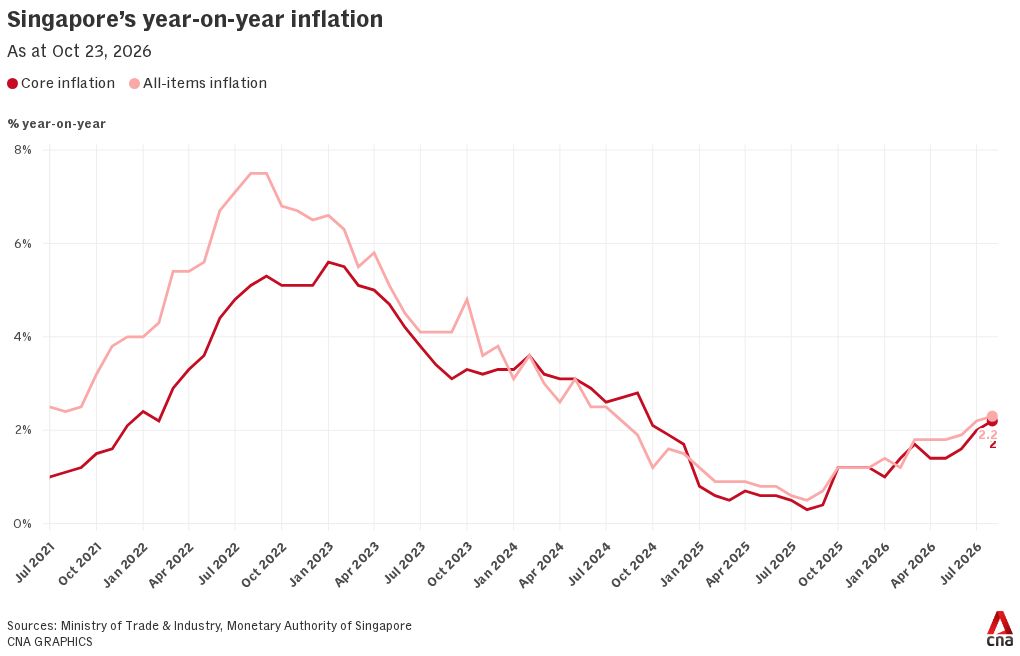
新加坡:根据周五(10月23日)公布的官方数据,新加坡9月核心通胀率按年率计算放缓至2%,低于8月的2.2%。
SINGAPORE: Singapore’s core inflation eased to 2 per cent year-on-year in September, down from 2.2 per cent in August, according to official figures released on Friday (Oct 23).
新加坡金融管理局(MAS)和贸易工业部(METI)在一份联合媒体声明中表示,这是由于服务业、零售及其他商品以及私人交通的通胀率下降所致。
This was because of lower inflation in services, retail and other goods and private transport, the Monetary Authority of Singapore (MAS) and Ministry of Energy, Trade and Industry (METI) said in a joint media release.
核心价格(不包括住宿和私人交通)在9月按月环比上涨0.1%。
Core prices, which exclude accommodation and private transport, rose by 0.1 per cent month-on-month in September.
以消费价格指数(所有项目)衡量的整体通胀率,按年率计算从8月的2.3%降至9月的2.2%,原因是核心通胀和私人交通通胀放缓。
Overall inflation, as measured by the Consumer Price Index-All Items, fell to 2.2 per cent year-on-year in September from 2.3 per cent in August, due to lower core inflation and private transport inflation.
按月环比计算,整体通胀(不包括购房、股票及其他金融资产购买和所得税等非消费支出)在9月上涨0.2%。
On a month-on-month basis, overall inflation – which excludes non-consumption expenditures such as purchases of houses, shares and other financial assets and income taxes – rose by 0.2 per cent in September.
行业方面 周五发布的官方数据显示,服务业通胀率从8月的2%放缓至9月的1.7%,原因是点对点交通服务费用涨幅收窄,以及电信服务价格跌幅扩大。
SECTORS Official data released on Friday showed that services inflation eased to 1.7 per cent in September from 2 per cent in August due to a smaller increase in point-to-point transport service costs and a larger decline in telecommunication service prices.
零售及其他商品通胀率也从8月的1.8%放缓至9月的1.2%,因家具价格下跌,服装价格涨幅放缓。
Retail and other goods inflation also moderated to 1.2 per cent in September from 1.8 per cent in August as furniture prices declined and clothing prices rose at a slower pace.
私人交通通胀率也从8月的7.5%降至9月的7.1%,原因是汽车价格涨幅趋缓。电力及燃气通胀率维持在8.7%不变,因9月和8月涨幅相近。
Private transport inflation also fell to 7.1 per cent in September from 7.5 per cent in August due to a more gradual increase in car prices. Electricity and gas inflation was unchanged at 8.7 per cent as prices rose at a similar pace in both September and August.
新加坡金管局和贸工部指出,每季度的管制电费主要根据前一季度前两个半月的天然气平均价格等因素设定。
MAS and METI noted that the regulated electricity tariff for each quarter is set based largely on the average natural gas prices in the first two and a half months of the preceding quarter, among other factors.
“2026年第三季度受管制电价的上涨,是2026年4月至6月中旬全球能源价格飙升的结果,”当局表示。
“The increase in the regulated electricity tariff in the third quarter of 2026 is thus the result of the spike in global energy prices over the period of April to mid-June 2026,” the authorities said.
住宿通胀率由8月的0.8%微升至9月的0.9%,住房租金涨幅加快。
Accommodation inflation edged up to 0.9 per cent in September from 0.8 per cent in August, with housing rents increasing at a faster pace.
食品通胀率也由8月的2.3%升至9月的2.4%,原因是非熟食和餐饮服务的通胀率均有所上升。
Food inflation also rose to 2.4 per cent in September from 2.3 per cent in August due to higher inflation in both non-cooked food and food services.
展望 当局表示,进口成本压力预计在短期内对新加坡而言将保持坚挺。
OUTLOOK The authorities said that imported cost pressures are expected to remain firm for Singapore in the near term.
“能源商品价格再度上涨,预计短期内将保持高位,”新加坡金融管理局和贸工部表示。
“Energy commodity prices have risen anew and are projected to remain high in the near term,” said MAS and METI.
“全球和地区食品价格也预计将回升,因为投入成本上升和不利天气模式影响粮食生产。”但当局补充称,随着临时供应中断的影响消退,进口通胀预计将在2027年缓解。
“Global and regional food prices are also expected to pick up as costlier inputs and adverse weather patterns affect food production.”But imported inflation should ease over 2027 as the effects of temporary supply disruptions fade, the authorities added.
在国内方面,价格压力可能保持温和,新加坡金融管理局和贸工部表示,随着生产率持续提升,服务业单位劳动力成本预计将保持受控。
On the domestic front, price pressures are likely to stay subdued, with unit labour costs in the services sector expected to remain contained amid continued productivity gains, MAS and METI said.
当局补充称,政府加强补贴,例如医疗和教育补贴,也将抑制服务业通胀。
Enhanced government subsidies, such as for healthcare and education, will also dampen services inflation, the authorities added.
考虑到这些因素,核心通胀和总体通胀预计在未来几个季度内将保持略高水平,随后从2027年中期开始更明显地回落。
Taking into account these factors, core inflation and overall inflation are expected to remain slightly elevated in the immediate quarters ahead before easing more discernibly from mid-2027.
核心通胀预计2026年平均为1.5%至2%,与新加坡金融管理局全年预测区间一致;2027年预计平均为1.5%至2.5%。
Core inflation is expected to average 1.5 per cent to 2 per cent in 2026, in line with MAS' full-year forecast range It is also expected to average 1.5 per cent to 2.5 per cent in 2027.
总体通胀预计2026年约为2%,2027年为1.5%至2.5%。
Overall inflation is expected at around 2 per cent in 2026 and 1.5 per cent to 2.5 per cent in 2027.
“通胀风险仍偏向上行。全球能源或食品价格出现急剧且持续的飙升,可能使新加坡的进口成本高于预期,”新加坡金融管理局和贸工部表示。
“The risks to inflation remain tilted to the upside. A sharp and sustained surge in global energy or food prices could lift Singapore’s import costs by more than projected,” MAS and METI said.
当局补充称,如果与人工智能相关的产业繁荣带来的负面影响进一步扩大,且单位劳动力成本上升速度加快,国内通胀可能会持续处于高位。
Domestic inflation could also stay elevated if spillovers from the artificial intelligence-related boom broaden and unit labour costs rise more rapidly, the authorities added.
“然而,全球利率高于预期,或者与人工智能相关的投资减少,都可能对经济增长产生负面影响,进而抑制通胀。”马来西亚中央银行(MAS)和马来西亚经济事务部(METI)表示。
“中东地区的能源生产和出口可能会比预期更快地恢复,从而导致能源价格进一步下跌。”
“However, higher-than-expected global interest rates or a pullback in AI-related investment could exert a drag on growth, and thus, inflation,” MAS and METI said. “Energy production and shipments from the Middle East could also recover more quickly than projected, resulting in a greater decline in energy prices.”