韩国战争结束后,裴五道(Bae Oh-do,音译)还是个孩子时,就会走进森林捡拾柴火给家里取暖。“手工时代完全烙印在我的记忆里,”这位70岁的小提琴销售员坐在首尔钟路区一座公园的树下说道。他回忆起不得不踩脚踏泵打水,以及第一批拖拉机开进韩国农村时的欣喜。
AS A BOY growing up in the aftermath of the Korean war, Bae Oh-do would venture out into the forest to gather firewood to heat his family’s home. “The manual era is completely ingrained in me,” says the 70-year-old violin salesman, sitting under a tree in a park in Seoul’s Jong-no district. He recalls having to use a foot-operated “treadle pump” to get water, as well as his delight when the first tractors rolled into the South Korean countryside.
近几十年来,他见证了互联网和智能手机让生活变得“如此便利”。那人工智能呢?“这没什么好让人类担心的。这种东西是好的,”他说。“他们应该继续发展这项技术。人类发展到我们这一代已经进步这么多了。世界会怎么变,谁也说不准。”读读西方媒体的头条新闻,似乎对AI的反弹正在全球迅速蔓延。但目前并非如此。
In recent decades he has seen things “develop so conveniently”, with the internet and smartphones. And what about artificial intelligence? “It’s nothing for humans to worry about. This kind of thing is good,” he says. “They should keep developing the technology. Humanity has advanced so much up to our generation. There’s no telling how the world will change.”Read the headlines in Western media and it may seem as though a backlash to AI is spreading fast everywhere. But so far, it is not.
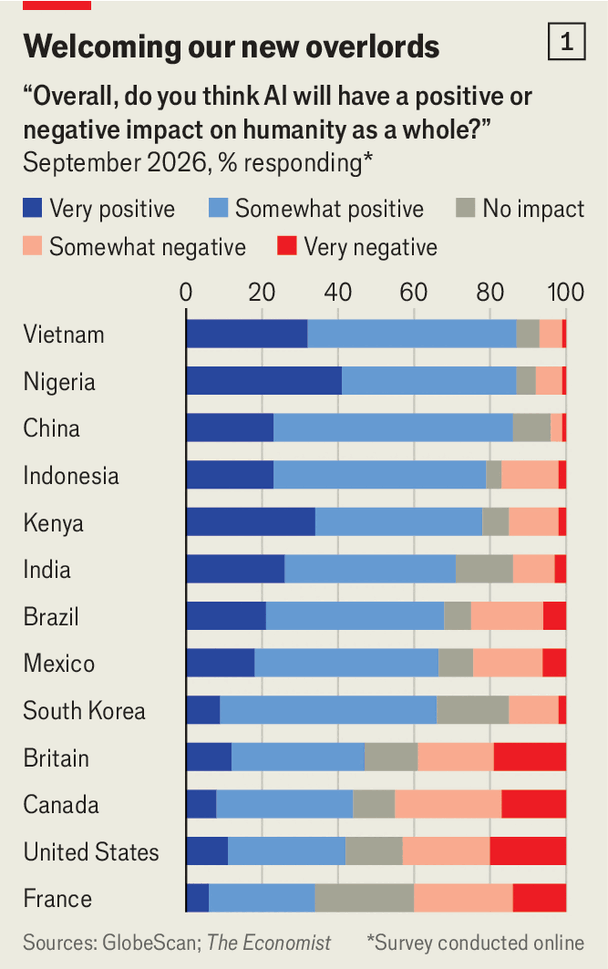
根据民调机构GlobeScan为《经济学人》进行的一项调查,近三分之二的韩国人与裴先生一样,对AI持乐观态度。在非富裕国家,这种积极情绪甚至更强烈:例如,尼日利亚和越南近十分之九的受访者表示,AI不仅会改善他们自己的生活,还会造福全人类(见图表1)。
Mr Bae’s sunny disposition about AI is shared by almost two-thirds of South Koreans, according to a survey that GlobeScan, a polling firm, conducted for The Economist. Outside rich countries this good feeling is even more strongly shared: nearly nine in ten people in Nigeria and Vietnam, for example, said that AI will improve not only their own lives, but the lot of humanity (see chart 1).
这项覆盖34个国家的民调是在线进行的,这可能会使态度倾向于支持AI。然而,在同一项调查中,富裕西方国家的情绪要悲观得多。在美国、加拿大和法国,对AI未来对人类影响持负面看法的人多于持正面看法的人。在其他西方国家,情绪虽为净正面,但远不如贫穷国家强烈。盖洛普与微软合作最近对37个国家进行的另一项调查得出了类似结果:AI广受欢迎,但在富裕西方国家不那么受欢迎。
The polling across 34 countries was carried out online, which could tilt attitudes in favour of AI. Yet in the same survey sentiment in rich Western countries was much gloomier. In America, Canada and France more people felt negatively than positively about AI’s future impact on humanity. In other Western countries sentiment was net-positive, but far less so than in the poor world. Another recent survey of 37 countries, carried out by Gallup with Microsoft, returned similar results: AI is broadly popular, but less so in rich Western countries.
为什么西方国家与其他国家之间存在差距呢?随着越来越多的贫困国家的人们直接接触到人工智能(AI)或数据中心,并看到这项技术对不同群体的影响(有些群体受益,有些群体则受到负面影响),人们原本的乐观情绪可能会逐渐减弱。根据微软的一项研究,2026年第二季度,肯尼亚只有约9%的劳动年龄人口使用了AI技术;然而,85%的受访者表示AI技术会改善他们的生活。
Why the gap between the West and the rest? Some of the optimism may cool as more people in poor countries come into direct contact with AI or data centres, and see the technology helping or hurting some more than others. Around 9% of working-age Kenyans used AI in the second quarter of 2026, according to a study by Microsoft. Yet 85% told GlobeScan that it would change their lives for the better.
不过,无论是穷人还是富人,很多人都已经对AI技术的潜在问题有所了解。皮尤研究中心(Pew Research Centre)的一项调查显示,韩国人和澳大利亚人最担心AI技术会导致大规模的就业流失并加剧社会不平等。不过目前来看,人们对AI技术的期待似乎仍然超过了这些担忧。
But plenty of people, poor and rich alike, are already at least vaguely conscious of AI’s pitfalls. In a survey by Pew Research Centre, South Koreans were most likely (along with Australians) to say they expect AI to generate massive job losses and worsen inequality. For now, though, such fears appear to be outweighed by intrigue about the technology’s promise.
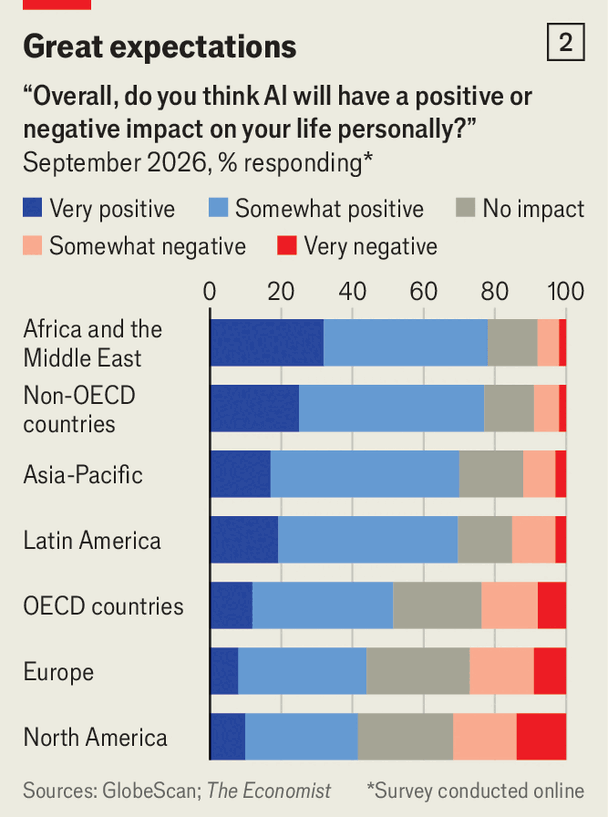
造成这种差距的部分原因是:在那些最不富裕的国家,许多劳动者的工作性质较为非正式,工作稳定性较低;与西方国家相比,他们失去稳定工作的风险相对较小。在印度等地,信息技术行业和其他后台支持岗位的工作者也更容易受到技术变革的影响。
Part of the explanation is that many workers outside the richest countries have less to lose from AI than do their counterparts in the West. In much of the poor world work is often informal and, compared with jobs in the West, precarious. The notion of losing a secure office job to technology is more of a rich-world problem (though in India, say, information-technology and other back-office workers look vulnerable to disruption).
贫困国家同样可以从AI技术中获益。在那些缺乏完善的社会制度和正规教育体系的国家,AI技术能够帮助一些人改善自己的生活。帕亚尔·阿罗拉(Payal Arora)在她的著作《从悲观到希望》(From Pessimism to Promise)中指出:“悲观只是一种特权——只有那些有能力感到绝望的人才会有这种情绪。”她认为,只有那些经济条件较好的人才有资格对AI技术感到绝望。
The poor world has much to gain from AI, too. In countries where institutions and formal education can be lacking, AI helps some people help themselves. “Pessimism is a privilege for those who can afford to despair,” argues Payal Arora, author of “From Pessimism to Promise”, a book about diverging attitudes to technology.
许多用户能够以低成本或免费的方式使用谷歌的Gemini或OpenAI的ChatGPT等应用程序;根据微软的最新研究,2026年第二季度,印度有近五分之一的劳动年龄人口使用了生成式AI技术,而美国这一比例为三分之一。中国的免费AI工具DeepSeek在非洲非常受欢迎,微软估计在许多非洲国家,约有十分之一的劳动年龄人口使用了该工具。
dia users have gained cheap or free access to apps like Gemini from Google or ChatGPT from OpenAI; nearly one in five working-age Indians used generative AI in the second quarter of 2026, compared with a third of Americans, according to a recent Microsoft study. DeepSeek, a free Chinese alternative, is popular in Africa, where Microsoft estimates that in many countries about one in ten working-age people used generative AI in the second quarter.
在孟买一个繁忙的郊区,有一条狭窄的小街,它很好地展示了人工智能(AI)带来的种种好处。这条街上的许多商店都在使用 ChatGPT 来辅助工作。眼镜商 Dinesh Chandra 曾要求 ChatGPT 为他的品牌生成一张“违反重力规律”的图片——结果 ChatGPT 真的生成了一张这样的图片,如今这张图片被印在了宣传册上,图片中显示眼镜仿佛漂浮在云层之上,而眼镜架则由一根羽毛支撑着。
A narrow street in a busy suburb of Mumbai illustrates the benefits. Many shops on it use ChatGPT to generate s. Dinesh Chandra, an optician, asked the chatbot to produce a “gravity-defying” photo for his brand. It duly created an image, now printed on brochures, of glasses floating above clouds while riding a feather.
隔壁卖干果、香料和腌制品的 Omkar Sapre 也在 Instagram 和 WhatsApp 上发布了由 ChatGPT 生成的“精美图片”,他的销售额因此有所提升。同条街上的一家干洗店员工 Ashlesha 说:“我们虽然工作很辛苦,但 AI 为我们提供了额外的帮助。现在几乎每个人都在使用 Instagram。”
Next door Omkar Sapre, who sells dried fruit, masalas and pickles, posts “beautiful pictures” from ChatGPT on Instagram and WhatsApp, and has noticed his sales pick up. Ashlesha, who works at a dry cleaner on the same street, says, “We work hard and AI is extra support for us. Everyone is on Instagram.”
他们都非常喜欢使用 AI 的便利性,没有人担心安全性、隐私问题或数据泄露的风险,更没有人担心 AI 会带来负面影响。在美国和欧洲之外,人们对 AI 内容的似乎相对较少。约翰霍普金斯大学的 Yuen Yuen Ang 表示:“西方历史上一直垄断着知识和思想的生产,但 AI 正在挑战这一现状。”她接着问道:“这种变化真的只会对那些因技术变革而受损的人造成危机吗?”
All of them love the convenience of using AI; none worry about safety, privacy or data leaks, much less “AI slop”. The shaming of AI content seems less common outside America and Europe. Westerners “have historically monopolised knowledge and ideational production, but AI challenges that,” says Yuen Yuen Ang of Johns Hopkins University. “Is it a crisis only for those who lose from disruption?”
正如 Bae 先生所提到的,即使在那些似乎会因技术变革而遭受更多损失的中高收入国家,AI 仍然非常受欢迎。微软称新加坡人是全球最热衷于使用 AI 的人群之一;在接受 GlobeScan 调查时,近三分之二的新加坡人表示他们认为这项技术会对他们的生活产生积极影响。在马来西亚这个大数据中心发展迅速的国家,虽然有一些针对相关数据中心的抗议活动,但这些抗议并未引发更广泛的反对浪潮。
As Mr Bae illustrates, even in some rich and middle-income countries where there seems more to lose from disruption, AI is surprisingly popular. Singaporeans are among the world’s top AI users, says Microsoft; nearly two-thirds told GlobeScan they thought the technology would have a positive effect on their lives. In Malaysia, which is experiencing a big data-centre boom, minor protests against the sites have not yet turned into a wider backlash.
那些对 AI 持乐观态度的国家有一些共同的特点,这些特点似乎跨越了不同的社会经济阶层:首先,这些国家普遍面临着劳动力短缺的问题。像东亚这样的地区长期以来生育率一直很低,人口正在迅速老龄化。许多人希望 AI(以及由 AI 驱动的机器人)能够填补劳动力市场的空白,从而帮助这些国家更好地照顾老年人口。
Some countries where AI-optimism runs high share common factors that seem to cut across socioeconomic lines. One is a looming shortage of workers. Parts of the world that have long had low fertility rates, like East Asia, are ageing rapidly. Many hope that AI (and AI-powered robots) can fill in for workers who do not exist, helping countries to care for greying populations.
一些对人工智能持乐观态度的国家的一个显著特点是:这些国家的人们亲身经历了技术在短短几十年内对社会产生的深刻变革。新加坡、韩国和台湾之所以能够从贫穷走向富裕,很大程度上得益于它们迅速采用了来自国外的新技术。
Another feature of some AI-optimist countries is a living memory of technology radically transforming societies in the span of a lifetime. Singapore, South Korea and Taiwan went from poor to rich partly by rapidly adopting new technologies that originated abroad.
在中国和印度,包括数字支付和配送应用在内的技术进步为人们带来了极大的便利和自主性。在北京从事广告工作的孟女士(40岁)表示:“在我们这个时代,我们已经经历了无数次变革;在中国,各种新技术还没来得及稳定下来,又会有新的变革出现。”阿罗拉女士则指出:“在印度,智能手机在短短几年内就为数亿人带来了巨大的便利。”
In China and India technological leaps, including through digital payment and delivery apps, have brought extraordinary convenience and autonomy. “At our age, we’ve lived through countless changes,” says Ms Meng, who works in advertising in Beijing and who, at 40, feels ancient. “Things haven’t even settled in China before another huge shift comes two or three years later.”In India smartphones have offered hundreds of millions of people a “God in their hand” over the course of just a few years, says Ms Arora.
相比之下,在西方国家,人们对人工智能的悲观态度可能源于他们觉得自己的生活并没有得到明显改善,甚至担心人工智能会让他们的生活变得更糟;同时,他们也认为政客们无法保护他们的利益。《技术治理》一书的作者丹尼尔·多布里戈夫斯基认为,这种态度受到了人们对社交媒体和大型科技公司的负面体验的影响——西方政府在监管这些企业方面一直面临困难。
In Western countries, by contrast, pessimism towards AI may reflect people’s perception that their lives are not getting much better, that AI could make their lives worse—and that politicians cannot be relied upon to protect their interests. Daniel Dobrygowski, author of the book “Technology Governance”, argues that this attitude is coloured by people’s experience of social media and Big Tech, which Western governments have struggled to rein in.
政客和企业在谈论人工智能时的态度也会影响公众的看法。美国的科技实验室负责人常常警告说,随着人工智能的发展,人们可能会失去工作,甚至面临人类文明的终结;而亚洲的政客和科技企业领导者则很少这样表达。这可能是因为亚洲国家本身并没有在人工智能领域开发出前沿技术。相反,他们更关注人工智能的实际应用,即他们如何利用这项技术,而不是这项技术会对他们产生什么影响。你几乎不可能听到三星公司的负责人公开谈论人工智能带来的负面后果。
The ways in which politicians and firms talk about AI may also make a difference. Bosses of American labs warn of job losses and human extinction as they race towards “artificial general intelligence”. Asian politicians and tech bosses rarely talk like that, perhaps in part because they are not developing frontier capabilities of their own. Instead they tend to focus on the practical uses of AI—what they will do with the technology, rather than what it will do to them. You are unlikely to hear the boss of Samsung talking publicly about AI doom.
在中国,尽管人工智能取得了重大进展,但政府官员确实担心其中存在的风险,比如网络安全威胁和经济结构失衡等问题。不过,官方媒体的整体基调仍然是积极的、支持人工智能发展的。
In China, where big advances in AI are being made, officials do worry about risks, from cyber-security threats to economic dislocation. But the general tenor of state media is boosterish.
但这并不意味着对AI持积极态度国家的民众毫无担忧。一些人对技术进步这一无法避免的命运更多是听之任之。“AI的影响可能不同于以往的每一次变革。但地球自有其节奏,”北京的孟女士说。“不该你活下来的时候,你就活不下来。你总不能天天活在担忧里,对吧?”首尔国立大学的Cho Kyu-jin认为,韩国人尽管有顾虑仍拥抱AI,是因为“被时代抛弃的恐惧大于失去稳定的恐惧”。
It would be wrong to conclude, though, that people in more AI-positive countries have no worries at all. Some are more resigned to the advance of technology as a fate that cannot be avoided. “AI’s impact might be different from every previous shift. But the Earth has its own rhythms,” says Ms Meng in Beijing. “When it’s not meant for you to survive, you won’t. You can’t live every day worrying, right?”Cho Kyu-jin of Seoul National University reckons that South Koreans are embracing AI despite their concerns because the “fear of being left behind is higher than that of losing stability”.
40岁的劳工律师Kim Ah-ran说:“工业革命来临时,也有积极和消极的影响。我们会找到生存之道。”她年幼的儿子站在首尔郊外的Galaxy Robot Park(银河机器人公园)她身旁,手里拿着一本讲解如何用AI给此类机器人编程的练习册,正模仿着一台正在练习泰拳动作的人形机器人。
Kim Ah-ran, a 40-year-old labour lawyer, says, “When changes came in the Industrial Revolution, there were positive and negative effects. We’ll find a way to live.”Her young son, standing next to her at the Galaxy Robot Park outside Seoul, is mimicking a humanoid that is practising Muay Thai moves, while clutching a workbook that explains how to use AI to code such robots.
这种务实的接受态度表明,像裴先生那样的积极态度可能依然脆弱。KAIST(韩国科学技术院)的Kim Jeong-nam是韩国总属国家人工智能战略委员会成员。他认为,韩国人的包容度有条件,取决于政策是否“构建得当”。如果AI开始“制造出看得见的输家”,比如在考试公平或就业方面,他担心这种宽容度可能会消失。其他地方也可能如此。“你怎么造出能开摩托车的AI?”巴西圣保罗的外卖骑手Anderson Santos问道,后来听到提及无人驾驶汽车时,他感到很沮丧。
Such pragmatic acceptance suggests that positive attitudes like Mr Bae’s could yet be fragile. Kim Jeong-nam of KAIST, a tech-focused university, serves on South Korea’s Presidential Council on National Artificial Intelligence Strategy. He thinks that South Koreans’ tolerance is conditional on “competently built” policy. If AI starts to “produce visible losers”, such as in exam fairness or jobs, he worries that leeway could vanish. The same could hold true elsewhere. “How are you going to invent an AI that can drive a motorbike?” asks Anderson Santos, a delivery driver in São Paulo, Brazil, who is later dismayed at a mention of driverless cars.
世界其他地区也出现了一些针对数据中心的初步抵制迹象,尽管尚未像美国许多地方那样演变成彻底的反抗。在菲律宾,民众正在游行抗议“硅和平”(Pax Silica),这是一个由美国主导、旨在发展人工智能和半导体供应链的倡议。在孟买附近的塔纳市,数百人抗议亚马逊计划在其社区建设的超大规模数据中心。不过,愤怒尚未达到全面爆发的地步。“这就像其他工厂一样,”一位居民说,“人工智能是未来。”■
There are some nascent signs of data-centre backlash in other parts of the world, too, if nothing like the outright rebellion seen in many parts of America. In the Philippines people are marching against “Pax Silica”, an American-led initiative to develop AI and semiconductor supply chains. In Thane, a city near Mumbai, hundreds have protested against an Amazon hyperscale data centre that is planned for their neighbourhood. Rage is not yet all-consuming, though. “It’s just like any other factory,” says one resident. “AI is the future.”■