
新加坡:根据数字发展及新闻部(MDDI)与逾2000名家长和青年互动的调查结果,约80%的家长和近70%的青年支持对社交媒体实行分级准入,而非全面禁止。
SINGAPORE: About 80 per cent of parents and nearly 70 per cent of youths support tiered access to social media over an outright ban, according to findings from the Ministry of Digital Development and Information’s (MDDI) engagement with over 2,000 parents and youths.
该部表示,调查结果强化了政府提出的适龄准入方案,并配合平台调整,让年轻人在更强保护下从科技中受益。
The ministry said the findings reinforce the government’s proposed approach of age-appropriate access, alongside platform adjustments to let young people benefit from technology with stronger protections.
该部计划明年推出立法,重点在于年龄核验和为青少年设计更安全的社交媒体。
It intends to introduce legislation next year focused on age assurance and safer design of social media for teenagers.
资讯通信媒体发展局(IMDA)表示,根据该方案,平台须为年轻用户设立有效的年龄核验措施,并通过设计让服务更安全。
Under the approach, platforms would have to put in place effective age assurance measures for young users and make their services safer by design the Infocomm Media Development Authority (IMDA) said.
这包括对不当内容、骚扰联系以及自动播放、每日时长限制等功能实施限制。
This includes restrictions on inappropriate content, unwanted contact and features such as autoplay and daily time limits.
调查结果发布之际,越来越多国家已强制实施针对儿童的社交媒体禁令。
The findings come as more countries have enforced social media bans for children.
印度尼西亚于今年3月成为东南亚首个限制16岁以下儿童使用社交媒体的国家。
Indonesia was the first country in Southeast Asia to restrict children under 16 from using social media in March this year.
马来西亚于6月紧随其后,强制执行禁止16岁以下儿童拥有社交媒体账号的规则。
Malaysia soon followed in June, enforcing rules barring children under 16 from having social media accounts.
“禁果效应” 这些调查结果源自MDDI于2026年6月至8月就青年社交媒体使用、网络风险及社交媒体分级准入方案,与家长和青年进行的互动。
"FORBIDDEN FRUIT" EFFECT The findings come from MDDI's engagements with parents and youths between June and August 2026 on young people's social media use, online risks and a tiered approach to social media access.
互动形式包括焦点小组讨论、校园对话以及在CrowdTaskSG上的问卷调查。社区合作伙伴包括TOUCH社区服务、Fei Yue社区服务、YouthTechSG和新加坡儿童会,也提供了观点。
The engagements comprised focus group discussions, school dialogues and a survey on CrowdTaskSG. Community partners including TOUCH Community Services, Fei Yue Community Services, YouthTechSG and Singapore Children’s Society also provided perspectives.
该部表示,无论是家长还是青年,均不赞成全面禁止儿童使用社交媒体。双方均认为,教育、数字素养和渐进式准入比全面限制“更具可持续性”。
Neither parents nor youths favoured an outright ban on social media for children, the ministry said. Both groups felt education, digital literacy and graduated access would be “more sustainable” than blanket restrictions.
家长认为,应让儿童逐步接触在线平台,以便他们在更安全的环境中学会驾驭社交媒体。部分青年表示,过度限制的措施可能产生“禁果效应”,反而让社交媒体更具吸引力。
Parents felt children should be introduced to online platforms gradually so they learn to navigate social media in a safer environment. Some youths said overly restrictive measures risk a “forbidden fruit” effect, which makes social media more appealing.
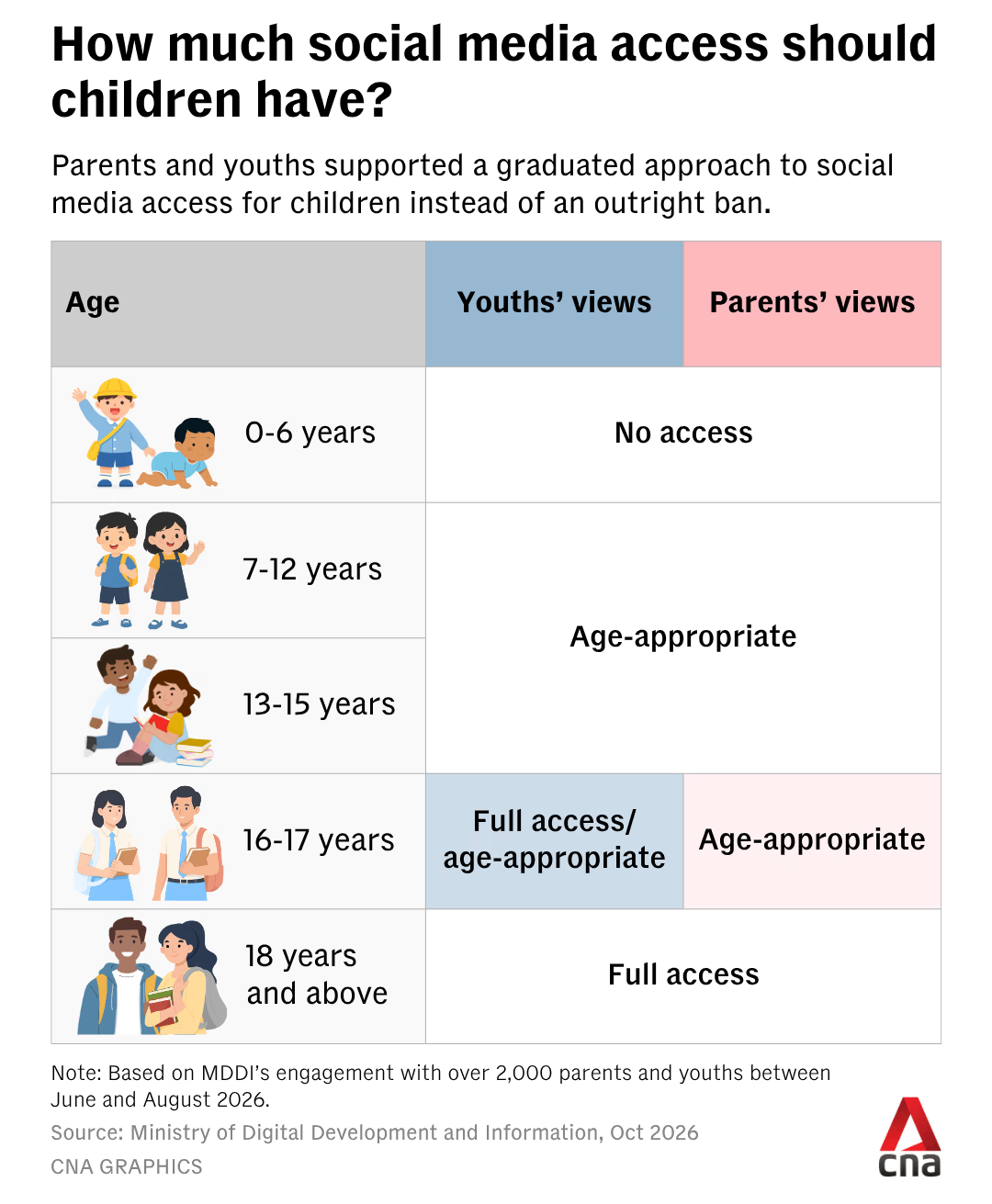
两组受访者均认为,零至六岁儿童不应接触社交媒体,而七至15岁儿童应获得适龄使用权限。青年普遍支持从16岁起给予更大的社交媒体使用权限,认为年轻人更成熟,更能独立管理使用行为;家长则继续支持适龄使用。
Both groups felt children aged zero to six should have no access, while those aged seven to 15 should have age-appropriate access. Youths generally supported greater access to social media from age 16, seeing young people as more mature and better able to manage their use independently, while parents continued to support age-appropriate access.
数字发展与资讯部表示,部分家长和青年也对仅凭年龄判断成熟度表示谨慎。
MDDI said some parents and youths also expressed caution against relying solely on age to gauge maturity.
近80%的家长同意应实施年龄核验或年龄估算。核验依赖经核实的身份证件来源,被视为更可靠且更易执行;估算则利用人工智能和面部分析来判断用户的可能年龄。同时,家长也强调保护隐私、不收集过多个人数据的重要性。
Close to 80 per cent of parents agreed that age verification or age estimation should be implemented. Verification relies on a verified source of identity documentation and is seen as more reliable and easier to enforce, while estimation uses artificial intelligence and facial age analysis to determine a user’s likely age. At the same time, parents also emphasised the importance of safeguarding privacy and not collecting excessive personal data.
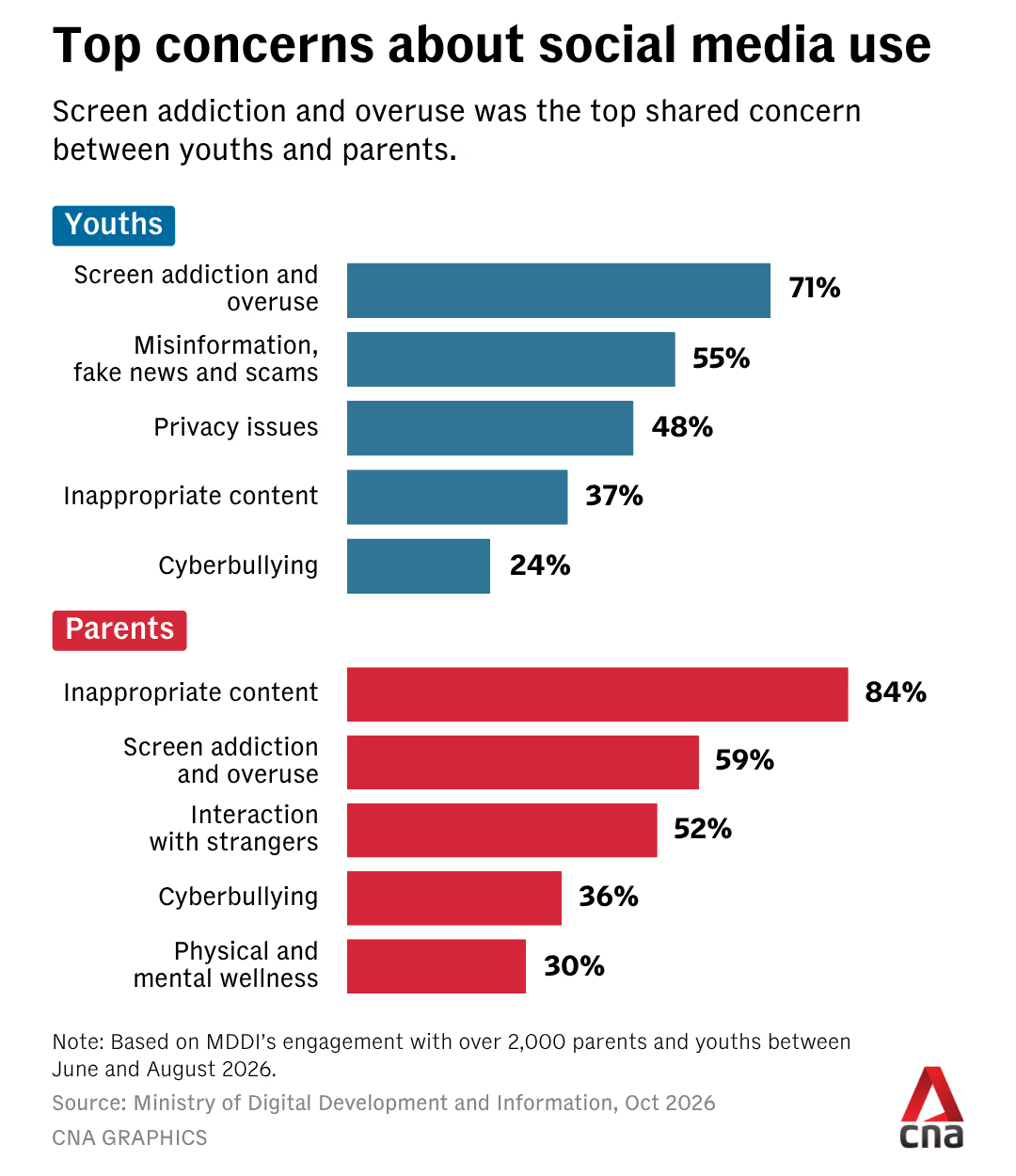
过度使用成首要担忧 家长和青年均将社交媒体过度使用列为首要担忧之一。约84%的家长将接触不当内容列为首要担忧,这一担忧在青年中的排名较低。
EXCESSIVE USE A TOP CONCERN Both parents and youths ranked excessive use of social media among their top concerns. About 84 per cent of parents ranked exposure to inappropriate content among their top concerns, a concern that ranked lower among youths.
数字发展与资讯部表示,两组受访者也对自动播放、无限滚动和定向推送等功能助长强迫性使用表示担忧。
Both groups also raised concerns that features such as autoplay, infinite scrolling and targeted feeds encourage compulsive use, MDDI said.
家长普遍支持每日屏幕使用时长限制,但希望保留根据孩子需求灵活调整的空间。排名前三的拟议默认保护措施为:禁用自动播放、禁用直接通讯功能和实施每日屏幕使用时长限制。
Parents generally supported daily screen-time limits but preferred the flexibility to adjust them to their children’s needs. The top three proposed default safeguards were disabling autoplay, disabling direct messaging and implementing a daily screen-time limit.
青少年担心,固定而僵化的限制可能会制约诸如课业和课外活动等正当用途。尽管人们普遍支持关闭算法推荐内容,但一些人认为这类功能在推送教育内容方面有其价值。
Youths were concerned that fixed and rigid limits could restrict legitimate uses such as schoolwork and extracurricular activities. While there was broad support for disabling algorithmic feeds, some saw value in their ability to surface educational content.
新加坡资讯通信媒体发展局表示:“总体而言,许多家长表示希望能在保障措施的实施方式上保留一定的自主权和灵活性,尤其是在自动播放和每日使用时长限制等措施上,可能需要根据孩子的发展需求、成熟程度和家庭情况加以调整。”
“In general, many parents expressed desire to retain some agency and flexibility over how safeguards were implemented, particularly where measures such as autoplay and daily time limits might need to be tailored to their children's developmental needs, maturity levels and family circumstances,” MDDI said.
资讯通信媒体发展局还与政府支持的学前教育机构合作,围绕四项关键行动开展数字习惯课程:设定上网边界、三思而后行、举报不当内容,以及家长的参与和支持。
HEALTHY DIGITAL HABITS FROM YOUNG IMDA is also partnering with government-supported preschools on lessons about digital habits built around four key actions: setting boundaries online, thinking before acting, reporting inappropriate content, and parental engagement and support.
该课程最初在E-Bridge学前中心100多名幼儿园二年级(K2)学生中试点。从12月起,课程将在E-Bridge所有学前中心推广,覆盖30个中心近3000名幼儿园一年级(K1)和二年级(K2)学生。
The curriculum was first piloted with more than 100 Kindergarten 2 students from E-Bridge preschool. It will be rolled out across all E-Bridge preschool centres from December, reaching close to 3,000 Kindergarten 1 and 2 students across 30 centres.
Skool4Kidz学前中心也在9月向其35个中心的800名幼儿园二年级儿童教授了该课程。资讯通信媒体发展局表示,明年将继续与幼儿培育署合作,并接触更多学前教育机构。
Skool4Kidz preschool also delivered the curriculum to 800 Kindergarten 2 children across 35 of its centres in September. IMDA said it will continue to engage the Early Childhood Development Agency and reach out to more preschool operators next year.
该局还表示,家长和家庭可以在“Digital for Life”门户网站上获取数字育儿资源。
Parents and families can also access digital parenting resources on the Digital for Life portal, it said.