以滑水者为例。他们在快艇激起的浪尖上冲浪,有时速度会超过拉着他们的船只——但永远不会超越它。近来,一些专家借用这一比喻来形容中国与美国在人工智能霸权上的竞争。他们指出,中国实验室令人瞩目的进步,很大程度上依赖于美国同行推进前沿的步伐。如果美国加速,中国或许也会随之加速;如果美国放缓脚步,中国实验室也会随之放缓。
Consider a water-skier. Surfing in the wake of a speedboat, they may at times go faster than the vessel pulling them along—but they never overtake it. Lately some experts have turned to this analogy to describe China’s race with America for supremacy in artificial intelligence. They suggest that the impressive progress of Chinese labs largely relies on the pace of their American peers pushing out the frontier. If America speeds up, so might China. If America were to throttle down, Chinese labs would slow too.
原因在于“蒸馏”:即利用另一个AI模型的输出进行训练,而非从头开始训练。随着AI能力日益增强,中国企业在多大程度上正在蒸馏美国最顶尖模型,已成为一个迫切的问题。美国企业需要用户为其昂贵的模型付费,而不是使用廉价的山寨版。美国也希望在AI领域遥遥领先于中国:特朗普总统曾表示,“谁赢了AI,谁就赢了世界”。然而,对前沿AI模型的广泛蒸馏,对美国未必全是坏事,对中国也未必全是好事。
The reason is “distillation”: the training of an AI model on the output of another, rather than from scratch. As ai becomes more capable, the extent to which Chinese firms are distilling the best American models has become an urgent question. America’s companies need users to pay for their expensive models rather than use cheap knock-offs. And America wants to stay far ahead of China: President Donald Trump has said that “whoever wins AI, wins”. Yet the widespread distillation of frontier AI models may not be quite as bad for America, nor as good for China, as it seems.
蒸馏的原理很简单。在训练早期,大语言模型(LLM)通常通过模仿互联网文本来学习。蒸馏则让它们改为模仿其他大语言模型。美国模型生成的文本,恰好展现了中国开发者希望自家模型掌握的各类技能与推理能力。因此,这些输出成了极佳的训练素材。
The idea of distillation is simple. In the early stages of training, large language models (LLMs) are usually taught to mimic text on the internet. Distillation teaches them instead to mimic other LLMs. The words generated by American models exhibit precisely the sorts of skills and reasoning Chinese developers want their own models to learn. As such, their output is useful fodder for training.
处于前沿的美国开发者已没有更先进的模型可供蒸馏,而互联网文本也几近耗尽。他们转而越来越多地依赖一种效率较低的技术——强化学习(RL)。这涉及为模型设定目标,例如解决复杂数学问题,然后让模型通过不断试错寻找解决方案。美国企业现在将超过一半的算力资源投入到RL相关技术上,而2024年初这一比例仅为二十分之一。
American developers on the frontier have no more advanced models to distil, and the text on the internet is all but exhausted. They instead increasingly rely on a less efficient technique called reinforcement learning (RL). It involves setting a goal for their model, such as solving a complex maths problem, and letting it experiment in search of a solution. American firms now spend more than half of their computing resources on RL-related techniques, up from a twentieth in early 2024.
因此,中国企业得以提炼出美国模型通过昂贵的强化学习训练所习得的能力。就像有家庭教师辅导的学生一样,它们的人工智能比独自摸索的美国同类学得更快。根据7月发表在《计算语言学协会会议论文集》上的一项研究,中国实验室DeepSeek用其最强大模型生成的80万个样本训练一个小模型,使其在一项热门数学测试中的得分从14.6%跃升至45.8%。
Chinese firms can thus distil the capabilities that American models learn through expensive RL training. Like a student with a tutor, their AIs learn faster than American ones working things out alone. A small model trained by DeepSeek, a Chinese lab, on 800,000 examples produced by their most powerful model went from a score of 14.6% to 45.8% on a popular mathematics test, according to a study published in the Findings of the Association for Computational Linguistics in July.
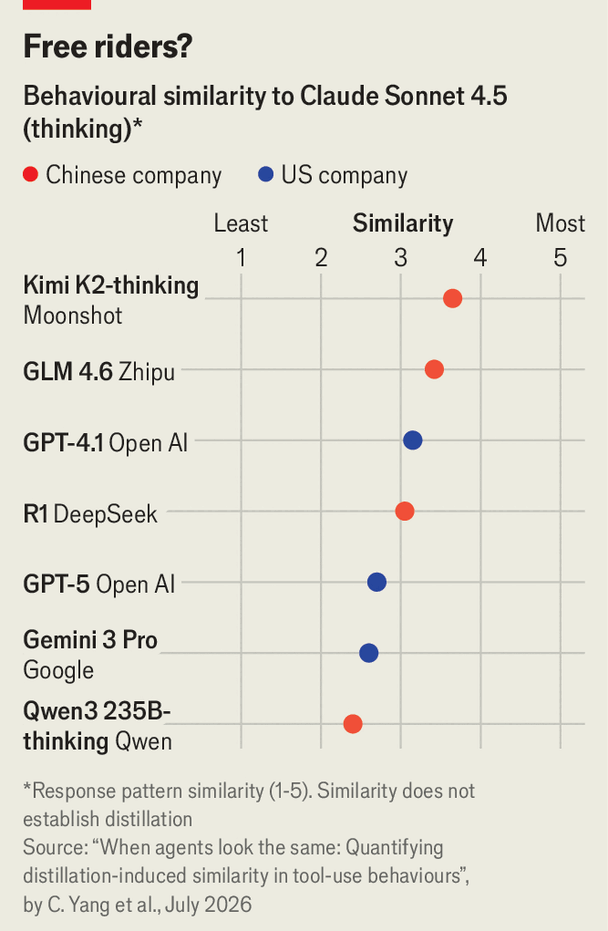
要达到前沿模型的能力需要多得多的数据——但中国实验室似乎正在大规模进行蒸馏。Anthropic于9月发布的一份报告发现,五家中国公司在五个月内从其模型中收集了超过1.8亿条信息。中国模型与美国模型有着可测度的相似性(见图表),有时甚至会自称Claude或ChatGPT。
Far more data are needed to match the capabilities of frontier models—but Chinese labs appear to be distilling at scale. A report published in September by Anthropic found that five Chinese firms had collected more than 180m messages from its models in five months. Chinese models bear a measurable resemblance to American ones (see chart), and sometimes even identify themselves as Claude or ChatGPT.
蒸馏究竟有多重要?中国在人工智能领域的大部分进步是自主实现的。按在全球主要人工智能会议NeurIPS上发表论文计算,全球顶尖AI研究人员中超过一半具有中国背景。但智力只能起到一定作用。先进计算机芯片如今是推动AI进步的主要驱动力,美国科技巨头各自拥有的芯片数量都超过所有中国竞争对手的总和。蒸馏帮助中国企业弥补了这一差距。
How much does distillation matter? Much of China’s progress in ai is homegrown. More than half the world’s top AI researchers are of Chinese origin, as measured by papers presented at NeurIPS, the main global AI conference. But brainpower only goes so far. Advanced computer chips are today the main driver of AI progress, and America’s tech giants individually have more than all of their Chinese competitors combined. Distillation helps Chinese firms compensate.
研究人员估计,中国AI落后最好的美国模型约三到六个月。华盛顿“技术与国家战略中心”的Saif Khan估计,若没有蒸馏,这一差距可能会扩大近一倍。
Researchers reckon Chinese AI is about three to six months behind the best American models. Without distillation the gap could almost double, estimates Saif Khan of the Centre for Technology & Statecraft in Washington.
Anthropic和OpenAI急于切断这条联系。它们已采取行动,终止一个于8月被发现的漏洞,该漏洞让中国企业得以获取其模型在解决问题时产生的推理过程。它们还加强了对蒸馏活动的检测。Anthropic已开始对Claude的请求收费,即使模型察觉到意图并拒绝响应——这让失败的蒸馏尝试也变得昂贵。
Anthropic and OpenAI are keen to cut the rope. They have moved to end an exploit, found in August, that gives Chinese firms access to the working-out that their models produce while solving problems. They have also stepped up their detection of distillation campaigns. Anthropic has begun charging for Claude requests even if the model senses what is going on and refuses to respond—making failed attempts at distillation costly.
Anthropic 表示,这些新措施可能不会长期有效,但迄今已将蒸馏者采集的数据量减少了 90% 至 99%。因此,该公司可能会放弃约 5% 至 7% 的收入。该公司认为,中国模型制造商发布了近乎前沿的模型,却缺乏防止滥用的护栏,而此类先进模型构成了国家安全风险。
Anthropic has said these new measures may not be lastingly effective, but have so far reduced the amount of data harvested by distillers by 90-99%. As a result it might give up about 5-7% of its revenue. The company argues that Chinese model-makers were releasing near-frontier models without guardrails against misuse, and that such advanced models posed a national-security risk.
然而,如果这些措施奏效,美国实验室可能会后悔切断对竞争对手的访问。中国研究人员对依赖蒸馏技术的明智性存有疑虑。极少有人认为基于美国模型进行训练在伦理上是错误的——毕竟,前沿实验室构建其系统所用的也是免费获取的互联网数据。但一些老板认为,依赖该技术将注定中国永远处于第二梯队。中国实验室的研究人员进一步指出,如果发生这种情况,递归自我改进——即 AI 模型自主构建自己的继任者——可能依赖于蒸馏者不具备的复杂基础设施。
Yet, if they succeed, American labs may come to regret closing off access to their rivals. Chinese researchers have their doubts about the wisdom of relying on distillation. Few believe that training on American models is ethically wrong—frontier labs built their systems on freely obtained internet data, after all. But some bosses think that relying on the technique will condemn China to permanent second-place. Researchers at Chinese labs further suggest that, if it happens, recursive self-improvement—AI models that autonomously build their own successors—may rely on sophisticated infrastructure that distillers will not have.
字节跳动创始人张一鸣在 7 月告诉员工,公司不会使用蒸馏技术来“强化”其模型。中国科技博客 LatePost 转述了张一鸣的评论,称蒸馏“充其量只能让我们不断缩小[与前沿的]差距,但很难真正超越”。张一鸣承认,放弃将中国进步系于美国前沿的那根“绳索”,正导致字节跳动落后。但与中国一些竞争对手不同,该公司拥有其他收入来源,能够负担得起在变得更加自给自足的过程中提供较差的模型。
Zhang Yiming, the founder of ByteDance, a Chinese internet firm, told his staff in July that the company would not use distillation to soup up its models. LatePost, a Chinese tech blog, paraphrased Mr Zhang’s comments, saying that distillation “will, at best, allow us to continually close the gap [with the frontier], but it will be difficult to truly surpass.”Mr Zhang acknowledged that letting go of the cord that tethers Chinese progress to the American frontier was leading ByteDance to fall behind. But the firm, unlike some of its rivals in China, has other streams of revenue and can afford to offer inferior models while it becomes more self-sufficient.
对于美国而言,蒸馏技术虽是一种烦扰,但或许总比中国企业自行摸索至前沿要好。这也可能让AI监管变得更容易。特朗普政府迄今一直不愿在AI变得更安全之前放缓其发展进程,以免美国将竞争优势拱手让给中国。但如果中国如同一名滑水者,即便拖船减速,它也未必能超越。■
As for America, distillation is an annoyance, but may be better than Chinese firms surfing their own way to the frontier. It could make it easier to regulate ai, too. Mr Trump’s administration has hitherto been reluctant to slow down the progress of AI while it is made safer, lest America hand the competitive advantage to China. But if China is like a water-skier, it might not overtake even a slowing towboat. ■